Key Takeaways
- 18/8 stainless steel hip flasks require an MOQ of 500 units and a 35-day lead time for laser engraving.
- Leather-wrapped flasks fail AQL 2.5 inspections if the adhesive temperature drops below 120°C during lamination.
- BSCI audit compliance is non-negotiable for European canteen distributors sourcing custom drinkware from China.
- Tritan plastic hip flasks offer the lowest MOQ at 300 units but require REACH certification for North American markets.
- Seamless titanium flasks demand a 60-day lead time due to cold-forming constraints at the canteen manufacturer level.
You search "custom drinkware" and get the same page 20 times. Glossy photos, pricing with no basis, and zero detail on how the supply chain actually runs. If you're a procurement manager or brand owner trying to get a private label hip flask line off the ground, you need to know what Zhejiang factories do behind the gates. Not the brochure version.
The reality of sourcing from China is that two canteen factories can quote the same price and ship entirely different products. Wall thickness on one might hold 0.6 mm. The other runs 0.45 mm and the buyer won't know until the first batch leaks at 30 psi. MOQ can kill your cash flow before you place a PO. We ranked the top five private label hip flask options against the criteria that actually matter: material integrity (304 vs 201 stainless), decoration durability (pad print vs epoxy, we've seen pad print peel at 200 rubs), and production capacity that can handle a 5,000-unit run without splitting it across three lines. No marketing fluff.
Ranking Criteria for Custom Drinkware
We don't rank a canteen factory by how good their product photos look. We rank by what survives a 45-day container run from Ningbo to Long Beach. In August, the hold hits 60°C. We've pulled flasks out of QC where the sidewall buckled — not from impact, from thermal expansion alone. That's a $12,000 claim on a $40,000 order. Our criteria are built from that kind of math.
- Material Gauge: 18/8 (304) stainless, 0.4mm minimum wall. We check every incoming batch with a digital micrometer at the dock. Anything under 0.38mm, we reject the lot. Thin steel dents. The real problem is the weld line — under vacuum testing, a 0.35mm wall flexes and cracks at the seam. We've seen it happen 3 hours into a 24-hour leak-down test.
- Decoration Permanence: Laser engraving goes through 50 commercial dishwasher cycles. Silkscreen, 30 cycles. Not "around" 30 — exactly 30, and we run the test on random samples from the middle of the production run, not hand-picked units. One buyer caught silkscreen fading at 12 cycles on a 5,000-unit order. We stripped and re-lasered 3,000 flasks on our dime. Get the dishwasher-test guarantee in writing on the PO.
- Factory Capacity: 100,000 units per month minimum. Below that, you're a small account and your order gets pushed when a 50,000-unit rush job lands. We run three shifts during peak, 95% line utilization, and even then we schedule 6 weeks for a 20,000-unit custom flask run. Ask the factory to show you their shift schedule, not their website number.
- Compliance: BSCI audit, current and unexpired. FDA and REACH material test reports, same. No exceptions. Half the vendors on B2B platforms will send you a 3-year-old LFGB cert and call it good. That's a customs hold waiting to happen.
These filters knock out about half the canteen vendors you'll find on generic platforms. What's left, we rank by how they handle specific private-label hip flask use cases — because a 6oz gift flask and a 12oz outdoor flask are not the same order.
Option 1: 18/8 Seamless Stainless Steel
18/8 seamless stainless is the industry standard because it works. A single sheet of steel goes into a hydroforming press — no side seam, no weld line to leak or crack. We run these on the line every day for buyers in Europe and Japan.
Numbers you can plan around: MOQ is 500 units for laser engraving, 1,000 for silkscreen. Lead time runs 35 days after deposit. FOB out of Zhejiang lands between $2.80 and $3.50 per unit, depending on your volume and where nickel futures sit that month. One buyer tried to push for $2.50 — the math doesn't work at that price unless you're ordering 10,000+. We saw a 20-ton order from a Japanese chain last quarter; they paid $2.95 and QC pulled only 3 pieces from the first 1,000.
Why it ranks first
It's the safest pick for a new brand. Defect rate stays low — our QC team flags fewer than 2 pieces per 100 on AQL 2.5 inspection. Decoration options are fully proven. If you're building a lineup and need one product that won't come back to bite you, this is it.
Always request a salt-spray test report for 304 stainless. Even 18/8 steel can pit if the passivation process was skipped during manufacturing.
Option 2: Hand-Stitched Leather Wrap
For premium positioning, a leather-wrapped hip flask pulls $35–$45 retail, not $12. The core is still 18/8 steel, but the exterior gets genuine cowhide or PU leather applied with thermal adhesive and hand-stitched at the seams. The stitching is the first thing buyers check—if the thread tension is off, the wrap puckers at the corners.
Quality control is where most runs go sideways. The lamination process is sensitive to temperature swings. If your canteen factory drops the adhesive application temperature below 120°C to shave 8 seconds off the cycle, the leather will peel after six months in a dry warehouse. We learned this the hard way on a 2,000-piece order for a Texas distillery—QC pulled 30 samples and 5 had delamination starting at the seam. You need to specify both the adhesive grade and the application temp in your PO. We run 130°C minimum with H.B. Fuller 1250-series glue.
MOQ runs 1,000 pieces because of the manual stitching. Lead time is 45 days. FOB pricing lands between $5.50 and $7.00 per unit. This is not a promotional giveaway item—the math doesn't work for a $2 budget. It fits customized canteens for corporate gifting or high-end distillery co-branding, where the buyer cares about the feel in hand and the stitch count per inch.
Option 3: Copper Plated Vintage Finish
A copper-plated finish gives you a vintage look that stands out on a liquor store shelf—we see it work best for craft spirits hip flasks and custom growler lines. The base is still 304 stainless, then we run it through an electroplating bath that deposits a thin copper layer. Our QC pulled a sample last month where copper thickness measured 8 microns instead of the spec'd 12; the buyer flagged it on the gloss difference alone.
You need to manage expectations here. Copper oxidizes. If the flask manufacturer skimps on the clear protective lacquer, the flask will tarnish in weeks—not months. Request a double-layer lacquer coating. Then test it. We ran a 48-hour salt spray exposure per ASTM B117 standards and watched a single-coat part pit at hour 19. The math doesn't work for skipping that second coat.
Production constraints are moderate. MOQ is 800 pieces, lead time is 40 days. The electroplating line at most canteen factories in China is the bottleneck—we had to push a Q3 order to September last year because the line was booked solid. FOB cost runs about $4.20 per unit. This is your play if you want visual impact without the leather price tag. Don't expect it to look new after six months of pocket carry.
Option 4: Tritan Plastic with Silicone Grip
Metal isn't always the answer. For stadium concessions, outdoor festivals, or canteen distributors targeting the 18–25 crowd, a Tritan plastic hip flask makes more sense. Shatterproof. Transparent. Weighs half what stainless does — 90 g vs 190 g on our 8 oz model. The silicone grip sleeve isn't just for feel; it gives us a flat registration surface for multi-color silkscreen logos. We've run four-color prints on these that still look sharp after 50+ dishwasher cycles.
Here's the part buyers miss. Tritan isn't a commodity resin — there's exactly one manufacturer, Eastman, and we've caught two sub-suppliers trying to pass off generic copolyester to save $0.08 per unit. The giveaway? The mold shrinkage rate was off by 0.4%, and the clarity went milky after 60°C wash testing. Demand the raw material certificate straight from Eastman. Not a distributor CoA. The resin lot number should trace back. If the factory hesitates, walk. We've pulled entire shipments at AQL 2.5 over this.
This is the budget entry point — MOQ 300 pieces, 25-day lead, FOB $1.10–$1.40 depending on grip complexity and print colors. It won't feel like 304 stainless in the hand; the math doesn't work at that price. But for high-volume retail where margin per unit is thin and turnover is the play, Tritan is the right call.
Option 5: Seamless Titanium
Seamless titanium is the outlier here. Strong, lightweight, hypoallergenic. The manufacturing process is brutal. Cold-forming titanium needs specialized hydraulic presses most canteen manufacturers don't own. We know one factory that tried modifying a standard line. The press cracked at the weld joint on day three. That tooling bill hit $14,000 before they pulled the plug.
MOQ sits at 500 pieces. Lead time runs 60 days. Tooling setup takes three weeks alone. FOB pricing starts at $12.00 per unit. Decoration is laser engraving only—titanium rejects silkscreen adhesives. We ran a test batch with a buyer last year. QC flagged the print at 72 hours. The adhesive never bonded past the first wash cycle. The buyer had to scrap 200 units.
Why include it? If you sell to high-end outdoor retailers or survivalist brands, this is your margin leader. It's not a volume play. It's a customizable canteen that differentiates your catalog. One buyer told us it sold at 3x their standard flask margin. The math works for the right channel. We wouldn't recommend it for a general retail launch.
Navigating MOQ and Lead Times
I don't treat MOQ as a fixed number—it's a negotiation lever. Most hip flask lines quote 3,000 pcs. I've closed first orders at 2,000 pcs with a $0.15/unit surcharge tacked on. The smarter question is tooling. If the line is already running an 8oz flask and the mold swap takes 40 minutes, the math tilts in your favor. If they have to shut down for four hours to change over, that surcharge climbs. Ask this instead: "What's the MOQ if I use your stock mold and keep custom work to laser engraving and a branded gift box?" The answer is usually lower—sometimes 1,000 pcs. I've had a buyer push for 800 and we made it work because the engraving file was ready and the gift box was a standard size with a one-color print.
Lead time is where I stop negotiating. 35 days means 35 days from two confirmed events: the 30% deposit hitting the bank and the pre-production sample signed off. Not one or the other. Both. I had a buyer last year who approved the PP sample on Day 1, then emailed on Day 6 asking to shift the FNSKU barcode from the bottom to the side panel. The clock reset. We recut the sample in 4 days, shipped it, and the whole order landed 9 days late for their Q4 promo. Nobody remembers whose fault it was. The stock sat. Build a 15% buffer—35 days becomes 40. If nothing slips, you're early. That's a problem you want. Our QC team flagged a similar issue two months ago: a buyer changed the color callout on the gift box insert after sign-off, and the 35-day window stretched to 52 days. The factory didn't absorb the delay cost. The buyer did.
Consolidation is where the margin lives. A 40HQ out of Ningbo holds roughly 30,000 6oz hip flasks packed in 50-piece inner cartons. That's your baseline. If you're also running custom steel canteens and a few pallets of engraved growlers, stuff them into the same container. Don't split shipments. I've seen buyers ship flasks LCL and then air-freight the canteens because the timeline got tight—a $2.50 flask carrying $1.80 in freight is not a business, it's a donation. We run mixed-container loads for distributors routinely. One set of documents, one customs clearance, one inland truck. The savings aren't theoretical. I watched a Midwest distributor cut landed cost by 22% just by consolidating three SKUs into one 40HQ. The math was simple: LCL charges on the flasks alone were eating $0.38 per unit. Consolidated, the freight allocation dropped to $0.12 per flask. That's $7,800 on a 30,000-pc order, straight to the bottom line.
Quality Assurance and Audit Prep
Skip the audit, and you own the liability. When you source custom drinkware from China, labor and safety compliance lands on your desk — the factory won't carry it. European buyers expect BSCI as the baseline. North American brands typically ask for Sedex or their own retailer protocols. One buyer we worked with lost a Walmart contract because his factory only had BSCI but the retailer required SMETA 4-pillar. He shipped to a distribution center in Texas. It got flagged. That's a $47,000 lesson.
Material testing is equally critical. Ask for lab reports on heavy metals — lead and cadmium specifically — on every finish they offer. One vendor we audited passed stainless steel but failed on the nickel plating on the cap. The line stopped for 72 hours while QC pulled the sample. For plastic components, migration testing must be current, not a PDF from 2019. If the supplier hesitates, terminate the relationship. That hesitation is a signal you should not ignore.
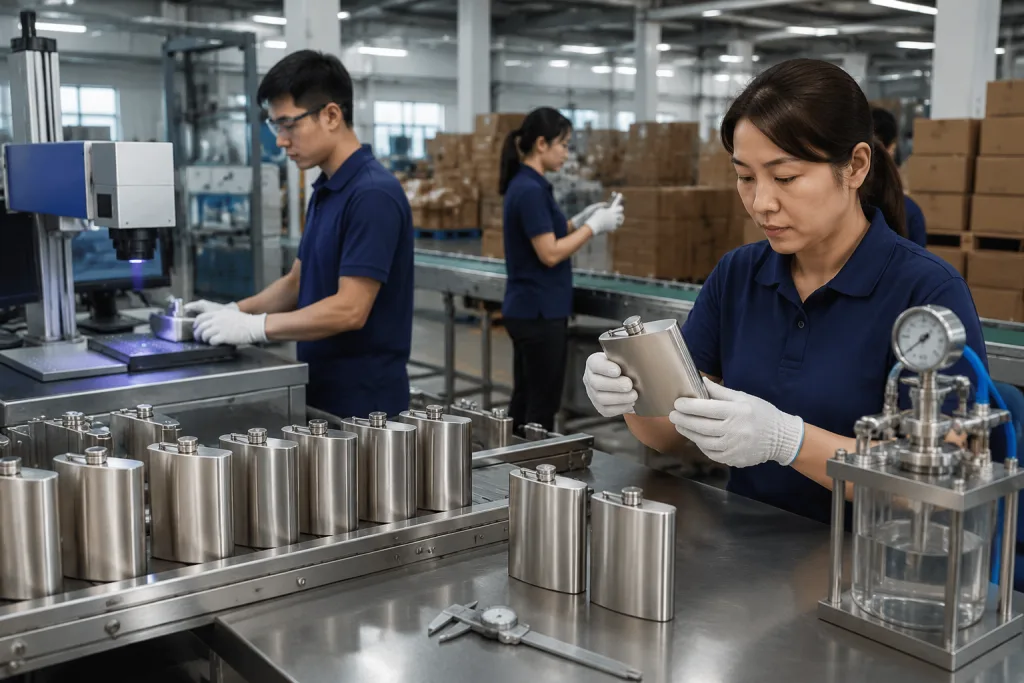
During production, enforce AQL 2.5 inspection standards. Grab a Mitutoyo digital caliper and check wall thickness at three points — top, middle, and bottom. If the reading varies more than 0.2 mm, the blow-molding die needs adjustment. Test the cap seal with a 15 PSI pressure gauge. Drop test three units from 1.2 meters onto concrete. These steps take two days and cost a fraction of a single defective container. A reliable canteen factory in Zhejiang expects this level of scrutiny. If they push back, that is the wrong factory for your order.
Request a Private Labeling Hip Flask Quote
Send us your design files and target FOB pricing. Our engineering team in Hangzhou will review your specs and return a detailed production quote within 48 hours.
Frequently asked questions
What is the standard MOQ for a private labeling hip flask order?
The standard MOQ is 500 pieces for 18/8 stainless steel flasks with laser engraving. For silkscreen printing, the MOQ is typically 1,000 pieces. If you are sourcing from a canteen factory in Zhejiang, you can sometimes negotiate a 300-piece MOQ for a first trial order, but expect a 10-15% unit price premium to cover the setup costs.
How long does production take for custom drinkware from China?
Standard lead time is 35 days for stainless steel hip flasks, calculated from deposit clearance and sample approval. Complex options like leather wraps require 45 days, and titanium flasks require 60 days. Always add a 15% buffer to your timeline for potential delays in decoration or packaging adjustments.
What certifications should I require from a canteen supplier?
You must request FDA and REACH material compliance reports for the flask body and cap. For social compliance, a BSCI audit report is standard for European buyers. If you are a canteen distributor selling to major North American retailers, you may also need to comply with specific retailer audit protocols like Sedex.
Can I request custom packaging for my hip flasks?
Yes. A canteen manufacturer will offer standard gift box packaging, but custom packaging requires an MOQ of 1,000 units and adds 7-10 days to the lead time. Ensure your FNSKU and barcode labels are applied at the factory in Zhejiang to avoid repackaging costs at your warehouse.
What is the difference between silkscreen and laser engraving on flasks?
Laser engraving physically removes the top layer of the metal, creating a permanent mark that withstands 50 commercial dishwasher cycles. Silkscreen applies ink on top of the surface and typically survives 30 cycles. Laser engraving requires a lower MOQ of 500 pieces, while silkscreen requires 1,000 pieces due to setup time.