Key Takeaways
- Stainless vacuum growlers usually cost USD 6.80-11.50 FOB at 1,000-3,000 units, depending on finish and lid
- Glass growlers suit tasting rooms and retail shelves, but freight damage risk is normally 2-4 times higher than steel
- Laser engraving is the safest logo option for long-life distributor growler programs
- A realistic custom growler timeline is 7-10 days for sampling and 30-45 days for mass production after approval
Private labeling a growler bottle looks simple until you sit down to quote it. Stainless grades. Vacuum performance numbers. Lid-seal failure modes. Carton drop tests. Logo durability on a curved 304 body. FOB vs EXW math. And whether your buyer actually needs 64 oz or just thinks they do—half the time, the 32 oz moves faster and costs less to ship. One wrong spec on a distributor growler line turns a clean margin into a container full of complaints. We saw a buyer skip the AQL 2.5 inspection and land 8% dented bodies in the first shipment. The dents came from a stacking test that wasn't spec'd.
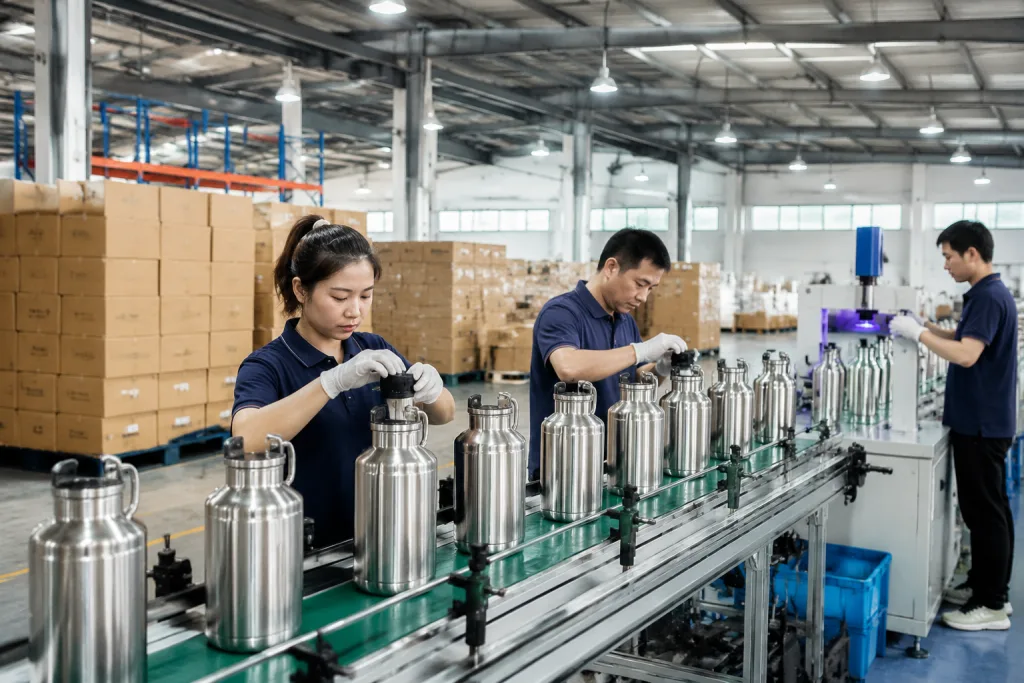
BottleForge Industrial runs out of Hangzhou, Zhejiang. We ship 300,000 units a month across stainless bottles, tumblers, and growlers. Typical growler MOQ sits at 1,000 units per SKU—lower than that and the line-change cost eats the margin. Our QC team measures vacuum performance with a Fluke thermocouple probe. Anything below 12-hour retention at 95°C gets kicked back to the welding station, no exceptions. Below is the comparison we walk buyers through before anyone cuts tooling, pulls samples, or approves private-label packaging.
The head-to-head spec comparison
A growler's base construction decides whether your order works or fails before decoration even enters the conversation. We see three paths: vacuum stainless, single-wall stainless, and glass. Tritan gets pitched occasionally for beer, kombucha, and cold brew, but buyers reject it 8 out of 10 times the moment they hold a sample. Too light. Doesn't feel like a $30 retail product. On the line, a 64 oz vacuum growler runs 3–5 leakers per thousand when the cap gasket drifts 0.2 mm. That's the real cost baked into the bottom of the FOB range.
| Spec | Vacuum stainless | Single-wall stainless | Glass growler |
|---|---|---|---|
| Common capacity | 64 oz / 1.9 L | 40-64 oz | 32-64 oz |
| Material | 304 inner, 201 or 304 outer | 304 or 201 stainless | Soda-lime or borosilicate |
| Wall thickness | 0.4-0.5 mm typical | 0.5-0.7 mm typical | 3-5 mm typical |
| Insulation | 12-24 hours cold, depending test condition | None | None |
| FOB China range | USD 6.80-11.50 | USD 3.80-6.20 | USD 1.80-4.50 |
| Best logo method | Laser, screen print, powder print | Laser or screen print | Screen print, decal, sleeve |
| Main risk | Vacuum failure, lid leak | Denting, heat transfer | Breakage, heavy freight |
If you're selling through canteen distributors or outdoor retailers, vacuum stainless gives you the lowest complaint rate we track. By a lot. Single-wall return rates hit 12% in that channel—QC pulls dented bodies at AQL 2.5 and the buyer flags them. Glass still ships for local breweries running short transport legs, but run the freight numbers before you fall for the unit price. The FOB looks cheap. Then you spec a corrugated inner box and pay dimensional weight on a full 40HQ. Suddenly it's not cheap. A canteen promo buyer chasing rock-bottom unit cost usually lands on single-wall. A premium distributor drinkware buyer wants vacuum stainless, a cap that passes a 24-hour leak-down test, and a retail box that survives Ningbo to a warehouse shelf.
Which growler fits which buyer
Nobody makes one growler that works for every buyer. We match the bottle to your channel, your price ceiling, and how much breakage your margins can actually absorb. We evaluate four things: landed cost, perceived value, transport risk, and branding flexibility. Catalog photos don't tell you any of that.
Best for premium retail: vacuum stainless
For outdoor, camping, sports, and premium beverage accounts, a double-wall private labeling growler bottle is the safest bet we run. Powder coating, laser engraving, color matching, gift boxes, barcode labeling—all standard on the line. You position it as customizable drinkware, not commodity packaging. The catch is cost. Under 1,000 units, setup charges kill the quote. We've seen a 500-unit order land at $11.20 FOB where a 3,000-unit run drops to $7.60. The math doesn't work in small batches. At 3,000 units, FOB pricing starts making sense for shelf-ready retail.
Best for budget promotion: single-wall stainless
Single-wall steel works when insulation isn't the selling point. For a canteen custom program, company event, school campaign, or bundled merch, it delivers a metal product at a lower piece price. One buyer flagged this on a 10,000-unit PO: condensation pools on the desk and there's zero hot-liquid comfort. We don't recommend it for hot coffee or carbonated drinks unless the lid is purpose-built and tested for pressure. We've seen a poorly vented cap turn a growler into a projectile at 35°C.
Best for tasting rooms: glass
Glass tells a clean beverage story and the piece price looks great on paper. It punishes bad packaging. A 64 oz glass growler that lands at $2.30 FOB can cost you $4.80 after breakage if you skip the dividers. We run 3mm corrugated partitions and a 6-sided drop test as standard on export glass. If you're a canteen vendor shipping pallets across North America, ask your forwarder for the claims rate on LTL glass shipments before you commit to the quote. That cheap unit price gets expensive fast.
Capacity, mouth, and lid choices
Most custom growler projects start at 64 oz because that size is standard in beer and kombucha. That doesn't mean it's the right call. For outdoor retail, 40 oz and 32 oz sizes move faster — they fit backpack side pockets and car cup holders. One distributor running a canteen program split his order 60/40 between a 64 oz hero SKU and a 40 oz companion in the same color. That mix cut his stock risk by half.
Mouth diameter drives filling speed, cleaning access, carbonation retention, and cap cost. A 50-55 mm opening is common for stainless growlers — big enough for ice cubes and a bottle brush. Narrower mouths feel more like a drinking bottle but slow down brewery fills because the hose doesn't fit. On glass growlers, standard neck finishes simplify cap sourcing, but private mold caps give tighter control over your branding. We've seen a buyer run into trouble when their custom cap didn't seat right on a standard finish — QC caught it before the line ran, but that fix cost a week.
Lids are where private label projects fail most. A cheap PP lid with a thin silicone ring may pass a desk leak test but cracks after three dishwasher cycles or sits in a warm warehouse and warps. For vacuum growlers we specify food-grade silicone gaskets, 304 stainless contact surfaces where the drink touches metal, and a torque check during final QC — every unit. If your product will hold carbonated drinks, the math changes. A sealed growler is not automatically safe for fermentation pressure.
Do not write “keeps beer fresh for days” unless your closure, filling process, and pressure testing support that claim. Your packaging copy can create liability faster than the factory can fix it.
Materials and compliance expectations
A spec sheet that says "food grade" tells a buyer nothing. Stainless vacuum growlers use SUS304 for the inner liner—that's the standard. Some buyers ask about 316 stainless. The upgrade runs $0.80–$1.20 per unit. For cold brew, iced tea, still water, that money buys zero retail advantage. The math only makes sense if the liquid is acidic seltzer or high-chloride municipal water. Outer shell material: 201 or 304, depending on your price point and what the bottle will actually go through. Coastal market? Hard-use outdoor channel? Go 304. We've pulled 201 shells from a Qingdao batch that pitted at the weld seam inside two weeks of salt-air exposure. QC caught rust spotting on three units before they left the warehouse.
Lids: PP handles most production. Tritan shows up for transparent parts and costs about 3× per piece. Silicone seals and gaskets need LFGB or FDA food-contact grade, market-dependent. European buyers typically want REACH and LFGB documentation before they'll open a PO. US buyers care about the FDA food-contact declaration plus California Proposition 65—that one trips up coatings and printed inks. A buyer flagged a typo on a PO last quarter and testing slid two weeks. If you're dealing with a large chain, expect a restricted substances list and third-party lab work. Build that into the timeline from day one. We run the full test cycle in-house before samples go out. The buyer's lab runs everything again anyway.
Glass growlers: soda-lime keeps the unit cost down. Borosilicate gets you better thermal shock resistance at $0.40–$0.60 extra per piece. Cold-fill only? Not worth it. When you're sourcing from a canteen factory in China, ask two things—was the glass properly annealed, and does the supplier control wall distribution. Thin spots near the shoulder are where bottles fail. Last year QC pulled a sample that cracked at 8 psi in our lab. Wall thickness measured 1.2 mm where the spec called for 2.0 mm. One bad mold and a whole container's at risk.
Factory audits: BSCI, Sedex, ISO 9001. Brand owners ask for them. We work with audited lines in Zhejiang, but confirm the exact audit scope before you promise compliance to a customer. A single certificate does not automatically cover every workshop, subcontracted coating line, or packaging supplier. That one assumption can kill a deal during due diligence. We had a buyer walk after discovering the lid supplier's coating line wasn't included in the main factory's Sedex report. They'd already approved samples.
Branding methods compared plainly
We get asked for the biggest logo possible on almost every RFQ. Wrong question. We've run branding on over 120,000 growlers in the past 18 months — bigger just means bigger. What actually matters: the substrate finish, how fine the artwork detail is, the batch quantity, and whether the bottle sees a commercial dishwasher or a hand-wash sink.
- Laser engraving. This runs daily on our line — 304 stainless and matte powder coat both take it well. Clean mark, permanent, no consumables. A single-position engraving is USD 0.15–0.45, depending on size and cycle speed. The hard stop: no color. At all. If your artwork has gradients, halftones, or CMYK builds, laser can't do it. We've had buyers send a Pantone-heavy brand guide and then push back at sampling when the mark comes out monochrome. We flag it now before tooling starts.
- Silkscreen printing. Solid choice for one- to three-color logos on straight-wall or gently curved bodies. Setup costs are low. But a curved growler body without a proper jig will drift — we've measured 1.5 mm registration shift on samples from a shop that skipped the fixture. At standard MOQ, expect USD 0.08–0.25 per color per position. QC pulls at AQL 2.5 and does a 3M 610 tape adhesion test on every batch. If it peels, the line stops.
- Heat transfer. This is the go-to when a buyer wants a full-wrap design or multi-color artwork with gradients. It costs more than screen printing. Adhesion testing isn't optional — especially over textured powder coat. We had a 500-piece run fail peel testing because the coating surface energy measured too low. The entire order got stripped and re-run. Now we check dyne level on every new coating batch before the transfer heads touch a single bottle.
- Decal on glass. Looks sharp on a retail shelf. But glass growlers need scratch testing and a 50-cycle dishwasher test before you sign off the pre-production sample. We've watched decals start lifting at cycle 30. If your end customer runs these through a commercial dishwasher every shift, decal probably isn't the right call — no matter how good the mockup looks.
- Embossed or debossed mold logo. Nothing signals brand ownership like a logo molded into the part. Tooling runs USD 800–3,000 depending on whether it's a cap insert or a body mold cavity. One buyer pushed back hard on the upfront cost, then amortized it across three SKU runs — came out to USD 0.03 per unit. The math works if you're building a brand, not flipping a single promotional order.
For a customizable growler line, we point distributor programs toward laser — fast, repeatable, no consumables to stock. Price-sensitive promo orders get screen printing. If you're building a long-term brand: keep the logo system consistent. One mark type across growlers, sports bottles, travel tumblers, and any custom canteen models in the range. Same placement logic, same finish family. We've seen buyers mix laser on one SKU, screen print on another, and end up with a shelf that reads like factory leftovers. That's a branding problem, not a production problem.
Cost, MOQ, and lead time reality
A real quote isn't a unit price. It's a line-by-line breakdown: material, capacity, finish, logo method, packaging, MOQ, sample fee, production lead time, Incoterm, and validity. We ship FOB Ningbo or FOB Shanghai out of our Hangzhou facility. Ex-works looks cheaper on paper. The math doesn't work if you don't already have a freight forwarder clearing export customs on the China side.
For private labeling on a growler, MOQ is 1,000 units for an existing mold and standard color. Custom powder coating starts at 1,000-3,000 units per color. A fully custom mold needs 5,000-10,000 units to make economic sense. Sampling runs 7-10 days for existing mold with logo, or 20-35 days when new tooling is involved. Mass production is 30-45 days after sample approval and deposit.
As a rough FOB China guide, a 64 oz stainless vacuum growler with powder coating and laser logo lands at USD 7.50-10.80 at 3,000 units. Add a retail box, instruction sheet, hangtag, and carton barcode, and you add USD 0.35-0.90 per unit. Glass quotes below USD 3.00, but the buyer flagged it last time when we compared without freight, packaging reinforcement, and damage allowance.
If you are a canteen supplier or distributor growler buyer, ask for a price ladder at 1,000, 3,000, and 5,000 units. That tells you whether the canteen manufacturer has real production efficiency or is just padding a small order. It also helps you set wholesale tiers without renegotiating every reorder.
Quality control before shipment
Growlers fail the same six ways, batch after batch. Lids leak at the gasket seat. Vacuum bleeds out by month three. Coating scratches from conveyor jostling. Color drifts two Pantone chips off target. Dents on the base radius. Logo placement off by 3 mm. Cartons crushed because someone spec'd single-wall instead of double-wall. A decent factory won't blink at a written QC checklist. We sent one supplier a 14-point inline inspection sheet and they pushed back hard. That order landed with 18% major defects. Now if a vendor resists the checklist, we walk. No exceptions.
For stainless vacuum growlers, we run hot-water retention sampling on every shipment—no skip-lot shortcuts. Fill at 95°C ±1°, seal, measure at 6 hours in a 22°C room. Target: ≥68°C remaining for a 64 oz double-wall unit. Cold retention mirrors the same method: fill with 3°C water, check at 12 hours, expect ≤8°C. Destructive testing across the full batch isn't realistic. The line runs 1,200 units a shift. So process control carries the weight. The factory tracks three things daily: vacuum-furnace temperature logs, copper brazing inspection records, and pull-test data on the inner-outer wall bond. Leak testing isn't a quick 30-second upright check. We require inverted with shaking, 60 seconds minimum, plus a separate lid-only pressure test at 15 kPa. A buyer last year skipped the shake test. 400 units seeped at the thread ring. We caught it during re-inspection, but the container was already 9 days late.
Appearance inspection runs AQL Level II as the floor: critical 0, major 2.5, minor 4.0. Big-box retailers sometimes tighten major to 1.5—we can accommodate that on the same line without slowing throughput. Logo position tolerance is ±1 mm from the approved placement drawing, measured from the base seam. QC checks color against a physical Pantone swatch or the signed-off PP sample under D65 lighting. Phone photos are useless. We've seen a buyer approve "navy" from a warehouse snapshot that was actually dark teal. Carton drop testing follows ISTA 1A or your actual distribution path. E-commerce and FBA handling demand individual box protection with corner inserts and a drop from 91 cm on six faces. Pallet-only wholesale can relax to 61 cm, but we still spec double-wall B-flute as minimum. Single-wall cartons are a false economy. During a recent QC pull, the outer master carton looked pristine. The inner growler box was accordioned. Every unit inside had base dents.
Before balance payment, get these from your canteen manufacturer: PP samples with a full dimensional report, inline photos from three production stages (body forming, painting, assembly), final inspection reports with AQL data and defect photos, and carton mark proofs showing shipping marks, barcodes, and country-of-origin. If you need FNSKU labels, retail UPC/EAN barcodes, or MADE IN CHINA markings, lock placement during the PP sample stage. We had a client confirm barcode placement after 3,000 growlers were already sleeved. Relabeling cost $0.42 per unit and delayed the container by 11 days. The math doesn't work.
Packaging and channel fit
Packaging is part of the product spec, not an afterthought. A distributor ordering growlers for retail needs different packaging than a corporate promo job. Retail requires a color box, a UPC or EAN barcode, care instructions, warning text, and an outer carton that survives warehouse stacking at 6 layers high. For promo bulk, a white box or egg-crate divider is usually enough. We've seen buyers skip the barcode once, then call us in a panic when the retailer rejected the entire pallet at receiving.
For glass, we run stronger dividers, top and bottom pads, and conservative carton quantities. A carton holding 24 glass growlers looks efficient on paper, but at 22 kg it becomes a back injury risk and a freight surcharge problem. The math doesn't work. For stainless, 12 units per master carton is standard for large 64 oz growlers, though exact packing depends on box footprint and gross weight. QC pulled a sample last month where the inner partitions were 2 mm too thin — the bottles shifted in transit. Keep cartons under 15-18 kg when possible. Your warehouse crew will thank you.
If your customer sells on Amazon or Walmart Marketplace, packaging must survive parcel distribution, not just sea freight. Add a polybag or paper wrap to prevent rubbing between bottles. Use thicker E-flute or B-flute retail boxes and test the packed unit with a 1.0-1.2 m drop sequence. One buyer flagged scuff marks on three of twelve growlers from a single drop test. If your customer is a canteen distributor serving corporate accounts, carton labeling and fast pick-pack handling matter more than shelf graphics. They don't care about a glossy box — they care that the carton mark reads clearly and the picker can grab it in under 10 seconds.
Match packaging to channel before you approve the sample. A beautiful customized growler with weak packaging is still a bad shipment. A plain box with correct barcode, clear carton marks, and a low damage rate often makes the buyer happier than premium graphics that scuff in transit.
Build a growler spec that buyers can approve
Send your target capacity, price range, logo artwork, and market. We will return practical options with MOQ, FOB pricing, and lead time.
Frequently asked questions
What is the best material for a private labeling growler bottle?
For most B2B programs, double-wall 304 stainless steel is the safest choice. It gives better perceived value, lower breakage risk than glass, and supports laser engraving or powder-coated brand colors. A 64 oz stainless vacuum growler usually quotes around USD 6.80-11.50 FOB China at 1,000-3,000 units, depending on lid and finish. Glass is cheaper per unit, often USD 1.80-4.50, but it needs stronger packaging and has higher damage risk in long-distance freight. Single-wall stainless is acceptable for promotional use, but not if insulation is part of your sales promise.
Can I order a fully customizable growler with my own shape?
Yes, but it only makes sense at the right volume. For an existing growler body with your logo, color, and packaging, MOQ can start at 1,000 units per SKU. For a custom cap or handle, tooling may be USD 800-3,000. For a completely new stainless body shape, you should expect 5,000-10,000 units minimum and 45-75 days before mass production, including tooling samples. If you are testing a new distributor growler line, start with an existing mold first and spend your budget on finish, logo, and packaging.
How long does private label growler production take in China?
For an existing mold, plan 7-10 days for logo samples and 30-45 days for mass production after sample approval and deposit. Custom powder colors, complex heat transfer artwork, or special retail packaging can add 5-10 days. New tooling can add 20-35 days before you even approve the final sample. Shipping is separate: sea freight to North America or Europe commonly takes 25-40 days port-to-port, plus customs and inland trucking. If you need a seasonal launch, start sourcing at least 90 days before your required warehouse date.
Which logo method lasts longest on customized growler orders?
Laser engraving is usually the most durable option on stainless steel, especially over powder coating. It does not peel like a poor print and works well for distributor drinkware programs that expect repeated outdoor use. Silkscreen printing is cheaper and can look good for simple one- or two-color logos, but it should pass tape, rub, and dishwasher-related testing if you make durability claims. Heat transfer is better for full-color graphics, though it costs more and needs careful adhesion testing. For glass growlers, screen print or fired decal is more common than laser.
What should I check before paying a canteen supplier deposit?
Ask for a written specification sheet covering capacity, material grade, wall thickness, lid material, gasket material, finish, logo method, packaging, MOQ, lead time, and Incoterm such as FOB Ningbo or FOB Shanghai. Confirm compliance documents for your market, such as FDA, LFGB, REACH, or Prop 65 review where relevant. Request a production sample with your actual logo, not a similar catalog sample. Also ask how the canteen factory handles AQL inspection, leak testing, vacuum testing, and carton drop testing. A serious canteen supplier can answer these points before taking a 30% deposit.