Key Takeaways
- A stock private label travel tumbler usually starts at 1,000 pcs MOQ and USD 3.20-6.50 FOB China
- Laser logos add 3-5 days; new mold development can add 35-55 days before mass production
- Custom color coating normally needs 3,000 pcs per color to control powder loss and line setup cost
- Plan 45-75 days from approved artwork to vessel departure for most bulk travel tumbler orders
A private-label coffee tumbler looks simple on a buyer’s sheet: pick the body, add the logo, approve the carton, ship it. The quote is not that clean. A 16 oz stainless travel tumbler can land from USD 3.20 to USD 8.80 FOB China, depending on steel grade, lid gasket, powder-coating loss rate, gift-box paper, AQL 2.5 inspection scope, and whether we run a stock mold or cut a coffee mug custom made from scratch. QC pulled one sample last month with a 0.6 mm lid gap on the feeler gauge. Small gap. Big problem. That gap changed the leak test result and turned a simple price talk into a lid-tooling discussion.
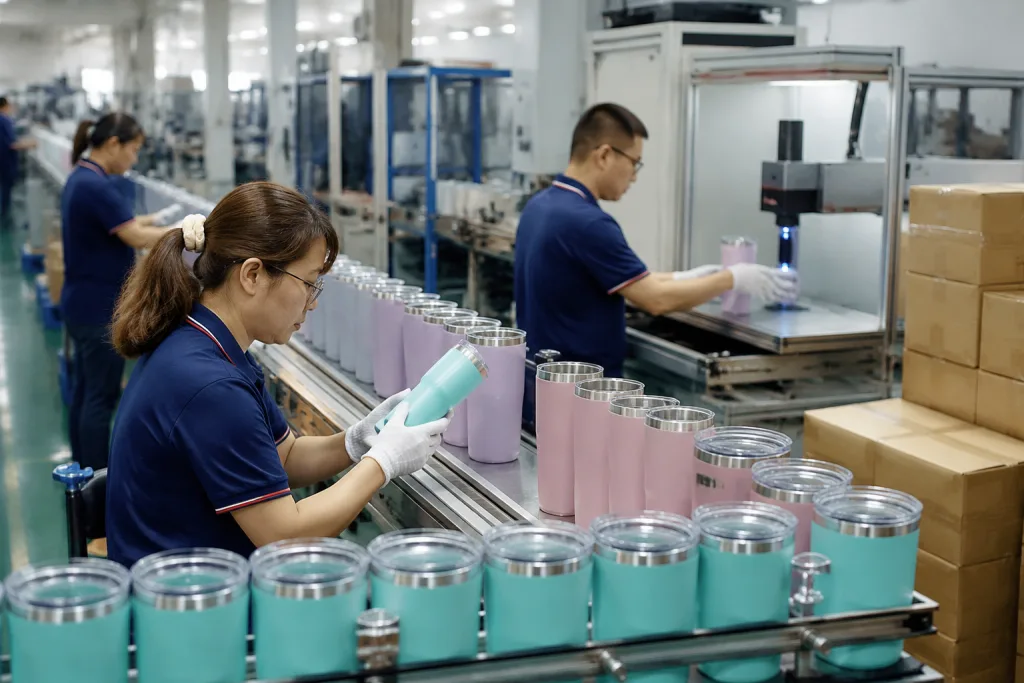
For a coffee brand building retail merch, or a corporate-gift buyer tied to a launch date, unit cost and calendar days decide the order. Cheap is not the same as safe. Our factory in Zhejiang, China produces up to 450,000 stainless drinkware units per month, and we’ve seen this go sideways when the PO says “matte black” but the approved sample is Pantone 426C. The math does not work if the buyer saves USD 0.18 on coating and then rejects 6 cartons for color shift under the light box. This guide shows what moves the price and what slows the schedule, from logo alignment on the rotary fixture to carton approval before mass packing.
Start With The Cost Stack
Don’t ask a coffee mug manufacturer for “your best price.” That is the wrong question. Ask what sits inside the quote: steel grade, wall thickness in mm, lid weight in grams, gasket shape, logo method, packing style, compliance checks, and FOB export terms. Last month a buyer flagged a USD 0.40 gap; QC pulled the sample onto our 0.01 g bench scale and found 0.38 mm outer steel instead of the quoted 0.45 mm, plus a lid that was 17 g lighter. Cheap was not cheaper.
For a common 16 oz to 20 oz double-wall stainless travel tumbler, this is the FOB China range we see from a Zhejiang coffee mug factory. We run these quotes against a 3,000 pcs MOQ sheet, not a showroom sample price. Big difference. One PO even came in with “matte balck” on the color line, and the buyer still expected a clean retail finish.
- Basic stock tumbler with one-color logo: USD 3.20-4.20 at 3,000 pcs, normally silk screen or pad print on a standard body, packed in a white box or egg-crate carton. We check logo rub with 3M tape before the line signs off.
- Powder coated tumbler with laser logo: USD 4.10-5.60 at 3,000 pcs, with coating thickness checked on the line by gauge and logo position measured against a paper jig, usually within 1.5 mm.
- Retail gift tumbler with custom box and insert: USD 4.80-6.80 at 3,000 pcs, after adding printed carton, instruction sheet, barcode label, and inner protection that can survive a 0.8 m drop test. We ship this only after carton corners pass a quick compression check.
- New lid, new body tooling, or premium finish: USD 6.50-8.80, sometimes higher at launch volume, because mold trial and first-article inspection eat 7-12 days before mass production starts.
The body is often 304 stainless steel inside and 201 or 304 outside. Buyers ask for 304/304 because it sounds safer, and for retail coffee mug private label programs it is usually the right call. For short-run coffee mug promotional products, 304 inside and 201 outside can pass if your market accepts it and the coating spec is controlled. The math doesn’t work if the target price ignores wall thickness, salt spray hours, and sample weight in grams. We run mass-market travel tumblers at 0.4-0.5 mm; below 0.4 mm, we’ve seen cartons arrive with rim dents even when the master carton looked fine.
MOQ Tiers That Actually Matter
MOQ is not a punishment. It is the break point where 304 stainless purchasing, laser fixture setup, powder-coating oven time, carton plate charges, and QC labor stop making the cost sheet look silly. For a bulk coffee travel mug order, MOQ changes the moment you move away from our current cup body drawing, the standard lid mold, or the colors already sitting in the powder room. We had one buyer push for 800 pcs in a new Pantone with soft-touch coating; the line counted the 12 kg powder minimum, the coating master checked the spray gun setup, and the math did not work.
Here is how we run price tiers from our China production line:
- 500 pcs: possible for sample market tests using stock color and laser logo. Unit cost can run 15-30% higher because the laser jig, 1 carton artwork proof, and QC pull still take almost the same labor. Small order. Same paperwork.
- 1,000 pcs: practical starting MOQ for a coffee mug customized with one logo on an existing tumbler. We run 2 logo positions max, keep the lid from the standard mold, and check the logo height with a 0.5 mm tolerance on the fixture gauge before mass laser.
- 3,000 pcs: better price point when powder coating needs its own oven slot and the retail carton uses printed artwork instead of a label. AQL inspection is cleaner at this volume. QC pulled 125 pcs on a recent 3,000 pcs order, found 3 cups with light dust under the coating, and the buyer still had enough spare units for photo samples and replacements.
- 5,000-10,000 pcs: suitable for coffee mug distributors with fixed carton specs, paid subscription drops with strict packing rules, or corporate gifting campaigns that need split shipment to 4 or 6 addresses. The buyer usually flags carton marks here, so we check the shipping mark against the PO before mass packing. One wrong slash in “CTN/NO.” can hold a pallet.
- 20,000 pcs and above: where custom lids, exclusive colors, and reserved production capacity become easier to defend. At this level, we can block line time before peak season instead of squeezing your PO between two retail programs. The production planner reserves the hydroforming line by week number, not by a hopeful email date.
A coffee mug in bulk is not automatically cheaper if the specification keeps moving. This is the wrong question to ask: “Can we confirm the color later?” If you change the Pantone number after coating powder is booked, swap the lid after the silicone ring test, revise the insert card, or send a new barcode because the PO had one digit wrong, the factory loses the efficiency of the higher tier. We saw one PO typo turn 697124 into 697142, and the carton plate had to be remade. A coffee mug oem manufacturer should push you to freeze specifications before collecting the deposit. It feels conservative. It saves money.
For corporate-gift buyers, 1,000 to 2,000 pcs is often the clean range. The logo is approved, the gift box is simple, and we ship without turning the order into a retail packaging project. For coffee brands selling online or through cafés, 3,000 pcs per SKU is safer because it supports lower FOB pricing and leaves buffer for 20 counter samples, 30 replacement units, and influencer kits after cartons get crushed at the warehouse. We have seen this go sideways when a brand ordered 1,000 pcs, then needed 80 extra units for café staff before the first shipment even cleared Ningbo.
Logo Choices Change Both Price And Days
Most buyers call the logo a branding choice. Wrong question. On a custom coffee tumbler order, the logo method changes unit price, line scrap, and the forwarder booking date. A black 35 mm logo on a straight 304 stainless body runs fast; a full-wrap CMYK file on a tapered cup needs AI file checking, jig adjustment, and extra QC pulls for seam drift. Last month the buyer flagged a 1.8 mm logo drift on a tapered 20 oz sample. Fair complaint. The line slowed down that afternoon, and we lost half a shift.
Laser engraving is the cleanest choice for stainless or powder coated tumblers. It usually adds USD 0.15-0.45 per pc and 3-5 production days after logo approval. It will not peel. Good for coffee mug promotional orders where the buyer wants a premium feel without opening a mold. We run one sample under the laser head first, then QC checks logo depth and position with a vernier caliper; on matte black powder coat, even a 1 mm shift shows up fast under the inspection lamp.
Silkscreen printing works for bold one- or two-color logos. Expect USD 0.10-0.35 per pc, plus a screen fee around USD 30-80 per color. It runs best on straight walls. On tapered bulk travel mug bodies, registration needs tighter control, and the math does not work if the buyer changes Pantone numbers after the screen is burned. We once got a PO with “PMS 186C” in one line and “PMS 186U” in the artwork note; that typo cost 2 days before pre-production sample approval.
Heat transfer and water transfer handle gradient artwork and larger full-body patterns. They can add USD 0.60-1.50 per pc and 7-12 days. Abrasion testing needs to be stricter. We normally check adhesion with 3M tape, alcohol rub, and dishwasher simulation if requested by the buyer. For full-wrap artwork, QC pulled the sample after 50 rub cycles once because the seam edge lifted by about 2 mm near the bottom radius. That batch did not ship.
Embossing or debossing can look excellent, but it usually means new tooling. Budget USD 1,200-4,500 for mold work and add 35-55 days before mass production. For a first private labeling coffee tumbler order, we usually tell buyers to prove demand with laser or screen first, then pay for tooling on the second run. We have seen this go sideways when a 3,000 pc launch order jumps straight to a custom mold and the retail buyer changes the lid color after the steel tool is already cut.
Packaging Is Not A Small Detail
Packaging can move your bulk coffee tumbler quote faster than the logo method. A plain white box adds USD 0.18-0.35 per pc. A four-color retail box with matte lamination, QR code, instruction sheet, and molded paper insert adds USD 0.55-1.20 per pc. If you need an FSC paper claim, plan another 5-7 days for paper sourcing, mill paperwork, and our carton supplier’s certificate check. We run packaging through the same pre-production file as the tumbler spec, because one wrong dieline at 92 mm instead of 95 mm leaves the cup rubbing the box wall. It sounds small. It is not.
Corporate-gift buyers often ask for individual kraft boxes because they feel safe and neutral. Coffee brands need retail packaging that can sit beside beans and brewers without looking like spare parts from a warehouse shelf. Both are valid, but they need different carton planning. A gift order might ship with one tumbler per mailer plus 18 g honeycomb paper around the lid. A retail order often uses 24 pcs per master carton to cut freight and warehouse handling. The wrong question is “which box looks better?” Ask how the goods will be picked, scanned, stacked, and returned. Last month QC pulled a sample where the kraft box looked fine, but the 310 g lid rattled inside after 10 drops on the test bench.
For Amazon or 3PL delivery, we need FNSKU labels, carton labels, and sometimes suffocation warnings for polybags. Labeling is cheap, usually USD 0.03-0.08 per unit, but late barcode files can stop packing for 2-3 days while finished tumblers sit beside the sealing machine. It happens. The buyer flagged it too late, then asked why the ETD slipped from the 12th to the 15th. If you are sending to 4 DCs in North America or Europe, send the carton routing early, not after production is finished. One PO typo on “FNSKU” as “FNSK” cost us a full afternoon of label rework.
A good coffee mug supplier will ask about drop-test requirements before quoting. We normally design master cartons around 5-ply corrugated board for export. For fragile lids or handle tumblers, we may recommend a 76 cm carton drop test. We ship containers out of Ningbo often, and the math does not work if a cheaper carton saves USD 0.12 but creates 3% dented lids after the Pacific crossing. Fix the carton first. Claims are slower.
A Realistic Production Calendar
A stock-shape private label coffee tumbler out of Zhejiang runs through seven clear gates. If a factory quotes 15 days for a fully customized retail launch in peak season, they're cutting corners somewhere. Here's what a workable timeline actually looks like:
- Day 1-3: lock the model, target price, MOQ, logo placement, packaging spec, and Incoterms — usually FOB Ningbo or FOB Shanghai.
- Day 4-8: digital mockup rounds, quotation tweaks, proforma invoice issued.
- Day 9-15: pre-production sample or logo sample — timeline shifts depending on whether it's laser engraving, screen print, or powder coat.
- Day 16-18: buyer sign-off, deposit wired, material booked on our end.
- Day 19-45: mass production for 1,000–5,000 pcs on an existing mold. The line runs 800–1,200 pcs per shift depending on decoration complexity.
- Day 46-52: final inspection at AQL 2.5, packing, export carton marking, vessel booking.
- Day 53-60: truck to Ningbo or Shanghai port — timing hinges on vessel space and terminal congestion.
That's 45–60 days from approved artwork to vessel departure. Add 7–15 days if your order needs custom powder color matching. The coating sample has to cure, get checked under D65 light, then get reproduced on the line — no shortcuts. New mold development tacks on 35–55 days. Budget another 5–10 days of buffer around Chinese New Year, Golden Week, or when the port stacks up. We had a buyer skip the pre-production sample on a powder-coated 20 oz last year. QC pulled the first batch and measured a 2.5 delta E color shift. Rushing doesn't save time. It burns it.
Air freight can bail out a corporate event deadline, but the numbers hurt. A packed 20 oz stainless tumbler with gift box runs 0.42–0.55 kg. Air freight adds USD 3–7 per piece depending on destination and fuel surcharge. The cheaper fix is approving artwork three weeks earlier. One client paid USD 4,200 in air fees on 600 pcs — the PO had a typo in the logo PMS number. Approve slowly. Ship on time.
Compliance And Inspection Costs
Compliance isn't a checkbox you tick after the molds are cut. When your logo is laser-etched onto 5,000 stainless tumblers, the liability sits with you. A customer in Hamburg who smells solvent residue from the lid gasket doesn't call our QC desk in Hangzhou. They post a one-star review with your brand name attached.
Test requirements split by market. EU buyers typically need LFGB or EU 1935/2004 food-contact migration testing. U.S. distributors ask for FDA 21 CFR compliance on the stainless and the coating. REACH screens the silicone gasket, the powder coat, the PP lid — anything polymer-based. Here's the part buyers get wrong: a tumbler that looks like an adult product can still trigger ASTM F963 and CPSIA if the cup geometry, graphics, or colorway appeal to children under 12. We've seen an enamel camp mug flagged by a U.S. lab solely because of the handle design. Budget USD 300–900 per model and material set. A full package — LFGB + FDA + REACH + heavy metals — runs higher. Skip one test and you'll pay in warehouse time. Two years ago a buyer omitted REACH on a silicone gasket. A German chain flagged it during inbound inspection. 18 days of demurrage and re-testing ate the margin on the entire PO.
Factory audits are a separate line item. Some corporate programs require BSCI, Sedex SMETA 4-pillar, or ISO 9001:2015. Others bring their own 68-point social compliance checklist. Our Zhejiang facility holds current BSCI and ISO 9001 certificates. We also run batch-level production traceability — each PO gets a unique batch code that ties back to raw material heats, coating lots, and shift logs. Confirm your required documents before we cut the first coil of 304 stainless. Retroactive paperwork after a container has sailed is slow. In some cases — a missing REACH declaration on a custom-color powder coat, for instance — it's impossible without re-testing from retained samples.
Final inspection: most buyers we work with set AQL Level II, critical 0 / major 2.5 / minor 4.0. A third-party inspection in China costs USD 250–380 per man-day. On a 3,000 pc tumbler order, that's roughly 8–12 cents per unit. Compare that to a rejected pallet at a Rotterdam distribution center. QC pulls 80 or 125 random samples depending on lot size, then checks vacuum decay (we look for less than 3°C rise over 6 hours), lid seal under hot-fill simulation, coating cross-hatch adhesion, logo position tolerance (±1.5 mm), barcode scan grade, and a carton drop test at 0.8 m. We prefer inspection. One tight report closes the argument before the goods leave Ningbo port.
How To Compare Supplier Quotes
A supplier list gives you names. It does not tell you who to trust. Real factories and traders get mixed together on those lists. A capable trader is fine, but you need to know who runs the forming, welding, polishing, coating, and final inspection under one roof.
Force every quote into the same template. Ask each supplier for body size, capacity tolerance, steel grade, lid material, coating type, logo process, packaging, carton size, gross weight, MOQ, sample lead time, production lead time, payment terms, and Incoterms. FOB Ningbo is not the same price as EXW — one quote quietly leaves out freight and loading. That gap cost a buyer USD 0.18 per unit before they caught it. We saw a typo on a PO where "EXW" was written as "FOB" and the buyer ate the trucking cost.
Ask for the boring numbers too. What is the monthly output? What was the defect rate on their last three similar orders? Is AQL 2.5 included, or do you pay extra for the inspection report? What is the MOQ for replacement lids? Can they match the same powder color on a reorder six months later? A buyer we worked with last year got a second batch with a 3 mm lid gap because nobody locked the color standard. QC pulled the sample, but the line had already run 4,000 pieces. The fix cost them 12 days of rework and a late container. Ask for a retained sample with your signed approval label — keep it in your office, not theirs.
For coffee mug distributors, consistency beats squeezing USD 0.05 out of the first order. You lose more when the second run shows up with a different lid color, a looser slider, or a box that no longer fits your warehouse rack. A customizable product still has to be repeatable. The wrong question is "Can you do it?" — most factories in China say yes. The better question: "How will you control it on 10,000 pieces?"
Where Buyers Usually Overspend
Most overspend on coffee mug private labeling because they change too much too early. A new buyer walks in wanting a custom body, exclusive lid, Pantone-matched coating, full-color retail box, printed insert, branded tissue, and five different carton label versions. That math works for an established coffee brand with sell-through data. For a first launch? That simple USD 4.50 tumbler becomes a USD 7.50 project before freight lands.
The safer path: spend where the customer feels it. Pick a proven vacuum body — we run the same 304 stainless blank across 12 stock molds. A lid that opens smoothly. A coating that survives normal bag abrasion (our QC ran 500-cycle rub tests last week on a matte powder coat). A logo method that matches your brand, not the factory's convenience. Keep the box clean. If the tumbler gets sold with premium coffee, the unboxing should look intentional — not expensive for its own sake. That's the wrong question to ask.
For corporate-gift buyers, skip over-custom engineering unless the order clears 10,000 pcs or the campaign repeats every year. We've seen this go sideways: USD 8,000 in mold costs for a 2,000-piece run that never reordered. A stock travel tumbler with a precise laser logo and a good insert card beats a rushed new mold every time. For a coffee mug distributor serving multiple clients, build a small range of reliable bodies in black, white, navy, and stainless. Then customize logo and packaging per client. That gives you speed without carrying 47 slow-moving SKUs.
Our practical recommendation from Zhejiang: use existing tooling for the first 1,000-3,000 pcs. Validate demand. Collect feedback on lid comfort and heat retention — one buyer flagged a 2 mm gap on our standard silicone gasket, and we fixed it on the next batch. Then move to coffee mug custom made tooling if reorders are real. That sequence is less glamorous, but it protects cash and delivery dates.
Price your private label tumbler before booking inventory
Send capacity, logo, MOQ, packaging, and delivery market. We will return a practical FOB China quote with lead time and risk notes.
Frequently asked questions
What is the MOQ for a private labeling coffee tumbler?
For an existing stainless travel tumbler, the normal MOQ is 1,000 pcs with your logo. If you need custom powder coating, retail box printing, or multiple colorways, 3,000 pcs per color is more realistic. We can sometimes run 500 pcs using stock color and laser engraving, but the unit price is usually 15-30% higher because setup costs are spread over fewer units. For new molds, exclusive lids, or embossed body logos, expect 10,000 pcs or an agreed tooling charge. A serious coffee mug factory should explain which MOQ is driven by material, coating, packaging, or machine setup.
How much does a bulk coffee travel mug cost FOB China?
A standard 16 oz to 20 oz double-wall stainless bulk coffee travel mug usually costs USD 3.20-6.50 FOB China when ordered at 1,000-5,000 pcs. A basic stock color with laser logo sits near the lower end. Powder coating, custom cartons, insert cards, and upgraded lids push the price toward USD 5.00-6.50. New tooling, special finishes, ceramic lining, or complex full-wrap artwork can move the cost above USD 7.00. Always compare steel grade, lid structure, carton specification, and inspection terms before choosing the cheapest coffee mug supplier.
How long should we allow for a coffee mug custom order?
For a coffee mug custom order using an existing model, plan 45-60 days from approved artwork to vessel departure. Logo samples usually take 5-10 days, mass production takes 25-35 days, and final inspection plus port delivery takes another 5-8 days. Add 7-15 days for custom powder color development. Add 35-55 days if you need new mold tooling. If your event date is fixed, send artwork, packaging files, barcode rules, and ship-to instructions before the deposit. Late packaging files are one of the most common causes of delay.
Can we mix several logo designs in one bulk travel tumbler order?
Yes, but the cost depends on how you split the production. If all designs use the same tumbler color and the same logo process, we can often mix logos in one 3,000 pc bulk travel tumbler order with a small setup fee for each design. For laser engraving, that may be USD 20-50 per artwork. For silkscreen, each color normally needs its own screen, around USD 30-80 per color. If each logo also uses different packaging or carton labels, packing time increases and the factory may charge extra handling.
What files do you need for coffee mug promotional products?
For coffee mug promotional products, send vector artwork in AI, EPS, or PDF format with Pantone references if color printing is required. For laser engraving, black vector artwork is usually enough. We also need logo size, placement, packaging dielines, barcode files, carton marks, and any required compliance wording. If you are shipping to Amazon or a 3PL, provide FNSKU labels and routing rules early. A good pre-production sample should show the exact logo process, coating color, lid, box, and insert card before mass production starts.