Key Takeaways
- A practical MOQ for private label wine tumbler orders is usually 1,000-3,000 pcs per color, depending on coating and packaging
- 304 stainless steel with 0.4-0.5 mm outer wall thickness is the normal export-grade choice
- Laser engraving is durable, while full-color print and powder coating need tighter AQL control
- FOB China pricing can move USD 0.35-0.90 per unit based only on lid, coating, and gift box decisions
A private label wine tumbler looks simple until the PO says 3,000 pcs, 1-color logo, gift box, EAN barcode, and Friday vessel cut-off. The miss is usually small. A push-on lid rattles by 0.8 mm, the powder coat shows scratches after QC rubs it with 3M tape, or the carton layout adds USD 0.18 per unit because nobody checked the 24 pcs/master carton packing plan before mass production.
At our Hangzhou, Zhejiang line, 4 decisions control most of the result: body construction, surface finish, branding method, and packaging/compliance scope. China can make almost any version, but the math does not work if the buyer asks for mirror polish, retail gift box, laser logo, LFGB paperwork, and a 12-day lead time on a 1,000 pcs trial run. We ship these orders every month. Price is the wrong first question. We have seen this go sideways when the buyer only compares catalog prices instead of checking MOQ, artwork limits, inspection points, and carton CBM; last month QC pulled the sample after the PO showed “mat black” instead of “matte black,” and the buyer flagged it two days before packing.
Start With The Selling Channel
Your first decision is not tumbler shape. It is the selling channel. A private label wine tumbler for a retail gift set, corporate canteen promotional program, Amazon-style single unit, winery tasting room, or distributor drinkware catalog needs different specs, cartons, and QC points. We had one PO last spring marked “12oz wine cup,” but the buyer expected a 350 ml fill line and a 78 mm gift-box window. That mismatch cost us 6 days on artwork and box re-sampling.
Retail is unforgiving. The tumbler has to survive shelf handling and still look clean under store lighting. Powder coating, matching slider lids, printed care cards, and rigid color boxes matter because shoppers touch the box before they touch the cup. For corporate promotions, the buyer usually pushes on logo accuracy and lead time; QC pulled one sample because the laser logo was 1.5 mm off center on the rotary fixture. Carton labeling can bite you. We saw a PO typo, “Mat Black,” copied onto 62 master cartons before pre-shipment inspection caught it. For a canteen distributor or distributor growler program, repeatability and carton efficiency beat fancy packaging. Ask for a lower price without checking the carton plan, and the math doesn't work.
Use this simple filter before asking for a quote:
- Gift retail: use a drop-tested color box with barcode placement and hangtag copy, then set tighter cosmetic control under AQL inspection; the 80 cm box corner crush test tells you more than a nice mockup.
- Hospitality or winery: specify premium hand feel and a wine-friendly rim around 1.2 mm thick; keep case packs smaller so tasting-room staff are not moving 18 kg master cartons from the back room.
- Promotional: keep the logo simple and lock the delivery date; make carton marks match the event PO exactly, because one wrong event code can stop the line.
- Distributor inventory: choose neutral colors and scalable MOQ, then confirm spare lid availability; we have seen repeat orders wait 12 days vs 18 days because one black slider lid was out of stock.
At BottleForge Industrial in Zhejiang, a normal production line can output about 280,000 stainless steel drinkware units per month across tumblers, custom canteen programs, and customized growler orders. Capacity helps. It does not replace channel planning. We run different packing tables for bulk promo cartons and retail color boxes, with separate box gauges and label jigs, and one buyer flagged this after receiving 24-piece plain cartons for a product meant to sit on a winery shelf. This is the wrong place to save 0.18 USD. A cheap tumbler can be a good promotional item and a bad retail product at the same time.
Choose The Body Construction
Most export wine tumblers we ship are double-wall vacuum insulated stainless steel. The safe spec is still 304 stainless for both inner and outer walls, with outer wall thickness around 0.4-0.5 mm and inner wall around 0.35-0.45 mm. We check it with a Mitutoyo digital thickness gauge before tooling sign-off. At 0.32 mm inner wall, the cup feels thin in hand. Some low-cost quotes switch the outside to 201 stainless steel. That saves roughly USD 0.08-0.18 per piece, but for premium private label wine tumbler programs in Europe or North America, the math doesn't work. We have seen salt-spray marks after 24 hours, weaker corrosion resistance, and one buyer asking, “why does the cup feel cheap?” That small saving disappears fast.
Capacity is a practical choice, not catalog decoration. The common wine tumbler sizes are 10 oz, 12 oz, and 14 oz. We run 12 oz most often because it holds wine or cocktails without making the gift box bulky; one 12 oz set fits a 350 gsm color box more cleanly than a wider 14 oz body. The line packs it faster too. If you sell it next to canteen customizable bottles or customizable growler items, keep the style language consistent. Match the powder coating texture and lid tint, then set logo placement from the rim in mm. Not by eye.
Vacuum performance needs a test method on the PO. “Keeps cold long time” is the wrong wording and gives both sides trouble later. For wine tumblers, buyers ask for cold retention more than hot retention, so we test ice water at 0-4°C, room temperature at 20-25°C, and a 6-hour check. QC pulled the sample at hour 6 last month and found a 9°C difference between a slider lid and a sealed test cap. Do not promise 24 hours if the lid has a drinking slot. An open lid loses temperature faster than a sealed sports cap.
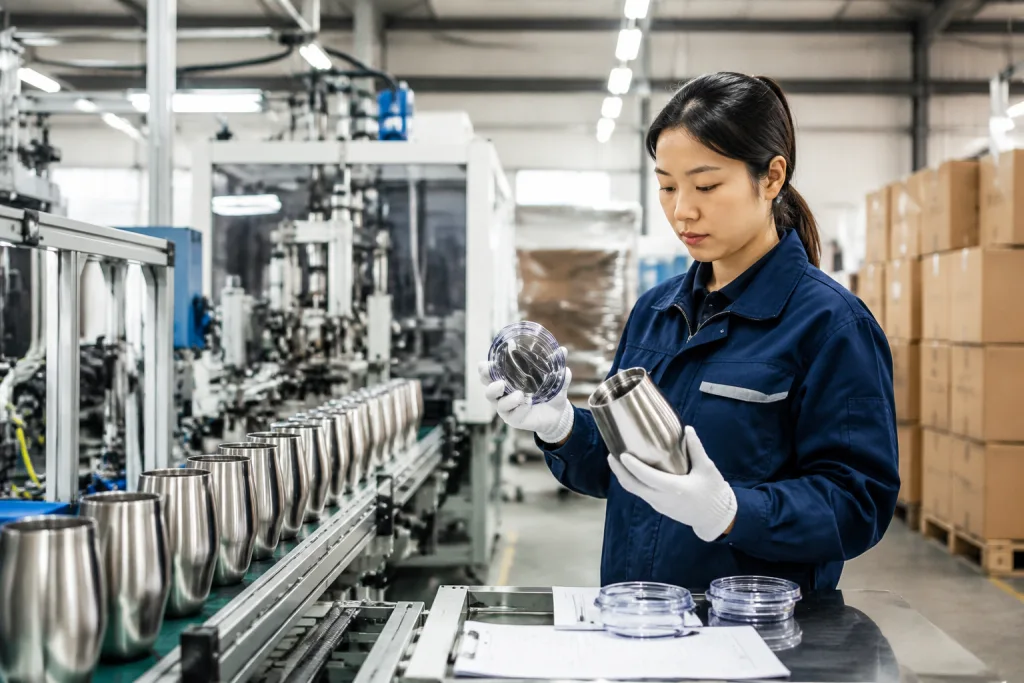
Check the rim. A rolled rim feels smoother, but poor polishing leaves uneven reflection, tiny burrs, or a lip that catches on the mouth. We use a cotton wipe test on the line; if fibers snag, the rim goes back for polishing before final AQL. Last spring, a buyer flagged 17 pcs in one pre-shipment inspection for rough mouth feel. For wine, drinking comfort is part of the product, not a side detail.
Match Finish To Your Risk Tolerance
The surface finish is where about 6 out of 10 customized drinkware complaints start. Stainless steel wine tumblers hit our line as powder coat, spray paint, plating, sublimation, or plain brushed steel. Same cup body, different scrap rate. Last month, QC pulled 200 pcs from a matte black run and found the trouble was not the weld seam; pinholes appeared near the lower radius after the second bake.
Powder coating is the safer default for a private label wine tumbler. It grips well, hides fingerprints, and covers the retail colors buyers keep reordering: cream for gift sets, sage green for outdoor assortments, charcoal for corporate orders, plus the usual matte white. We run coating thickness at 60-80 microns with a magnetic thickness gauge. Below that, the bottom curve looks starved. Above that, orange peel starts, and a few push-on lids can sit tight by 0.3-0.5 mm.
Spray painting gives you gloss and gradient effects, but dust points show up fast under the inspection lamp. Plating looks strong on a showroom sample, then the buyer flags water marks, color drift between cartons, and tiny pits near the rim. Sublimation works for full-wrap artwork, but MOQ and setup cost jump. The tapered body stretches artwork if the file is not corrected before the pre-production sample; we have seen a logo oval turn into an egg shape on a 12 oz wine tumbler. Not fun.
For AQL inspection, we normally suggest General Inspection Level II, AQL 2.5 for major defects and 4.0 for minor defects. For premium retail, the better move is to tighten cosmetic checkpoints, not just change the AQL number. Define rejects with photos: scratches longer than 5 mm, rim coating chips with metal exposed, dust under clear coat visible at 30 cm, lid color different from the approved sample, or logo position off by more than 1.5 mm. We also mark the inspection sheet with a 30 cm viewing distance, because without that note the math does not work and every tiny speck becomes an argument.
Pick the finish your channel can tolerate. A glossy mirror tumbler sells well in photos, but QC will punish it under a 6500K light box.
Decide Branding Before Tooling
Most B2B orders we run at the factory fall into two branding camps: laser engraving and silk screen printing. Together they cover about 80% of private-label wine tumbler programs. The other methods—pad printing, heat transfer, water transfer, full-wrap sublimation—exist for edge cases, but they add cost and complexity that smaller runs rarely justify.
Laser engraving is the one that won't come back to haunt you. The beam burns through the powder coat and exposes bare 304 stainless, so there's nothing to peel, crack, or fade. We've had buyers run engraved tumblers through 200+ commercial dishwasher cycles with zero degradation. The catch is color. You get metal contrast—silver on matte black, silver on navy—not a Pantone match. For single-color logos, line art, and clean wordmarks, it's the right call. One thing we've learned: if you're building a brand that spans multiple shapes—canteens, growlers, tumblers—laser keeps the decoration look identical across SKUs. Silk screen can't always do that because curvature messes with registration.
Silk screen printing earns its place when the buyer needs a specific Pantone. We charge a setup fee of USD 45–80 per color, and that's where small orders get squeezed. On a 500-piece run, that setup might cost more than the actual printing. The process works well on powder-coated surfaces, holds fine detail down to about 0.5mm line weight, and delivers consistent opacity across a production lot. Two colors max is what we recommend. Three colors and you're stacking registration tolerances that QC will flag at AQL 2.5.
Heat transfer and water transfer support full-color graphics and gradients. They show up in lifestyle retail where shelf appeal matters more than long-term durability. But they introduce variables that bite back: artwork seams that misalign on tapered tumbler walls, adhesion failures on textured finishes, curing time that drifts with humidity on the factory floor. If you're running 1,000 pieces and still validating the market, skip the complex artwork. A clean logo, one strong color, and packaging that tells the brand story will move more units than a four-color wrap that peels after three hand washes.
Before we cut tooling, approve a physical golden sample. Not a photo. A photo won't show you how the gloss level shifts on a textured coating under office lighting. The sample should include logo size measured with calipers, position relative to the rim and base, Pantone reference, lid fit with a torque test, and total weight. We ship these by express—usually DHL, 3–4 days to most markets. The USD 60–120 in courier cost is cheap insurance against a container of 20,000 tumblers arriving with the logo 3mm too high.
Know The Real MOQ Math
MOQ isn't a factory trick. It's batch math. For a private label wine tumbler, the numbers break down like this: 1,000 pcs if you're running a stock color with laser engraving. 2,000–3,000 pcs once you spec a custom powder coat — the coating supplier fires minimum 2,000 m² per run, and nobody eats that cost for a 500-piece order. 3,000–5,000 pcs if you want custom printed color boxes at a unit price that doesn't wreck your margin.
A canteen manufacturer might quote you 500 pcs MOQ on stock bodies. That line is already running canteen custom bottles, customizable canteen models, distributor canteen SKUs — swapping a wine tumbler body in costs them almost nothing in changeover time. But don't assume every finish is available at that number. The powder coating supplier sets the real floor. We've had a buyer push back on this, insisting 800 pcs should qualify, and the math just doesn't close. The powder line needs volume to fire, period.
Here's the cost stack we actually run. A standard 12 oz double-wall tumbler lands around USD 2.20–3.10 FOB Ningbo or Shanghai — steel grade (304 vs 201), lid type, finish, and total volume all move that number. Laser engraving adds USD 0.08–0.18. Custom color box adds USD 0.22–0.45. A premium sliding lid adds USD 0.15–0.35. No single line item kills you. Together they shift your landed margin by a dollar or more. QC pulled a sample last month where the buyer had stacked engraving, a custom box, and a silicone-wrapped lid — unit cost looked fine on the quote, but their P&L at the warehouse told a different story.
If you're a canteen supplier, canteen vendor, or distributor drinkware buyer managing multiple SKUs, watch how you combine colors and models. Chinese factories can consolidate production timing across SKUs — same run window, same line, less setup waste. They cannot consolidate MOQ across unrelated coatings, lids, and cartons. Powder goes with powder. Cartons go with cartons. Try to bundle a matte black tumbler and a glossy rose-gold tumbler under one "color MOQ" and you'll get a polite no from the production manager. We've seen this go sideways when buyers assume consolidation applies everywhere. It doesn't.
Package For Freight And Retail
Packaging hits two cost columns at once: product BOM and freight. A wine tumbler ships in a plain white box, a kraft box, a printed color box, a window box, or a gift set bundled with a straw and cleaning brush. The lowest per-unit box price on the quote sheet rarely produces the lowest landed cost. Breakage at 3% on a 10,000-unit run, repacking labor at the 3PL, and two extra warehouse touches—those eat the savings faster than the buyer expects.
For e-commerce or FBA-bound orders, we run a 5-ply export carton and individual boxes that survive a 1.0 m flat-face drop test. Not a corner-drop. Flat-face. If your channel needs FNSKU labels, suffocation-warning polybags, carton marks, or pallet-height limits (Amazon caps at 63 inches unless you request an override), send the spec before the line starts. One buyer flagged missing suffocation text at final inspection last spring. Relabeling 3,000 units post-production took two workers three shifts and added $0.18 per unit in local labor alone. The PO didn't cover it.
Retail box artwork needs capacity, material, care instructions, country of origin, barcode, and any market-specific compliance wording. Skip medical claims entirely. Skip "thermal insulated" if the wall is single-layer 304 stainless with no copper lining—we've had QC pull samples where the laser engraving said "insulated" and the cross-section said otherwise. If the lid has a drink slot, call it splash-resistant. Leakproof means inverted for 30 seconds with zero seepage. Most slider lids fail that test by second 12. Printing "leakproof" on a splash-resistant lid is a chargeback waiting to happen, and Amazon's automated returns system doesn't ask questions.
Carton math matters. A standard pack is 24 pcs per master carton, gross weight 8–11 kg depending on box style. Switch to a bulky gift box and the carton drops to 12 pcs. The buyer who squeezed $0.10 off the unit price just handed back roughly $0.25 in freight and warehouse cost per piece. We've run this calculation on three Amazon SKUs in the last quarter—the margin hit showed up in the P&L within two months.
Before you issue the PO, get a packing diagram, carton dimensions, gross weight, and CBM per 1,000 pcs. If the supplier can't produce these numbers, the packaging hasn't been engineered. It's been sketched.
Check Compliance Before Deposit
Lock down compliance before the wire transfer leaves your account. Not after QC pulls the first sample off the line. By then, you own the problem.
For Europe, the standard ask is LFGB food contact on the stainless and the coating, REACH screening on any colored or printed finish, and factory audit docs—BSCI or ISO 9001, usually within 12 months. For the US, FDA 21 CFR on the food-contact side is the floor. One thing buyers miss: if your packaging, your listing photos, or your tumbler shape reads "kid's cup" to a regulator, CPSIA triggers. A Disney-shaped lid on a 12 oz vessel got flagged at Long Beach last year. Don't build that headache.
When the factory sends test reports, check the date and the product. A 2021 LFGB report on a powder-coated 20 oz mug is not a pass for your wet-coated 12 oz wine tumbler. That's a reference, not a cert. New coating, new lid gasket material, or a print that lands within 5 mm of the drinking rim—budget USD 300 to 800 for fresh third-party testing. BV or SGS, depending on scope.
Inspection scope: vacuum hold time (we run 6 hours minimum at 90°C), lid thread fit and leak under inversion, coating adhesion via cross-hatch tape test on the line, logo placement against your signed artwork, odor, carton drop at 76 cm, barcode grade, and carton quantity count. For odor, the quick check is sealing 5 random lids and silicone rings in a PE bag for 4 hours, then opening. If it smells like a chemical plant, that's a batch hold. One-star reviews pile up fast with "plastic smell" in the headline.
Chinese manufacturing runs smooth when the spec sheet is tight. The gap opens when a buyer writes "premium quality" on the PO and approves no measurable standard. That's not a spec. That's wishful thinking. The math doesn't work.
Pick A Supplier You Can Scale
A stainless steel canteen factory isn't automatically the right wine tumbler supplier. Forming a double-wall body, pulling vacuum, holding 0.3mm tolerance on the rim curl, then applying a coating that won't craze after 500 dishwasher cycles—that's a different production line. We've seen buyers approve a tumbler sample, then discover the supplier's lid assembly was outsourced three provinces away. One design tweak added 14 days nobody budgeted for.
Ignore the first FOB quote. Ask what's done in-house and what's farmed out. We run hydroforming, vacuum furnaces, spray lines, and laser engraving under one roof in Hangzhou. When coating, logo, and packaging all move through one QC gate, a change doesn't ricochet across four subcontractors. Real numbers from our floor: approved sample to shipment runs 25–35 days for stock colors, 35–50 days for custom coating or custom packaging. Sampling—7–12 days for stock color with logo, 15–25 days for a custom finish. Add a week if Chinese New Year is anywhere near your timeline. We learned that one the hard way after a buyer's PO landed on Jan 12 and their ship window evaporated.
If you're building a full drinkware range, pick a partner who can run custom canteen, customized canteen, custom growler, customizable growler, and customized growler items on the same finishing line. A buyer's brand looks sharper when the wine tumbler, bottle, and growler share the same Pantone, same logo placement spec, and same inner box. We've shipped mixed-container orders where three SKUs went through one inspection—AQL 2.5, one report, one bill of lading. QC pulled all three from the same pallet stack and the buyer signed off in 48 hours. That's how you want it to work.
At BottleForge Industrial in Hangzhou, Zhejiang, we discuss the buyer's channel, target FOB, MOQ, and inspection standard before quoting. It's slower than blasting out a price sheet. But it kills the worst-case scenario: a sample the buyer loves, a mass production price they can't hit margin on, and a delivery date their sales team already emailed to a retail buyer. We'd rather lose a quick quote than ship a problem. The math doesn't work any other way.
Send Your Wine Tumbler Spec For Factory Review
Share capacity, target FOB, logo method, packaging needs, and delivery window. We will check feasibility before quoting.
Frequently asked questions
What is the normal MOQ for a private label wine tumbler?
For standard stainless steel wine tumbler bodies, the workable MOQ is often 1,000 pcs per logo if you accept existing powder-coated colors and laser engraving. For a custom Pantone powder coating, plan for 2,000-3,000 pcs per color because the coating line has batch setup loss. For printed retail boxes, 3,000 pcs is more realistic if you want a good unit cost. Some suppliers may offer 500 pcs, but you will usually pay higher decoration and packaging costs. If you are testing a new SKU, start with stock body, stock color, and custom logo before committing to custom lid, custom coating, and full retail packaging.
How much should I budget per unit FOB China?
A typical 12 oz double-wall 304 stainless steel private label wine tumbler can range from about USD 2.20 to USD 3.10 FOB Ningbo or Shanghai for normal B2B quantities. The range depends on wall thickness, powder coating, lid type, logo method, packaging, and inspection requirements. Laser engraving may add USD 0.08-0.18 per unit. A printed color box may add USD 0.22-0.45. A better slider lid can add USD 0.15-0.35. If a quote is much lower, check whether the outer wall is 201 stainless steel, the lid material is lower grade, or the packaging is only a thin white box.
Is laser engraving or printing better for wine tumblers?
Laser engraving is better for durability because it removes the coating and exposes stainless steel, so there is no ink layer to peel. It is the safest choice for corporate gifts, distributor drinkware, and repeat private label programs. Printing is better when your brand requires exact Pantone colors or a large graphic. One-color silk screen printing is usually stable and affordable, but multi-color artwork needs tighter registration control. For textured powder coating, always test adhesion and logo edge sharpness before mass production. If the tumbler will be washed frequently or used outdoors, choose laser unless color is essential.
What compliance documents should European buyers request?
European buyers should normally request food contact test reports such as LFGB for stainless steel, lid plastic, silicone gasket, and coating where relevant. REACH screening may be needed for coatings, inks, or external surface materials. Many importers also ask for BSCI or ISO 9001 documents to support supplier qualification, although those are factory management documents, not product safety tests. Make sure the report matches the same material family and similar finish. If you choose a new coating, new plastic lid, or printed decoration near the drinking rim, budget USD 250-800 and 5-10 working days for fresh third-party testing.
Can I use the same supplier for wine tumblers, canteens, and growlers?
Yes, and it is often smarter if the supplier has real stainless steel drinkware capacity. A factory that can handle private label wine tumbler production plus custom canteen and distributor growler programs can keep coating color, logo scale, packaging style, and inspection criteria consistent across your range. The risk is assuming every canteen supplier has the same technical strength in all categories. Ask for samples of the exact product types you want: wine tumbler, canteen, sports bottle, and growler. Also confirm lead time by category. A normal combined program may need 35-50 days after sample approval if custom colors and printed boxes are involved.