Key Takeaways
- MOQ for custom-printed private label water bottles starts at 1,000 units for silk-screen, 3,000 for full-wrap printing
- 18/8 stainless steel (304) is the baseline for reusable bottles; avoid 201-grade for food-contact surfaces
- AQL 2.5 normal level II is the standard sampling plan for drinkware; reject suppliers who offer looser inspection
- Lead time for a first custom order averages 45–55 days from deposit to FOB Shanghai; reorders run 30–35 days
Your brand is locked in. Channel is picked—Amazon FBA, retail shelf, or a corporate-gifting program. But you still don't have a bottle that hits on logo placement, target cost, and defect tolerance. After 14 years running drinkware lines here in Hangzhou, here's what I've seen: the price gap between suppliers is noise. The real gap is whether that shipment reorders itself or gets buried in returns.
This guide is the same walkthrough we give buyers who come through our floor at BottleForge Industrial. We cover material grades—304 vs 316, and when 201 becomes a trap. We cover decoration methods that survive a dishwasher cycle. Real MOQ floors, not the padded numbers. And the inspection points that caught a 12% leak rate on a 40,000-unit run last October before it left the dock. If you're sourcing a canteen factory or a custom drinkware vendor for the first time, the wrong question is "what's your price." The right one is "show me your AQL 2.5 report from the last three shipments."
Define Your Bottle Type and Use Case
I've seen RFQs come in that just say "need water bottle quote." That's not a spec. That's a 10-day email loop waiting to happen. Before you reach out, nail down three things: volume (ml or oz), material, and closure.
A gym bottle? 750 ml, double-wall 18/8 stainless, wide mouth (we run 54 mm on our sport line), and a flip-top lid you can pop with your thumb mid-set. We've had buyers try narrow-mouth for gym—the ice cubes don't fit, and the return rate tells the story. A craft-beer growler is the opposite: narrow neck, swing-top cap with a silicone gasket, 64 oz. Our QC team pressure-tests every swing-top seal at 2 bar; we've pulled entire batches when the gasket durometer was off by 5 points. For hiking, skip the double-wall. Single-wall 304 stainless or BPA-free Tritan, 500 ml, with a carabiner loop. The weight difference is 140 g vs 310 g—hikers notice.
Corporate gifts are a different game. European distributors almost always request double-wall vacuum-insulated bottles—500 ml, copper-lined inner wall, laser-engraved logo on the powder coat. The retail markup justifies the tooling. Promotional giveaways flip the math: single-wall aluminum, 600 ml, carabiner included, shipped flat. We run these on a separate line at 15,000 units/day. The per-unit landed cost drops enough that a 5,000-piece order actually makes sense for a trade-show drop.
Material Specifications: Stainless, Plastic, or Glass
We ship over 200,000 water bottles a month out of Hangzhou. Material choice is where 90% of new buyers either save real money or burn it — and we've seen both. Three materials cover almost every private-label project.
18/8 (304) stainless steel is the workhorse. Corrosion resistance holds up. No flavor transfer. Passes FDA and LFGB without drama. Here's the trap: some canteen vendors quote 201 stainless to knock $0.40 off the unit price. We've seen POs come back with "SUS201" buried in the fine print. 201 carries more manganese — fine for a pen holder, not for daily drinking. We run 304 exclusively. QC pulls a spectrometer check on every incoming coil. No exceptions.
Tritan copolyester (Eastman TX1001 or TX2001) is what we spec for clear bottles. BPA-free, survives a dishwasher cycle, and doesn't shatter when a customer drops it on concrete. The real cost driver isn't the resin — it's the mold. Injection tooling for Tritan runs 3x what a stainless forming die costs. That pushes MOQ to around 3,000 units before the math works. Below that, we steer buyers toward stainless or a stock Tritan blank with a simpler decoration path.
Borosilicate glass shows up most in tea-infusion bottles and growlers. It's heavy. It breaks. But the tea and wellness segment won't accept plastic, and they'll pay the freight for glass. The spec that matters: wall thickness. We set 2.0 mm minimum on a 500 ml bottle. At 1.5 mm, we saw a 14% breakage rate in DHL test shipments to Frankfurt. The buyer flagged it on the first reorder. We bumped to 2.2 mm and breakage dropped under 2%.
Before you approve a sample, ask for material test reports — REACH for EU, FDA for US, LFGB for Germany. A factory that can't produce these in three business days is not running certified stock. We send ours as PDFs from the lab, not self-declarations.
Customization Methods: Logo Placement and Decoration
Four processes get a logo onto a bottle. They're not interchangeable—each one dictates cost, durability, and the minimum you're locking into.
Silk-screen printing works on flat sidewalls and soft-radius curves. At 1,000 units, budget USD 0.15–0.30 per color per bottle. We see 12–18 months of daily use before the ink starts thinning at the edges. A buyer sent us a photo of a three-year-old bottle that was down to ghosted outlines—that's past its useful life. MOQ sits at 1,000 pieces per design. Below that, screen setup fees eat the margin.
Pad printing reaches where screens can't: caps, narrow neck rings, the inside of a lid. Ink deposit is thin. We only recommend this for giveaways and one-time promo runs. Five dishwasher cycles and the logo looks tired. If you're building a line you plan to reorder, skip it.
Laser engraving ablates the stainless surface directly. No ink layer to fail. At 1,000 units you're at USD 0.50–0.80 per bottle. The trade-off is obvious once you hold one: the etched texture signals premium. Outdoor and camp brands default to this on their canteen orders. We had a customer flip from silk screen after batch three came back with adhesion failures at the QC bench—laser solved it permanently.
Full-wrap heat transfer takes a printed film and shrinks it edge-to-edge around the body. Gradients, photo detail, bleed-to-rim patterns all work. MOQ starts at 3,000 units. The math shifts sharply above 10,000 pieces. We ran 25k last quarter and the per-unit landed 40% below the 5k quote.
Get a digital proof first. Then get a physical pre-production sample before the line starts. A factory that knows what they're doing charges USD 30–80 for that sample and deducts it from the PO. If there's no sample fee and no sample, walk.
MOQ, Pricing, and Payment Terms
Minimum order quantities on private label water bottles depend on the bottle type and your decoration method. We run stock bottles here, and our numbers are tighter than most Chinese factories.
- Stock bottle with silk-screen logo: MOQ 1,000 units, FOB price USD 2.80–4.50 for a 500 ml stainless bottle
- Custom color (Pantone-matched) bottle with silk-screen: MOQ 3,000 units, price USD 3.20–5.00
- Full-wrap heat transfer: MOQ 3,000 units, price USD 3.50–5.50
- Custom mold (new shape): MOQ 10,000 units, mold cost USD 3,000–8,000 amortized over the order
Payment terms for first orders: 30% deposit, 70% before shipment. Standard stuff. After two or three clean orders, some factories will float you 30/70 net 30. One buyer last year asked us to do 50% upfront on a first order — we said no. The math doesn't work for a new vendor. Do not pay more than 50% upfront to any canteen manufacturer you haven't run a full order with.
Lead time: 45–55 days for first orders. QC pulled a Pantone sample last month that took 9 days just to approve. Reorders: 30–35 days. Add 15–20 days for ocean freight to a US West Coast port. If you're shipping to Houston, tack on another 3 days.
Sample Approval: The Step Most Buyers Rush
Most buyers rush the sample step. They open the box, glance at the bottle, say "looks fine," and green-light production. Then 45 days later they're negotiating a discount on a container of 5,000 units with crooked logos.
A drinkware factory sends two samples. Stock sample: an off-the-shelf bottle, no branding, just to show the base quality. Pre-production sample: your bottle, your logo, your specs, your packaging. The stock sample is skippable. The pre-pro sample is not.
On the pre-pro sample, go through these:
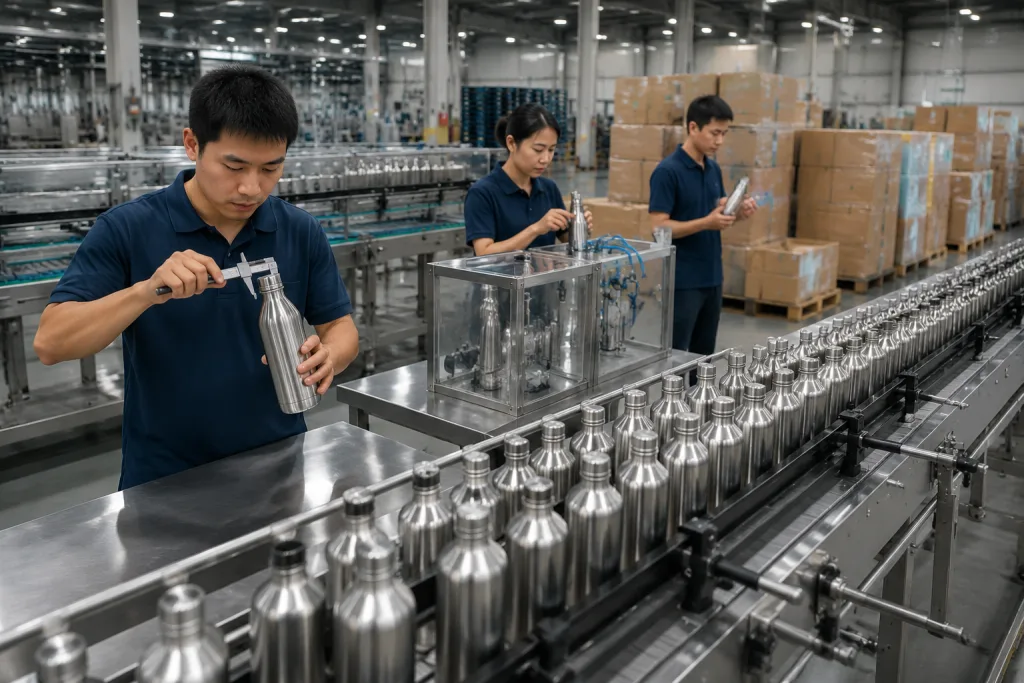
- Logo position and size — measure it with calipers. Is it centered, or does it drift left by 2 mm? Pantone match under daylight and office light? We had a buyer catch a logo 3 mm off-center on a sample. QC missed it. The 500-piece run had to be stripped and re-lasered. That cost the factory, not us.
- Cap seal — fill the bottle, cap it, flip it upside down, shake it hard. No drips. One batch we ran, the silicone gasket was spec'd at 1.5 mm. The factory cut it to 1.3 mm to save material. Every bottle leaked. Sample three caught it.
- Thread quality — screw the cap on and off a dozen times, fast. If you feel a catch on turn four or five, the mold cavity is wearing. That grit won't disappear in production. It'll get worse.
- Interior finish — flashlight inside, all the way to the bottom. No rough weld seams, no debris, no orange rust flecks. Rust spots are easy to miss under fluorescent lights on a QC table. We check under a desk lamp at 4000K.
- Weight — put it on a scale. ±5 grams from the spec sheet. We once had a shipment come in 12 grams heavy across the whole order. The factory swapped 0.5 mm steel for 0.6 mm without a word. Buyer rejected the lot.
Pre-pro sample passes these? The run will almost certainly pass AQL 2.5. It fails even one — reject it and demand a revised sample. A factory that pushes back on a re-sample is telling you something. We've walked away from suppliers over that pushback. The ones worth working with ship the revision in 5–7 days, no argument.
Quality Control: What to Inspect Before Shipment
We learned this the hard way — never trust a factory's own QC as your only checkpoint. Hire a third-party inspector or send your own person to the line for final random inspection. The standard for drinkware is AQL 2.5 normal level II. For a 10,000-unit order, the inspector pulls 315 units. If more than 14 show critical or major defects, the whole lot gets rejected. That's not a negotiation; that's the math.
Defects we catch on private label water bottle runs:
- Scratches on the body — nine times out of ten it's handling during assembly. The line was rushing. We flagged a batch last quarter where 22 out of 315 samples had hairline scratches because the conveyor guides hadn't been padded.
- Misaligned printing — our tolerance is 1 mm. A buyer rejected 5,000 pieces last month over a 1.2 mm logo shift. The screen jig had loosened on the third shift and nobody caught it until final inspection.
- Leaking caps — a water-fill test tells you nothing. We run a pressure test on every sample: 0.5 bar for 30 seconds. Failed seals usually trace back to a worn gasket mold that should've been replaced 10,000 cycles earlier.
- Dents or deformation — almost always packaging. No cardboard divider between layers, or boxes stacked five high in the container when the spec sheet said three. We've seen 80 cartons arrive with crushed bottom rows because someone on the loading dock got creative.
- Off-taste or odor — residual stamping oils that didn't burn off in curing. QC pulled the sample and we re-baked the liners for 12 hours. Adding a post-bake sniff check to the inline process stopped this from repeating.
Ask the factory for a QC report with photos. At BottleForge, we send buyers a video of the leak test for every batch — the full sequence, not a few clips. If a supplier refuses third-party inspection, walk away. We've seen this go sideways: one buyer skipped inspection to save $300 and landed 40% leaking caps. The rework cost them $4,200 and a six-week delay.
Check the packaging too. Each bottle individually polybagged. Cardboard divider between layers in the master carton. Carton weight should not exceed 22 kg — warehouse workers drop anything over that. We've seen cartons come in at 26 kg and the buyer's logistics team refused to touch them. Forklift drivers aren't gentle and your packaging is the only thing between a finished bottle and a dented return.
Logistics and Documentation for Export
FOB Shanghai or Ningbo covers 90% of what we ship to Europe and North America. We load the container, clear export customs, and hand off. You arrange ocean freight and insurance. Straightforward—until a buyer books EXW without understanding they just bought a container stranded at Yiwu West Station with no customs broker assigned. We've taken that panicked WeChat call. Stick with FOB unless you run a freight forwarder you've worked with before and a broker who picks up at 11 p.m.
Documents you need from us before the container sails:
- Commercial invoice—HS code must match what your customs broker has on file. A mismatch triggers a hold. Minimum three days. We've seen six.
- Packing list with carton dimensions and gross/net weight per carton. Missing the net weight is the single biggest reason a packing list bounces. QC weighs every carton on the floor scale before palletizing.
- Bill of lading—confirm the "shipper" field wording before the cut-off. Post-issue amendments run USD 150 and delay release by a day minimum. We send a draft 48 hours ahead for your sign-off.
- Certificate of origin—required for EU tariff preference under GSP or MFN. We file at the Zhejiang CCPIT office; turnaround is two working days.
- Material test report—REACH for EU, FDA for US. We send samples to SGS or TÜV Rheinland. Never an in-house lab. Buyers flag in-house reports every time, and we agree—third-party only.
Amazon FBA shipments need FNSKU labels applied on our packing line. Confirm this in the PI and the pre-production sample sign-off. Skip it, and a 3PL in California charges USD 0.50–1.00 per unit to label, plus a week of dock time. On a 5,000-unit run, that's USD 2,500–5,000 burned. We've had buyers tell us to ship unlabeled, then call two weeks later asking why inventory isn't live. The math doesn't work. Label at the factory.
Ocean transit: 25–30 days Shanghai to Los Angeles or Rotterdam. Air freight cuts that to 5–7 days but costs 4–5x. The breakpoint sits around 500 kg—roughly 2,000 standard 500 ml bottles. Above that, the air premium buys the container with money left over. We ship production runs by ocean. Air makes sense for samples or an emergency top-up when your stockout clock is running and you need 300 units in five days, not 28.
Building a Long-Term Relationship with Your Canteen Supplier
A buyer in Ningbo runs 90-day cycles like clockwork. Six months in, they asked for net-60 — we said yes without blinking. Never missed a payment. That’s the whole playbook. A Zhejiang canteen factory seeing steady orders every 60–90 days will hold your mold, reserve line capacity, and extend terms. The first PO doesn’t earn that. The fifth one does.
Pay on time. Send a 12-month forecast, even if it’s rough. And do not change specs mid-production. We had a buyer revise a handle loop three weeks into a six-week lead time. QC pulled the sample, and 200 pre-forms went straight to regrind. That’s $1,800 in material alone. If you need a new design, order a pre-production sample before the full run. A good canteen vendor will also tip you off when 304 stainless coil prices are about to jump or when a new powder coat finish is trending — that kind of heads-up is worth more than squeezing $0.03 off a unit price.
We’ve run with some buyers for over a decade. They started with one SKU — 1,000 private label water bottles — and now pull container loads: custom canteens, 64 oz growlers, corporate gift runs with laser-engraved logos. The math is dead simple. Consistency beats cleverness every time. On our floor, the line gets prioritized for buyers who trust the spec sheet and don’t rewrite it at week three.
Ready to spec your private label water bottle?
Contact our sales engineers for a quote and free sample of our stock bottle shapes.
Frequently asked questions
What is the difference between a canteen supplier and a canteen distributor?
A canteen supplier (or canteen manufacturer) owns the factory and produces the bottles. A canteen distributor buys from multiple factories and resells to end buyers. For private label water bottles, you want to work directly with a canteen factory—you get better pricing (typically 15–30% lower), direct control over QC, and shorter lead times. Distributors are useful for small quantities (under 500 units) where the factory's MOQ is too high, but for branded orders above 1,000 units, go direct.
Can I get a custom canteen with my own mold?
Yes, but the investment is significant. A new mold for a double-wall stainless steel bottle costs USD 4,000–8,000 depending on complexity. The mold is your property, and the factory will store it for you. MOQ for a custom mold order is typically 10,000 units. If you are a startup, we recommend starting with a stock shape and customizing the color and logo. Once you have proven the market, invest in a custom mold.
What is the typical MOQ for a customizable growler?
For a 64 oz stainless steel growler with a swing-top cap, the MOQ is usually 1,000 units for silk-screen printing and 3,000 units for full-wrap decoration. Glass growlers have a lower MOQ—around 500 units—because glass molds are cheaper. If you are a canteen distributor looking for a growler line, expect to pay USD 5.50–8.00 per unit FOB for a 64 oz stainless growler at 1,000 units.
How do I verify the quality of a canteen manufacturer in China?
Request a factory audit report from a third party like SGS or Bureau Veritas. Look for BSCI certification (social compliance) and ISO 9001 (quality management). Ask for photos or a video of the production line and the QC station. Then order a pre-production sample. If the sample matches the spec and the factory is responsive, proceed with a small trial order of 1,000–3,000 units. Do not place a container-size order without first testing the product.
What is the lead time for private label water bottles?
From a factory in Zhejiang, China, the lead time for a first order is 45–55 days from deposit to FOB. This includes 7–10 days for sample production and approval, 25–30 days for production, and 5–7 days for QC and loading. Reorders are faster: 30–35 days. Add 25–30 days for ocean shipping to the US or Europe. Plan your inventory 3–4 months ahead for the first order.