Key Takeaways
- A realistic MOQ for a private label water bottle order is 3,000-5,000 units per color for factory-direct pricing
- Plan 35-45 days for repeat production and 50-65 days when new mold, custom lid, or retail packaging is involved
- Use AQL 2.5 for major defects and AQL 4.0 for minor defects on export drinkware inspections
- FOB Ningbo or Shanghai pricing is cleaner than comparing mixed DDP quotes with hidden freight assumptions
A U.S. buyer sends what looks like a clean brief: 10,000 stainless bottles, matte black, logo on one side, retail box, delivery before a September promotion. Looks simple. Then our sales engineer asks for the real specs: capacity tolerance in ml, lid material, carton drop test height, FNSKU placement, and whether the coating must pass a 3M tape test after 20 dishwasher cycles. Last month QC pulled a matte black sample where the logo edge lifted 1.5 mm after the tape pull, so we ask these questions before the PO is locked.
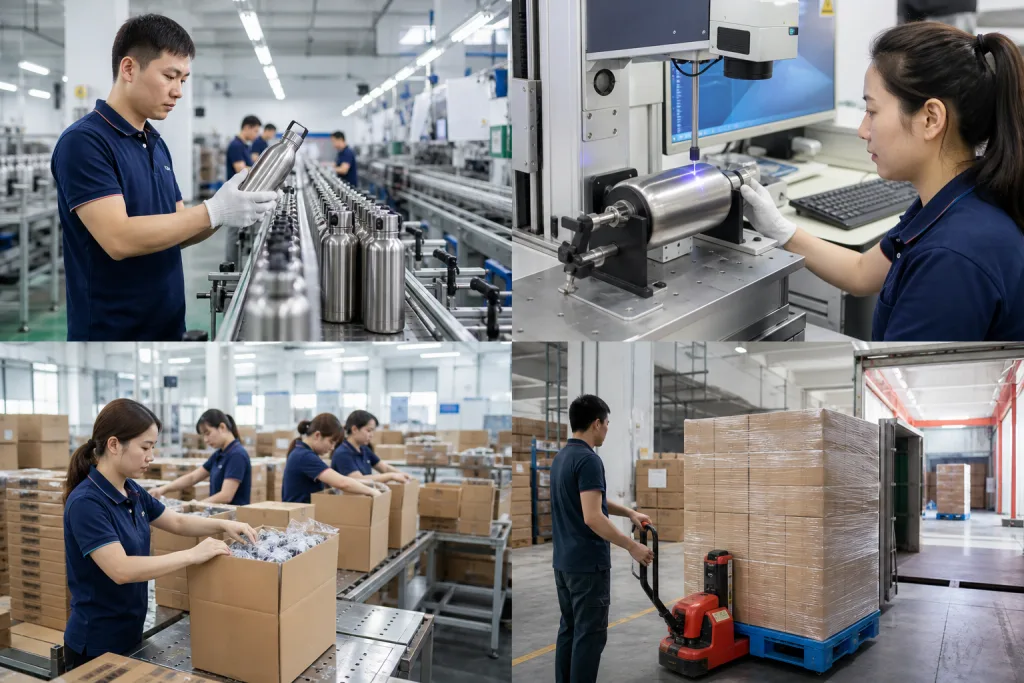
This is how we run a private label water bottle order through a factory in Zhejiang, China. Not theory. We specify the product, price tooling and decoration, confirm compliance, inspect by AQL, and ship it with the known risks on the table. A pretty rendering is not approval; we have seen that go sideways when the buyer signs artwork but misses the 304 stainless callout on the lid insert.
The buyer brief is not enough
The first mistake is treating “private label water bottle” as a finished spec. It is just a category. For a purchase order we can price without guessing, we need the bottle body, lid system, decoration method, packaging, compliance market, and inspection standard fixed before our costing sheet goes to the sales desk. Last month QC pulled a sample where the PO said “black bottle,” but the buyer expected matte RAL 9005 powder coating and the line had quoted standard glossy paint.
For this case, assume you are buying for a North American outdoor brand and want the option to sell in the UK and Germany later. A usable working spec looks like this: 750 ml double-wall stainless steel bottle, 304 inner wall, 201 outer wall, copper coating optional, powder-coated finish, leakproof screw lid with PP inner parts and silicone gasket, laser logo, individual kraft box, 24 units per export carton. That is enough for us to check wall thickness, gasket fit, carton drop risk, and whether the logo area has a flat enough zone for clean laser marking.
At BottleForge Industrial in Hangzhou, Zhejiang, our normal MOQ for this type of private label water bottles order is 3,000 units per color if you use an existing mold. For a custom lid or new body shape, expect 10,000 units and a tooling charge from USD 1,200 to USD 6,500 depending on complexity. Monthly capacity for stainless vacuum bottles is about 420,000 units across standard SKUs, but production slots still matter in March-May and September-November. We run into this every spring: a buyer approves artwork on April 18, then asks for an early May vessel date, and the math does not work once powder coating, vacuum testing, and AQL 2.5 inspection are on the calendar.
If you search for private label water bottle usa, private label water bottle uk, or private label water bottle germany, you will see 40 or 50 offers that hide the same factory questions. The market name changes; the spec discipline does not. We have seen this go sideways when a buyer prices for the USA first, then adds LFGB for Germany after mass production has started.
Lock the bottle construction first
Before you argue over logo size, lock the build spec. A cheap single-wall bottle and a vacuum insulated bottle are different products, full stop. For a 750 ml vacuum bottle, we usually see 0.4 mm to 0.5 mm wall thickness before forming. Go thinner and you may save USD 0.15-0.30 per unit, but the line starts showing dent marks after carton drop tests and retail handling gets messy.
For the inner wall, 304 stainless steel is the standard export pick. Some buyers push for 316 stainless steel because it sounds premium; fair point for saltwater, acidic drinks, or medical-positioned products, but the math does not work for most private label water bottles usa and private label water bottles united kingdom programs. If test reports cover food-contact compliance, 304 is the normal answer. We ship that spec all the time.
The lid is where complaints start. Spell out PP, Tritan, stainless cap insert, silicone gasket hardness, carry loop material, and whether spare gaskets ship in the carton. QC pulled the sample on one run and the thread engagement was only 1.2 mm; it looked fine on day one, then failed after 5,000 openings. This is the wrong question to ask if you only check appearance.
- Leak test: fill to 90%, invert for 30 minutes, then shake for 30 seconds.
- Vacuum test: use 95°C water, then check outer wall temperature after 3 hours.
- Coating check: run cross-hatch and 3M tape pull after curing.
- Fit check: measure lid torque on at least 20 random units.
These checks cost little. Skipping them costs a rework lot, and we have seen that go sideways fast.
Price the order like a buyer
I’ll rewrite the section in place, keep the HTML tags intact, and strip the AI-sounding phrasing while making it read like a factory-side sales note.A private label water bottle quote should break out the bottle, decoration, packaging, testing, and freight terms. If a supplier sends one all-in number with no breakdown, you cannot compare it fairly against another offer from China, the United States, Britain, or Germany. We run into this all the time, and the buyer usually finds the hidden cost at the carton stage.
For a sample order, a realistic FOB Ningbo price for 10,000 units of a 750 ml double-wall stainless bottle is USD 4.10-5.40 per unit, depending on steel grade, coating, lid design, and carton packing. Laser engraving may add USD 0.08-0.18 per unit. One-color silk screen may add USD 0.06-0.12, but the Pantone code and setup charge must be confirmed. A retail kraft box can add USD 0.22-0.45. A color box with lamination and insert tray may add USD 0.45-0.90. QC pulled a 12-piece sample last week and found a lid mismatch on a 24 mm neck finish, so the math does not work if the spec sheet is loose.
For buyers comparing private label water bottle US inventory against China production, the domestic stock option is faster but it usually limits shape, finish, packaging, and margin. A private label water bottle American distributor may ship in 7-10 days, but you are often decorating someone else’s generic bottle. Factory production in Zhejiang gives you more control, but you need to accept a 35-45 day production timeline after deposit and artwork approval. The buyer flagged a typo on the PO once, and that one comma cost us two days on the line.
Payment terms also matter. For new buyers, 30% deposit and 70% before shipment is common. Established buyers with stable volume may negotiate 20/80 or partial balance after inspection. Do not pay 100% before a pre-shipment inspection unless the order value is too small to justify normal controls. We ship on terms like this because once the pallets are wrapped, leverage is gone.
Artwork approval prevents rework
I’ll rewrite the section in-place, keep the HTML tags exactly as-is, and strip the AI-ish phrasing while making it sound like a real factory sales engineer wrote it.Private label work goes off the rails when a buyer signs a mockup and calls it approved artwork. A white-background rendering does not prove the logo will hold up on a curved, powder-coated bottle at scale.
For this order, the buyer wants a 45 mm logo centered 70 mm below the shoulder. We would ask for vector files in AI, EPS, or PDF, then confirm the Pantone code for print, the engraving depth for laser, and which side must face the drinking hand. That last point looks minor until your product photos show the logo turned away from the user.
For laser engraving on matte black powder coating, the mark color changes with the coating layer and the stainless substrate. Approve a physical pre-production sample. QC pulled a matte black sample last month, and the buyer flagged a 2 mm shift that never showed on the screen proof. For silk screen, ask for rub resistance after 100 cycles with a dry cloth and 50 cycles with an alcohol cloth if the bottle goes into promotional or corporate channels.
Packaging artwork needs the same discipline. If you sell private label water bottle united states or private label water bottles america programs, carton labels may need SKU, FNSKU, country of origin, suffocation warning for polybags, and a retail barcode. For private label water bottle united kingdom or private label water bottle britain orders, importer details and recycling marks may be required. For private label water bottle germany and private label water bottle deutschland projects, packaging law registration and German text may sit on your side, not ours.
Approve the sample as the mass-production standard, because that is how the line will run it.
Compliance depends on destination
A bottle can pass QC and still fail in your market. State the destination country before we run the first samples. “Export standard” is not a standard; it is what sales says when the buyer has not pinned down the test list.
For the United States, buyers often ask for FDA food-contact testing, California Proposition 65 screening if the channel needs it, and ASTM checks for children’s items when the bottle is sold to kids. For the UK and European Union, we usually see LFGB, REACH, and a BPA-free declaration for plastic parts. Germany is blunt on this point. Many importers there trust LFGB more than a generic food-contact statement.
Factory audits are a different lane. BSCI, Sedex, ISO 9001, or a retailer audit does not replace product testing. It tells you about management systems, labor control, or the way the line runs. At our Zhejiang facility, we keep incoming material records, vacuum test logs, and final inspection sheets tied to batch numbers. QC pulled a sample last week and matched it back to the same mold cavity in under 3 minutes. That traceability saves the reorder when the buyer flags a finish mismatch six months later.
Testing usually takes 5-10 working days after the lab receives the sample. Budget USD 250-900 for common food-contact and material tests, more if you need a full EU plus US package. The math does not work the other way around: spending a few hundred dollars up front is cheaper than a container sitting in customs or a retailer rejecting the PO because the paperwork missed one line.
QC the order before balance
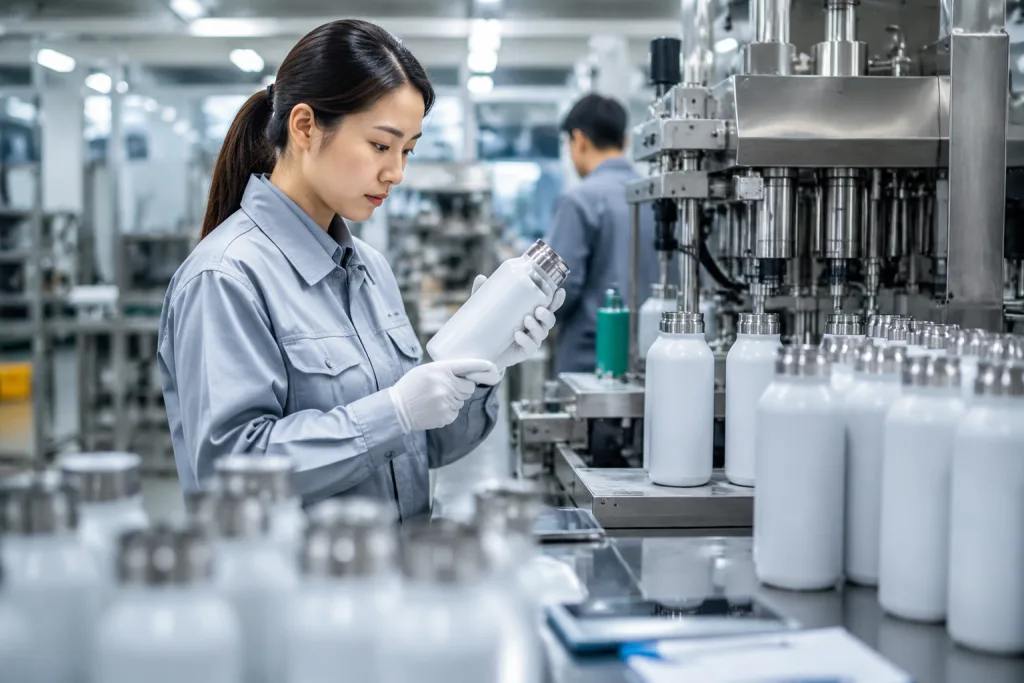
I’ll rewrite the section in-place, keeping the HTML tags and structure untouched while making the prose sound like a factory-side sales engineer wrote it.For a 10,000-unit order, 10 bottles is a joke. We run an AQL sampling plan instead. A common setup is AQL 2.5 for major defects and AQL 4.0 for minor defects under ISO 2859-1 general inspection level II. On 10,000 units, that usually means 200 pieces checked, with accept/reject numbers fixed before QC pulls the sample.
Major defects cover leakage, wrong capacity, sharp edges, broken lids, incorrect logo, heavy dents, coating peel, a dirty inner wall, and barcode failure. Minor defects cover small coating specks, slight color shift inside the approved range, carton scuffing, or tiny engraving drift. Critical defects are zero-tolerance items. Foreign matter inside the bottle or unsafe metal burrs go straight to reject.
QC has to cover cartons too. We check carton size, gross weight, drop test result, shipping marks, pallet plan if required, and barcode scan rate. For Amazon-style routing, FNSKU placement and carton labels must match the logistics file exactly. For distributors, mixed-SKU cartons are a bad idea unless the buyer signed off in writing; we’ve seen that go sideways on the dock.
We want inspection when goods are 100% finished and at least 80% packed. If the report comes back bad, the line still has time to rework. If you wait until after loading, the math doesn’t work. You are just paying to document a problem you already own.
For private label water bottles us and private label water bottles uk buyers, third-party inspection in China usually runs USD 220-350 per man-day. On a USD 45,000 order, that is cheap insurance. One pallet label typo can cost more than the inspection.
Shipping choices change your margin
I’ll rewrite the prose only, keep the HTML tags intact, and tune the tone to sound like a real export sales engineer. Next I’m doing a tight pass for margin/logistics phrasing, concrete shipping details, and removing the AI filler.Once QC clears, the next call is how the goods move. FOB Ningbo or FOB Shanghai is the cleanest term for buyers who already run their own freight. You book the forwarder, choose the sailing, cover insurance, and deal with destination charges. EXW looks cheaper on paper, but it hands China-side trucking and export docs to your forwarder. DDP is easy for the buyer, and that is why we push back on it until duties, remote drop fees, storage, and customs liability are written out line by line.
For 10,000 units of 750 ml bottles, we usually see 420-520 cartons, depending on box spec and pack style. That lands around 12-18 CBM. We had one buyer flag a PO typo on the carton count, and the shipment was off by two pallets until QC pulled the sample pack and rechecked the master carton size. Sea freight to the United States or United Kingdom usually takes 25-40 days port-to-port, then add customs and final delivery. Air freight can land in 5-9 days, but if it adds USD 2.00-4.50 per bottle, the math does not work unless the launch date is fixed.
This is where search phrases like private label water bottle america, private label water bottle united states, private label water bottle uk, and private label water bottle germany stop mattering as much as landed cost. Your customer does not care whether the sourcing page said private label water bottle britain or private label water bottle deutschland. They care that the carton arrives clean, the barcode scans on the first try, the bottle does not leak after a 1.5 m drop test, and the reorder matches the first run. We ship a lot of repeat orders on that basis, and we’ve seen this go sideways when a buyer chased a lower freight quote and ignored carton strength.
A good private label program is quiet by the time it leaves the line. The risk got handled earlier in the spec sheet, sample sign-off, compliance file, AQL 2.5, and the booking with the forwarder.
Send your bottle spec before you request price
Share capacity, material, lid type, logo method, packaging, quantity, and destination market. We will return a practical FOB quote and QC plan.
Frequently asked questions
What is the normal MOQ for private label water bottles?
For existing stainless steel bottle molds, a practical MOQ is usually 3,000-5,000 units per color. Some simple logo-only orders can start at 1,000 units, but the unit price is higher and color options are limited. If you need a custom lid, custom body shape, or exclusive mold, expect 10,000 units or more plus tooling. For plastic or Tritan bottles, MOQ can vary from 5,000-10,000 units because color matching and injection setup take time. Always ask whether the MOQ is per model, per color, or per artwork version.
How long does a private label water bottle order take?
For a repeat order using an existing mold, plan 35-45 days after deposit, artwork approval, and sample confirmation. A new private label water bottle with custom packaging, new coating color, or special lid is closer to 50-65 days. Add 5-10 working days for lab testing if required. Sea freight then adds about 25-40 days to many US, UK, and EU ports, depending on route and season. If you have a fixed launch date, work backward from warehouse arrival, not factory completion.
Should I buy from China or use local US or UK stock?
Local stock is useful when you need 500-2,000 units quickly, accept standard shapes, and can live with limited decoration. Factory production in China makes more sense when you need 3,000+ units, custom color, retail packaging, better margin, or repeatable private label control. A private label water bottle usa or private label water bottle uk supplier may still be importing from China and decorating locally. That is not bad, but you should understand what you are paying for: speed and convenience, not necessarily product ownership.
What inspections should I require before shipment?
Use a pre-shipment inspection under ISO 2859-1, usually general inspection level II with AQL 2.5 for major defects and AQL 4.0 for minor defects. For a 10,000-unit order, the sample size is often around 200 units. Check leakage, capacity, coating adhesion, logo position, lid fit, odor, carton strength, barcode scanning, and packaging accuracy. Critical safety defects should have zero tolerance. Inspection should happen when production is 100% complete and at least 80% packed, so rework is still possible before balance payment.
What compliance documents do buyers usually need?
For the United States, buyers often request food-contact material testing, BPA-free declarations for plastic parts, and sometimes Prop 65 screening. For the UK and EU, LFGB, REACH, and food-contact declarations are common. Germany often prefers LFGB reports from recognized labs. If the bottle is for children, ask about ASTM, CPSIA, small parts, and age grading. Factory audit documents such as BSCI or ISO 9001 help, but they do not replace product-specific lab tests. Confirm the destination market before sampling.