Key Takeaways
- Private label usually starts from 1,000-3,000 units per SKU; OEM commonly needs 3,000-10,000 units plus tooling.
- Choose private label when speed, lower development risk, and tested molds matter more than exclusive shape.
- Choose OEM when your retail position depends on unique structure, lid design, capacity, or material specification.
- For Europe and North America, confirm AQL, REACH/LFGB/FDA test scope, barcode rules, and carton drop testing before deposit.
Private label vs OEM is not a branding debate. It is a cost, risk, timing, and control decision. If you are buying custom drinkware for retail, corporate gifting, Amazon FBA, or distributor programs, the wrong path can lock you into slow sampling, high tooling bills, or a product that looks too generic for your price point.
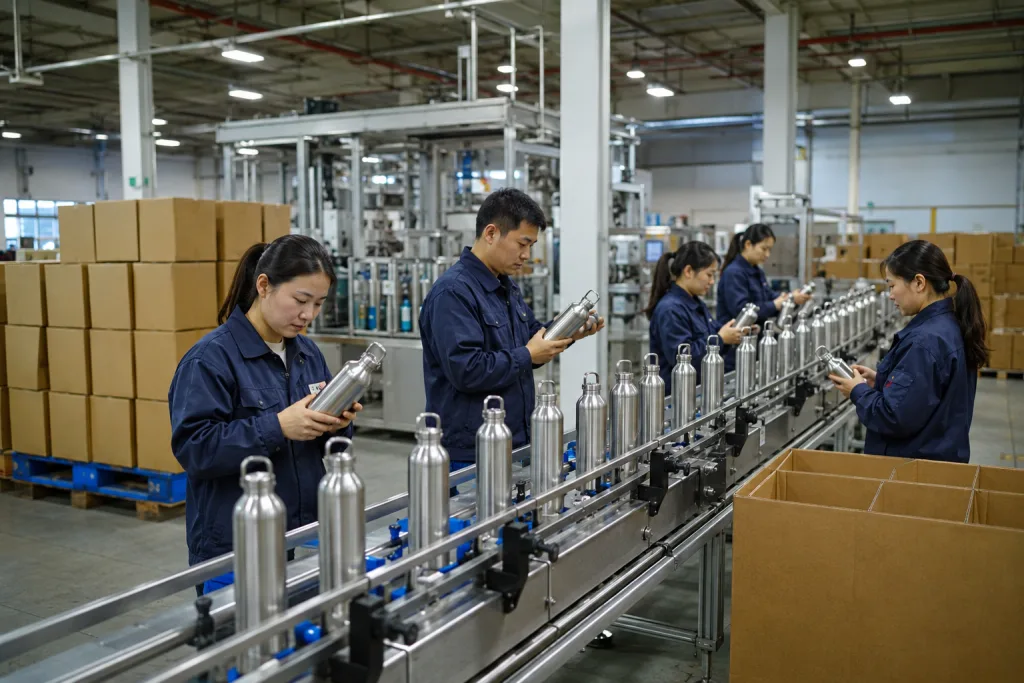
From our canteen factory in Hangzhou, Zhejiang, we see buyers split into two groups: those who need a proven bottle with their logo fast, and those who need a canteen customized from the structure up. China can support both, but the buying process is very different. You should decide based on ownership, MOQ, compliance, packaging, and how much product risk you can absorb.
Start With Four Buying Decisions
Before you ask a canteen supplier for pricing, settle four things internally: how unique the product must be, how fast you need it, how much volume you can commit, and who eats the design risk. These four decisions point you toward private label, OEM, or a controlled hybrid. Get this wrong and you burn 8 weeks on a mold nobody asked for.
Private label means you use an existing factory design and stamp your branding, colors, packaging, barcode, and sometimes accessories. This is the standard route for a distributor canteen program, promotional orders, retail starter ranges, and seasonal catalog launches. The product is professional. You are not reinventing the lid, thread, body shape, or vacuum structure. QC pulled a sample last month from a stock 500ml bottle with a buyer's logo—passed AQL 2.5 on the first run. That's what private label buys you: speed.
OEM means the canteen manufacturer builds to your design requirements. That may include a new mold, custom growler mouth diameter, handle shape, powder coating texture, wall thickness, capacity, or packaging system. OEM works when you need product differentiation. It also puts more weight on your spec sheet and approval process. One buyer flagged a 0.2mm thread tolerance mismatch on a prototype. We fixed it. That fix cost 12 days and a second sample round.
At BottleForge Industrial in Zhejiang, our split is simple. If you can sell an existing stainless steel bottle body with your logo and packaging, private label is the safer call. If your buyer, retailer, or brand story depends on a shape nobody else has, OEM is worth the conversation. Do not choose OEM just because it sounds more serious. The math doesn't work. Most failed custom drinkware projects started as OEM when a canteen customizable stock model would have launched 60 days earlier. We've seen this go sideways too often.
When Private Label Makes Sense
Private label fits when your real risk is market demand, not product engineering. You want to test a category, serve a distributor who needs drinkware for corporate gifts, run a canteen promo for a construction crew, or add bottles to an existing lifestyle brand — without building a product development department from scratch.
A typical private label job starts with an existing stainless steel vacuum bottle, sports bottle, travel tumbler, kids bottle, or canteen shape. You pick capacity, finish, logo method, lid type, packaging. A 750 ml stainless canteen with powder coating, laser logo, printed color box, EAN barcode, and master carton marks can go from approved artwork to mass production in 25-35 days after deposit. The coating color and order quantity will push that number up or down.
The main advantage is lower uncertainty. That mold has run before. The lid fit is known — no last-minute seal redesign. The leak test procedure already exists on the line. A decent factory should have historical QC data on vacuum failure rate, coating adhesion, and carton breakage. Your first order may only be 1,000 or 2,000 units per color. That doesn't justify deep engineering work.
Private label also suits canteen distributors managing 50+ SKUs. If you sell to corporate gift buyers, outdoor shops, or regional retailers, those customers care about logo quality, price stability, and delivery accuracy. They don't ask whether the base mold is exclusive. The trade-off is obvious: another buyer may run a similar silhouette. You can reduce that risk with custom color, a lid accessory, a sleeve, custom packaging, and a tighter brand system. But you cannot claim structural exclusivity unless the factory puts it in writing. One buyer tried to argue exclusivity based on a verbal conversation — QC pulled the sample and found an identical lid assembly on a competitor's shelf three months later.
When OEM Is Worth The Trouble
OEM is worth the trouble when your product must solve a specific problem that available molds do not solve. That could be a customized growler with a special cap, a wide-mouth canteen for filtration accessories, a nesting cup system, a non-standard 1.2 L capacity, a handle that works with gloves, or a retail design language that must match a larger product family.
Time is the first hit. OEM sampling runs 30-60 days before you get a usable pre-production sample, longer if new tooling is involved. Stainless body molds, plastic injection, silicone parts, packaging inserts — each has its own queue. Tooling cost can range from $400 for simple accessories to $8,500 for new body or lid systems. If the first sample fails leak testing or ergonomics, you need another round.
MOQ is the second hit. Many canteen manufacturers in China will ask for 3,000-10,000 units for OEM because setup losses, tooling amortization, material purchasing, and line changeover are higher. If you need custom color silicone, special gauge stainless steel, or a proprietary lid, the minimum may be driven by the sub-supplier, not the final assembly factory.
OEM also requires better documentation from you. A sketch is not enough. You should prepare drawings, target capacity tolerance, steel grade, coating requirements, logo size, packaging dielines, compliance markets, and inspection standards. Without that, the canteen vendor is guessing. Good OEM work is not magic; it is disciplined specification control. If you cannot define the product, do not expect the factory to protect your brand position for free.
MOQ, Price, And Lead Time Reality
Every buyer wants the lowest MOQ, the cheapest unit price, and the fastest ship date on one purchase order. We hear it weekly. The math simply doesn't pencil out. A canteen supplier can deliver two of the three. Expecting all three means someone's cutting corners you won't see until QC pulls the shipment sample.
For private label laser engraving or single-color silk screen, we run 1,000 units per model. That's our floor. Custom powder coating, full-color packaging, or three colorways? 2,000-3,000 units. Price reality: FOB Ningbo on a standard 500ml vacuum bottle sits at USD 3.20 to USD 5.80. Step up to a 1L bottle with 0.4mm stainless walls and a push-button lid, you're looking at USD 8.50. Growlers cost more—a 64oz growler eats three times the container cube of a 500ml bottle, and the steel weight alone pushes the carton past 14 kg.
OEM unit pricing after tooling isn't wildly higher than private label. The pain point is cash flow. You're paying 50% to 100% of the tooling upfront, before we cut steel. Then 30% deposit on the mass production order. Then 70% balance before the container leaves Ningbo. If you're a canteen distributor working on 60-day retail terms, that final 70% hits your books roughly 8 weeks before your customer pays you. We've watched this knock smaller buyers off their feet. One buyer last year had the PO ready, the artwork approved, and then froze when the finance team ran the working capital numbers. Plan for it.
Our Hangzhou lines push about 600,000 stainless units a month through standard production. After sample approval and deposit, 30-45 days is the honest lead time. Peak season ahead of Q4 tacks on 10-15 days—we highlight that in every quote. If a vendor tells you 15 days on a 10,000-unit custom powder coat order and hasn't asked about line capacity, that's a sales answer, not a production answer. The coating spec sheet won't match the sample, and QC will flag it at the AQL 2.5 inspection.
Branding Depth Is Not Design Ownership
Branding depth is not design ownership. A private label product can carry a strong brand without the buyer holding the mold. Owning a mold means little when the packaging, finish, and unboxing feel generic. We see this confusion every quarter.
Private label branding runs through logo placement, color, surface treatment, packaging, inserts, and add-ons. Laser engraving holds up well on 304 stainless — QC pulled a sample after 500 dishwasher cycles and the mark was still sharp. Silk screen gives better color saturation, but we had a batch fail adhesion on matte powder coating last year; the buyer flagged it. Heat transfer and water transfer handle complex art, but scrap hits 8–12% on curved surfaces, and unit cost jumps. For retail, a printed color box with barcode, capacity, material stamp, and country of origin often moves more units than a big logo on the bottle.
For OEM, ownership needs ink on paper. Who holds the mold? Can we run that tooling for another buyer if you drop the line? What happens when annual volume falls short — do we keep the mold? Can you transfer it to a different factory? These questions make people uncomfortable. Serious buyers ask them before they wire the tooling fee. A handshake and a vague exclusivity promise? The math doesn't work.
If you need a canteen that works across multiple customer groups, try a platform approach. One body mold, two lid options, three colors, and different packaging sets for retail, promo, and distributor channels. This keeps purchasing volume concentrated — we run one mold at 50,000 units instead of eight molds at 6,000 each. Sales teams get enough variation to pitch different segments. It is usually more profitable, and the supply chain stays clean.
Quality And Compliance Decide The Margin
A cheap bottle gets expensive fast—one leaking lid, a failed heavy metals migration test, or 200 dented cartons sitting in a Long Beach warehouse. I've seen a $2.80 landed cost turn into a $6.50 write-off because nobody locked down the spec before the PO. For the US, you need FDA 21 CFR food contact on the inner wall and any mouth-contact parts. Germany and wider EU programs typically ask for LFGB or EU 1935/2004 migration testing. If your bottle has a colored coating or silicone grip ring, REACH SVHC screening is standard. California-bound SKUs often need a Prop 65 lead and phthalates assessment. Kids' lines add CPSIA total lead, phthalates, and sometimes ASTM F963 mechanical testing—the age grading on the artwork file dictates whether you trigger it.
Inspection runs on AQL, not on the factory's WeChat album. We set AQL 2.5 for major defects and AQL 4.0 for minor, with zero-accept on criticals. A major is a leak at the lid thread, vacuum failure below spec (6 hours under 50°C when the target was 8), a sharp burr on the rim, a logo that shifted 2 mm left, a coating peel visible from arm's length, or a barcode that won't scan at the 3PL. Minor: a dust dot under the clear coat smaller than 0.5 mm, a Pantone delta E of 1.2 instead of 1.0, a carton scuff that didn't break the corrugated layer. QC pulled 125 pieces on the last 5,000-unit run and caught one major—that's a pass. The same order six months later with a different shift manager? Three majors. That's a rework conversation nobody wants.
For vacuum drinkware, ask the factory how they test insulation and leakage on the line, not just what's on the spec sheet. We run a hot-water charge test (≥95°C water, seal, measure after 6/12/24 hours), air-pressure leak decay at the lid seal, and a lid torque check with a digital gauge—0.8–1.2 N·m is our typical window for a screw-top sports lid. Coating adhesion gets a cross-hatch test (ISO 2409) followed by a 3M 610 tape pull. Drop test is 1.2 m onto concrete, three orientations, filled and capped. Wall thickness matters. Most of our bottles use inner 304 at 0.4–0.5 mm. The outer wall is often 201 unless the buyer paid the upcharge for 304 outer—about $0.35–$0.50 per unit at 5,000-piece MOQ. Don't assume. We've had a buyer catch 201 outer on a reorder because the factory "thought it was equivalent." It isn't, and the rust spots showed up in month four.
Passing a lab test once is table stakes. Repeatability is the margin. I've watched a second order go sideways because the gasket compound switched from food-grade silicone to a cheaper EPDM blend—same color, same durometer, different migration profile. Or the powder coating line changed suppliers and the new matte black chipped at 8 H instead of 4 H pencil hardness. Or the carton went from B-flute to E-flute to save ¥0.12 per box, and the 3PL reported 15% crush rate on pallet three. Your margin bleeds out through returns, chargebacks, and the cost of air-freighting replacements while the next shipment sits in Yantian waiting for a booking.
Best Path By Buyer Type
I’ve seen a buyer burn $120K on tooling before their first container sold through. The real filter isn’t budget. It’s your sales channel. Start there.
- New retail brand: Skip OEM until you’ve got 12 months of sell-through data. Private label lets you test 2-3 proven shapes with margin drivers that actually matter: a custom color, packaging that doesn’t look like a catalog rip, and the compliance docs your retailers demand. We run a 500-unit MOQ on stock bodies with custom decoration. That gets you into 40 doors and gives you real velocity numbers. OEM tooling at this stage is a bet placed blind.
- Established outdoor or lifestyle brand: If the bottle anchors your line—not a merch afterthought—OEM makes sense. Lock it down. Tooling ownership clause in the contract, your drawings on file, an annual forecast the factory can plan production around. Without the forecast commitment, you're just another inquiry. I watched a 304 stainless camp flask project stall for 14 weeks because the buyer refused to commit quarterly volumes. The factory deprioritized it. No hard feelings. That's how it works.
- Promotional distributor: Private label, almost always. Your buyer cares about three things: logo placement accuracy, the event date, and whether the MOQ fits their budget. A 500-piece canteen order for a 5K charity run doesn't need a custom mold. It needs a factory that won't miss the ship date. We've shipped 12-day turnarounds on stock 18/8 bottles with laser-engraved logos—QC pulled the sample Friday, container closed Monday. Custom tooling adds 35 days minimum. The math doesn't work.
- Regional distributor / drinkware wholesaler: Hybrid approach. Run standard bodies for the volume SKUs—your 600ml and 750ml single-wall lines—then develop one exclusive lid or a proprietary color series. That one custom element protects your catalog from being undercut by the next guy who walks into the same factory. I've seen a single Pantone-matched lid add $0.38 to the unit cost and block three competitors from copying the line sheet. That's a $0.38 insurance policy.
- Amazon or marketplace seller: Private label first. Get the FNSKU labeling right, confirm suffocation warning requirements for polybags, and measure your carton dimensions before you commit to FBA fees. We had a buyer lose 22% margin on a 40oz tumbler because the master carton was 3cm over the oversized threshold. Fix that before you spend a dime on OEM tooling. Understand your return reasons and review risk on a stock body. Then invest in custom design once you know the unit economics hold.
This ranking isn't about prestige. It's about matching investment to evidence. If you can't forecast 5,000 units per SKU with a straight face, OEM tooling becomes a tax on your first order—amortized over volume you don't have yet. If you can forecast 50,000 units across 12 months with purchase orders, not just a pitch deck, then staying on generic private label leaves differentiation on the table you're paying to defend.
How To Brief A Factory
A good inquiry saves 5–7 days of back-and-forth. A weak one says, “send me your best price for customized drinkware.” A useful inquiry tells the canteen suppliers what decision you are trying to make.
For private label, include target product type, capacity, order quantity by color, logo method, packaging type, destination market, required compliance, target FOB port, and delivery deadline. Example: “750 ml stainless steel vacuum custom canteen, 3 colors, 2,000 units each, laser logo, color box, EU market, LFGB and REACH needed, FOB Ningbo, goods ready by August 20.” That lets a canteen manufacturer quote a real product instead of a guess.
For OEM, add drawings, reference dimensions, capacity tolerance, lid function, material grade, finish, expected annual volume, exclusivity expectations, and tooling ownership request. If you want a custom growler with a 64 oz capacity and special carry handle, say whether the handle must pass a loaded swing test, dishwasher conditions, or a carton drop sequence. We had a buyer skip the swing test spec — QC pulled the sample and the handle snapped on day one. The more precise you are, the less room there is for expensive interpretation.
Be honest about your target price. Some buyers hide it, hoping the factory quotes lower. Usually it wastes time—we’ve seen this go sideways for weeks. If your target FOB is USD 4.20 and your spec costs USD 5.10, a practical canteen supplier in China can suggest changes: simpler lid, standard color, thinner color box, or higher MOQ. That conversation is where real sourcing work happens.
Choose the right sourcing path before tooling
Send your target quantity, market, and design goal. We will tell you honestly whether private label, OEM, or hybrid sourcing fits.
Frequently asked questions
Is private label lower quality than OEM for custom drinkware?
No. Private label and OEM describe the development model, not the quality level. A private label bottle from a proven mold can be very reliable because the canteen factory has already produced it many times. An OEM bottle can be excellent, but it can also fail if the design is untested. Quality depends on material specification, process control, and inspection. For stainless steel vacuum drinkware, confirm 304 inner steel, leak testing, vacuum testing, coating adhesion, and AQL inspection. AQL 2.5 for major defects and 4.0 for minor defects is a normal B2B starting point. If you need EU or US sales, define FDA, LFGB, REACH, or other test requirements before deposit.
What MOQ should I expect for private label vs OEM?
For private label custom drinkware, a realistic MOQ is usually 1,000 units per model for simple logo work and 2,000-3,000 units when custom coating or retail packaging is required. Some canteen vendors may offer 500 units, but pricing and color options will be limited. OEM usually starts higher, often 3,000-10,000 units per SKU, because the factory must cover tooling, setup loss, material purchasing, and engineering time. If plastic injection parts, custom silicone, or a new stainless steel body mold are involved, the MOQ may be set by the component supplier. Always ask whether MOQ is per model, per color, or per logo.
Can I get exclusivity with a private label canteen?
You can sometimes get limited exclusivity, but you need to define it carefully. With private label, the base mold normally belongs to the canteen manufacturer, so full global exclusivity is unlikely unless you commit serious annual volume. More realistic terms include exclusive color combinations, exclusive lid pairing, exclusive packaging design, or regional exclusivity for a defined buyer channel. For example, a factory may agree not to sell your exact color, logo-free packaging set, and lid combination to another distributor in Germany for 12 months if you order 20,000 units. Put this in the purchase agreement. Verbal exclusivity is weak protection.
How long does sampling take for customized canteen projects?
For private label, sampling usually takes 7-15 days if the factory has blank stock and your logo method is straightforward. Custom powder coating, heat transfer artwork, or new packaging can extend this to 15-25 days. OEM sampling is longer. A new lid, handle, or body mold may require 30-60 days before you see a functional sample, and another 10-20 days if revisions are needed. After sample approval, mass production commonly takes 30-45 days. Add ocean freight time, customs clearance, and any third-party inspection booking. For Q4 retail programs, start discussions at least 90-120 days before your required warehouse date.
What information should I send to compare canteen suppliers fairly?
Send the same RFQ sheet to every canteen supplier. Include product type, capacity, material grade, order quantity per color, logo method, packaging, destination country, compliance tests, target ship date, and trade term such as FOB Ningbo or FOB Shanghai. If comparing OEM, include drawings and tooling ownership expectations. Ask each supplier to quote unit price, MOQ, sample cost, tooling cost, lead time, carton size, gross weight, and inspection standard. Without this, one canteen vendor may quote a 0.4 mm wall bottle in a white box while another quotes 0.5 mm wall thickness with a printed color box. The prices will not be comparable.