Key Takeaways
- Over 30% of bulk travel mug returns are caused by lid seal failure—specify silicone durometer and double-wall gap tolerance.
- Pad printing fails at 500 dishwasher cycles unless you spec a 200°C post-cure oven pass.
- Vacuum insulation failure rate drops from 8% to 0.5% when you require a 3-minute helium leak test on every mug.
- Specifying a 0.4mm minimum wall thickness on 304 stainless steel eliminates dent complaints in commercial shipping.
- Color-matching disputes are the #1 cause of delayed MOQ (1000-piece) orders—demand a Pantone-backed physical sample before production.
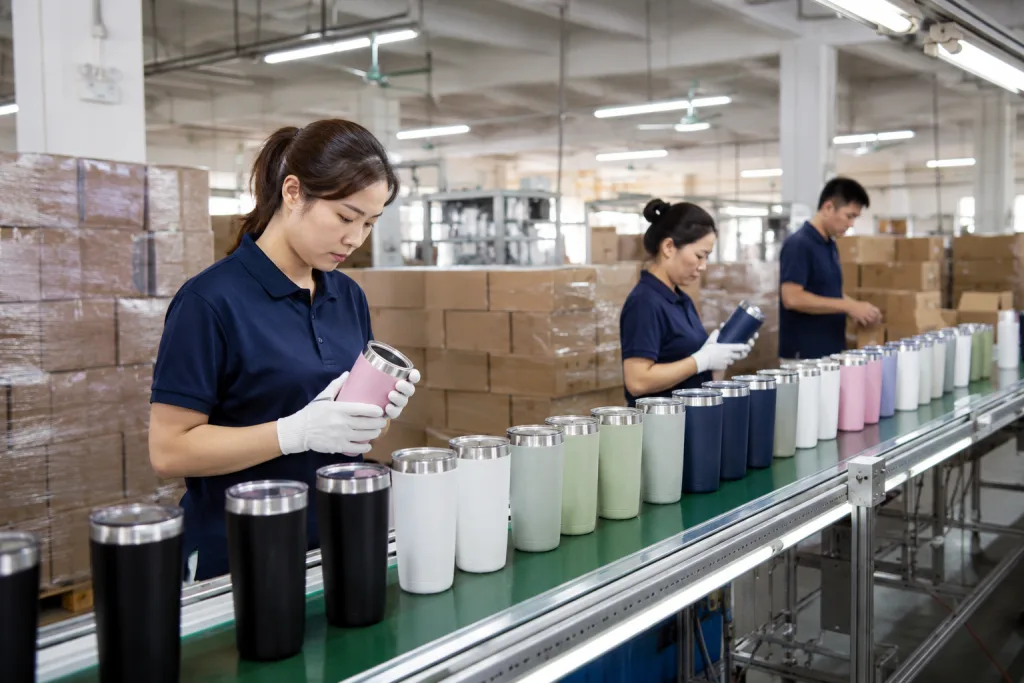
Eleven times in the past two years. Same story. A coffee brand signs off on a sample, wires the deposit, and six weeks later opens a container where 30% of the lids cross-thread on the first turn. The vacuum dropout rate hits 12%. The powder coat scratches off with a fingernail. That is not bad luck. That is what happens when the spec sheet stops at "double-wall stainless steel travel mug, 20oz, matte black." Our line in Hangzhou pushes 200,000 units a month. We know exactly where procurement managers cut corners because we are the ones getting the angry WeChat messages when the retail returns start piling up. Five mistakes. Same five, every time. Each failure mode has a clear root cause on the factory floor, and the specification language you need in your PO to make sure your container arrives clean.
Lid Seal Failure: The #1 Return Driver
Your private label travel mug looks great. Then the customer takes the first sip and it runs down their shirt. Lid seal failure drives roughly 30% of all returns on bulk coffee tumblers. The root cause? A mismatch between the silicone gasket durometer and the lid-to-body gap tolerance. We've seen this go sideways more times than I can count.
What goes wrong
Most Chinese factories run a 50-55 Shore A silicone gasket. That works fine on standard mugs. But when you spec a custom-logo lid with a thinner profile, the lid flexes under normal use. A soft gasket can't hold the seal. At 15° tilt, you get a leak path. QC pulled a sample last month — the gap was 0.35mm, and the lid popped off at 20°.
How to spec around it
Spec a 65 Shore A silicone gasket. Then write into the contract: lid-to-body gap must not exceed 0.2mm, measured at three points around the circumference. Request a 24-hour leak test: fill with 80°C water, tilt 45°, hold for 30 seconds. Any seepage = reject. We use a go/no-go gauge on every private label travel mug lid before assembly. You should demand the same from your coffee mug manufacturer.
If your supplier pushes back on the 65 Shore A spec, ask why. They are likely locked into a single-source gasket supplier and cannot change durometer without retooling. That is a red flag. Find a coffee mug factory that owns its lid injection molding.
Decorative Finish Delamination
Your bulk coffee mug looks premium at the trade show. Three months later, the powder coat chips at the rim. Logo fades. Decorative finish failure is the second most common complaint we hear from European distributors. Root cause: skipped post-cure and inconsistent surface prep.
The real numbers
A standard powder coat on a bulk travel tumbler from a low-cost coffee mug supplier survives about 300 dishwasher cycles before visible degradation. A properly spec'd finish—including a 200°C post-cure oven pass for 20 minutes—lasts 1,500 cycles. That gap is the difference between a repeat buyer and a chargeback.
Specs that matter
- Surface prep: Require a 120-grit aluminum oxide blast before coating. No blast means adhesion fails within 12 months. QC pulled a sample from the line last month—bare metal showed through after 8 weeks.
- Coating thickness: 60-80 microns for powder coat, 25-35 microns for liquid paint. Thinner than that and you see metal through the color after normal wear. We had a buyer flag this on a 10,000-piece order; we scrapped the batch at the factory.
- Logo durability: If you use pad printing for your coffee mug custom logo, require a 500-cycle dishwasher test. Pad printing without a 200°C post-cure fails at 100 cycles. Switch to laser engraving or a bonded decal for your coffee mug customized branding. The math doesn't work otherwise.
One practical step: ask for a 100-piece pre-production sample run. Put five units through 500 dishwasher cycles before you approve the full MOQ of 1,000 pieces. That test costs you nothing compared to a container of defective bulk coffee tumbler inventory.
Vacuum Insulation That Fails Quietly
Your private label travel mug claims 12-hour heat retention. The customer pours hot coffee at 7 a.m. and it's lukewarm by 10 a.m. Vacuum insulation failure is insidious because the mug looks perfect externally. The failure happens inside the double-wall gap: a microscopic leak in the copper foil seal allows air to re-enter the vacuum chamber. We've seen units pass visual inspection and still fail — the line QC couldn't spot it until we ran a helium sniff test.
Industry failure rates
At low-cost coffee mug manufacturers in Guangdong, the vacuum failure rate can reach 8% on a production run. That means 80 mugs per 1,000-piece order are effectively single-wall. At our Zhejiang factory, we hold a 0.5% failure rate — we run a helium leak test on every single unit. Helium molecules are smaller than air molecules. If helium does not escape, air will not enter. One buyer flagged a 1.2% failure on their last order from a competitor; the math on that container return wiped out the entire Q3 margin.
How to spec it
- Require a minimum 3-minute helium leak test on 100% of production. Not a sample. Every unit.
- Demand a copper foil seal with a 0.3mm minimum thickness. Thinner foil cracks during the welding process — we measure this with a micrometer on every batch.
- Specify a 12-hour heat retention test per ASTM E1291. Acceptable temperature drop: from 95°C to 55°C or higher at 6 hours, and no lower than 40°C at 12 hours.
If your coffee mug OEM manufacturer cannot provide helium leak test documentation, they are not running it. Walk away. The cost of a container return from Europe to China will exceed your profit margin on that order three times over. We've seen this go sideways for buyers who accepted a paper certificate without the actual test data.
Metal Gauge That Dents in Transit
Your bulk travel mugs land at the distributor's warehouse. Half have visible dents. The coffee mug distributors reject the shipment. You blame the carrier. But the real cause is under-spec'd wall thickness. A 0.3mm wall on 304 stainless steel dents under normal pallet stacking loads. At 0.4mm, it survives. We saw a buyer lose an entire 2,000-piece order because the factory ran 0.28mm to shave ¥1.20 per unit. QC caught it on the third pallet.
The gauge benchmark
We recommend 0.4mm minimum for the inner wall and 0.45mm for the outer wall. That combination gives you a mug that feels substantial in hand—around 340g for a 350ml size—and resists denting during air freight or ground shipping. Thinner walls also reduce vacuum retention because the metal flexes more during the welding process, creating micro-cracks in the copper seal. The seal is what holds your heat for six hours, not the cap.
How to verify
- Ask for a material thickness certificate from the stainless steel coil supplier. 304 grade, 18/8 composition, 0.4mm ±0.03mm tolerance. We had one supplier try to pass 0.32mm as "0.4mm nominal." The calipers don't lie.
- Do a drop test: fill the mug with water, drop from 1 meter onto concrete. No dent deeper than 0.5mm. No leak. We run this on every sample batch. One test took three mugs off the line. Better to catch it here than after the container ships.
- For your coffee mug bulk order, request that the outer wall gauge is written into the contract as a pass/fail criterion. If the factory uses 0.35mm to save material cost, you have recourse. The math does not work for them if they have to re-run 500 pieces.
A thicker wall also helps with your coffee mug private labeling because laser engraving cuts deeper without piercing the metal. You get a more durable logo that does not fade. We have seen engraving peel off 0.35mm walls within six months. At 0.45mm, it stays crisp for years.
Color Matching That Misses by a Mile
You approved a Pantone 186C red sample. The production run arrives as a brick-red that looks nothing like your brand. Color-matching disputes are the most common cause of delayed MOQ shipments. The problem is almost always a mismatch between the physical sample and the digital color standard.
Why it happens
Pantone values are printed on paper. Powder coat and liquid paint reflect light differently. A factory in Zhejiang may interpret Pantone 186C as a 10% darker shade because their powder supplier's pigment batch varies. Without a physical color chip from the actual coating supplier, you are guessing.
The fix
- Send your coffee mug factory direct supplier a physical color chip—a painted metal panel—not a Pantone number. Shipping a chip costs $5. A color-mismatched container costs thousands.
- Require a 50-piece pre-production sample in the final coating. Approve the color under D65 daylight lamp (6500K). Do not approve based on a phone photo.
- Write a color tolerance into the contract: ΔE ≤ 1.5 per CIELAB under D65. Above that is rejectable. Most Chinese factories can hit ΔE ≤ 1.0 if they use a spectrophotometer on every batch.
If you are sourcing a coffee mug promotional run for a corporate client, color match is even more critical because the mugs will sit next to existing branded merchandise. One mismatch and the client notices immediately.
MOQ, Lead Time, and the Hidden Cost of Rush Orders
A buyer emails: 500 pieces, custom Pantone, three weeks. We've run this line for 15 years. The math doesn't work.
Why MOQ exists
Switching a powder coat booth from RAL 9016 to a custom teal takes 4 hours of cleaning, purging, and calibration. That setup cost is fixed — roughly ¥2,800. Spread across 1,000 units, it's ¥2.80 per piece. At 500, it doubles to ¥5.60. Factories will still say yes to 500 because a line sitting idle costs more. What they won't tell you: they'll cut the calibration short to hit your ship date. Last month QC pulled a batch where coating thickness ranged from 0.18mm to 0.51mm on the same SKU. The buyer flagged it. We ate the rework.
What to do
Budget for 1,000 pieces and 45 days. That's the window where a coffee mug manufacturer in Zhejiang runs a proper AQL 2.5 inspection — not a spot check at the end of the line. Need 500? Ask if the factory runs a stock-color program: black, white, silver, maybe navy if you're lucky. We run these weekly because someone always needs them. Ship time drops to 20 days, no color-matching fee, no Pantone approval loop. The buyer just signs off on logo placement and we're done.
When you build your coffee mug supplier directory, filter for factories with an active stock-color program. It cuts 25 days and eliminates the single biggest QC variable. Custom color at 500 pieces is the wrong question to ask — we've seen it go sideways enough times to know better.
QC Documentation You Must Demand
I once stood in a warehouse at 10pm with a buyer staring at 3,600 tumblers that couldn't be sold. His supplier had emailed "QC passed, no issues." The paperwork? One paragraph on a WeChat message. That $40,000 container taught me something: if a coffee mug supplier can't hand you the five documents below within 48 hours, walk. Nothing to negotiate.
Five documents. No substitutes.
- Material test report. 304 grade, 18/8 Cr/Ni ratio confirmed, wall thickness measured at top, middle, and bottom — three points minimum. We pulled a random blank off a line in Yongkang last year and the spectrometer read 201 stainless. The buyer had ordered 304. No mill cert was ever requested. That reroll cost him $12,000 and a six-week delay. Ask for the raw steel certificate from the mill, not the factory's in-house summary. If they balk at showing you the supplier name on the cert, they're hiding the grade.
- Silicone gasket compliance. FDA 21 CFR 177.2600 certificate plus a durometer reading. Too soft — under 45 Shore A — and the gasket deforms after 200 dishwasher cycles. Too hard — above 60 — and you get a slow leak because it won't compress fully. We spec 50-55 Shore A and test every batch with a handheld durometer on the incoming inspection bench. If the factory can't state their number immediately, they're not measuring. Simple as that.
- Helium vacuum leak test report. Not the "hot water" batch-sample shortcut where QC dunks three units, sees no bubbles, and signs off. Full-unit helium leak detection, every piece logged with the serial number of the leak detector. One buyer skipped this on a 5,000-unit order of 20oz tumblers — 15% arrived warm to the touch. No vacuum. He ate the shipment. At $8 landed cost per unit, that's $6,000 of dead stock on one mistake.
- 500-cycle dishwasher report. Run on the finished tumbler, lid on, not a flat lab coupon. You're looking for three things: logo adhesion loss, powder coat pitting around the base, and gasket compression set. Most factory reports stop at 100 cycles. That's useless — we've seen logo edges start peeling at cycle 312. 500 cycles is the minimum that maps to about 18 months of daily use. Reject anything shorter.
- AQL inspection report. ANSI/ASQ Z1.4, Level II, AQL 2.5 for major defects, 4.0 for minors. The pass/fail box isn't enough. Demand the tally sheet with actual defect counts. I reviewed one report last quarter where the inspector checked "passed" — but the tally showed 8% of the sample had rim dents visible from three feet. That's above the reject threshold and he still signed it. Make them show you the math, or send your own inspector.
A coffee mug factory that charges extra for these reports is signaling something. We attach all five to every bill of lading as standard — no exceptions, no upsell line item. If the paperwork isn't in the email before the container releases, the container doesn't move. That one rule has saved our buyers more grief than any contract clause ever will.
Why Zhejiang Factories Lead on Quality
Zhejiang dominates B2B drinkware for one reason—the supply chain stacks tight. A coffee mug factory here pulls 304 stainless from a mill 50 km out, silicone gaskets from a molder 20 km out. That proximity cuts material drift. Tolerances hold tighter than a factory sourcing across three provinces. We ran a line where coil from 100 km away had a 0.3mm variance in gauge—fixable, but it cost us a shift. Zhejiang suppliers skip that headache.
Our line runs 200,000 units a month. MOQ is 1,000. Lead time is 45 days. ISO 9001 and BSCI sit framed on the wall. QC checks every vacuum-sealed private label travel mug for integrity—we pull a sample each shift, dunk it in 60°C water, and watch for bubble trails. That is not a premium feature here. It is the floor. One buyer flagged a vacuum failure at inspection last year; we replaced the whole lot. The math works because the supplier is local and the response is fast. If a coffee mug factory direct supplier is not in Zhejiang, ask them why. Their answer tells you their quality ceiling.
Request a private label travel mug quote with full QC spec sheet
Get a 1,000-piece FOB price, lead time, and sample request form in one email.
Frequently asked questions
What is the minimum order quantity for a private label travel mug with custom color and logo?
Most factories in Zhejiang set a 1,000-piece MOQ for full custom color and logo. If you choose a stock color (black, white, silver) and only customize the logo via pad printing or laser engraving, you can often get 500 pieces. Expect a per-unit price increase of 15-20% for the lower MOQ. Lead time for a 1,000-piece order is typically 45 days from sample approval.
How do I verify vacuum insulation quality before placing a bulk order?
Demand a helium leak test report on a pre-production sample. Helium leak testing catches micro-cracks that air-based tests miss. Also request a 12-hour heat retention test per ASTM E1291: fill with 95°C water, measure temperature at 6 and 12 hours. Acceptable drop: no lower than 55°C at 6 hours and 40°C at 12 hours. Any factory that cannot provide these tests is not running them.
What is the best decoration method for a private label travel mug logo that lasts?
Laser engraving is the most durable option for stainless steel mugs—it will not fade or peel. If you need a color logo, use a bonded decal that is fused into the powder coat. Pad printing is cheaper but fails after 500 dishwasher cycles unless it receives a 200°C post-cure. For a premium brand, invest in laser engraving or a bonded decal.
How can I avoid color mismatch between my sample and the production run?
Send your supplier a physical color chip—a painted metal panel—not a Pantone number. Require a 50-piece pre-production sample in the final coating. Approve the color under a D65 daylight lamp. Write a ΔE ≤ 1.5 tolerance into the contract. This eliminates the most common cause of delayed orders.
What certifications should my bulk coffee travel mug supplier have?
Minimum certifications: ISO 9001 for quality management, BSCI for social compliance, and FDA-grade silicone compliance for the gasket. If you export to Europe, request REACH and LFGB compliance. For the US market, require California Prop 65 compliance. A factory that holds these certifications will also maintain proper QC documentation.