Key Takeaways
- Stock toddler bottle MOQ usually starts at 1,000-3,000 units; custom mold programs often need 10,000-20,000 units
- Typical FOB China cost ranges from USD 1.20-2.80 for plastic and USD 3.20-6.50 for stainless toddler bottles
- Real lead time is 35-55 days after sample approval for stock molds, and 70-110 days when new tooling is required
- Testing for toddler products should include LFGB or FDA food-contact checks plus CPSIA, ASTM F963, and small-parts review when applicable
A private label toddler bottle looks simple until the quote lands. One-color pad print is a different job from a molded grip ring. PP and Tritan don't run at the same scrap rate, and a stock lid is not priced like a bite-valve straw lid with a dust cap. Last month QC pulled 20 pcs from the first-off tray because the straw cut length was 2 mm short on the steel ruler.
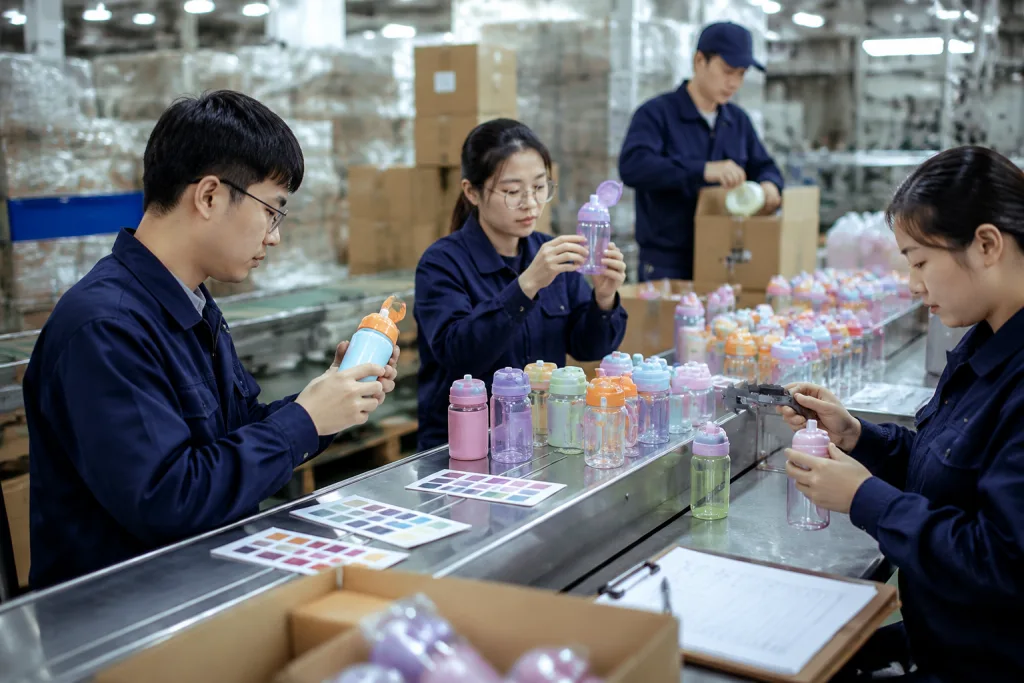
If you buy custom drinkware from China for retail shelves or distributor programs, the real fight boils down to cost vs. timing. At our Zhejiang facility, a normal toddler bottle program runs from 3,000 to 50,000 units. Production capacity sits around 600,000 drinkware units per month across stainless steel vacuum bottles, injection-molded plastic cups, and glass bottle lines — and we run each on a separate line. The math goes bad fast when the buyer flags Amazon FBA prep after the PO is signed, especially when the carton mark file still shows the old SKU.
Start with the sellable specification
A toddler bottle is its own product category. The grip diameter runs 42–48 mm—narrow enough for a three-year-old’s hand to close around. Straw durometer is a real QC variable. Shore A 50–55 is where we land for most silicone straws; softer than 45 and the valve collapses under suction, harder than 60 and we get buyer complaints about gum discomfort. Lid torque on a flip-top needs to hold at 6–8 kgf·cm. We’ve seen lids spec’d at 4 kgf·cm pop open inside a diaper bag during shipment. The return rate on that batch hit 11%. These numbers aren’t decoration—they decide whether a SKU stays on shelf.
Three formats cover 90% of the private-label toddler bottle RFQs we process in Zhejiang. First, the 300–450 ml Tritan or PP flip-straw bottle. One mold set for body and lid, roughly 38–42 days to T1 samples from a shop running three shifts. Tooling cost is the lowest of the three formats. Second, the 350 ml double-wall 304 stainless bottle with a plastic handle lid. This one adds a vacuum line step and a 0.4 mm minimum wall thickness—skip that and the inner wall dimples during cooling. Per-unit cost runs 18–22% above Tritan at 3,000-piece runs, assuming AQL 2.5 on the vacuum seal. Third, the lightweight aluminum canteen, 8–10 oz, common for outdoor and school-channel promotions. Internal lacquer spec is non-negotiable. We QC-tested a batch without it using apple juice at 40°C for 48 hours—the lining failed, metallic taste leached, the whole run got scrapped. Each format pulls from a different cost curve. Mixing formats on one RFQ just muddies the quote.
Lock these five items before you ask for pricing:
- Capacity: 300 ml, 350 ml, 400 ml, or 450 ml. Pick one. “Around 350 ml” is not a spec—it’s a negotiation opener that stalls the tooling drawing.
- Material: Tritan, PP, 304 stainless, or aluminum. We’ve had buyers write “eco plastic” on a PO and get flagged at import review. Use the resin grade name.
- Lid type: screw lid, flip straw, push button, carry handle, or leakproof valve. Testing standard ties directly to the lid claim. “Leakproof” without an inversion-test duration—15 min, 30 min—means the factory has nothing to sign off against.
- Decoration: silk screen, heat transfer, UV print, laser engraving, powder coating, or full-wrap artwork. Send Pantone or CMYK values. One buyer sent “light blue” and we ran three rounds of pre-pro samples before the color landed. Three rounds.
- Packaging: white box, color box, hang tag, belly band, PDQ, or FBA carton labeling. For FBA, we need barcode placement and the carton weight limit before the line starts. Getting this wrong on pallet #1 means rework on 2,000 units.
Send a photo and ask for “best price,” you’ll get a low anchor number. That number won’t survive a real PO. A factory that actually molds and assembles the bottle prices against a drawing, a test standard (FDA, LFGB, or both), and a confirmed order quantity—3,000 pieces lands a different unit cost than 300. Spec sheet first. Quote second.
FOB cost by bottle type
Opening a negotiation with "give me your best FOB" before we've agreed on a spec is the wrong question. FOB means nothing until the bottle, lid, finish, and testing requirements sit side by side. Here's what we actually quote for toddler bottles out of Ningbo or Shanghai.
- PP toddler bottle, 350–450 ml: USD 1.20–2.20 at 5,000–20,000 units. PP runs clean on our injection lines and holds color well. The tradeoff is surface feel—fine for a school fundraiser or promotion kit, less so for premium retail. We've seen buyers try to push PP into gift-box programs. The feedback was predictable.
- Tritan toddler bottle, 350–450 ml: USD 1.80–3.20 at 5,000–20,000 units. Clarity is why buyers pick it. A 410 ml Tritan with a silicone sleeve and flip lid lands around USD 2.60 at 10k units. That's the sweet spot for European reusable-kids programs. Eastman resin only—we don't substitute generics unless the buyer signs off on the test report.
- 304 stainless toddler bottle, 300–400 ml: USD 3.20–6.50 at 3,000–10,000 units. The spread is real. A plain brushed 300 ml vacuum bottle with a screw cap sits near the bottom. Add powder coating, a straw lid with a silicone bite valve, and a carry loop—you're at USD 5.80 before you blink. MOQ drops to 3,000 because the polishing station setup time doesn't shrink with volume.
- Aluminum custom canteen, 400–500 ml: USD 1.60–3.00 at 5,000–20,000 units. We run these for outdoor-kit distributors and canteen promo projects. The per-unit gap comes down to print: one-color silkscreen or full-wrap CMYK. One-color on a 450 ml canteen at 10k units: USD 1.85 ex-works.
The lid drives the quote more than the bottle body. A basic screw cap runs USD 0.18–0.35. A flip straw lid with a silicone valve, axle pin, button, and carry loop—that's USD 0.55–1.20. If the button spring spec isn't dialed in, QC pulls samples for leak testing twice. New lid mold? Add USD 2,800–4,500 and three extra weeks. I've seen a PO delayed 18 days because the buyer forgot the valve tooling wasn't cut yet.
On stainless, wall thickness matters in ways a spec sheet doesn't capture. We use 0.4–0.5 mm 304 for the inner wall. A factory down the road runs 0.35 mm to shave USD 0.18 per unit. That bottle dents on the first drop from a highchair. For plastic, ask the supplier for the resin grade, the resin origin, and whether the color masterbatch carries a food-contact letter. If they can't produce the masterbatch cert in 24 hours, walk.
MOQ tiers that change pricing
MOQ isn't some arbitrary number the factory pulls out of thin air. It's driven by real production constraints: the minimum raw material purchase, pigment mixing loss (you dump 3-5 kg of colorant just to purge the previous run), screen setup, carton die-cutting, and line changeover downtime. For private label toddler bottles, MOQ scales directly with how far you push the customization.
At BottleForge Industrial in Hangzhou, here's how the tiers break out:
- 1,000 units: only works on stock shapes with a one-color logo, existing lid colors, and standard packaging. The per-unit cost is high because those fixed setup charges get amortized across too few pieces. We've had buyers try this route and the landed cost just doesn't pencil out.
- 3,000 units: this is the floor for anything retail-ready. One bottle color, one logo method, custom color box. Below this, you're either cutting corners on the box or accepting a price that kills your margin.
- 5,000 units: opens up Pantone-matched body color, a matching straw lid color, and multi-color print. At this volume, the molding team can justify running a dedicated batch of lid resin tinted to your spec instead of pulling from open stock.
- 10,000-20,000 units: required when you need a new mold for a custom shape, a unique handle geometry, new silicone overmold parts, or a multi-SKU launch. The mold alone for a custom toddler bottle body runs USD 3,000-6,000 depending on cavity count, and you need the order volume to absorb that upfront.
Buyers frequently ask about mixing colors within one PO. Yes, but each color carries its own minimum. For injection-molded plastic parts, 1,000-2,000 units per color is workable before the line supervisor starts pushing back on changeover time. For powder-coated stainless steel, we can accept 500-1,000 units per color if the total order hits 3,000 — but this only works if the coating line is already running a similar shade and the operator can tweak the gun settings without a full cleanout. On printed artwork, every artwork change adds USD 30-100 in setup cost depending on whether it's screen, pad, or UV fixture. The buyer who says "I'll do 500 each of six designs" is asking for six setup charges, not one.
Here's what I tell distributors on their first order: don't over-customize. Run a stock mold with your logo, validate the channel, get 90 days of sell-through data. Then come back for the custom toddler bottle or a full customizable growler family once you've got repeat demand and the numbers to back it up. We've seen too many first orders with 17 SKUs and a USD 45,000 deposit that take 14 months to sell through. The math doesn't work.
Tooling and sampling costs
Tooling is where the budget gets real. A stock mold toddler bottle? Quick turnaround. A new lid or bottle body? Different story. We've had buyers who planned for a 30-day lead time and ended up at 65 because the cavity count was too aggressive. A simple injection mold for a plastic cap runs USD 1,500-4,000. A flip straw lid with two or three moving parts? That jumps to USD 6,000-15,000. A new bottle body mold lands at USD 5,000-20,000, depending on how many cavities you want and whether the surface needs a texture our tool shop has to cut from scratch.
On stainless steel toddler bottles, new body tooling is usually cheaper than a complicated plastic lid. But don't assume custom shapes come free. We still need fixtures, forming tools, and test runs. One buyer wanted a tapered shape with a rolled rim — the forming tool alone took three tries before QC signed off. If you're thinking about a fully customized growler down the road, the logic is the same, but the mold gets bigger and the material thickness drives the cost up.
Three sampling rounds. First: a reference sample from stock, 3-7 days. Second: logo or color sample, 7-12 days if we have the material on hand. Third: a tooling sample for a new part, 25-45 days after we get your mold payment and the 2D or 3D drawing approved. One buyer pushed back on that timeline. Then their competitor's lid cracked during drop testing, and they stopped complaining.
Budget honestly. A logo sample costs USD 50-150 including local setup. A custom molded prototype runs USD 300-800 before production tooling. Courier freight to Europe or North America is usually USD 45-120 for a small sample carton.
Good sampling is cheaper than fixing 10,000 bottles with a lid that toddlers cannot open or parents cannot clean.
Decoration and packaging add-ons
Decoration costs swing hard based on coverage, durability requirements, and how many colors you're running. Single-color silk screen on a plastic toddler bottle lands around USD 0.05-0.12 per unit. Step up to multi-color and you're at USD 0.12-0.35 — we once had a 4-color design rejected at pre-production because registration was off by 0.5mm between passes. UV digital printing runs USD 0.25-0.80 but handles photo-quality artwork without plate fees, so it pencils out on mixed-SKU orders under 500 pcs per design. Laser engraving on stainless is permanent and cheap to run — USD 0.08-0.25 per position — no consumables, no curing, nothing to peel.
Powder coating shows up on most stainless toddler bottles we ship, and for good reason. Hand feel is grippy, the matte finish photographs well, and it hides minor surface scratches from the line. Budget USD 0.35-0.80 per bottle for a standard coat. Here's where buyers miss things: demand cross-hatch adhesion testing and boiling-water resistance checks. We ran a batch last year where the coating passed visual QC but started flaking after three dishwasher cycles. Claims opened within six weeks of delivery. A pretty finish that can't survive a dishwasher isn't worth the freight.
Packaging follows the same pattern — cheap upfront, expensive when it fails. A plain white box is USD 0.08-0.18. Printed color boxes run USD 0.18-0.45 depending on board thickness, lamination, and run quantity. Window boxes, insert trays, or PDQ displays push USD 0.40-1.20. The detail that gets forgotten: carton strength. For stainless steel orders, use 5-ply export cartons and keep gross weight under 15 kg per carton where possible. We've had buyers save $0.03 per carton on 3-ply and then eat a 12% damage rate on the receiving dock.
Amazon FBA sellers, plan this early — FNSKU labels, carton labels, suffocation warnings on polybags, and master carton dimensions. FBA prep tacks on USD 0.05-0.20 per unit. A supplier who quotes only bottle price almost never surfaces these costs until shipment week. By then your prep center has the inventory and you're paying rush fees to fix labeling that should have been confirmed at the PO stage.
Testing, compliance, and inspection
Toddler drinkware carries more compliance risk than adult promotional bottles. You're dealing with children, food contact, small parts, and silicone mouthpieces. A single failed choke-tube test can kill a whole container. For Europe, buyers usually ask for LFGB or EU 1935/2004 food-contact testing, REACH screening, and migration reports for plastic and silicone. For North America, FDA food-contact compliance is common, and CPSIA requirements apply for children's products. ASTM F963 is often required when the item is sold as a children's product.
Do not use an old material report from a different color or part. Pigments, silicone batches, coatings, and decals can change test results. We had a buyer submit a red lid sample that passed — the pink from the same mold failed on lead migration. A proper test plan should cover the bottle body, lid, straw, gasket, printed area, and coating. Third-party lab testing takes 5-10 working days, with cost from USD 300 to over USD 1,500 depending on market and test scope.
Inspection should be written into the purchase order. This is where most first-time buyers slip up. For normal export orders, use AQL Level II with critical defects at 0, major defects at 2.5, and minor defects at 4.0. Critical checks include sharp edges, choking hazards, leakage, odor, incorrect material, blocked straw, weak handle, poor lid torque, and missing warning labels. QC pulled a sample last month where the straw retention ring was 3 mm undersized — that's a critical defect the line would have missed.
Many canteen manufacturers can make bottles. Fewer can control toddler bottle details consistently. The math doesn't work if you pick the cheapest canteen supplier and expect them to handle silicone valve tolerances. Ask your canteen suppliers for BSCI or Sedex audit status if your retailers require social compliance. ISO 9001 is useful, but it does not replace product-specific testing and inspection.
Realistic timeline from inquiry to shipment
We run stock molds for private label toddler bottles. You approve the sample, pay the deposit, and clean goods ship in 35-55 days. That number excludes the week you spend on artwork back-and-forth. New tooling runs 70-110 days — longer when the lid fails leakage or drop testing on the first try. QC pulled a lid last month: six grams off spec. We had to re-cut the steel.
Here is the real schedule:
- Day 1-3: quotation, spec check, rough freight estimate, initial compliance talk. Push for a launch date here, not later.
- Day 4-12: reference samples, logo artwork, packaging dieline, Pantone confirmation. One buyer sent a PMS number that did not match their brand red. We caught it on day 7.
- Day 13-25: pre-production sample, packaging sample, buyer approval. Add 25-45 days if new mold tooling is needed. The math does not work if you skip this step.
- Day 26-50: material purchase, injection, forming, coating, printing, assembly, inline QC. We run 6-oz and 8-oz polypropylene bodies on the same line. Tool change takes 40 minutes.
- Day 51-58: final inspection, lab report review, packing, export documents, container loading. AQL 2.5, normal level II. If the lab report is not ready by day 51, the container sits.
Sea freight from Ningbo or Shanghai to major North American ports runs 18-35 days on water. Europe is 28-40 days. Add customs clearance and inland trucking. Air freight works for launch recovery, but a toddler bottle is bulky — air can cost more than the goods on low-priced plastic bottles. We have seen this go sideways for buyers who budgeted air as a backup.
If your launch date is fixed, tell the factory before quotation. A responsible China canteen manufacturer adjusts the plan, not promises impossible dates. The fastest path: stock mold, existing material colors, one-color logo, standard export carton, and testing started before mass production. That is how you hit 35 days.
How to compare supplier quotes
Compare supplier quotes with a standard table. Never use lowest FOB price as your first filter. List every quote side by side: material grade, capacity, lid structure, wall thickness, coating, decoration, packaging, MOQ, tooling cost, sample lead time, production lead time, payment terms, test scope, and inspection standard. We run this checklist against every RFQ. Missing columns usually mean hidden costs.
Vague language is a red flag. "Stainless steel" must specify 304 inner and outer, or 304 inner with 201 outer for a lower price point. "BPA free" needs material declarations and a test report — QC pulled samples last year that failed on the first batch because the buyer trusted a certification that expired. "Leakproof" should cite a test method: inverted bottle test for 30 minutes, shaking test at 50 cycles per minute, or pressure/vacuum test where relevant. If they won't write it down, the math doesn't work.
For private label toddler bottle programs, insist on a written golden sample approval process. You approve one sealed sample for color, print position, lid function, packaging, and barcode. Production gets checked against that physical sample — not against a photo someone took on the factory floor. This stopped an argument last year when a buyer claimed the pink was off by 2 Pantone points. The sample proved otherwise.
Ask who owns the mold if you pay tooling. Some manufacturers keep the mold but reserve it for your use. Others allow transfer after a minimum order value — we've seen that threshold set at 50,000 units. Get that in writing. This matters for canteen customized ranges or long-term distributor drinkware programs. One buyer lost six months of production because the supplier refused to release the mold after the order volume dropped.
A good canteen supplier will challenge your assumptions. If a $0.90 target price conflicts with CPSIA testing, a straw lid, and a color box, you need to hear that before the deposit clears. Cheap surprises are still surprises. They usually arrive after the money is wired.
Price your toddler bottle program with real factory numbers
Send your target capacity, material, lid style, artwork, MOQ, and market. We will return a practical FOB quote and timeline.
Frequently asked questions
What is the lowest MOQ for a private label toddler bottle?
For stock molds, the practical MOQ is usually 1,000-3,000 units with one logo and existing bottle or lid colors. At 1,000 units, expect a higher FOB price and limited packaging choices. For Pantone-matched plastic, custom lid colors, or multi-color artwork, 5,000 units is more realistic. If you need a new bottle body or flip straw lid mold, most factories in China will expect 10,000-20,000 units to make the tooling and setup worthwhile. Mixing colors is possible, but each color may need 500-2,000 units depending on material and process.
How much should I budget for toddler bottle testing?
A basic food-contact test may cost around USD 300-600, but toddler bottles often need a wider scope. For Europe, LFGB or EU 1935/2004 migration plus REACH screening can push testing to USD 600-1,500. For North America, FDA food-contact review, CPSIA-related checks, lead, phthalates, and ASTM F963 small-parts or mechanical checks may apply, depending on positioning and packaging. Test the actual production materials, including straw, gasket, lid, coating, and printed decoration when relevant. Do not use a report for a different color or old silicone batch.
Is stainless steel or Tritan better for a toddler bottle?
Stainless steel is better when you need insulation, premium shelf position, and stronger perceived value. A 300-400 ml stainless toddler bottle often costs USD 3.20-6.50 FOB China, depending on lid and coating. Tritan is lighter, transparent, and easier for parents to see liquid level, with typical FOB cost around USD 1.80-3.20 at 5,000-20,000 units. Tritan can crack under hard drops, while stainless can dent and the coating can chip. For preschool retail, both work. For low-price promotional or school campaigns, PP or aluminum may be more cost-efficient.
Can one supplier make toddler bottles, custom canteens, and growlers?
Yes, but check whether they actually control the processes. A factory may assemble plastic toddler bottles but outsource stainless vacuum bottles, or make aluminum canteens but not molded straw lids. If you plan a broader customizable drinkware range, ask for production photos, audit documents, monthly capacity, and sample records across each category. A supplier handling toddler bottles, custom canteen items, and customized growler projects should be clear about which parts are made in-house and which are subcontracted. Subcontracting is normal in China, but quality responsibility must stay with your contracted vendor.
What payment terms are normal for a first order?
For a first order, 30% deposit and 70% balance before shipment is common. Tooling is usually paid 50%-100% upfront because the factory must start mold work before production. For larger repeat orders, some suppliers may accept 30% deposit, 70% against bill of lading copy, or limited credit terms after a trading history is built. If your order needs third-party inspection, schedule it before the balance payment. For a 5,000-unit private label toddler bottle order, hold enough time for final inspection, lab report review, and any rework before vessel cutoff.