Key Takeaways
- A serious private label thermos US RFQ should state capacity, steel grade, vacuum target, logo method, packaging, MOQ, and AQL level
- Typical stainless thermos MOQ is 1,000 units per color for standard molds and 3,000-5,000 units for custom colors or lids
- Pre-production samples usually take 7-12 days after artwork approval; bulk production is commonly 30-45 days
- For outdoor retail, prioritize 304 stainless inner wall, stable powder coating, ASTM or FDA food-contact support, and carton drop resistance
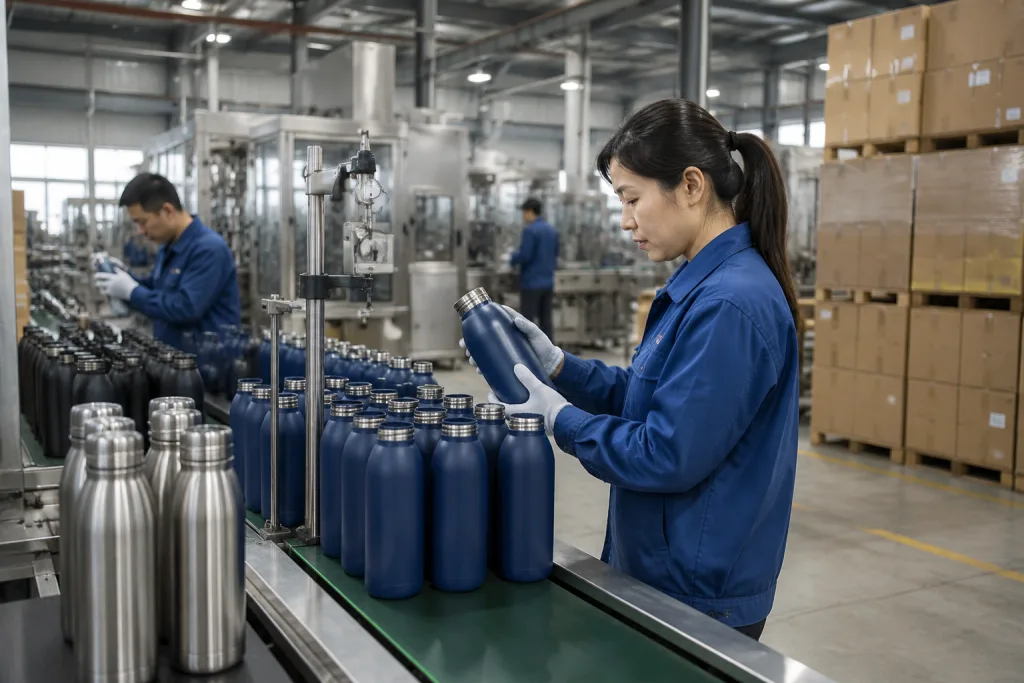
If you sell outdoor gear or manage promotional drinkware programs in the US, a private label thermos is not just a bottle with a logo. You are buying vacuum performance, FDA food-contact compliance, retail packaging, carton strength, barcode control, and the delivery date printed on your customer’s PO. We run 24-hour heat-retention checks with a probe thermometer before mass production; QC records the start temperature, room temperature, and final reading on the inspection sheet. One weak vacuum lot can kill a reorder. We have seen a 6,000 pcs shipment held because 11 samples in the pre-shipment pull lost heat faster than the approved sample. Painful lesson.
From our factory in Hangzhou, Zhejiang, we see this 8 or 9 times a month: buyers ask for a cheap custom thermos quote before fixing capacity, lid type, coating, logo method, and test standard. Wrong question. A 500 ml powder-coated flask with laser logo and a push-button lid will not price like a 1 L handle thermos with a cup lid, even if the first email says “send best price.” The buyer flags the price gap later, samples fail, or sea freight breaks the margin by USD 0.18 per piece. We’ve seen this go sideways over small details: a 62 mm barcode placed on a curved carton panel, a PO showing matte black while the approved sample was gunmetal, or a carton mark with the brand name typed one letter wrong. A cleaner RFQ gives the line something real to build against, down to the lid mold, coating rack, and carton drop-test plan.
Start With The Real Use Case
Before you ask a thermos manufacturer for pricing, decide what the bottle must survive. Start there. A giveaway thermos for a 2-day event does not need the same build as a retail flask hanging in an outdoor shop at $29.99. Mix those jobs and the math does not work: you either pay for specs the customer will never see, or you ship a bottle that comes back with lid leaks. We saw this last March when QC pulled 32 samples from a 500 ml promo run; 5 lids showed seepage after the carton drop test from 80 cm.
For outdoor retailers, start with performance: 12 hours hot, 24 hours cold, no metallic smell, leak resistance inside a backpack, plus coating that still looks clean after one camping weekend. For promotional brands, the priority shifts to decoration speed, logo color inside the approved Pantone tolerance, event delivery date, and landed cost after US domestic distribution. Ask the better question. “What is your cheapest thermos?” is the wrong question to ask. Ask what failure you cannot accept. On the line, we run powder coating thickness around 60 to 80 μm, checked with a coating thickness gauge; one buyer flagged it fast when a matte black sample came back with silver showing on the bottom rim.
Your RFQ should include a short product position, not just a photo. Like this: “20 oz stainless vacuum thermos for US outdoor retail, powder coated, laser logo, retail box, 1,500 units per color, FOB Ningbo.” That one sentence tells a Zhejiang factory the real job. We know the order size, sales channel, finish, logo process, packing, MOQ per color, and shipping term without guessing. We still get POs with “blue bottle” typed in the item line; one buyer even wrote “FOB Shanghai” on page 1 and “FOB Ningbo” on page 3, which cost 2 days of confirmation.
Useful first-line RFQ details include:
- Capacity: 350 ml, 500 ml, 600 ml, 750 ml, or 1 L; confirm if this is nominal fill or brim-full, because our 500 ml mold checks at about 515 ml to the lip with a graduated cylinder
- Body shape: slim cup-holder fit for US cars, wide-mouth food jar for soup, or hiking flask with a grip area that gloves can hold without slipping
- Material: 304 stainless inside, 201 or 304 outside depending on budget; we check incoming coil with an XRF tester when the order calls for 304 stainless
- Lid: screw cap, push-button, cup lid, straw lid, or handle lid; tell us if it must pass upside-down leak testing for 30 minutes at room temperature
- Decoration: laser engraving, silkscreen, heat transfer, or full-color UV; logo files should come as AI or PDF, not a 72 dpi JPG pulled from a website
- Packaging: white box, kraft box, retail color box, or FBA-ready carton; include carton mark wording, barcode size, and any drop-test requirement before mass packing
Do not hide your target market. If the customized thermos is for the US, say so. Compliance documents, UPC placement, carton marks, and polybag warnings are different from a generic export order. We ship US orders with UPC placement checked on the retail box, usually with a 30 mm quiet zone check, and AQL 2.5 inspection often catches small issues like a missing suffocation warning on the polybag before the goods leave Hangzhou.
Write An RFQ Suppliers Can Price
A bad RFQ gets you the wrong number. A vague RFQ invites the lowest bid — and that lowest bid usually assumes thinner steel, cheap paint, no retail box, and zero testing. We've seen that go sideways. When you compare thermos quotes from suppliers, make sure each one prices the same construction.
For stainless vacuum items, specify wall and material details. A common retail-grade spec: 304 stainless steel inner wall at 0.4 mm to 0.5 mm thickness, outer wall in 201 or 304 stainless at 0.5 mm, copper-coated vacuum insulation, and food-grade silicone gaskets. Some manufacturers won't state these unless you push. QC pulled a sample once where the inner wall measured 0.32 mm — below spec, and the buyer's lab flagged it on the first test.
Include your commercial terms clearly. At BottleForge Industrial in Hangzhou, Zhejiang, our standard MOQ for existing stainless thermos molds is 1,000 units per color. 2,000 to 3,000 units gives better coating and packing efficiency. New lid tooling or a private mold body pushes MOQ to 5,000 units — tooling setup, injection color matching, and QC fixtures all take more time on the line.
Your RFQ should request pricing in a table, not scattered emails. Ask for:
- FOB Ningbo or FOB Shanghai unit price
- EXW price if your forwarder consolidates in China
- Sample cost and sample lead time
- Bulk lead time after deposit and approved sample
- Carton quantity, carton size, gross weight, and net weight
- Available test reports: FDA, LFGB, REACH, CPSIA if relevant, and heavy metal for coatings
- Factory audit status such as BSCI or ISO 9001
If you are sourcing thermos bulk programs for multiple SKUs, give an annual forecast. A factory quote for 1,000 units once is not the same as a 20,000-unit seasonal program split across three POs. The math is different — we run the line differently for each.
Rank The Best Product Fit
We don't sell "the best thermos." We sell the thermos that won't get returned from your channel, at a margin that works. When a US buyer sends a brief, we rank options against five things: leak risk, decoration area, perceived retail value, carton cube, and how that SKU runs on our line. Chasing a trendy shape that generates 3% lid complaints is a fast way to burn margin on CS tickets.
Best for outdoor retail: 20 oz or 24 oz wide-mouth, screw lid, powder coated. Flat body gives you a solid laser engraving canvas. Photographs clean on white background—important if 70% of your sales are Amazon or DTC. We run these at 3,000 pcs/day on Line 2, so lead times stay predictable.
Best for corporate promo programs: 500 ml slim bottle, standard screw cap. Lower cube. Fits a cup holder. Ships flat to 20 branch offices without killing your freight budget. Silkscreen or laser both work. One buyer ran 5,000 units with a 3-color silkscreen; QC pulled AQL 2.5, zero rejects on registration.
Best for distributor catalogs: 750 ml hiking flask with cup lid. Feels heavy in hand—construction and outdoor buyers like that. Multiple decoration methods supported. The downside: higher freight per unit, and the cup-lid assembly is slower. We clocked it at 18 seconds per lid vs 9 seconds for a standard screw cap. That adds cost.
Best for premium private label: 1 L vacuum thermos, handle lid, retail color box. This is where lid torque and gasket fit get real. We check torque at 3 stations, not 1. If your brand is going on a shelf next to Stanley, a loose lid kills you. Strong shelf presence, but don't rush the QC step.
Best for fast-turn events: stock-color body, laser logo, white box. If the event is inside 45 days, skip custom Pantone coating. The math doesn't work. A Pantone match adds 12–15 days to pre-production and risks a shade rejection right before Chinese New Year shutdown. Stock colors ship. We've seen too many buyers miss their event date chasing a specific teal.
We can show you 200 shapes. Your first job is to eliminate 190 of them by channel fit. That's the honest conversation.
Control Samples Before You Commit
Sampling turns a private label thermos project from paper specs into something you can actually hold. Don't approve a sample just because the logo looks clean under your office lights. Test it the way a customer will—boiling water, a commute bag, a drop onto concrete.
If the mold already exists, we can ship a blank sample in 3–5 days when stock is on hand. A custom sample with logo, coating, and a retail box usually runs 7–12 days after artwork approval. Pantone powder coating? Add another 5–7 days for the color panel sign-off. We got a rush request last quarter from a buyer who skipped that step. The bulk order arrived with a muted navy instead of the bright cobalt on their brand deck. Rework cost them 18 days.
Your sample PO needs to spell out exactly what you're approving—line by line. Bottle model number. Capacity. Body finish. Logo size in mm. Logo position. Lid color. Packaging style. Insert sheet. Barcode label. Courier service. If your buyer needs three approval samples and your QA office in LA needs two, write five on the PO. Don't assume our team knows your internal routing. We've shipped samples to a forwarder's address by mistake because the PO was vague. That's a week lost.
When the samples land, run simple checks that catch what QC misses:
- Fill with boiling water, cap it, and feel the outer wall after 10 minutes. You're checking vacuum integrity, not just "warm."
- Close the lid, invert for 30 minutes on a paper towel. Any damp spot is a fail.
- Measure capacity to the practical fill line—brim volume is useless for real-world use.
- Rub the logo with a wet cloth, then an alcohol pad if it's printed. We've seen silk-screen logos lift on the third wipe.
- Check lid thread feel, gasket seating, any odor inside, and run a finger along the rim for burrs.
- Drop the retail box from 80 cm. If this is going FBA, a crushed corner on arrival kills the listing.
When something fails, document it with photos and numbers. "Lid feels bad" tells us nothing. "Lid requires more than 1.2 N·m torque and cross-threads on 2 of 5 samples" gives us a target. That's the difference between a sample round that takes three days and one that drags for three weeks.
Build The PO Line By Line
A bulk PO for a custom thermos should read like a production instruction, not a payment document. Most disputes start because the PO says "500 ml black thermos with logo" while the email thread has the real details. By the time the coating line is running, nobody wants to dig through old messages. We saw a buyer ship 5,000 units with the wrong lid thread because the PO skipped the cap spec — the email said "standard screw lid" but the factory assumed a different 1.5 mm pitch. That error cost $1.80 per unit to rework.
For each SKU, write a clean line item. A practical PO line looks like this: SKU BF-500W, 500 ml double-wall vacuum stainless thermos, 304 inner, 201 outer, matte black powder coating, laser logo 45 mm wide on front center, black screw lid, individual kraft box, 24 pcs/master carton, FNSKU label on box, FOB Ningbo, 1,200 pcs.
Add separate lines for tooling, sample refund, test fees, spare parts, and packaging if needed. For distributor thermos programs, spare lids matter. We suggest 1%-2% spare lids or gaskets packed separately for larger retail orders. Cost is minimal — maybe $0.12 per spare gasket — and it keeps your customer service team from replacing a full bottle for one lost cap. One buyer flagged that his PO had no spare parts line, and we had to split a container load to FedEx 80 gaskets after his customer lost three caps in a week.
Payment terms belong on the PO. A typical China factory thermos order is 30% deposit and 70% balance before shipment after passed inspection. Some repeat buyers use 20/80 or OA terms after a trade history. But first orders need a deposit because stainless steel, coating powder, cartons, and labor are all committed early. The math doesn't work without it. We had a buyer try to negotiate net 60 on a 2,000-piece run — the line stopped at tooling because no steel was ordered.
State the inspection standard. For drinkware, most US buyers use AQL 2.5 for major defects and AQL 4.0 for minor defects. Critical defects — leakage, contamination, wrong material, sharp metal burrs — should be zero tolerance. Put that on the PO before production, not after QC pulls the first sample and you find 12 leakers in a 500-piece run. That exact number came from a real inspection report in March.
Check Compliance And Packaging Early
Compliance isn't a box you tick after the sample's done. Stainless steel drinkware holds hot liquids and goes against someone's mouth. Your thermos supplier needs to hand over food-contact documentation, coating safety data, and third-party test reports—not vague assurances.
We regularly provide FDA food-contact support for 304 stainless and silicone parts. LFGB for EU buyers. REACH for chemical restrictions. And if you're selling into California, Proposition 65 evaluation is non-negotiable. A buyer last year skipped Prop 65 on a 500 ml bottle. Los Angeles distributor flagged it at inbound inspection. The rework cost more than the margin on the order. For kids' products, the rules tighten further—CPSIA tracking labels and specific substance limits kick in. A children's thermos is not a scaled-down adult bottle. We've seen this go sideways when buyers assume otherwise.
Packaging will bite you just as hard. A glossy retail box that collapses inside a container during 18 days at sea isn't retail-ready anymore. For bulk shipments of heavier 750 ml and 1 L flasks, we run 5-ply export cartons with inner dividers to protect printed surfaces. If you sell through FBA, carton drop tests matter. One crushed box leads to a removal order. Put FNSKU requirements, suffocation-warning bags, carton labels, and "Made in China" marks directly into the artwork pack—before plates are made. QC pulled a carton sample last quarter where the buyer's artwork file read "0238" instead of "0328." One digit. That would have routed 2,000 units to the wrong DC.
Barcode control gets less attention than it deserves. A single wrong UPC stops a pallet at the distributor's dock. Attach the barcode file, label dimensions, placement photo, and a scan-verification requirement to your PO. For promotional thermoses heading to an event, carton marks need event name, PO number, destination, SKU, quantity, and carton sequence—all of it. We ship 12,000 to 18,000 units per container. Barcode errors remain the most frequent fix we catch on the line.
A factory that doesn't ask where the goods will be sold is quoting you a container filler, not a private-label retail product. That's the wrong question to skip.
Manage Bulk Production Without Guessing
Deposit clears, the pre-production sample gets signed off, and the factory clock starts. For standard stainless thermos production, 30–45 days after approval is realistic. September through January? Add two to three weeks. Coating lines run double shifts. Lid injection molds swap every six hours. Carton printers wedge your 5,000-unit job between a 50,000-unit order for Walmart and a rush run for a Japanese buyer. Vessel booking turns into a bidding war — we've watched spot rates jump 40% in a single week during peak.
Our stainless drinkware capacity sits around 450,000 units per month across tumblers, bottles, and thermos lines. Capacity is not instant availability. We run three powder coating booths, two laser engraving stations, and one vacuum testing room with 12 test ports. Scheduling is the real bottleneck. A 10,000-unit promotional order with four colors and four logos hits the line differently than one 10,000-unit SKU in a single color. The line stops four times for color change instead of once. QC pulls two extra samples per changeover. Setup waste creeps up. Your unit cost should reflect that, and if your supplier's quote doesn't, ask why.
Demand production checkpoints. Not a daily essay. Proof at the gates that matter:
- Material arrival and stainless body forming — we photograph the mill certs and the first 20 formed bodies off the press
- Vacuum insulation and temperature retention test records — 12 ports, 6 hours minimum hold, pass/fail logged per cavity
- Coating color panel or first-off coated body — shot under D65 light, compared to the signed master swatch
- Logo first article photo with a steel ruler in frame — not a tape measure, not a coin for scale
- Packaging first article with barcode scan — we scan it twice, once in the QC room and once on the packing line reader
- Inline inspection findings before final packing — raw notes, not a cleaned-up summary
For orders above 5,000 units, hire a third-party inspector or use your China office for PSI. Standard inspection covers quantity, workmanship, leakage, vacuum performance spot checks — we pull 32 units per 1,000 on AQL 2.5 — logo position, packaging, carton marks, and drop condition. If the order is headed to US outdoor retail and has multiple colors or lid types, open more cartons than the minimum. We learned that lesson on a 5,000-unit run: a buyer flagged a color mismatch on 200 units we never caught because the inspector opened four cartons. Four. The defect sat three layers deep in a pallet.
Do not wait until goods are packed to raise defects. Reworking 300 bottles before carton sealing is a headache. Reworking 300 bottles after cartons are sealed, palletized, and booked for vessel is a line item that eats your margin. Freight doesn't refund. Warehousing charges start clocking. The math doesn't work in your favor.
Plan Freight, Reorders, And Sell-Through
Landed cost doesn't end at FOB. Stainless drinkware is bulky relative to its value. A 500 ml bottle ships 24 per carton. A 1 L flask ships 12. That gap ripples through ocean freight, warehouse receiving, and last-mile parcel rates. Last year a buyer spec'd a cheaper bottle design, then discovered the carton was 22% empty space. The freight cost ate every cent of the unit-price savings.
Before you sign the bulk PO, get the carton dimensions and run the CBM math yourself. A $0.15 lower unit price means nothing if the design ships 18% more air. For tight promotional deadlines, air freight works but expect $1.50 to $4.00 per unit, depending on weight and route. Ocean freight or sea-air splits make more sense for most thermos distributors. We've watched a Q4 margin evaporate because the buyer never checked volumetric weight on the air waybill.
Reorders start before the first container departs Ningbo. One folder: the approved sample sign-off, Pantone code, logo vector, carton dieline, and the final inspection report. If those first 2,000 units move fast, you don't want to rebuild the project from scattered email threads. Tell your thermos factory to hold a golden sample and the production file for 24 months minimum. One distributor we work with lost six weeks because the QC report sat in an ex-employee's locked inbox.
For outdoor retailers, track returns by exact reason: lid leakage, coating chips, lid breakage, heat retention failure, wrong barcode, or shipping damage. Send that breakdown to the factory. A solid supplier will adjust gasket hardness, carton compression strength, coating pretreatment, or lid assembly QC. A weak one just says "next order better." We had a client with 8% returns on a lid leak issue. The factory switched to a silicone gasket with 0.5 mm more compression. Failure rate dropped under 1% on the next run.
The best factory relationships are boring: clear RFQ, signed sample, controlled PO, documented inspection, repeatable reorder. That's how a customizable thermos turns into a stable private label product, not a one-shot sourcing gamble.
Send Your Thermos RFQ Before Locking Artwork
Share capacity, target price, logo file, packaging needs, and delivery date. We will reply with practical options, MOQ, and FOB pricing.
Frequently asked questions
What MOQ should I expect for a private label thermos US order?
For an existing stainless thermos mold, a realistic MOQ is 1,000 units per color. If you need custom Pantone powder coating, special lids, retail color boxes, or mixed logo versions, many factories in China will ask for 2,000-3,000 units. A fully custom mold or exclusive body shape often starts at 5,000 units because tooling, fixtures, and production trials cost more. If you are testing a new outdoor retail SKU, start with a standard mold and invest in better packaging and logo execution first.
How much does a custom stainless thermos cost from China?
For FOB China pricing, a standard 500 ml double-wall stainless custom thermos often falls around USD 3.20-5.80 depending on steel grade, coating, lid, logo method, and packaging. A 750 ml or 1 L outdoor flask can run USD 5.50-9.50. Retail color boxes, full-color printing, copper vacuum lining, and 304 outer walls increase cost. Always compare quotes with carton size and weight included. A cheaper bottle that ships 15% fewer units per cubic meter may not be cheaper landed in the US.
Which logo method is best for a promotional thermos?
Laser engraving is usually the safest for powder-coated stainless thermos programs because it is durable, clean, and fast after setup. Silkscreen is cheaper for simple one-color logos on smooth bodies, but curved surfaces and textured coatings can create registration issues. Heat transfer or UV printing works for full-color artwork, though buyers should approve scratch and adhesion tests before bulk. For US promotional orders with tight event dates, use stock bottle colors plus laser engraving; it can save 7-10 days compared with custom coating.
What tests should I request before shipping bulk thermos orders?
At minimum, request leakage testing, vacuum insulation spot checks, visual workmanship inspection under AQL 2.5/4.0, logo adhesion checks, barcode scan verification, and carton drop review. For food-contact compliance, ask for FDA support for stainless steel and silicone parts; add LFGB or REACH if you also sell in Europe. For coating safety, heavy metal testing may be useful. A pre-shipment inspection should open cartons across all colors and SKUs, not only the easiest top cartons.
How long does the full sourcing process take from RFQ to delivery?
A normal timeline is 2-4 days for RFQ clarification, 7-12 days for logo sample production, 2-5 days for sample courier delivery, 30-45 days for bulk production after deposit and approval, and about 25-40 days for ocean freight to many US ports. That means 9-13 weeks is a practical plan for a first private label thermos order. If you need custom mold work, add 25-45 days for tooling and trial samples before bulk production starts.