Key Takeaways
- A practical private label tea bottle MOQ is 1,000-3,000 pcs per color for stable pricing
- 304 stainless steel at 0.45-0.55 mm outer wall thickness is the normal retail-grade choice
- Plan 7-10 days for samples and 30-40 days for mass production after artwork approval
- Use AQL 2.5/4.0 inspection plus leak, vacuum, coating, and carton drop tests before shipment
You are not just buying a bottle. You are buying a shelf promise: tea that does not taste metallic, a lid that survives a Hangzhou-to-Shanghai train bag, and a gift box that arrives without crushed corners. QC pulled a sample last month because the infuser mesh sat 0.6 mm off-center; the buyer flagged “small leak” on the first video call after we filled it with 90°C water and turned it upside down for 30 seconds. Small detail. Big claim risk. A private label tea bottle order looks simple until one PO has to lock the infuser mesh, silicone grade, logo method, carton drop test, and AQL level.
Use a real order shape: 3,000 stainless steel tea bottles for a European wellness brand, shipped FOB Ningbo from Zhejiang, China. We run this job often. The same calls apply if you buy for a canteen channel or add custom drinkware beside an existing tumbler line; last week one PO even had “matte balck” in the color field, and the line stopped before powder coating. Asking only for the cheapest bottle is the wrong question. If the lid spec is loose, the math does not work after one return claim.
Start with the retail use case
The first mistake buyers make is asking for a “nice tea bottle” before saying how the end customer will use it. Wrong starting point. A yoga studio gift bottle needs a light body and clean logo placement; a premium loose-leaf tea retail item needs a better infuser and tighter coating control. A corporate canteen promo bottle usually needs a tougher lid and a cheaper box because staff throw it into lockers and dish trays. QC once pulled a sample that looked perfect in the catalog, then failed the 1.2 m drop test because the buyer chose a slim push-button lid to save USD 0.18. The math did not work.
For our sample order, the buyer wants a 500 ml double-wall stainless steel private label tea bottle with removable infuser, powder coating, one-color logo, and individual kraft box. The target retail price is USD 24.90 in Europe. That leaves room for a FOB China cost around USD 5.20-6.80, depending on lid structure and packaging. On the line, a basic screw lid can sample in about 12 days; a silicone-lined lid with cleaner tooling often needs 18-24 days after the drawing is signed. Do not promise your launch date before we check the mold schedule and confirm the CNC slot.
As a canteen manufacturer in Zhejiang, we would push you to decide two things before discussing color chips: the tea type and the sales channel. If the bottle is for loose-leaf tea, use a deeper 304 stainless infuser basket with 0.5-0.8 mm perforations; our caliper check is on the first 20 baskets before mass assembly. If it is for fruit tea or cold brew, a longer removable strainer works better because buyers complain when orange peel blocks the drinking flow. For Amazon or a distributor canteen program, packaging and barcode rules can kill the shipment as fast as a leaking lid. We have seen this go sideways when a PO had one wrong digit in the EAN code and the buyer flagged it after 3,000 boxes were printed.
For most B2B buyers, the safest starting spec is 500 ml or 550 ml, double-wall vacuum insulation, 304 stainless steel inner wall, 304 or 201 stainless outer wall, food-grade silicone sealing ring, and a screw lid with at least 3 full thread turns. It sells cleanly. This spec fits wellness and office use without turning into a custom engineering headache for travel retail or gifting. We run this type often, so AQL 2.5 inspection points are clear: vacuum test at the aging station for 100% of bottles, coating adhesion cross-cut with 3M tape, lid torque check, logo position within about 1 mm, and carton drop condition before we ship.
Lock the bottle specification sheet
A proper specification sheet saves the argument after the goods land. “Same as sample” does not survive the inspection table. Put measurable details on the purchase order, because our QC inspector can only reject what is written. Last March, a buyer flagged a 0.08 mm wall difference during AQL 2.5 inspection, and the PO had no wall thickness line. Bad place to save 30 seconds.
For this order, we would write the core spec like this: 500 ml nominal capacity; 304 stainless steel inner liner; 0.45 mm inner wall; 0.50 mm outer wall; copper-coated vacuum layer; temperature retention minimum 60°C after 6 hours from 95°C starting water; removable 304 stainless infuser with deburred rim checked by glove test; BPA-free PP lid insert; LFGB-grade silicone gasket; matte powder coating; laser-engraved logo or silk-screen logo based on artwork size and color count. QC pulled the sample and measured the body with a Mitutoyo caliper, then logged three points around the cup mouth and lower body. Not by hand feel.
Do not over-specify blindly. If the target is only “make it feel premium,” this is the wrong question to ask. A 0.60 mm outer wall feels solid but adds cost and carton weight; on a 3,000 pcs run, the freight math changes fast when one master carton jumps from 14 kg to 16 kg. A complex push-button lid looks good in a rendering but adds leakage risk and mold cost. A glass inner liner gives a cleaner taste, but it raises breakage risk for distributor drinkware shipments; we have seen 2% breakage after a 1.2 m rough drop test on the packing bench. For private label tea bottle programs, simple screw lids create fewer claims.
If you are comparing canteen suppliers, ask each canteen factory to quote the same spec. Same drawing. Same test method. Otherwise one canteen vendor may quote 201 outer steel, another may quote 304 outer steel, and a third may cut the wall thinner to hit the target price. The cheapest price is often a different product, not a better deal; we once saw a PO typo list “0.40 mm outer wall” instead of “0.50 mm,” and the line followed the PO exactly. The buyer pushed back after shipment photos. The math didn’t work for a remake.
- Capacity: 450-600 ml sells well for tea and commuting; we run 500 ml most often for office gift orders, usually at 3,000 pcs MOQ per color.
- Infuser: 304 stainless steel, removable, with deburred edges checked before packing; QC uses a white cotton glove because burrs show up fast.
- Insulation: vacuum performance tested by batch using 95°C water and a 6-hour reading, not by promise; failed cups get pulled before logo work.
- Finish: powder coating for matte retail colors with better scratch resistance, or spray paint when the buyer needs lower MOQ color matching and accepts weaker abrasion results.
Choose branding without hurting function
Private label does not mean covering the whole tea bottle with artwork. The user grips it at 7 a.m., twists the lid with wet hands, scrubs tea stains, and drops it on tile. The logo has to live through that abuse. Last month QC pulled a sample after 30 rubs with a 3M tape test; the photo looked clean, but the logo edge had already lifted by about 1 mm. Looks sell samples. Wear sells reorders.
For a 3,000 pc order, we run four common options. Silk screen printing suits one-color or two-color logos, usually USD 0.08-0.18 per position on a simple logo, but the operator needs clean registration on the curved body and a stable jig. Laser engraving costs more on powder coating, often USD 0.15-0.35 per unit, but it does not peel and feels right for premium custom drinkware. Heat transfer is better for full-color artwork; run abrasion testing and dishwasher exposure testing if your carton claims dishwasher safety. Water transfer covers a larger area, but we have seen it go sideways near lid shoulders when the curve gets too tight.
For this buyer scenario, we recommend matte sage green powder coating with a vertical laser logo. It fits the tea category, avoids ink registration trouble, and keeps the bottle premium without shouting. Simple wins here. On the line, a 22 mm tall vertical logo is easier to fixture than a wraparound mark, and the buyer flagged fewer alignment questions during sample review. For canteen customized gifts at events, silk screen is enough. For a retail private label line, laser or a well-tested heat transfer feels more durable in hand.
Packaging is branding too, but the math has to work. A kraft box with one-color print may cost USD 0.22-0.38. A rigid gift box can exceed USD 1.00 and does not improve sell-through unless the bottle is sold as a gift set. We ship 24 pcs per carton often; on a 3,000 pc run that means 125 cartons, and one crushed corner on a fancy box creates more buyer complaints than a plain box ever does. We have seen this waste a full afternoon in final inspection.
Ask for dielines before sample approval. Your EU or North American importer details, SKU, barcode, recycling marks, country of origin, and warning text all need real space, not a last-minute squeeze at 6 pt font. We once caught a PO typo where the barcode number had one extra digit, and prepress stopped the file before plate making. Good catch. If the product goes to Amazon FBA, carton labels and FNSKU handling must be planned before packing, not after the container is sealed in China.
Price the order like a buyer
I price 3,000 pcs of a private label tea bottle the same way every time. The bottle body lands around USD 4.30–5.20 FOB Ningbo. The removable infuser runs USD 0.35–0.70 — mesh gauge and diameter shift that number. Powder coating adds USD 0.25–0.45, logo decoration another USD 0.10–0.35 depending on print area and color count. A standard retail box adds USD 0.25–0.60. Stack those up and you're looking at USD 5.25–7.30 FOB total. We run these numbers on quotes every week.
Drop the quantity to 1,000 pcs and the unit price climbs. Coating setup, screen prep, raw material MOQ — fewer units to spread fixed costs across. Bump to 5,000 or 10,000 pcs and you shave 4–9% off, assuming same colorway and same logo film. We push 450,000 stainless vacuum units a month through the plant. That's capacity, not lead time. A small custom run still needs a slot on the line, and the scheduler won't bump a 50,000-pc repeat order for your 2,000-pc trial.
New buyers pay 30% deposit, 70% before shipment after AQL 2.5 passes. I've had distributors ask for net 30 on a first PO — the answer is no. After three or four clean orders, we can talk. Standard bottle shapes don't carry a mold fee. A custom lid, a proprietary growler cap, or a tea infuser with an unusual press-fit profile will trigger tooling. I've seen those range from USD 800 for a simple silicone stopper mold to USD 5,000 for a multi-cavity infuser tool with complex shutoffs.
One thing that trips up buyers: EXW quotes. FOB Ningbo or FOB Shanghai is cleaner — export declaration, port fees, and local handling are baked in. Compare an FOB price against an EXW price side by side and your spreadsheet spits out a margin that doesn't exist. I've watched that mistake kill a sourcing project. A decent canteen vendor breaks out product cost, packaging, logo, and any special testing line by line. One vague bundled number hides where the money's actually going.
Approve samples before production
Samples are not souvenirs. They are the physical contract for mass production. Always run two stages: first a stock sample for structure review, then a pre-production sample with final color, logo, infuser, and box.
A stock sample ships in 3-5 days if the shape exists. Custom logo samples run 7-10 days after artwork confirmation. Pantone-matched powder coating adds another 3-5 days for coating panels — we've seen buyers skip this step and regret it. Stainless steel doesn't print like paper. We tell clients upfront: accept a reasonable tolerance or pay for extra lab rounds. One buyer rejected a color that matched their Pantone chip under daylight but not under their office fluorescents. That cost them a 12-day respray cycle.
When the sample arrives, test it like an angry customer. Fill it with 95°C water, close the lid, invert it for 10 minutes, shake it over a white towel, then leave it on its side for 30 minutes. Stick your nose in after hot water soaking — if it smells like machine oil, the line didn't rinse properly. Run a finger around the infuser rim looking for burrs. Screw the lid on and off three times; if it catches, the thread tooling needs adjustment. Measure capacity to the practical fill line, not just brimful. Photograph the logo size and position with a ruler.
Send clear approval notes to the factory: approved item, approved color, approved logo position, approved packaging, and any changes required. "Looks good" on WeChat is weak — we've had POs go sideways over that. A proper sample approval PDF protects both sides. At BottleForge Industrial in Hangzhou, Zhejiang, we keep the approved sample and production file together so the production line, QC team, and export sales engineer are checking the same target.
Set QC checkpoints early
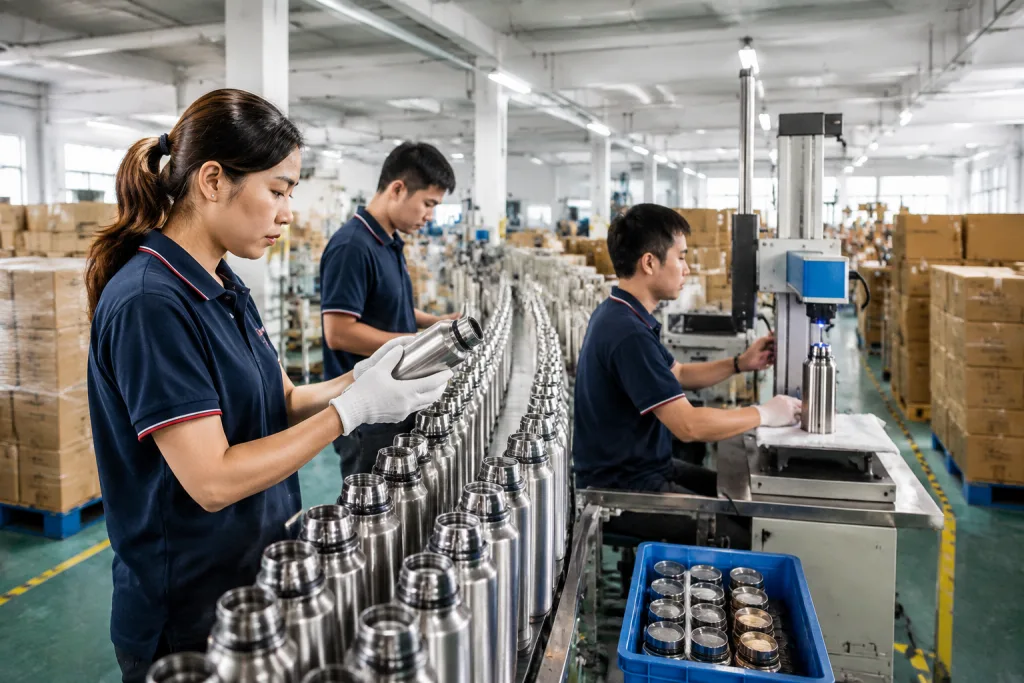
QC that only shows up at final inspection is a bet most buyers lose. You open the cartons, find defects, the factory sorts them—fine. But nobody remakes 3,000 tea bottles in three days. You just ate an 18-day delay. We run six checkpoints on every private-label tea bottle order: incoming 304 stainless coil check (we catch off-spec wall thickness here before a single blank gets cut), in-process after forming and welding, 100% vacuum test on the line, coating adhesion inspection, assembly check on the first 20 finished pcs, and final random inspection per AQL. Miss one, and QC pulls a sample that tells you the problem when it's already baked into 2,500 units.
Final inspection follows ANSI/ASQ Z1.4. We set AQL 2.5 for major defects, 4.0 for minor. Critical—leakage, a sharp burr on the rim, anything that cuts a lip—is zero-tolerance, full stop. For a 3,000-pc order under general inspection level II, sample size is 200 pcs. Tell your inspector to pull cartons from multiple pallets, not just the top row near the loading door. We had a buyer flag a batch where the bottom three pallets carried the wrong logo placement because the inspector only checked the top layer. That cost a re-ship and killed the margin on the whole PO.
Define defects in writing before the first coil hits the line. Major: leakage, failed vacuum, wrong logo, exposed rust on the inner wall, broken lid, missing silicone gasket, coating peeling larger than 2 mm, wrong packaging. Minor: small dust spots under the coating, slight color variation within the approved Pantone tolerance band, a tiny print scuff outside the main logo area. If you sell through premium retail, tighten the cosmetic bar hard—we've seen a single 0.5 mm bubble in the coating kill an order for a QA manager who rejected the whole lot. If this is a canteen promo giveaway, your cosmetic tolerance can be looser. Leakage cannot. The math on returns doesn't work, and your buyer won't tolerate wet bags.
Run these tests: 100% leak testing on the line (every bottle, not a sample), vacuum heat retention sampling, 3M tape test for coating adhesion, cross-hatch coating test where the substrate warrants it, carton drop test from 76 cm, torque check on lid closure. For EU markets, ask for LFGB, REACH, and food-contact declarations upfront—don't discover during shipping that your German buyer needs a document you didn't request. For the US, request FDA food-contact documentation. A serious drinkware factory in Hangzhou or Yongkang will tell you what's standard and what requires paid third-party lab testing. If they hedge or say "don't worry, we handle that," that's a red flag. You should worry.
Plan compliance and logistics
Compliance isn't a document you chase the day before shipment. It hits materials, ink, coatings, silicone, packaging claims, and even the sales copy on your website. Claim "dishwasher safe" or "plastic free" or "keeps hot 12 hours" — and you'd better have the report to back it up. One US retailer rejected a full batch because the "BPA-free" label on the cap insert wasn't verified. That cost the buyer $2,800 in rework and air freight.
For a standard stainless private label tea bottle, you'll need a food-contact declaration, LFGB or FDA test reports for food-contact parts, a REACH report for coating or external surface if the buyer asks, BSCI or a social audit if your retailer demands it, and ISO 9001 factory quality docs. If the product is for kids, the standards jump — ASTM, CPSIA, or EN requirements depending on the market and design. We once had a buyer add a silicone straw at week 10; that kicked off a new LFGB test cycle and pushed the ship date by three weeks.
Logistics comes down to carton math. A 500 ml tea bottle in a color box packs 24 pcs per master carton. That carton runs about 48 x 33 x 55 cm and weighs 12-15 kg depending on bottle wall thickness. For 3,000 pcs, you're looking at roughly 125 cartons and 11-13 CBM. That's LCL or a consolidated shipment — not a full container. We run this math before quoting. If CBM lands over 13, we flag it. Splitting the order into two sailings costs less than a late container charge. We've seen that go sideways: one buyer chose one sailing to save $400, then paid $1,200 in demurrage.
If you're a distributor adding tea bottles to a mixed drinkware program, combine production schedules carefully. A stainless thermos line, custom canteen line, and customized growler line often use different workshops and finishing queues. One late item can hold the whole shipment if you insist on one sailing. Ask your canteen suppliers for a production timeline with artwork approval, material purchase, coating, logo, assembly, inspection, and ETD listed separately. We had a buyer last quarter whose growler line finished two weeks before the tea bottles. They refused to split the shipment and lost six weeks of shelf placement. The math doesn't work — split it.
What the final PO should say
Your purchase order should be boring, detailed, and hard to misread. A one-page PO with only item name, quantity, and price is not enough for customized drinkware. The final PO for our scenario needs model number, capacity, material grade, wall thickness target, finish, Pantone or coating reference, logo method, logo size, infuser spec, packaging spec, carton quantity, barcode requirements, inspection standard, shipment term, payment term, and required documents. Miss one of these and QC pulls the sample — then you pay for rework.
Write the tolerance where it matters. Capacity tolerance is ±5%. Logo position tolerance is ±2 mm — we just had a buyer flag a 1.5 mm shift on a lid logo last month. Color must match the approved sample under normal daylight or a defined light box condition. Temperature retention requires a test method: starting water temperature, room temperature, fill level, test duration, and minimum result. Without that, the test means nothing.
For a first order, keep the design controlled. Do not combine a new bottle mold, new lid mechanism, custom coating, full-color artwork, special infuser, and premium gift box unless the launch timeline allows mistakes. A standard body with strong private label execution is usually smarter. Once sales data proves demand, you can move into a more customizable shape or a fully customized canteen program. The math doesn't work on a first run with six unknowns.
The best buyers are not the ones who demand the lowest number in the first email. They are the ones who know which details protect their margin after the goods arrive. Specify clearly, approve samples properly, and inspect before paying the balance — a private label tea bottle order from Zhejiang, China becomes predictable instead of stressful. We ship 80,000 units a month from our factory, and the ones that go smooth all start with a PO that's boring to read.
Send your tea bottle brief for a practical quote
Share capacity, quantity, logo method, market, and target FOB price. We will return a workable spec, MOQ, and timeline.
Frequently asked questions
What MOQ should I expect for a private label tea bottle?
For a standard stainless steel private label tea bottle, 1,000 pcs per color is often possible, but 3,000 pcs is a healthier MOQ for stable coating, logo setup, and FOB pricing. If you need a custom Pantone powder coating, some canteen manufacturers prefer 2,000-3,000 pcs per color because coating line cleanup and powder purchase have fixed costs. For stock colors with laser logo, MOQ can sometimes be lower. For a new lid mold, custom infuser, or unique bottle shape, the practical MOQ may rise to 5,000-10,000 pcs because tooling and trial production must be amortized.
How long does a custom tea bottle order take from China?
A normal timeline is 7-10 days for a pre-production sample after artwork approval, then 30-40 days for mass production after deposit and sample confirmation. Peak season, usually August to November for holiday drinkware, can add 7-15 days. Lab testing may add another 5-10 working days if you need fresh LFGB, REACH, or FDA-related reports under your own SKU. Sea freight from Ningbo or Shanghai to Europe commonly takes 30-40 days port to port, while North America can range from 18-35 days depending on destination.
Is laser engraving better than silk screen printing?
Laser engraving is usually better for premium retail because it removes the surface coating and creates a permanent mark that will not peel like ink. It works especially well on matte powder-coated stainless steel. Silk screen printing is cheaper, often USD 0.08-0.18 per unit for a simple one-color logo, and is fine for canteen promotional orders or short campaigns. The trade-off is abrasion resistance and color limitation. If your logo has gradients or multiple colors, heat transfer may be better, but you should run tape, rub, and hot-water handling tests before approving mass production.
What inspections should I require before shipment?
Use AQL inspection with clear defect definitions. For 3,000 pcs, general level II normally means checking about 200 units. Set AQL 2.5 for major defects and 4.0 for minor defects, with zero tolerance for critical issues like leakage, sharp metal burrs, broken lids, or unsafe contamination. Ask the factory for 100% leak testing during production, then have the inspector repeat leak tests, visual checks, logo checks, packaging checks, barcode scans, and carton drop tests. For tea bottles, also check infuser fit, gasket placement, lid thread smoothness, and heat retention on sampled units.
Can one supplier handle tea bottles, canteens, and growlers?
Yes, if the canteen supplier has stainless vacuum forming, polishing, coating, logo, and assembly capacity in-house or under tight local control. Many canteen vendors can also produce a custom growler or distributor growler, but do not assume the same MOQ or lead time. A 500 ml tea bottle, 1 L customized canteen, and 1.9 L customized growler may use different molds, lids, gauges, and carton tests. Ask for separate specification sheets and production timelines. Combining them in one shipment can save freight, but only if the latest item does not delay the entire order.