Key Takeaways
- Typical MOQ is 1,000 pcs per color for stock molds and 3,000-5,000 pcs for custom colors or lids
- A 500 ml stainless private label hydration flask usually lands at USD 3.20-6.80 FOB Ningbo depending on steel, lid, finish, and packaging
- Normal production lead time is 30-45 days after sample approval, with 7-12 days for pre-production samples
- Decoration, carton strength, AQL inspection, and compliance testing can change both cost and schedule more than the bottle body
A hydration flask looks straightforward on a spec sheet. Then you sit down with three factory quotes and none of them measure cost the same way. Supplier A says USD 3.20 EXW. Supplier B is at USD 4.10 but includes the first-round logo setup. A trading company promises delivery in 20 days. Nobody mentions whether that clock starts before or after sample approval, lid sealing tests, or the carton drop test that QC flagged last month on a 500 ml batch.
If you're buying for a retail brand, a corporate gifting program, or a distributor line, chasing the lowest unit price is the wrong question. The job is pinning down cost drivers before they drift and push your shipment into overtime. From our Hangzhou office, we see it every quarter: a buyer locks in a deposit, then artwork lands in RGB instead of CMYK, the lid SKU gets swapped during sampling, and "standard" packaging quietly becomes a matte-laminated gift box at double the carton cost. By the time anyone catches it, the production line is already running.
Start with the landed cost logic
Most first-time buyers ask for the "best price" before they've defined the product. That's backwards. A factory unit price means nothing until you see the cost split underneath it.
A proper FOB quotation breaks out six line items at minimum: flask body, lid assembly, decoration method, inner/outer packaging, third-party testing, and tooling or mold amortization. When a supplier hands you one blended number, you can't compare it against another quote. You're guessing. Ask for the split. If they push back, that's a red flag. We've seen buyers accept a blended quote, then get hit with a $2,800 mold fee on the PI that wasn't disclosed upfront. That call never ends well.
For reference: a 500 ml double-wall vacuum flask — 304 interior, 201 or 304 exterior, powder-coated, single-color logo — lands between USD 3.20 and USD 6.80 FOB. A basic single-wall custom canteen drops to USD 1.80–3.50. Large growlers with vacuum insulation and a multi-part cap run USD 7.50 to USD 14.00, and that range widens fast once you spec a silicone overmold lid or a dual-opening pour-through cap. The gap between $7.50 and $14.00 is almost entirely in the cap assembly and the vacuum hold time the factory commits to. We quote 12-hour thermal retention as standard on our vacuum line. Some competitors quote 6 hours at a lower price. The buyer needs to know which number they're buying.
The second mistake: treating every cost line as equally negotiable. They aren't. Steel gauge, vacuum hold time, and lid seal geometry are engineering decisions. Cut there and QC will find the problem. We pulled a batch last month where the buyer had spec'd 0.4 mm interior steel to save $0.18 per unit. Four out of 80 samples failed the thermal test. That's a 5% fail rate on a tiny sample — unacceptable for any AQL 2.5 inspection. Packaging and logo method are flexible. A wholesale distributor running 24 pcs per plain kraft master carton has a different landed cost profile than a retail brand that needs a four-color box, barcode sticker, folded instruction sheet, and an outer carton that survives a 1.2 m drop test. Same flask silhouette. Two completely different products.
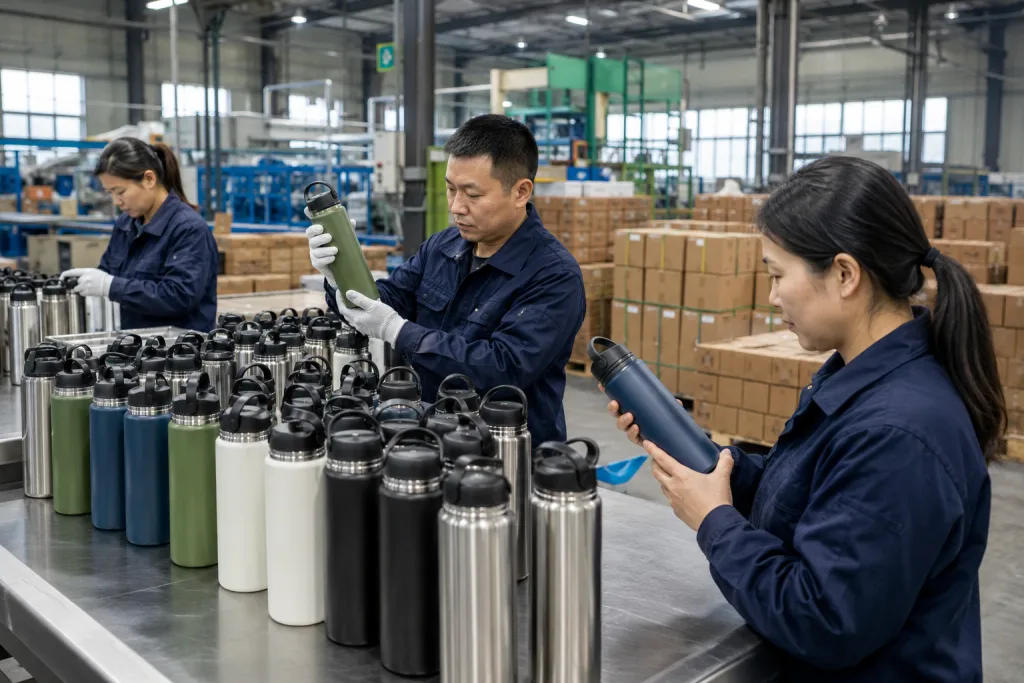
We run about 650,000 stainless units a month across bottles, tumblers, and flasks at our Zhejiang facility. Capacity matters. It won't save a vague spec sheet. The tighter your spec — wall thickness tolerances, lid thread pitch if it matters to you, exact Pantone for the powder coat — the faster you get an accurate quote. And the fewer surprises when the pre-shipment samples land on your desk. A buyer sent us a spec last quarter that just said "blue." We shipped RAL 5015. They wanted Pantone 299 C. That rework cost them three weeks and a second mold setup fee. Specify the color system and the code. Every time.
MOQ tiers that change pricing
MOQ isn't a penalty—it's the order size where the math on setup, color changes, raw material purchasing, and QC time actually works. For custom drinkware, the first real question is: are you pulling from an existing mold or paying for a new shape? Existing molds keep unit cost down and lead time short. We run these daily. New molds? We can do them, but I've told buyers directly: the ROI doesn't land unless you're committing to volume.
For a private label hydration flask on an existing bottle body, here's how our tiers break:
- 500 pcs: stock color, stock lid, simple laser logo, domestic China packaging. Unit price runs 15–30% above a 1,000 pc order. We've done it, but QC pulled a sample last month where the logo placement drifted 0.5 mm and the buyer flagged it—small runs leave less room for error.
- 1,000 pcs: our standard MOQ per color for powder-coated flasks with one logo. This is where most first-time B2B buyers should start. The line runs clean, coating setup cost gets absorbed, and you're not overpaying per unit.
- 3,000 pcs: Pantone-matched coating becomes realistic. Custom canteen packaging, retail barcode labels, mixed lid options—all on the table. We once shipped a 3,000 pc order with three lid SKUs and individual UPC stickers; it required extra sorting at the end of the line, but the per-unit cost still dropped 8% vs the 1,000 pc tier.
- 5,000–10,000 pcs: distributor programs, national promotions, multi-SKU canteen lines. Pricing stabilizes. Raw material gets reserved in bulk. MOQ on custom packaging inserts usually hits here too—our supplier won't tool a die-cut insert below 5,000 units.
A promotional canteen order often asks for four colors at 500 pcs each. Technically that's 2,000 pcs total. But the factory still does four coating setups, four logo checks, and extra QC sorting across four batches. The price will sit closer to a small-batch quote than a true 2,000 pc single-color run. I've had buyers push back on this—"but it's 2,000 pieces"—and the answer is the same: setup time doesn't compress just because you split the volume into more colors.
If you're a canteen distributor consolidating demand across regions or customers, volume planning is your real leverage. Combine repeat SKUs into a rolling quarterly forecast. We've seen this reduce unit price 3–8% and lock in raw material allocation without forcing you to take delivery all at once. One buyer we work with forecasts 12,000 flasks per quarter across two SKUs and ships in three batches—he gets the volume price, and we don't sit on finished goods.
Material choices behind the quote
Buyers say "stainless steel bottle" like it's one grade. It's not. We run three combos on the line: 304 inside/304 outside, 304 inside/201 outside, and occasionally 316 inside/304 outside. For food-contact surfaces, 304 is the floor. I'd argue 201 on the outside is fine for promo-tier programs where cost kills the deal. For European or North American premium branding, 316 is an option—adds 12–18% on body cost and the corrosion resistance difference matters mostly in salt-spray or marine use. Unless the brand's story hinges on "surgical-grade," skip it.
Wall thickness changes everything. We start with 0.4–0.5 mm coil before deep-drawing the inner and outer shells. Go thinner and you lose dent resistance. We had a 0.35 mm trial batch in 2023—QC pulled the samples after carton drop tests at 60 cm. Polishing also gets tricky on thin walls; the buffing compound can create micro-waves you'll see under a gloss coat. Heavier gauge improves hand feel and sound, but a 500 ml flask jumps from 260 g to 340 g. Freight math: 80,000 units at +75 g each is an extra 6,000 kg. That's real money on a 40HQ.
Lids cause more factory-floor headaches than bodies ever do. A simple screw cap with a silicone gasket is cheap and passes leak tests reliably. Flip straw lids, push-button lids, carry-handle lids—those add USD 0.35 to USD 1.20 per unit depending on part count and mold complexity. We run a dedicated leak-test station for flip lids: 5 seconds inverted at 45°C water. The buyer flagged 12% failure on a straw-lid batch last Q3. Silicone must be food-grade, and plastic parts need a spec: PP for general use, Tritan if the client wants glass-like clarity and BPA-free marketing. Do not leave materials vague when REACH, LFGB, FDA, or Prop 65 documentation is in play. The lab report is only as clean as the resin grade you call out on the BOM.
Surface finish is the last material decision and the one that generates the most photos. Powder coating is the workhorse—durable, uniform, available in Pantone-matched colors. But matte light shades show fingerprints and carton rub. We've seen ivory lids arrive at the 3PL looking smudged straight out of the master carton. Spray painting can hit certain neon or metallic colors at half the MOQ, but abrasion resistance falls off a cliff. Electroplating and gradient finishes photograph beautifully; on the line, they add process steps, scrap rates, and lead time. A good canteen factory will tell you outright when a finish won't survive the delivery window. If the vendor says yes to everything, ask for a third-party AQL 2.5 inspection report on the last gradient run.
Decoration costs are not equal
"Custom logo included" is a phrase that costs buyers money when they don't define the spec upfront. Pin down four numbers: logo width in millimeters, number of print positions, Pantone color count, and whether the mark spans a curve or stays on a flat panel. I've watched a buyer approve a quote where "free logo" meant a single 15×15 mm laser mark on the base—invisible on a retail shelf. Get the decoration data sheet filled out before you compare unit prices, or you're comparing apples to a hole in the ground.
Laser engraving on our line runs USD 0.08–0.25 per piece. The beam burns through powder coat to expose the raw 304 stainless underneath—buyers like that contrast, no ink to peel, no cure time. Cycle time tracks engraving area: a 30×30 mm mark clocks about 4 seconds. Silk screen hits USD 0.05–0.15 for single-color, but the setup fee is fixed (screen + film), so the math only works above 500 pcs. Matte and textured coatings are where silk screen gets tricky. QC pulled three samples off the line last month—ink feathered at the edges on a matte black finish, and we rejected the batch. Heat transfer and water transfer handle full-wrap, multi-color art at USD 0.35–1.50 per unit. UV printing suits short runs and tight registration, but we run a cross-hatch adhesion test on every coated surface. UV ink lifts clean off if the base coat wasn't fully cured, and we've caught that on pre-pro samples more times than I can count.
One mistake that inflates quotes: treating personalization like private label. Running 1,000 flasks with the same brand mark is a standard production order. Running 1,000 different names is a fulfillment project—each piece needs individual handling, data entry, and QC matching against a name list. Price these two lines separately or your landed cost estimate is fiction. If you're selling on Amazon, factor in FNSKU labels and individual polybags. That's roughly USD 0.12–0.18 per unit in labor and materials. Skip them and your inventory gets rejected at the FC; we've had buyers learn this the hard way.
Our approval flow before production: digital mockup → physical pre-pro sample → cross-hatch adhesion test → 3M tape pull → 24-hour water soak post-decoration. For outdoor retail accounts, we add a dry-cloth rub test, 50–100 cycles directly on the logo area. Cheap decoration fails fast. A peeling logo on a customer's first Instagram post costs more than the USD 0.10 you saved by skipping the adhesion check. We'd rather catch the failure here than in a review photo.
Packaging and compliance timeline
Packaging isn't decoration. It runs anywhere from USD 0.12 for a plain kraft box to USD 1.80 for a full retail setup—per unit. On a 3,000-piece order, that gap is real money. A wholesale private label hydration flask order can ship in a simple white box with a sticker label on the carton. A retail-ready flask needs a printed color box, insert card, hang tag, UPC barcode, warning text in two or three languages, and carton marks that match the warehouse receiving system. If the destination is an Amazon-style fulfillment center, we also verify carton weight limits, FNSKU labels, suffocation warnings on polybags, and barcode scannability before the line starts packing. We've had a carton rejected because the barcode printed 2 mm too close to the carton edge and the scanner missed it.
Carton strength trips up a lot of first-time buyers. We run 5-ply corrugated master cartons on all insulated stainless drinkware, with edge crush strength spec'd to the carton size and gross weight. For a standard 500 ml flask, the default is 24 pcs per carton, gross weight 9–12 kg. Larger growlers for distributor orders drop to 12 pcs per carton to keep manual handling safe. We once had a buyer push for 36 pcs per carton to save on freight; the cartons arrived with crushed bottom flaps and a 3% damage rate. The freight savings disappeared in replacements.
Compliance lead time is not theoretical. If you have valid material reports from the same factory and the same production line, document review can close in 2–3 days. New third-party testing—LFGB, FDA, REACH, Prop 65—runs 7 to 15 working days depending on the lab's scope and backlog. ASTM checks come into play for kids' bottles or any product with child-specific claims on the packaging. One thing we insist on: request BSCI or ISO 9001 factory documents before your internal vendor approval cutoff. Not the week before the container is booked. We've seen a PO stall for 10 days because a compliance team needed a document we could've sent a month earlier.
Do not sign off on packaging artwork until legal text, country of origin, recycling marks, and importer details are locked. We've watched a buyer approve a color box proof on Tuesday, spot a missing Prop 65 warning on Thursday, and lose 8 days and about USD 400 in plate rework costs because the printer had already burned the plates. The math doesn't work. Finalize the text first.
A realistic production calendar
A real production calendar gives you gate-by-gate dates, not a vessel ETA. For a standard private label hydration flask from our Zhejiang factory using an existing mold, plan on 45–65 calendar days from spec sign-off to container departure. Blank stock can move faster—we shipped a 500ml stainless order 18 days after PO. Custom work means approvals at every handoff. One missed sign-off cascades.
Here's the sequence we run. Quotation and spec confirmation: 2–4 days. Artwork adjustment: 1–3 days. Sample production: 7–12 days. Courier to Europe or North America: 3–5 days. Buyer review: 2–7 days. That review window is where we've seen a typo on a PO eat an entire week—one buyer's purchasing manager was out on leave, nobody else had sign-off authority, and the clock kept ticking. Material purchasing and production scheduling after deposit: 3–7 days. Mass production: 20–35 days. The longer end applies if you've spec'd a gradient powder coat that needs two passes through the spray booth—our coating line runs at 180°C for the base, then a second bake after the fade layer. Internal QC and packing: 2–4 days. Third-party inspection: 1 day on site plus report turnaround. Export booking and trucking to Ningbo or Shanghai: 3–7 days. Total: 45–65 days. The math holds if you don't skip the sample round.
Air freight can bail out a small promotional order, but flasks are bulky. A 20-foot container of 1,000ml canteens runs about 8x sea freight to Los Angeles. Sea is the standard move. FOB Ningbo is efficient for Hangzhou and wider Zhejiang production—our trucks hit the terminal in under 3 hours. FOB Shanghai can make sense when vessel schedules or your forwarder's consolidation favor it. If you're a canteen distributor buying for seasonal retail, build in a 14-day buffer minimum. Coating rework, late packaging approval, a failed AQL inspection—we've had QC pull the sample at 2.5% and the buyer flagged the gloss level, rejecting the lot—can burn that buffer in 72 hours. I've watched a 12-day buffer evaporate over a Pantone mismatch on a hangtag nobody proofed twice.
Repeat orders with approved materials and locked artwork drop to 25–35 days after deposit. Smart drinkware buyers secure core SKUs early and resist the urge to swap lids, colors, and box structures every reorder. The line runs smoother when you stop changing the specs. We ran a 3-SKU program that went from 55 days on the first run to 28 days on the third, purely because the buyer froze the BOM. Same tooling, same 304 stainless, same powder formula—just no more last-minute emails about "tweaking the lid gasket durometer."
Inspection points before balance payment
Drinkware defects stick out once you know what to look for. You need tight defect definitions before wiring the balance. For most B2B custom drinkware orders, we run AQL 2.5 on major defects and 4.0 on minor — that's the baseline. Critical defects: sharp edges, leaking, wrong material, contamination, unsafe packaging. Zero tolerance. No exceptions.
On a private label hydration flask, check vacuum performance, leakage, coating, odor, logo position, lid assembly, carton marks, barcode readability, and quantity. Vacuum test: fill with hot water at about 95°C and measure temperature retention after 6 or 12 hours, depending on the product claim. One buyer flagged a "24 hours cold" claim that failed at hour 16 — the factory hadn't specified the test environment. Marketing claims without test methods create disputes. Every time.
Cosmetic standards need reference photos. A tiny dust speck under matte coating might pass on a promotional canteen but kill a premium retail flask. Define viewing distance, lighting, acceptable scratch length. Our standard: no scratch longer than 3 mm on the front logo area; no dent visible at 50 cm under normal light. If the buyer can spot it from an arm's length, it's a fail.
If you're working with a trading company or multiple canteen vendors, insist inspection happens after 100% goods are packed, pre-shipment. Partial inspection during production helps, but final random inspection catches mixed cartons, wrong labels, and last-minute substitutions. We've seen a vendor swap in uncoated lids at the last minute because the coated ones ran short. Balance payment follows passed inspection — not a handshake promise that "QC already checked."
Where buyers can safely save
I tell buyers they can cut 12–15% off unit cost without touching anything the end user will notice. Keep the food-contact steel (304 or 316L, no substitutions), the silicone seals, the leak-down test, and the coating adhesion spec. Cut the SKU sprawl. One body, two colours, one lid, one box style. Run that at 5,000 pcs total across two colours and your per-unit lands maybe $0.40 lower than the same 5,000 pcs split across six colours, three lids, and mixed packaging. The line setup time alone eats the margin on those small colour runs.
First order? Use an existing mould unless your brand already has a proven channel that justifies the tooling. A simple 304 stainless body mould runs USD 1,500–3,000; a complex flip-top or straw lid mould can hit USD 8,000 fast. That’s before you wait 20–40 days for T1 samples. We’ve had buyers burn 12 weeks on mould iterations for a private label hydration flask that sold 800 units. The math doesn’t work. Grab an open-mould bottle, lock in your colour, laser-etch your logo, pick your box and accessory set—it still reads as your product. I’ve seen distributors run three seasons on an open-mould 500 ml flask and never get called out.
Watch the too-good-to-be-true quotes. We’ve QC-pulled samples from a “fully landed” offer and found 201 stainless inside, wall thickness at 0.4 mm instead of 0.5 mm, single-wall cartons that collapsed in transit, and zero LFGB or FDA test reports. Ask flat-out: interior steel grade, wall thickness range (we spec 0.5–0.6 mm on a standard 500 ml body), lid material (PP vs ABS, recycled content), silicone grade (platinum-cured vs peroxide), coating type (powder vs wet paint), carton spec (double-wall B-flute, burst strength), MOQ per colour, and lead time after sample sign-off. If the supplier hedges on three of those, walk.
Building a distributor growler line or custom growler range? Same rule. Standardise the invisible parts—thread form, gasket seat, vacuum port geometry—and spend your budget on what the customer actually touches: lid snap feel, handle rigidity, finish consistency, unboxing presentation. That’s what drives repeat orders. We shipped a 64 oz growler last year where the buyer put 60% of the landed cost into the lid mechanism and the sleeve artwork. The body was our stock double-wall 304. Reorder rate hit 40% in six months.
Send your flask spec for a practical factory quote
Share capacity, lid style, color, logo, packaging, MOQ, and destination. We will return a clear FOB cost and lead-time plan.
Frequently asked questions
What is the normal MOQ for a private label hydration flask?
For an existing stainless flask mold, 1,000 pcs per color is the normal MOQ for powder coating and one logo. We can sometimes support 500 pcs if you accept stock color, stock lid, and laser engraving, but unit cost is usually 15-30% higher. For Pantone-matched coating, retail packaging, or a customized lid color, plan 3,000 pcs. New body molds or complex lid tooling usually need 5,000 pcs or more to make financial sense. If you are a canteen distributor testing a new market, start with fewer colors rather than pushing the factory to split 1,000 pcs into five small color lots.
How much should I budget for a 500 ml stainless private label flask?
A realistic FOB China range for a 500 ml double-wall private label hydration flask is USD 3.20-6.80. The low end usually means standard mold, basic screw lid, one-color logo, simple box, and normal 304 interior stainless. The higher end may include 304 stainless inside and outside, custom powder color, better lid, full-wrap artwork, color box, barcode labels, and stronger cartons. Testing, inspection, and mold fees are usually separate unless the quotation clearly says otherwise. For landed cost, also include sea freight, duty, customs brokerage, domestic delivery, and any retailer compliance charge in your market.
Can I get samples before paying a production deposit?
Yes, but sample type matters. A stock sample can usually ship in 2-4 days and only proves shape, size, and general quality. A custom pre-production sample with your coating color, logo, and packaging normally takes 7-12 days after artwork approval. International courier to North America or Europe usually adds 3-5 days. For first orders, we recommend approving a physical sample before mass production, especially for matte coating, multi-color printing, or special lids. Sample fees commonly range from USD 50 to USD 200 depending on decoration complexity, and courier cost is usually charged separately or billed to your account.
Which compliance documents should I request for Europe or North America?
For Europe, ask for food-contact test reports relevant to the material and destination, often LFGB plus REACH screening for coatings or plastic parts. For North America, FDA food-contact conformity and California Prop 65 review may be needed depending on your sales channel. If the flask is marketed for children, additional ASTM or CPSIA-related checks may apply. Also request BSCI or ISO 9001 documents if your retailer or internal sourcing team requires factory approval. New third-party lab testing usually takes 7-15 working days, so include it before production completion, not after cartons are packed and the shipment is already booked.
Why does one canteen supplier quote much faster lead time than another?
Fast quotes often exclude steps. A supplier may say 25 days but mean 25 days after deposit, after sample approval, after materials arrive, and excluding inspection and export booking. For a real private label order from China, use 45-65 calendar days from specification confirmation to vessel departure. Repeat orders can be faster, often 25-35 production days after deposit, if artwork, color, packaging, and materials are unchanged. Ask every canteen supplier to break out sample time, production days, packing, inspection, and port delivery. If they cannot provide that timeline, the promised date is not reliable enough for a seasonal launch.