Key Takeaways
- A realistic MOQ for private label drinkware US orders is 1,000-3,000 units per SKU for custom color and logo work
- A 32 oz customized canteen usually gives better freight efficiency than a 64 oz customized growler
- Laser engraving is slower but more durable than 1-color silkscreen for outdoor and promotional programs
- Allow 35-55 days production plus ocean freight if you need custom packaging and pre-shipment inspection
Buying private label drinkware for the US market? The hard part is not finding a bottle. It is choosing the right format before you pay for tooling, cartons, inserts, logo setup, and freight. A 32 oz custom canteen, a 40 oz tumbler, and a 64 oz custom growler can all look good in a mockup. They behave very differently in retail, ecommerce, corporate gifting, and distributor drinkware programs.
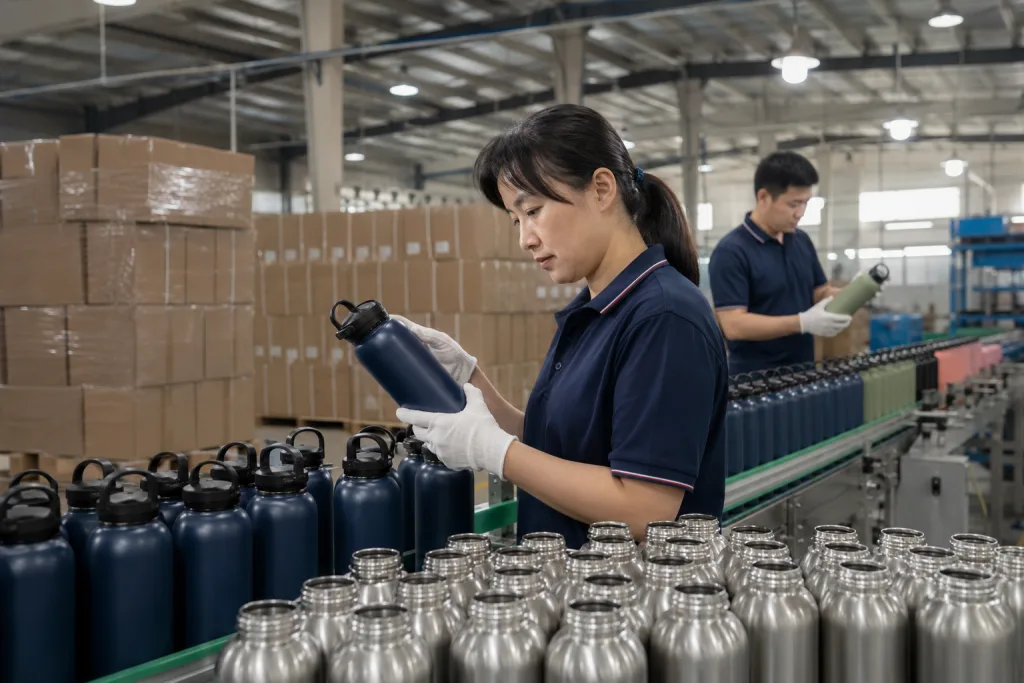
From our factory floor in Hangzhou, Zhejiang, we watch buyers lose margin when they treat every stainless vessel as the same product. It is not. Wall thickness, lid complexity, carton size, AQL level, and decoration method change your landed cost more than a small FOB price difference ever will. Last week QC pulled a sample because the lid gasket was 0.3 mm off spec — that kind of thing either gets caught at our line or it hits your warehouse.
The Shortlist Buyers Actually Compare
Private label drinkware in the US usually comes down to four shapes. I've sat through enough buyer calls to know: you're picking between a custom canteen, a travel tumbler, a sports bottle, and a custom growler. Each carries your brand. Each fits a different buyer — and a different headache.
Here's the comparison we run with new importers and canteen distributors. This table's been taped to the whiteboard for two years:
| Format | Typical size | FOB China range | Best use case | Risk point |
|---|---|---|---|---|
| Custom canteen | 24-40 oz | USD 3.20-6.80 | Outdoor retail, events, school, fitness | Lid leakage if gasket spec is weak |
| Travel tumbler | 20-40 oz | USD 4.10-8.50 | Commuter, corporate, ecommerce | Handle and straw lid parts add defects |
| Sports bottle | 18-32 oz | USD 2.80-5.90 | Gym, youth, promotional campaigns | Lower perceived value if too light |
| Custom growler | 64 oz | USD 7.80-13.50 | Brewery, camping, specialty gift | High freight cube and dent risk |
For a first order, I push buyers toward two sizes max. One lid platform across both. We've watched five-size, three-mold launches eat a year of margin. At BottleForge Industrial in Zhejiang, a normal starting MOQ is 1,000 units per color on an existing mold. Add a custom powder coat color, retail box, and barcode label on that canteen? 3,000 units. QC pulled a 32 oz tumbler last week because the powder coat thickness hit 0.06 mm instead of our standard 0.08 mm. The buyer flagged it. We re-shot the batch. That kind of detail matters more than how many SKUs you can list.
Canteen Versus Tumbler Fit
A custom canteen is the safer bet when your buyer wants outdoor, school, gym, or employee merchandise. It stands upright in backpacks. Fewer protruding parts. Packs better than handled tumblers. A 32 oz vacuum insulated canteen with 0.5 mm inner 304 stainless steel and 0.6 mm outer 201 or 304 stainless steel is a common export spec from China. For US buyers, we recommend 304 stainless for all food-contact parts and PP or Tritan lid components with LFGB or FDA documentation. Last year, a QC report flagged a batch where the inner wall stamp was missing the "304" mark — the buyer caught it before shipment.
A tumbler is stronger for desk, car, and commuter use. If your channel is Amazon FBA, boutique retail, or corporate gifting, the tumbler photograph usually sells faster because buyers understand the daily-use habit. The problem is complexity. A straw lid, sliding lid, handle, silicone boot, and gift box can add 6 to 12 inspection points per unit. More parts mean more claims unless your factory controls incoming components. We've seen a single handle mold shift cause 800 units to warp at the attachment point.
If your brand is new, the custom canteen has one advantage: decoration area. A cylindrical body accepts 1-color silkscreen, wrap printing, laser engraving, water transfer, or UV print without fighting around a handle. That matters for canteen promotional orders where the logo must be visible from 2 meters away. A tumbler can work, but your artwork may need to be smaller or repositioned to avoid distortion. The math doesn't lie — the canteen gives you a bigger canvas.
Growler Versus Canteen Economics
A 64 oz double-wall growler isn't a scaled-up canteen. On our standard tooling, wall thickness jumps from 0.4 mm to 0.5 mm. The mouth opens to 48 mm ID—a 38 mm ID on the 32 oz canteen means the cap thread engagement is a different design entirely. Carton drop survival stops being theoretical. We watched a pallet of growlers hit Long Beach with a 12% dent rate. The buyer had spec'd single-wall cartons to shave $0.30 per unit. Unit FOB was $9.50. Landed cost, once you add ocean freight, 7.5% duty, drayage, and 3PL receiving, landed between $13 and $16. A 32 oz canteen lands at $5.80 to $7.20. Different animal.
A 32 oz canteen ships tight: 36 units per master carton. A 64 oz growler fits 12. Carton weight stays under 12 kg on the canteen, so small-parcel rates for distributor fulfillment don't blow out. One buyer running a canteen program across 200 retail doors told us shelf depth killed the growler SKU. The growler pushed 110 mm out from the pegboard and got knocked off. The canteen sat at 85 mm and stayed put. Turns beat margin per unit. A SKU turning 2x per quarter at 42% margin outruns a SKU turning 0.4x at 58%. We ran the comparison on actual PO data across three Q4 seasons.
Run a custom growler when the channel demands it: brewery taprooms, campsite general stores, corporate gift sets above $80 retail, specialty coffee-and-growler bundles. Don't default to it because a spreadsheet shows higher margin dollars. Bigger bottles punish weak powder coating—a 64 oz body flexes more in the curing oven. QC pulled samples last month where the coating micro-cracked along the bottom radius on 8 out of 50 pieces. Cap thread tolerance on a wide mouth is tighter. A 0.3 mm deviation on thread pitch gives you a slow leak nobody catches until the warehouse QA check. For 64 oz growlers, we spec 100% leak test, vacuum test per AQL batch, and full visual at 2.5 major. That inspection add costs roughly $0.18 per unit. Replacing 300 leaking units after they hit a US 3PL costs $4,500 minimum. We've seen both sides of that invoice—the $0.18 is cheaper.
Spec Table For Sourcing Decisions
Send me a spec table before you ask for a price. A quotation that leaves out material grade, wall thickness, coating type, carton dimensions, and inspection level isn't a quotation. It's a conversation starter.
| Spec | Budget program | Retail-ready program | Premium program |
|---|---|---|---|
| Body material | 304 inner, 201 outer | 304 inner, 304 outer | 316 inner option |
| Wall thickness | 0.4/0.5 mm | 0.5/0.6 mm | 0.6/0.7 mm |
| Insulation | Single wall or basic vacuum | Copper plated vacuum | Copper plated plus tighter vacuum test |
| Logo | 1-color silkscreen | Laser or 2-color print | UV full color or emboss tooling |
| Packaging | White box | Retail color box | Gift box plus insert card |
| Inspection | Internal QC | AQL 2.5/4.0 | AQL plus third-party inspection |
For US private label drinkware, I wouldn't spec below 0.5 mm on the inner wall of a vacuum stainless item. Unless it's a pure promo piece where price is the only KPI. Thin bodies dent. We've had a buyer flag 23 dented units in a single pallet after LCL consolidation. The replacement air freight ate their margin. A canteen factory with stable polishing, welding, vacuum pumping, and powder coating can hold defect rates under 2% after final inspection. Our Zhejiang line runs roughly 450,000 stainless units per month across canteens, tumblers, and bottles. Capacity only helps when the approved sample is detailed enough to reproduce. We've seen a 1.2 mm tolerance gap on a lid thread turn a 5,000-piece order into a rework job.
Logo And Packaging Choices
Decoration follows the channel, not the designer's mood board. Canteen promo campaigns still run best on 1-color silkscreen. Setup runs USD 35-60 per color and the line turns fast at 2,000-10,000 units. Laser engraving beats it on durability, but for a seasonal giveaway bottle nobody cares if the print fades by month four. We had a buyer push for 4-color process on a USD 2.50 bottle last spring — the artwork alone ate 18% of the unit cost.
Laser engraving runs USD 0.25-0.60 per unit depending on logo size and the powder coat finish underneath. For outdoor or premium SKUs, nothing else holds up. It won't peel. It reads cleaner on matte black and navy than any print method we've tested. UV print handles full-color art, but curved powder coated walls are where adhesion fails. We run cross-hatch tape testing and alcohol rub testing on every UV job before the line starts. One US buyer flagged a logo flaking after 3 dishwasher cycles — QC caught the same defect in pre-pro sample, so we switched to pad printing and avoided the recall.
Packaging is where US buyers overspend before their first reorder. A retail color box adds USD 0.35-0.90 per unit. Add a molded pulp insert, instruction leaflet, UPC sticker, FNSKU label, and master carton marking — lead time stretches from 25 days to 38. We've seen this math kill a launch date twice this year. If you sell through a distributor drinkware network, a clean kraft box with a barcode is enough. Direct-to-consumer needs a stronger unboxing feel, but the box still has to pass a 76 cm carton drop test and survive Amazon FC handling. Skip the magnetic closure box until you're running 10k+ units per SKU.
Compliance For US Importers
US compliance is straightforward if you need the right documents before the container leaves Ningbo. Every food-contact component requires FDA material test reports from a recognized lab — we use SGS or Intertek. For children's bottles, ASTM F963, CPSIA lead and phthalate limits, and tracking labels all apply. For adult stainless drinkware, buyers routinely ask for LFGB, REACH, CA Prop 65 screening, and BPA-free declarations. The law doesn't require every document for every SKU, but your distributor's compliance team will. We've seen a buyer flag a missing declaration on a single lid gasket and hold the whole shipment for 12 days.
Factory audits matter if you sell to national retailers or larger distributors. BSCI, Sedex, ISO 9001, and social compliance documents won't fix a bad bottle, but they reduce onboarding friction. A canteen manufacturer that can't provide basic QC flow charts, material traceability, and inspection records is risky for private label work — we had one factory fail an audit last year because their material lot numbers didn't match their own records. The math doesn't work if you're chasing paperwork after the goods are on the water.
Decide who owns the artwork and tooling before you place the PO. If you pay for a new lid mold, emboss plate, or silicone component mold, the purchase order should state ownership, storage period, and whether the factory may use it for other customers. For normal custom canteen orders using existing molds, you own the logo files and packaging artwork; the factory owns the base mold. Put that in writing. It avoids awkward conversations six months later when you reorder and the factory says your mold was "retired." We had a buyer in Chicago who paid for a custom lid tool and never got a written agreement — the factory used it for three other brands before we caught it.
MOQ Lead Time And Freight
We plan around the production calendar, not just the clock. Sampling from our Zhejiang floor takes 7–10 days after artwork approval. Bulk on existing molds: 35–45 days. Add custom packaging, a specialty coating, or multiple lid colors and you're at 45–55 days. Book late before Q4 peak and expect 10–15 extra days. We've had a November 5 PO miss Christmas because the buyer didn't account for coating-curing humidity delays in October.
MOQ depends on what you're touching. Plain stock color with a logo? 500–1,000 units start. A Pantone-matched powder coat on a canteen needs 1,000–3,000 per color. Coating lines waste powder on every changeover—the math doesn't work lower. A custom growler with a new cap color, gift box, and insert needs 2,000 units minimum to keep component pricing sane. Buyers push for 200 units with every detail. The answer is either a high unit price or a shortcut you won't like. QC pulled a sample from a 300-unit order like that—coating looked fine, but the lid didn't seal. The buyer flagged it before we packed. That order shipped 23 days late after we recut the lid mold.
Compare carton cube, not just weight. A 40 oz tumbler with a handle eats more space per unit than a 32 oz straight-wall canteen. That difference can erase a USD 0.30 FOB saving before it hits the container. For Amazon FBA, you need FNSKU labels, suffocation warnings on polybags, cartons under 22.5 kg, and clean dimensions. For wholesale distribution, focus on stronger master cartons and pallet loading plans. Pretty inner boxes don't matter when the buyer's warehouse is stacking them three pallets high—we've seen a whole shipment of embossed gift boxes get crushed because the master carton couldn't handle the top load.
How To Choose Your First SKU
Pick the SKU your channel can actually sell, inspect, and reorder. That sounds obvious. We still see first-time buyers load a container with six variants, three lid types, and a 72-hour design deadline—then act surprised when QC pulls 12% defects on the least-tested combo.
For outdoor retail, the 32 oz custom canteen is the cleanest starting point. Powder-coated 304 stainless, single-wall or double-wall, carry-handle lid, laser-etched logo. One decoration method. No multi-part assembly. We run this SKU across three lines in Hangzhou and the rework rate sits under 2% when the buyer sticks to a standard palate. For corporate programs, a 20 or 30 oz tumbler with a 1-color print and gift box often gets faster internal sign-off—procurement teams recognize the format and the per-unit landed cost lands around $3.80–$4.50 FOB for a 2,000-piece order. The 64 oz growler? It works for brewery retail and campsite shops, but only if your customer already knows the use case. The math falls apart fast on freight: a 40HQ fits roughly 40% fewer growler cartons than canteen cartons, and the dim weight kills your margin on reorders under 1,000 units.
I rank every first SKU on five things: defect risk, freight efficiency, decoration reliability, perceived value, and reorder probability. The canteen wins on four. The tumbler wins on commuter and office-gift reorder velocity. The growler wins on perceived value for niche buyers. A $1.20 sports bottle wins on unit cost for a 50,000-piece promotion but won't build the private-label equity most buyers tell me they want by month six.
Before you wire a deposit, ask for the golden sample, the full spec sheet, carton dimensions with gross weight, the AQL plan (we default to 2.5/4.0 unless the buyer specifies tighter), third-party test reports, and packaging dielines with bleed. Confirm FOB port—Ningbo vs. Shanghai can swing lead time by 3–5 days depending on booking availability. Lock down payment terms, barcode placement, the spare-lid policy (most of our buyers order lids in lots of 200–500), and whether replacement parts ship loose or packed. A good supplier answers these in the first email thread. A weak one loops back to color choices and "special price today." Price matters. The product that arrives clean, compliant, and repeatable matters more—that's the one you can actually build a business around.
Send your drinkware spec and target landed cost
We will check mold fit, MOQ, packaging, compliance documents, and FOB pricing before you commit to a private label production run.
Frequently asked questions
What is a realistic MOQ for private label drinkware US orders?
For existing stainless steel molds, a realistic MOQ is 1,000 units per SKU when you need one logo and a standard factory color. If you want Pantone powder coating, custom retail packaging, or mixed lid colors, plan on 2,000-3,000 units per color. Some factories will quote 300-500 units, but the unit price usually rises by USD 1.00-2.50 because coating, printing, and carton setup costs are spread over fewer pieces. For a first test, 1,000 units of one 32 oz custom canteen is usually more manageable than 500 units across four colors.
Should I choose a custom canteen or a custom growler first?
Choose a custom canteen first if your target buyer is broad: outdoor retail, school programs, gyms, corporate gifts, or distributor drinkware accounts. A 24-40 oz canteen is easier to ship, easier to display, and usually cheaper to replace if there is a claim. Choose a custom growler first only when the channel is specific, such as brewery merchandise, campsite retail, or premium gifting. A 64 oz growler may cost USD 7.80-13.50 FOB China and takes more carton space, so your landed cost can rise quickly even when the margin looks good.
How long does production and shipping take from China to the US?
For an existing mold with approved artwork, sampling usually takes 7-10 days. Bulk production normally takes 35-45 days after deposit and sample approval. Add 5-10 days for custom packaging, special powder coating, or multiple component colors. Ocean freight to the US West Coast may take about 18-28 days port to port, while East Coast routing can take 30-45 days. You should also allow time for booking, customs clearance, trucking, and warehouse receiving. A safe calendar from deposit to US warehouse is often 75-105 days.
What inspections should I require before shipment?
At minimum, require final random inspection using AQL 2.5 for major defects and 4.0 for minor defects. For vacuum insulated drinkware, include leak testing, vacuum performance checks, coating adhesion, logo position, carton drop checks, and packaging verification. For a 3,000-unit order, the inspector may check 200 units depending on the selected sampling plan. If the product has straw lids, handles, silicone boots, or gift boxes, add those to the checklist. Do not rely only on factory photos. Photos help, but they do not replace a written inspection report with defect counts.
What documents do US buyers usually need for custom drinkware?
For adult stainless drinkware, buyers commonly request FDA food-contact declarations or test reports for stainless steel, plastic lids, silicone gaskets, and coatings. Many also ask for BPA-free statements, LFGB, REACH, and CA Prop 65 screening depending on the sales channel. If the bottle is for children, ASTM F963 and CPSIA requirements may apply, including lead, phthalates, and tracking labels. Retailers may also request BSCI, Sedex, or ISO 9001 factory documents. Ask for available reports before deposit, because new lab testing can add 7-14 days and several hundred dollars per material set.