Key Takeaways
- For Germany, plan 1,000-3,000 pcs MOQ per color for most stainless private label drinkware
- Ask for LFGB, REACH, food-contact reports, AQL level, and packaging specs before deposit
- Laser engraving is durable, but silk screen or UV print suits larger logos and canteen promotional orders
- Normal production lead time from Zhejiang, China is 30-45 days after artwork and sample approval
Buying private label drinkware that German buyers actually reorder — the hard part isn't flipping through catalogs. It's picking a canteen supplier, a tumbler line, a custom growler, or a travel mug program that clears EU compliance, hits a container deadline, and still leaves your distributor a margin.
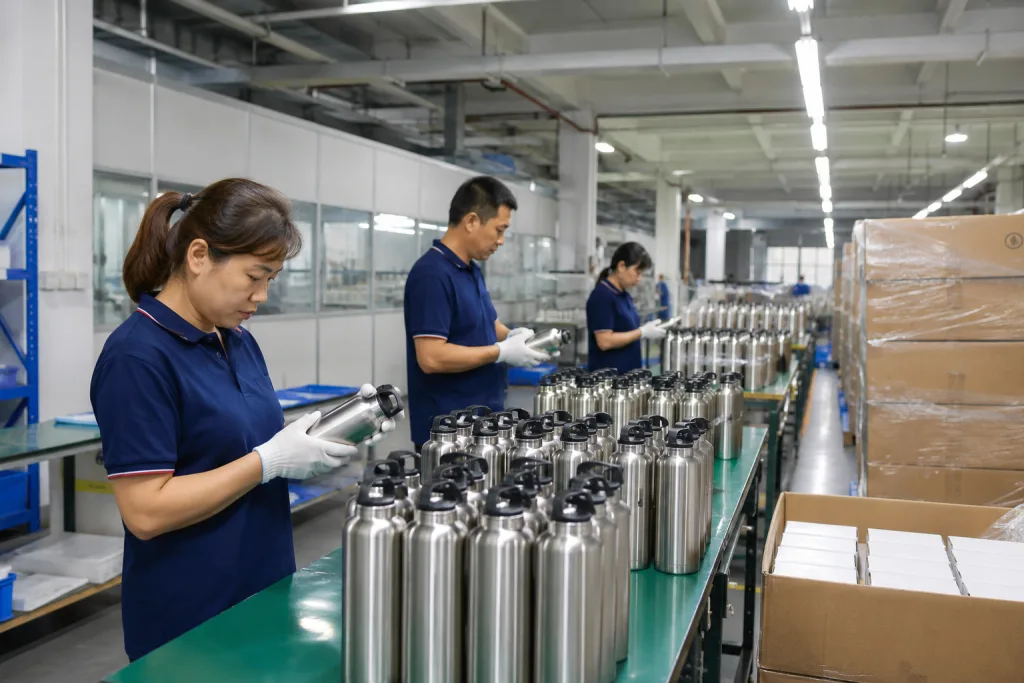
From our floor in Zhejiang, we see the same mistakes: buyers approve a pretty rendered mockup, ignore packaging weight until QC flags it, miss LFGB or REACH paperwork, then find out the product isn't retail-ready. One buyer ordered 5,000 canteens and the lid gasket failed REACH testing — we swapped materials mid-run. This is a practical Q&A and checklist. Use it before you ask any supplier for a quote.
What should you source first?
Start with the sales channel, not the bottle shape. A German outdoor retailer stocking shelves in a flagship store needs something entirely different than a B2B promo buyer stuffing 5,000 giveaway bags. An Amazon FBA listing? Different animal. We've seen buyers blast out a "custom canteen with my logo" email, get 14 catalogs back, and still have no idea what they actually need two weeks later. Wrong question asked.
For retail and distributor drinkware, we run 500 ml, 750 ml, and 1,000 ml stainless steel vacuum bottles plus 20 oz travel tumblers as the default launch set. Four SKUs. They cover German daily use, corporate gifting, and outdoor ranges without blowing the tooling budget on shapes that won't move. A powder-coated canteen with a 304 stainless inner wall, laser-welded vacuum, and a leakproof screw lid positions cleanly — you're not explaining an odd silhouette to a buyer who's never held one. We had a niche 380 ml flask shape sit on a shelf in Munich for six months because the accessory thread pitch didn't match anything in-market. The buyer ended up liquidating at cost just to clear warehouse space.
Supermarkets and large promotional programs flip the math. Unit price and carton efficiency run the show. A 10,000-piece canteen promo order might spec single-wall 304 stainless, a generic PP lid, and a printed brown box. FOB drops $0.35–$0.50 per unit versus the double-wall alternative. For premium outdoor or brewery merchandising, a customized growler in 1.2 L to 1.9 L moves perceived value up sharply. The catch: freight cost per unit climbs fast once you're shipping air inside a 1.9 L vessel. We had a Bavarian brewery order where landed cost per growler jumped 18% just from the dimensional weight reclassification on the pallet. The buyer hadn't modeled freight before locking in the spec, and it ate half their margin.
Checklist before selecting the product:
- Target retail price in Germany, including VAT and distributor margin.
- Required capacity: 350 ml, 500 ml, 750 ml, 1,000 ml, or growler size.
- Insulation target: 6 hours, 12 hours, or 24 hours heat/cold claim.
- Sales channel: retail shelf, Amazon FBA, corporate gift, horeca, sports club, or outdoor distributor.
- Packaging: brown box, color box, sleeve, FSC paper tube, or gift box.
A decent canteen factory's real job is cutting options, not stacking them. At BottleForge Industrial in Hangzhou, Zhejiang, we guide buyers toward 2 or 3 proven molds first — shapes we've already run through LFGB migration testing and a dozen QC inspections. Then we layer on color, logo, lid, and packaging. That sequence slashes tooling risk and pulls sample lead time from 18 days down to about 9. Less back-and-forth, fewer surprises when QC pulls the AQL 2.5 sample. We've had POs ship on time because the buyer didn't spend three weeks debating a rim profile that adds zero function.
Which compliance documents matter in Germany?
A German retailer will ask for documentation before they ask about pricing. I've had RFQs stall for three weeks because the buyer's compliance team flagged a missing LFGB section and nobody on our side caught it. If your supplier sends a one-page "food safe" PDF and calls it done, push back.
You need LFGB testing for every food-contact material in the assembly — the stainless body, the PP lid, the silicone ring, the straw tip. Plus an EU 1935/2004 declaration and a REACH screening that covers coating, ink, and any colored decoration. For kids' bottles, add phthalates, heavy metals, and mechanical safety — cap venting, small-part retention. If the SKU is cross-listed for the US market, your lab needs to layer in ASTM F963 or the relevant EN standard, and the test matrix gets expensive fast.
Here's where we see new importers trip up: they submit a lab report from a different SKU with a different lid material and assume it covers the whole range. It doesn't. Change the powder coat color from matte black to gradient blue and the pigment chemistry shifts. Add a bamboo sleeve and now you've introduced a natural fiber that German customs may want tested separately. The report has to match the bill of materials line by line. Inner wall grade matters too. 304 stainless is our standard for everyday canteens; 316 costs about 18% more on raw material and only makes sense if the bottle is marketed for seawater use or acidic drinks held hot for hours. Most buyers don't need it, and I'll tell them that directly rather than upsell.
Compliance checklist for your RFQ:
- LFGB test report for food-contact parts, preferably less than 3 years old.
- REACH statement covering coating, plastic, silicone, and decoration.
- Material declaration: 304/316 stainless steel, PP, Tritan, silicone, powder coating.
- BSCI, Sedex, or factory social audit if required by your German retail customer.
- AQL inspection plan, normally AQL 2.5 for major defects and 4.0 for minor defects.
Budget a realistic number. A fresh LFGB + REACH package for one SKU with two materials runs USD 450–900 depending on the lab's backlog. If you need a buyer-named report with the importer's company header, add a re-issuance fee. That's still a fraction of what a recall costs. We had a German discounter pull 3,200 bottles off shelf two years ago over a silicone gasket that leached above the migration limit. The lab fee would've been USD 680. The recall cost the importer close to 40 grand in logistics and penalty clauses. Do the math before you place the PO.
How should you compare quotations?
You get three canteen quotes. One says FOB Ningbo. Another says EXW Zhejiang. A third includes the color box but leaves out logo setup. Those are not the same price. Ask every supplier to quote in the same format.
A tight RFQ for private label drinkware Germany should carry: capacity, wall construction, steel grade, lid type, coating, logo method, packaging, carton quantity, gross weight, MOQ, sample fee, lead time, and Incoterm. For FOB China, factories in Zhejiang usually ship from Ningbo or Shanghai. Your forwarder can quote sea freight to Hamburg or Bremen once they have carton dimensions.
As a sanity check: a 500 ml double-wall stainless bottle with powder coating and one-position laser logo runs roughly USD 3.20–5.80 FOB China. Lid complexity, finish, order volume, and packaging move the number. A 1,000 ml custom canteen sits higher, often USD 5.50–9.50. A custom growler or customized growler with a handle lid and gift box can land at USD 8.00–16.00. These are not price lists. They are ranges you can use for budget planning before you trip over a surprise.
Quotation checklist:
- MOQ by model, color, and logo version. Total MOQ alone will hide a problem.
- FOB port and whether inland trucking from the factory to the terminal is in the number.
- Sample timing: 5-10 days for a logo sample, 15-25 days for a new color or new lid trial.
- Mass production lead time: usually 30-45 days after the approved sample and deposit hit.
- Carton size, units per carton, gross weight, and a suggested HS code.
Our production partners in Hangzhou, Zhejiang run about 300,000 stainless drinkware units per month across standard bottle and tumbler lines. That capacity helps only if you plan ahead. One late artwork approval and a 3,000-piece order stalls.
Which branding method fits your order?
Most buyers overspend on branding. Not because they pick a bad method — because they pick one that's wrong for their logo, their volume, or their price point. We watched a buyer pay for full-wrap UV on a single-color corporate logo. Laser would have been sharper and cost 30% less at their 1,200 pc order. Wrong question: "What's the best decoration?" Right question: "What holds up on my bottle for my quantity?"
Laser engraving is the workhorse on 304 stainless. It survives daily abuse on powder-coated bottles and tumblers — corporate gifts, outdoor lines, distributor growler programs where the logo gets knocked around in truck beds and dishwashers. The mark is a metal-tone etch, not a label. No multi-color. If your artwork has more than two colors, laser isn't your process. Skip to UV.
Silk screen printing handles one- or two-color logos. Cost-effective above 500 pcs. We run it often on canteen promotional orders — 800 pcs for a trade show, single-color white on matte black, 0.18 USD per placement. UV printing takes multi-color artwork, gradients, wrap designs. But request an adhesion test on your specific powder coat. We've seen a smooth matte finish reject ink that a textured coat held perfectly. Same factory, different coating batch. Heat transfer delivers strong visual impact. We've also seen it peel on curved bottle necks when the film doesn't match the contour radius. The operator on our line checks this with a go/no-go gauge before running the batch.
For a canteen headed to German retail, think about the packaging system, not just the bottle. You'll likely need a barcode, German care instructions, recycling marks, importer address, FNSKU for Amazon, and carton shipping marks. A well-decorated bottle in a generic white box looks unfinished to distributors. We get that feedback every quarter — most recently from a Berlin buyer who flagged it during a pre-shipment walkthrough.
Branding decision checklist:
- Laser engraving: best for durability and simple artwork.
- Silk screen: best for simple logos and larger canteen promo runs.
- UV print: best for multi-color designs, but approve the adhesion test first.
- Embossed or debossed logo: premium feel, but needs tooling and a higher MOQ — generally 2,000+.
- Custom color coating: expect MOQ around 1,000-3,000 pcs per color for stable pricing.
If your logo uses fine lines under 0.25 mm, ask for a print proof before sample production. Small text that looks sharp in a PDF can fill in during screen printing on a curved bottle. We had QC pull a sample last month because a 6 pt font turned into a black blur. The mesh count on the screen was too low for that line weight. We bumped it to 200 mesh and the next proof was clean.
What MOQ is realistic?
German buyers regularly ask: "Can you do 300 pcs, three Pantones, custom box, and keep the unit price under €3.50?" The math doesn't work. MOQ isn't the factory being difficult. It comes from the coating line minimum batch size—our powder booth needs 30 kg of powder just to charge the system. The screen setup on the printing table takes an hour. The offset press for color boxes requires a 1,000-sheet minimum. And our stainless coil supplier won't slit less than 2 tonnes for a specific gauge. We've had a buyer walk away at 500 pcs, then come back six months later when they realized the unit cost at 1,000 pcs was actually lower.
Here's what actually runs on our lines in Hangzhou. Standard stainless private label drinkware with a single-position laser or silk-screen logo on an existing stock color: 1,000 pcs per model. That's our floor. Custom powder coating jumps to 1,000–3,000 pcs per color because the booth operator purges and cleans between shades, and that setup time gets amortized across the run. Printed retail packaging: we can do 1,000 pcs with digital print or a sticker on a blank box. Offset-printed color boxes hit decent unit economics at 3,000 pcs. A custom lid—say a new growler cap with a different thread profile—means mold fees, 45–60 days of tooling, and a minimum commitment of 5,000 pcs just to validate the production run. QC pulled a sample last month from a 2,000-pc run of a custom lid; the thread pitch was off by 0.2 mm. You don't catch that in a short run.
Separate your launch order from your replenishment order. A distributor testing a regional German market can start with 1,000 pcs split across two SKUs if you stick to our in-house powder colors. We've done this for a Stuttgart client who launched with 500 pcs of matte black and 500 pcs of white, single-position engraving, standard kraft box with a sticker. That worked. National retail rollout is a different animal. You're looking at 5,000–20,000 pcs because carton planning, pallet optimization for the 40HQ container, and compliance documentation (LFGB, REACH, Prop 65 if you ever touch the US) all get cheaper per unit at scale. One buyer we work with in Hamburg keeps 30% safety stock because a reorder from our line still takes 35 days door-to-door via Ningbo to Hamburg, and a stockout during Q4 is a margin killer. They ran out in November once. Never again.
MOQ checklist before negotiation:
- Can you use an existing mold instead of opening new tooling?
- Can you accept standard factory colors for the first order?
- Is the logo one position, one method, one artwork?
- Do you need custom box printing or only a label on standard packaging?
- Will future repeat orders use the same SKU and packaging?
At BottleForge Industrial, we quote some standard logo projects from 500 pcs, but FOB pricing tightens up at 1,000 pcs. For a serious distributor program, plan at least 3,000 pcs across a focused SKU set. Fewer SKUs, deeper per-SKU quantity. That's where the landed cost actually makes sense for the German market. The wrong question is "What's the lowest MOQ?" The right one is "What's the MOQ that makes my margin work?"
How do you inspect quality?
I tell every German buyer the same thing on the first call: if your inspection standard fits on a Post-it, you’re not inspecting. You’re hoping. Good drinkware QC covers leaks, coating adhesion, vacuum hold time, residual odor, carton crush strength, barcode scannability, and logo positioning — all against a written spec the factory signs off on before production starts. “We check everything” means nothing until we see the checklist.
For stainless vacuum bottles, we run a standard battery: hot-water leak test, vacuum thermal retention measured at 6 and 12 hours, cross-hatch adhesion on powder coat or paint, a 1.2 m drop onto concrete (three orientations), lid torque to spec, silicone ring compression set, sniff test for rubber or chemical odor, inner-wall surface finish under 0.8 μm Ra, and fill-volume tolerance within ±3%. Wall thickness matters more than most buyers realize. We spec 0.4–0.5 mm on the inner wall and 0.5 mm on the outer for 500–750 ml bottles. Drop that to 0.35 mm and you save maybe $0.12 a unit — but we’ve seen 20% dent rates in FBA inbound when the steel’s too thin on a 1-liter canteen.
Book third-party inspection when 100% of goods are produced and at least 80% packed. AQL 2.5 major / 4.0 minor works for most mid-volume orders, but I’d tighten it to AQL 1.5 major if the logo is laser-engraved on a curved surface — that’s where we catch drift. Critical defects get zero tolerance: leakage past the lid seal, a burr sharp enough to cut skin, wrong material grade (304 declared, 201 delivered), wrong logo artwork, a barcode that won’t scan, or black mold spots inside the cavity. One of those in the sample and the lot fails. No negotiation.
Pre-shipment checklist:
- Confirm SKU count, color count, logo version, and packaging version against the PI — we’ve caught a buyer’s own PO typo here twice this year.
- Leak test 20–50 pcs per SKU lot; for orders over 5,000 pcs, pull 80.
- Scan EAN, UPC, or FNSKU with a Datalogic handheld, not a phone camera — phone scans miss narrow-bar quiet-zone violations.
- Weigh and measure one full master carton per pallet; cross-check against the freight forwarder’s CBM estimate. A 2 cm error per carton stacks up fast on a 40HQ.
- Photograph master carton marks, pallet layout, and inner-pack configuration — these photos go straight to the buyer’s warehouse team before the container sails.
For Germany, carton strength isn’t optional. If the outer carton flexes when you push the center with your thumb, it’ll collapse in a Hamburg CFS. We ship 5-ply export-grade cartons for any bottle over 600 ml, and double-wall for growlers or anything where the carton gross weight exceeds 12 kg. I’ve seen a 15 kg carton spec’d with 3-ply to save $0.30 — the whole pallet crushed on the bottom tier, 120 units dented, buyer ate the chargeback. Wrong place to cut cost.
How should Germany buyers plan logistics?
Logistics starts the day you approve the pre-production sample, not when the container is ready. A 750 ml bottle looks manageable on a spec sheet — add a rigid color box, and your 3,000-piece order jumps to 11 m³ fast. We had a Düsseldorf buyer ship that exact volume by air two years ago: $4.60/unit landed, margins gone, deal dead. Map the timeline backward from your warehouse receiving date, not forward from the factory completion date.
For private label drinkware Germany, sea freight into Hamburg or Bremerhaven is the workhorse. Transit runs 32-40 days port-to-port, depending on Ningbo congestion and whether the vessel skips Rotterdam. Then add 5-7 days for factory trucking to the port, German customs clearance, and final delivery to your 3PL. Rail through Duisburg can shave 10-12 days off that, but we've seen rates swing €800 per container between November and January. Air freight has its place — urgent trade show samples, a 200-unit top-up for a promotion — but for standard distributor canteen runs, the cost lands around $3.80-$4.50/unit. That's the whole margin on a mid-range bottle. Wrong tool for the job.
Amazon sellers have a separate logistics layer that bites hard if ignored. FNSKU labels need to scan on the first pass, suffocation warnings on polybags must hit 6 pt minimum, and cartons over 23 kg trigger surcharges and prep rejections. We learned this one the expensive way: a Frankfurt buyer had 400 cartons flagged because the warning text printed at 5 pt. The goods were already packed in our Hangzhou warehouse. Re-labeling took three workers two full shifts and pushed the shipment into peak-season rates. QC pulled the AQL sample, but nobody thought to measure the font size.
Logistics checklist:
- Get carton dimensions and gross weight before locking packaging specs — not after.
- Agree Incoterms (FOB Shanghai, CIF Hamburg, DAP to your warehouse) with your forwarder and supplier simultaneously.
- Verify EORI number, importer of record address, and Zolltarifnummer before the B/L is cut.
- Confirm HS code, material breakdown (e.g., 304 stainless, PP lid, silicone gasket), and product description in German customs format.
- For mixed SKU orders, demand a carton-level packing list — pallet-level isn't enough when customs pulls one box.
A canteen vendor in China should handle your German forwarder without friction. If they dodge requests for carton data, won't send shipment photos, or deliver a packing list that reads "assorted drinkware," that's your signal to push harder or walk. Paperwork isn't exciting, but we've watched a €2,800 warehouse detention charge eat the profit on a full container because the carton numbers didn't match the commercial invoice. That argument lasted six weeks.
What should your RFQ include?
Send us a spec sheet per SKU. One page. Not a five-line email that says "custom drinkware with our logo." That gets you a placeholder quote. We've seen those drift by 12% within a week, once the production team actually opens your artwork file and sees it needs laser engraving, not silk screen.
What belongs on that sheet: a model number if you picked from our catalog, or full dimensions. Capacity in ml. 304 or 316 stainless. Single-wall or double-wall. Lid type—flip, screw, straw, or loop. Coating color with Pantone if you have it. Logo method, logo size in mm, and print position. Add packaging breakdown: individual box or bulk, barcode placement, importer name and address in German, recycling marks. For a distributor growler or custom growler, specify lid seal gasket material, whether the fill will be carbonated, handle geometry, and filled weight. Most drinkware growlers are not pressure vessels. We learned that when a buyer's carbonated batch blew the lid during AQL 2.5 inspection—0.8 bar overpressure and the gasket failed. That call was not fun.
RFQ checklist—send this today:
- Product type: bottle, travel tumbler, custom canteen, kids bottle, glass bottle, or customized growler.
- Quantity broken out by SKU and color. Lump-sum totals hide MOQ issues. A buyer once combined 3,000 units across six colors; two colors fell below the 500-unit coating minimum and the line manager refused the run.
- Logo files in AI, PDF, or EPS. Pantone codes if printed. No JPGs pulled from a website.
- Packaging artwork: barcode, German text, importer details, recycling marks.
- Required docs: LFGB, REACH, BSCI, AQL inspection level, test reports.
- Incoterm and port: FOB Ningbo, FOB Shanghai, CIF Hamburg, or another basis.
- Target ex-factory date and latest warehouse arrival date. We work backwards from the vessel cut-off at Ningbo. Miss it by two days and you lose a full sailing.
Tell us your target price if you have one. A serious drinkware factory can adjust coating spec, lid complexity, packaging layers, and MOQ to hit a number that works for your German channel. Without a target, we quote blind. The result is often a product that lands at €6.20 FOB when your shelf price needed €4.80. That's the wrong question. Ask instead: what can we build for €4.80 FOB? The math gets interesting fast.
Send your Germany drinkware RFQ for a practical quote
Share quantity, logo, packaging, and compliance needs. We will reply with MOQ, FOB pricing, lead time, and realistic production notes.
Frequently asked questions
What is the normal MOQ for private label drinkware Germany orders?
For stainless steel bottles and tumblers, plan 1,000 pcs per model as a practical starting point. If you need custom powder coating, 1,000-3,000 pcs per color is more realistic because coating lines need setup and color stability. For printed color boxes, 3,000 pcs is usually more cost-efficient, although labels or digital packaging can support smaller launch orders. Some canteen vendors may offer 300-500 pcs on stock colors, but FOB unit price, logo cost, and inland handling will be higher. For a distributor canteen program, we recommend planning launch SKUs around 3,000 pcs total minimum.
Do I need LFGB testing for drinkware sold in Germany?
Yes, if the drinkware contacts food or beverages, LFGB testing is strongly recommended for Germany. You should also ask for an EU food-contact declaration under Regulation 1935/2004 and REACH documentation for coatings, plastics, silicone, and decoration. The test report should match the material structure of your bottle, including lid and seal. If your customized canteen uses a new coating, straw, or plastic component, an old report may not cover the final product. Budget roughly USD 300-900 for additional lab testing depending on the number of materials and the laboratory schedule.
Which logo method is best for custom canteen orders?
For durability, laser engraving is the safest choice on powder-coated stainless steel. It is good for outdoor, corporate, and retail products where the logo should resist washing and handling. For canteen promotional campaigns with large quantities, silk screen printing is usually cheaper for one-color logos. UV printing is better for full-color designs, but you should approve adhesion testing before mass production. For premium private label drinkware, some buyers use engraving on the bottle plus a printed retail box. Always send vector artwork and confirm logo size in millimeters before sampling.
How long does production and shipping from China to Germany take?
After artwork and sample approval, mass production normally takes 30-45 days for standard stainless drinkware. A new color, new lid, or custom packaging may add 7-15 days. Sea freight from China to Germany is commonly planned at 30-40 days port-to-port, then you need customs clearance and inland delivery. A realistic timeline from deposit to German warehouse is often 70-95 days. Samples can move by courier in 5-8 days after production, but bulk air freight is usually too expensive for normal distributor drinkware margins.
Can one canteen factory supply bottles, tumblers, and growlers?
Often yes, but check the factory’s real capability. Some canteen manufacturers specialize in stainless vacuum bottles, while others mainly assemble lids or trade multiple categories. A good supplier can provide consistent coating, logo control, and packaging across bottles, travel tumblers, and growlers. For a customized growler, ask about capacity tolerance, leak testing, handle strength, and whether it is intended for still beverages only. Do not assume pressure resistance unless it is tested and specified. For mixed programs, request one master SKU sheet covering MOQ, lead time, test reports, and carton data for every item.