Key Takeaways
- A realistic private label MOQ starts at 1,000 pieces for standard stainless models and 3,000 pieces for color-matched production
- FOB China pricing for 500 ml double-wall stainless bottles usually lands around USD 3.20-5.80 before custom packaging
- German buyers should request LFGB, REACH, EN 12546, BSCI, and AQL inspection terms before deposit
- Logo method, packaging, and Incoterms can move your landed cost by 8-18% even when the bottle looks identical
Private label drinkware for the German market — retail chains, corporate gifting programs, club channels, distributors — looks simple. Pick a bottle, slap on a logo, ship it. I wish it were that easy.
Out of our Hangzhou factory, we watch German buyers trip over the same thing every quarter: they fixate on the ex-works unit price and stop there. No one asks about the MOQ jump from 500 to 3,000 when you switch from silk-screen to laser engraving. No one checks whether the REACH dossier actually covers the silicone seal on that specific lid SKU. We had a shipment held in Hamburg for three weeks last year because the compliance file listed the wrong seal material. The bottle was fine. The paperwork wasn't. That's a €4,200 demurrage bill the buyer ate.
Here's the five-point sourcing comparison I walk through before we issue a single PI. If you skip it, the math on your landed cost is fiction.
How The Top Five Are Ranked
I rank private label drinkware Deutschland sourcing on four hard criteria: control, compliance readiness, landed cost transparency, and repeat-order stability. Asking "who has the lowest FOB" is the wrong question. A bottle that's USD 0.25 cheaper but lands in Hamburg with crushed cartons, patchy powder coating, or a missing REACH declaration for the silicone gasket costs a German importer far more than that quarter. We watched a 12-day customs hold eat the margin on a 5,000-piece tumbler order.
This comparison covers real B2B orders: 1,000 to 20,000 pieces, custom logo, export cartons, barcode or FNSKU when the listing requires it, shipping into Germany by sea, rail, or air. We run custom drinkware, custom canteen lines, distributor drinkware programs, and custom growler projects where private label packaging carries the brand. A Hamburg distributor we ship to runs 15 SKUs under their own label. Every master carton marking has to match their warehouse scan-in system or the pallet gets rejected at receiving. That happened once. It doesn't happen twice.
Four criteria drive the ranking:
- Compliance: LFGB food contact, REACH, BPA-free material declarations, and EN 12546 thermal performance where applicable. A missing REACH declaration for the silicone gasket alone can stall Hamburg customs clearance by 12 days. We've seen it. We keep a binder of third-party lab reports by component: gasket, lid body, bottle interior coating. The paperwork ships before the container does. No exceptions.
- Brand control: logo method, Pantone color match, lid selection, insert card, gift box, master carton markings, and spare parts availability. One buyer last quarter flagged a Pantone 186C shift of 2.8 ΔE on a tumbler run. QC pulled the samples at AQL 2.5, we caught it on the line, and re-sprayed before packing. That's the difference between a brand launch that hits the shelf on time and one that doesn't. The math is simple: a 2.8 ΔE is a miss. We don't ship misses.
- Commercial risk: MOQ, deposit exposure, sample timing, AQL inspection level, and remake responsibility when something fails. 30% deposit on a 10,000-piece order is normal. 50% deposit on a first order from an unvetted factory is not. We've seen buyers take that bet and lose six weeks of lead time when the coating thickness came back at 35 microns instead of 55. That's a rework. That's a missed shelf date.
- Repeatability: whether the same canteen manufacturer reproduces the finish, weight, and packing six months later. A distributor program dies if batch two doesn't match the buyer's warehouse photo. We keep a retained sample from every production run and cross-check the next run against it at the spray booth, not just at final QC. The booth operator checks it. The line supervisor checks it. QC checks it. Three layers before the carton is sealed.
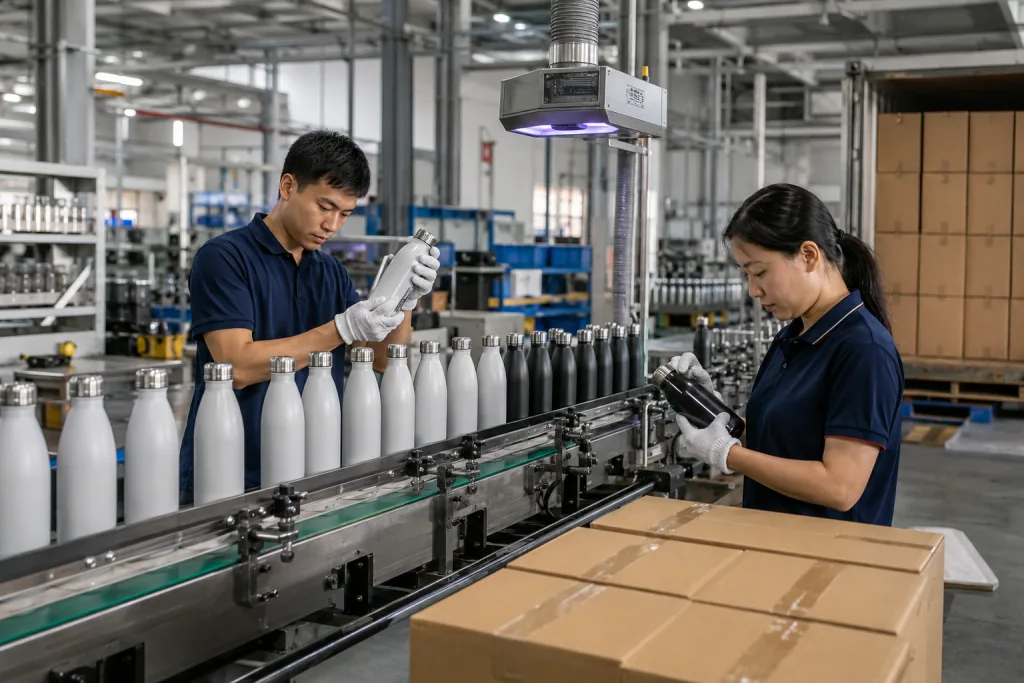
Our Hangzhou, Zhejiang facility runs roughly 450,000 stainless drinkware units per month: bottles, tumblers, thermos flasks, canteens. Standard lead time is 30-35 days after sample approval for 1,000-5,000 pieces. Heavier private label packaging or molded lid components push that to 40-50 days. Those numbers hold when production planning is tight and the artwork file arrives print-ready. When it doesn't, add a week. We've had a PO delayed because the buyer's designer sent an RGB file with fonts outlined wrong. Small thing, big ripple. The line is tight. We keep it that way.
Best Overall: Direct China Factory
We run roughly 70% of our private-label drinkware through direct factory orders. For German buyers who need cost control and real customization—not just a logo on a stock bottle—this is the route that works. MOQ sits at 1,000 pieces per SKU. You need repeat order intent. You're dealing with the same team that runs the steel grade on 304 coil stock, sets the vacuum furnace at 1,050°C for the brazing cycle, dials in powder-coating line speed at 6–8 meters per minute, registers the silk screen, assembles the lid gasket, and packs the final carton. No trading company layer. No handoffs.
Pricing tells the story. A 500 ml 304 stainless double-wall bottle, powder coated with a one-color silk screen, lands around USD 3.20–4.60 FOB Ningbo or Shanghai at 1,000–3,000 units. Laser engraving adds USD 0.15–0.35 per unit. A color gift box adds USD 0.28–0.55, the spread comes from paperboard gauge—we use 1.5 mm greyboard standard—lamination type, and print coverage. Custom 1.9 L growlers run USD 7.80–12.50 FOB. Cap structure and handle design swing that number hard. Last month a buyer cut the gift box to save USD 0.35. QC pulled the shipment sample at 60% humidity and the carton flaps had crushed on three sides. That USD 0.35 box was the cheapest insurance on the PO. He re-added it for the next run.
Spec management is where this goes sideways. Don't send a logo file and ask for a quote. It wastes everyone's time. Send capacity, material grade, lid type, target retail channel, packaging spec, compliance market, inspection level, and Incoterm. For Germany, write AQL 2.5 major / 4.0 minor into the purchase order. Add carton drop testing per ISTA 1A and leak testing before shipment. One buyer typed "AQL 4.0" on his PO instead of "2.5." The line shipped. 3% of units had pinhole leaks at the weld seam. We caught it on the reorder because he sent the corrected PO before the 30% deposit hit our account. Fix the PO early. It's free.
A direct factory is the right route for real customization: Pantone-matched coating, molded silicone boot, straw lid, carry loop, retail sleeve, QR code, a replacement lid program. If you need 500 pieces of promotional stock next week, this is the wrong question to ask. Lead time sits at 45 days minimum, and that's assuming the steel coil is in our warehouse and the mold for your lid already exists. For a serious private-label line with margin protection, direct factory usually wins. We've seen it work for buyers moving 20,000+ units annually into German retail chains. The math holds.
Second Choice: German Importer Stock
A German importer holding in-country stock solves two problems: speed and low minimums. You need 200 units for a Berlin trade show booth or a single-retailer pilot. You don't have the volume to clear a factory MOQ of 1,000 or 3,000. At this scale, paying EUR 8 per bottle instead of chasing FOB Shenzhen pricing is the right call. You skip the 35-day sea freight, the customs paperwork, and wiring a 30% deposit to a factory you've never walked through.
What you give up is spec control. Importer stock programs are fixed: their bottle silhouette, their color palette, their decoration menu. Pad printing a logo on a standard 500 ml double-wall? Fine, we run that in our sleep. A custom-molded lid with your thread pitch and your gasket spec? That's not coming from someone else's warehouse shelf. If the importer says they can do it, ask for the tooling timeline. We had a buyer show up at our door after an importer quoted 8 weeks for a custom cap — which is just a factory order with a middleman markup. At that point you're paying extra for something you could manage directly with a WeChat message and a PO.
Real pricing for a 500 ml stainless bottle from German stock: EUR 6.50-12.00 before VAT, depending on quantity and decoration steps. Stack that against an FOB quote of $2.80-$3.50 and it looks painful. But the FOB number doesn't include warehousing in Hamburg, local handling, or the difference between product on your desk in 5 days versus 55. For a 200-unit market validation run, I'd say the premium is acceptable. The math flips hard at 10,000 units — by then the importer's margin eats more than your freight, duty, and factory oversight combined. At that volume, you're better off placing the container order and managing the logistics yourself.
Use local importer stock when you're testing logo placement, reading retail response, or piloting a canteen concept with one distributor. Don't build a long-term private label drinkware strategy for Deutschland on it if your annual forecast runs five figures. German importers are solid distribution partners. They are not product engineers. We've watched this go sideways: a buyer wanted a double-wall lid redesign and the importer couldn't even source a sample mold quote. They don't run tooling projects — they run warehouses.
Third Choice: EU Distributor Programs
EU distributor programs sit between local stock and direct factory sourcing. A canteen distributor or distributor growler supplier consolidates orders, handles decoration, and invoices inside the EU. For buyers who don't want to manage China production directly, this is convenient. We see it used mostly by corporate gifting companies, smaller retail chains, and regional promotional agencies.
The main benefit is administration. You get one EU invoice, shorter delivery from a European warehouse, and support in German or English. Some canteen distributors actually understand EPR packaging rules, VAT handling, and retailer delivery windows better than our factory sales team in Zhejiang. That matters when you deliver to multiple DCs or need carton labels formatted with GS1-128 barcodes and a 5mm edge margin — one buyer returned 3 pallets because the label margin was wrong.
The limitation is product depth. A distributor canteen catalog shows 20 bottle models, but the lid, coating, and packaging are locked. When a brand owner asks for a customized canteen with a unique cap color, inside stainless marking, kraft retail box, and spare gasket pack, the distributor either declines or pushes the project back to suppliers in Zhejiang. We've seen this go sideways: the buyer approved a generic LFGB PDF from the distributor, but customs flagged the actual batch because the silicone gasket formulation wasn't covered.
Cost sits in the middle. For 500-2,000 pieces, an EU distributor is efficient. For 5,000-20,000 pieces, direct FOB sourcing usually beats it, even after freight and inspection. Ask whether the distributor owns the tooling. Ask whether repeat colors are controlled by Pantone or factory visual approval. Ask for current LFGB and REACH documentation for the exact batch — not a generic PDF. QC pulled a sample last month where the declared stainless grade didn't match the mill test certificate.
Fourth Choice: Trading Company Bundle
A trading company bundles your full order when you need stainless bottles, glass bottles, lunch boxes, tote bags, and maybe a custom canteen all under one campaign. One vendor coordinates the packing list, checks carton markings, and consolidates the shipment. For mixed promo orders, that saves you a few weeks of chasing separate suppliers.
The problem is technical depth. A general trader can quote a price, but ask them about vacuum failure rate on a 500 ml bottle, internal weld marks on the seam, powder coat adhesion after 72 hours, cap torque consistency, or straw lid leakage at 45° tilt—and they stall. A real stainless canteen supplier should tell you whether the body is 0.4 mm or 0.5 mm 304, whether the outer coating passes 3M tape peel test, and how long a 95°C fill holds above 60°C. Most traders can't answer without calling the factory.
Not every trader is bad. Some run tight QC and know their mills. But if you go this route, write a purchase order that leaves no gaps. Lock in material grade, capacity tolerance (+/- 2 ml), decoration method (pad print vs laser), carton dimensions, gross weight, AQL 2.5, and who covers the remake if QC pulls a failed sample. Also demand pre-production samples from the actual canteen line, not a showroom sample from a different source.
We rank this option fourth because it's efficient for standard drinkware but uneven for anything custom. For a custom canteen with engineering changes, private label packaging with tight color targets, or retailer compliance that needs batch-level traceability—the trader model breaks down. When a buyer calls us to rescue a delayed order, the root cause is almost always vague specs that passed through too many hands.
Fifth Choice: Marketplace And Agent Sourcing
Sourcing through marketplaces like Alibaba or freelance agents is a low-barrier way to get quotes moving. That's why it lands at fifth for private label drinkware Deutschland. The cost of entry is low. The cost of getting burned is not. Accountability disappears fast once the deposit clears and the WeChat replies slow to once every three days. You can find 200+ listings for double-wall canteens in one afternoon. What you can't find is proof that the "factory" owns a single trimming machine.
This route works if you know how to audit a supplier on the ground, pull an export license, cross-check a lab report against the cert number, and book a third-party inspector without hand-holding. If you're new to custom drinkware, skip it. Listings say 304 stainless, BPA-free, factory direct, MOQ 500. We've peeled back three layers on a "manufacturer" and found a trading office renting desk space above a packaging workshop. One buyer wired a 30% deposit to an agent who turned out to be a single WeChat account with stock photos pulled from our own Alibaba storefront.
Keep the first order boring. 1,000 pieces of one model, one logo position, one color, kraft box only. Don't split across two lid types and three packaging SKUs — the production team will batch it wrong and you'll eat the airfreight. Book a third-party inspection in China at roughly USD 220–300 per man-day. Hold the balance until photos, wall-thickness measurements, leak tests, and carton drop checks land in your inbox. QC pulled a 0.3 mm color drift on a Pantone 2945 C run last quarter. Agent said it was fine. It wasn't.
Agents earn their margin when they're technical and standing next to the injection machine, not forwarding screenshots from a couch. A strong agent checks tooling condition, confirms silicone gasket shore hardness, catches the color drift before 2,000 pieces come off the line, and sends the bad news early. A weak one forwards WhatsApp messages and hopes you won't ask for photos. For German buyers the real question isn't whether marketplace sourcing works. It's whether you have enough process control on the ground in China to make the whole thing boring. Most don't.
Compliance German Buyers Should Demand
Germany doesn't do "close enough" on compliance. Sell private label drinkware Deutschland through retail, online platforms, corporate channels, or distributor drinkware networks and you'll need documents tied to the exact material and batch. A generic certificate with no model reference won't survive a retailer's traceability request. We've watched buyers stall for three weeks on that single missing field.
For stainless drinkware, demand LFGB food contact testing, a REACH declaration covering coatings and plastic parts, a BPA-free statement for lids and straws, and EN 12546 performance testing when thermal claims appear on packaging. Products aimed at children add another layer — small parts checks, phthalate screening, and the relevant ASTM or EN references depending on the market. On the logistics side, confirm carton labels, FNSKU placement, polybag suffocation warnings, and drop-test strength before mass packing. A buyer we ran with last quarter caught a typo in the suffocation warning text. One wrong word. That mistake burned a week in relabeling at the 3PL.
Factory audits count. BSCI or Sedex gets asked for by European retailers regularly. ISO 9001 helps, but it's not a substitute for product testing. A factory can hold an ISO certificate and still ship a bad coating batch if the PO never spelled out inspection criteria. QC pulled a sample off the line last year — coating chipped at 50 microns. Spec called for 80. The audit paperwork was fine.
Pay for independent testing when the order size justifies it. On a 5,000-piece stainless bottle run, one lab test fee costs less than the conference call about a recall. A standard food-contact panel runs a few hundred USD depending on scope. That expense stings before shipment and feels like pocket change after a complaint lands. Chinese factories can supply existing reports, but check four things: issue date, applicant name, model description, and whether coatings, lids, and seals are included. We've seen reports covering the body only. The buyer assumed the straw was tested. It wasn't. That's not the lab's fault — it's a scope-of-work mistake on the sourcing side.
Logo Packaging And Landed Cost
Buyers usually ask for the bottle price first. I prefer to price the finished sales unit. For private label, that sellable unit includes bottle, logo, lid, accessories, insert, box, barcode, carton, pallet plan, inspection, freight, duty, and local handling. A low FOB price hides expensive packaging changes when you're already committed.
Logo method drives both look and durability. Silk screen works for one or two colors on smooth surfaces, runs USD 0.08-0.25 per position. Laser engraving is clean and durable on stainless or powder coating, typically USD 0.15-0.35. Heat transfer and UV printing handle full color but need better artwork control and abrasion testing — we once had a buyer who skipped the rub test and got scuffed logos inside six weeks. For canteen promotional projects, silk screen is enough. For premium customized growler or customizable growler lines, laser or debossed metal badges can justify a higher retail price.
Packaging is where German private label buyers regularly under-budget. A plain white box runs USD 0.12-0.22. A printed color box: USD 0.28-0.65. A rigid gift box can blow past USD 1.20 and it eats carton volume. Carton compression strength matters when shipping 2,000-10,000 units by sea. Weak 5-ply cartons save maybe 4 cents per box and create claims when the bottom blows out in Hamburg.
For landed cost planning, add sea freight, customs clearance, duty, VAT cash flow, local trucking, inspection, and possible warehousing. Depending on order size, these can move final cost by 8-18%. Ask your canteen supplier for carton dimensions and gross weight before you confirm price. Without that, your logistics quote is a guess. We've seen buyers lock a price based on FOB alone and end up 14% over budget at the warehouse door.
Send Your Germany Private Label Drinkware Brief
Share capacity, quantity, logo files, packaging needs, and target delivery date. We will reply with MOQ, FOB price, sample timing, and compliance options.
Frequently asked questions
What MOQ should I expect for private label drinkware in Germany?
For direct factory production in China, a realistic MOQ is 1,000 pieces per standard stainless model with one stock color and one logo. If you need Pantone powder coating, custom lid color, or printed retail packaging, expect 3,000 pieces per SKU. For molded parts, MOQ can rise to 5,000-10,000 pieces because silicone, PP, or Tritan components require tooling and color setup. Local German stock decorators may accept 100-300 pieces, but you will usually be limited to available colors and standard decoration. If your annual demand is below 1,000 pieces, start with importer stock. If you plan repeat orders of 5,000 pieces or more, direct factory sourcing becomes much more logical.
How long does a custom canteen order take from China to Deutschland?
A normal custom canteen order takes 30-35 days for production after sample approval when the model is standard and packaging is simple. Pre-production samples usually need 7-10 days after artwork confirmation. Sea freight from Ningbo or Shanghai to Hamburg often takes about 32-42 days port to port, before customs clearance and trucking. Rail can be faster but less predictable depending on route and season. Air freight is possible for urgent 300-800 piece top-ups, but the cost usually damages margin. For a new private label launch, plan 75-95 days from final specification to German warehouse. That schedule gives room for testing, AQL inspection, and carton label corrections.
Which logo method is best for customized drinkware?
It depends on the surface and price point. Silk screen is the practical choice for one-color logos on promotional drinkware, usually adding USD 0.08-0.25 per unit. Laser engraving costs more, often USD 0.15-0.35, but it is durable and looks better on powder-coated stainless bottles and custom growler bodies. UV printing and heat transfer can print full-color artwork, but you should request abrasion testing and a signed color proof before mass production. For German retail, I prefer laser for premium private label and silk screen for high-volume corporate programs. Avoid oversized logos across curved bodies unless the factory confirms distortion control with a real sample, not only a digital mockup.
What compliance documents do German buyers need?
At minimum, ask for LFGB food-contact testing for parts touching liquid, REACH documentation for coating and plastic components, BPA-free declarations, and EN 12546 test data if you claim thermal insulation. If the bottle is sold for children, add checks for small parts, phthalates, and age grading. For retailer programs, BSCI or Sedex audit status may be requested, and ISO 9001 can support factory quality management. The document must match the product: stainless body, lid, straw, gasket, coating, and printed surface where relevant. Do not accept a five-year-old generic certificate for a different model. For orders above 3,000 pieces, budget for independent lab testing and pre-shipment inspection.
Should I buy from a canteen manufacturer or a distributor?
Use a canteen manufacturer when you need repeatable private label production, custom packaging, Pantone colors, lid changes, or annual volume above about 5,000 pieces. You will get better FOB pricing and more control, but you must manage specifications, inspection, payment terms, and freight. Use a distributor when you need fast delivery, low quantity, EU invoicing, or a simple logo on existing stock. The distributor route is easier for 100-500 pieces and event deadlines. The manufacturer route is stronger for margin and brand ownership. Many German buyers start with a distributor canteen order, then move the proven SKU to factory production in Zhejiang or another China manufacturing base.