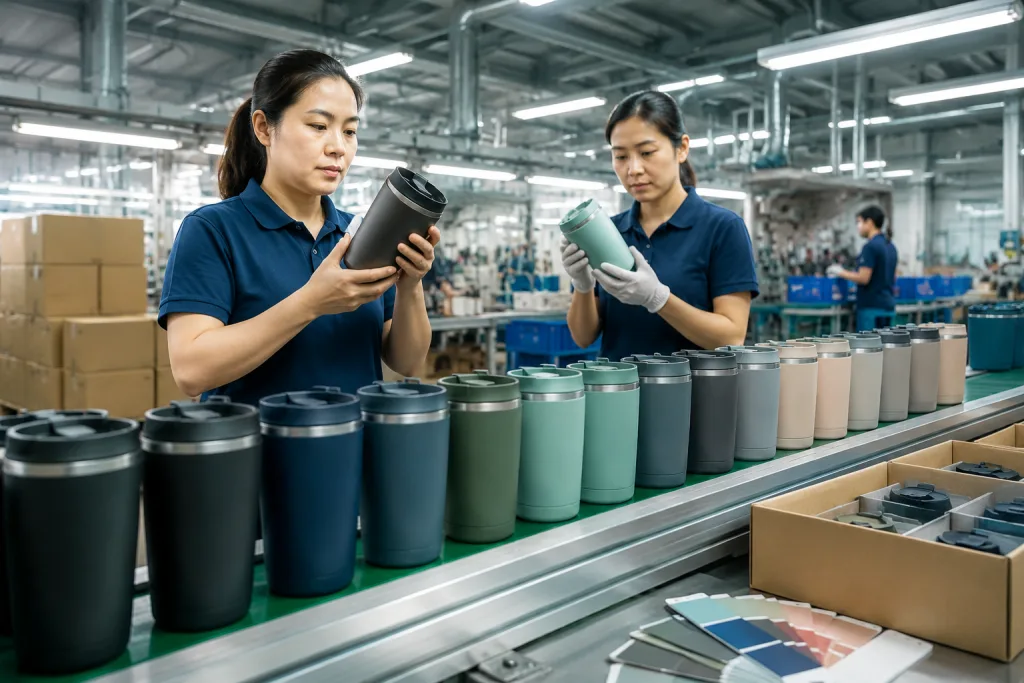
Key Takeaways
- For most private label coffee tumbler projects, 16 oz and 20 oz vacuum stainless models give the best retail and corporate-gift balance
- Realistic MOQ is 1,000 pieces per color for factory-direct stock molds, but custom lid or body tooling usually starts near 10,000 pieces
- Budget FOB China pricing from USD 3.20-6.80 for common double-wall stainless tumblers, depending on lid, coating, box, and logo method
- Use AQL 2.5/4.0 inspection, LFGB or FDA food-contact checks, and carton drop tests before shipping bulk coffee travel mug orders
A private label coffee tumbler looks simple on a PDF spec sheet. Then 5,000 pieces arrive and QC pulls a lid sample that leaks at the flip cap, the powder coat fails a 3M tape test, or the logo sits 3 mm off-center on the rotary jig. Painful. Coffee brands and corporate-gift buyers rarely lose margin because they picked matte black instead of navy. They lose it because they bought a bulk travel tumbler like a catalog SKU, not a small engineered product with tolerances, coatings, threads, and packaging drop risk. Wrong question.
From our factory network in Zhejiang, China, we get the same 8 or 10 buyer questions every week: 304 or 316 stainless steel, laser logo or silk screen after powder coating, 12 oz or 20 oz, retail box or kraft sleeve, FOB Ningbo or delivered duty paid. BottleForge Industrial produces up to 650,000 drinkware units/month, with typical MOQ from 1,000 pieces per color for standard molds and 25-35 days mass production after sample approval. We run pre-production samples with digital calipers on mouth diameter and lid fit before the line opens, because one buyer once flagged a 0.6 mm mismatch only after the PO said “leak-proof” in red text. The math gets ugly fast when a lid rework adds 12 days to an 18-day shipping plan.
Ranking criteria before choosing
A top 5 list is useless if it does not match the buying job. A coffee brand needs a private label coffee tumbler that protects aroma, mouthfeel, and lid comfort after 30 minutes in a delivery bag. A corporate-gift buyer is fighting different fires: event dates, kitting cartons, warehouse relabeling, and logo approvals that arrive at 6 p.m. QC pulled one sample last month because the drink-through slot scraped the upper lip by 0.4 mm. Small issue. Big complaint risk.
We rank the five options below on six checks we use with buyers: drinking performance and leak resistance come first, then branding area, unit cost, retail presentation, and production risk. Production risk is the one buyers underprice. The math doesn't work if a clean coffee mug custom design depends on a special silicone ring that needs 45 extra days from a second-tier vendor in Ningbo. On the line, we run a lid-fit gauge before packing; if the ring sits loose by even 0.2 mm, cartons stop.
For factory-direct buying in China, standard stainless travel tumbler projects usually land in this range. We ship these out of Zhejiang, and export cartons sit around 12-14 kg depending on capacity and gift box thickness. A 20 oz tumbler with a color box usually pushes closer to the top end. The warehouse scale tells the truth.
- MOQ: 1,000 pieces per color for existing molds; 3,000-5,000 pieces for uncommon colors or special packaging.
- FOB price: USD 3.20-6.80 for 12-20 oz double-wall vacuum stainless steel with a standard lid.
- Sample time: 7-12 days for logo samples; 18-25 days if you need a custom powder coat match.
- Mass production: 25-35 days after artwork and pre-production sample approval.
If a coffee mug supplier promises 500 pieces, 10 colors, custom packaging, and a low price, ask whether they are a coffee mug factory or a trading desk consolidating stock. That setup is fine for stock promos. It is the wrong question to ask if you need controlled production. We’ve seen this go sideways when the PO said “matte sand beige” and the supplier booked glossy beige from inventory; the buyer flagged it only after the first 38 cartons reached the forwarder.
Best overall: 16 oz vacuum tumbler
The 16 oz double-wall vacuum stainless tumbler is still the safest first private label coffee tumbler for most coffee brands. It fits a 330-380 ml daily coffee pour, passes our 74 mm vehicle cup-holder gauge, and still leaves a straight logo area around 45-55 mm tall without forcing the artwork onto the shoulder. If you sell roasted beans, subscription kits, or cafe merch, this is the first SKU I would quote. We run it every month. The line already knows where the defects hide, from lid flash on the PP slider to tiny powder-coat pinholes near the bottom radius.
Standard build is 304 stainless steel inside and outside, 0.4-0.5 mm wall thickness per shell before forming, copper-lined vacuum insulation, and a press-fit or slide-open PP lid with silicone gasket. A proper factory should have FDA, LFGB, and sometimes REACH documents for the coating and plastic parts. For Europe, ask for the LFGB food-contact test report, not a one-page internal material declaration. Last month, a German buyer flagged a lid resin report because the PO said “PP lid,” while the report covered only the silicone ring. Small wording issue. Big delay. QC had already packed 3 pre-production samples when the document mismatch stopped approval for 6 days.
Branding has room, but the cheapest method is not always the right call. Laser engraving on powder coat gives a cleaner retail finish, and it survives daily handling better than low-cost print. QC pulled one black sample after a 3M tape test because the engraving edge showed weak paint adhesion. Silk screen is cheaper for a single-color logo on smooth paint, but we still run tape testing and abrasion checks before bulk. For a coffee mug customized with full-wrap artwork, heat transfer or water transfer works, though scrap can jump from 2% to 6% on curved bodies when the film position shifts by 1.5 mm. We’ve seen this go sideways when the buyer sends a 300 dpi flat file but forgets the lid color callout.
For a 16 oz coffee mug private label order, budget around USD 3.60-5.20 FOB Ningbo based on lid style, coating process, and retail box spec. MOQ is usually 1,000 pieces per color. Choose this model if you need a balanced bulk coffee tumbler for online retail and cafe shelves without making the first Zhejiang, China order too messy. Start simple. We ship this size in 50 pcs cartons at around 13-15 kg, normally 12 cartons per pallet layer depending on the box height. The math works better than chasing a special shape before the brand has repeat orders.
Best premium choice: ceramic-lined steel
If your brand sells specialty coffee and makes claims about cup profile, a ceramic-lined stainless tumbler deserves a hard look. You keep the dent resistance and heat retention of a stainless travel mug. The ceramic lining strips the metallic note that some drinkers catch with acidic light roasts—washed Ethiopians, Kenyan SL-28s. We had one roaster reject a 304 stainless sample after cupping a washed Ethiopian in it for 20 minutes. Same buyer approved the ceramic-lined version the next morning. This spec is for brands chasing shelf price, not the lowest landed cost.
Cost and process control are where it gets tight. The ceramic interior coating sprays on wet and cures in a tunnel oven. If the oven profile drifts by 8-10°C, QC will catch pinholes or weak adhesion near the shoulder. Bad factories miss rough edges at the rim, thin spots at the bottom radius, and coating lift after 3-5 hot-water cycles. Before you sign off on mass production, ask for a cross-hatch adhesion test, a boiling water soak, and a tape pull on the coating. AQL inspection should list internal coating defects as a separate major defect category—do not let the factory bury them under general appearance. We run this with a 3M 600 tape pull and a 10x inspection light right at the rim.
FOB pricing lands around USD 5.20-7.80 for 12-16 oz. MOQ can hit 2,000 pieces per color because coating lines hate short color batches. Lead time adds 5-10 days over a standard stainless bulk coffee mug. In our line planning, that means 28 days versus 35 days when the coating oven is full. The math does not work for a one-off budget promo. It works for roasters, premium subscription boxes, and executive gifts where the buyer expects a better drinking experience than a basic promotional mug. We've seen this go sideways when a PO says "matte white inside" but the approved sample was gloss white—two different finishes, two different surface energies for adhesion.
Use laser engraving on the outside. Avoid dark interior ceramic if your market cares about seeing the coffee color. QC pulled one black-lined sample last year because buyers couldn't judge roast color in product photos. Also confirm whether the coating is PFOA-free and compliant with FDA or LFGB food-contact requirements—don't take the factory's word, get the lab report number.
Best for events: 12 oz compact mug
We run the 12 oz compact mug for conference swag, onboarding kits, campus cafes, and corporate gift packs where the buyer cares about landed cost. It beats the 16 oz size on two numbers: carton weight and cube per pallet. One buyer cut air freight by 22% after switching from 16 oz to 12 oz. The smaller box let us pack 48 pcs per carton instead of 36. The math works.
Don't treat this like a throwaway promo cup. We still spec 304 stainless, double-wall vacuum, and a lid that passes a 3-minute inverted leak test. QC pulls 20 pcs per carton for that check. The powder coat needs 100-grid cross-hatch adhesion, no peeling at the rim after a 90°C dishwasher cycle. For corporate-gift orders, lock carton strength before PI approval. These mugs ship twice: Hangzhou to your warehouse, then out again to employees or event venues. We've seen standard B-flute boxes pancake on the second leg. A 60 cm drop test with the packed carton is non-negotiable here.
FOB sits around USD 3.20–4.50 with one-color silk screen and a kraft box. Laser engraving adds USD 0.20–0.45, depending on logo size and run speed on the fiber laser. Variable data (individual names, employee IDs) needs its own production schedule. Don't batch it with the standard run. We need a flat file with exact strings, line by line. The line runs slower. One buyer sent 312 names in a WhatsApp screenshot — learned the hard way.
This is the right pick when the brief is honest: controlled budget, predictable delivery, no hero-product ambitions. A custom event mug doesn't need five accessories or a complicated lid. It needs consistent color across 2,000 units, clean logo placement within ±1 mm, food-contact-safe materials, and cartons that survive the second shipment. Simple bulk tumblers beat fancier products every time. If the brief is honest.
Best retail shelf: handle tumbler
A handled travel tumbler earns its shelf space faster than a straight-wall cylinder. It reads as a coffee mug—something bulk buyers already stock and customers already reach for—while still closing tight and fitting a car cup holder. For cafe merchandise walls, holiday gift sets, and distributor catalog spreads, the handle gives the product a silhouette that photographs clean and supports a $24.99–$34.99 retail anchor without the buyer second-guessing the price.
The handle also concentrates production risk into one spot. We run welded 304 stainless handles, and QC pulls samples at 22 kg static load minimum before powder coat. A clean weld line matters, but what kills you is thin coating near the weld root—we've had a 1,200-piece batch flagged at AQL 2.5 because the powder sagged into the radius and left a hairline of exposed steel after the first thermal shock test. Plastic handles drop cost by roughly USD 0.60–0.90 per unit, but get the texture wrong and the whole piece reads promo giveaway. Ask the factory for a handle pull test target and a cross-section photo of the coated weld, not just the finished product shot.
Most handled models land in the 16–24 oz range. 20 oz is the crossover that moves—big enough for iced coffee, not so tall it tips in a dishwasher rack. FOB runs USD 4.80–7.20 depending on wall thickness and decoration. MOQ usually sits at 1,000–2,000 per color, though we've split a 3,000-piece order across two SKUs when the buyer agreed to a shared base color. Packaging volume is the silent margin killer here. A handled tumbler in a gift box can push 0.012 cbm per piece against 0.007 cbm for a straight 20 oz. Run the landed cost per cubic meter, not the unit FOB. We've watched a USD 0.45 ocean freight difference per piece flip a profitable quote into a loss on a 40' container.
This format works for coffee mug distributors who need a distinct SKU and for brands running seasonal drops. Keep decoration tight: laser mark one face, and only mark the handle if your fixture can hold ±0.5 mm repeatability. Stack logos, and the product shifts from retail merchandise to corporate swag in the buyer's eye. We've seen too many samples come back looking like a trade show freebie.
Best large size: 20 oz commuter
The 20 oz commuter is what we ship most for corporate gifting, fleet orders, and construction-site programs. It's not a cafe-shelf size. It eats too much counter space for that. But when your customer's buyer is running a wellness program for 3,000 employees or restocking a field-crew supply closet, 20 oz is the number they put on the PO. We've seen procurement teams reject 16 oz and 24 oz outright because "that's not what the spec sheet says."
Lid design is where these jobs go wrong. A big tumbler with a bad lid generates returns. We spec a sliding lid or push-button lid with a replaceable silicone gasket, smooth drinking edge, and three parts max. Every extra component adds a mold cavity, a QC checkpoint, and a failure mode. One buyer showed us a clever 7-piece lid at a trade show. Looked great. After 50 dishwasher cycles, the locking ring warped and the seal leaked. The tumbler body was fine. The lid killed the reorder.
Vacuum performance needs clear test conditions. We run hot water at 95°C, ambient 20°C, and read the temperature at the 6-hour mark. A 20 oz stainless tumbler with a standard lid opening should hold 55–60°C at that point. If a supplier's spec sheet says "12 hours hot" or "24 hours hot" with no test parameters, push back. Ask for the starting temperature, ambient temperature, and lid-closed vs. lid-open protocol. The math doesn't work otherwise.
FOB pricing lands around USD 4.20–6.50 for this category. When you're comparing quotes from a coffee mug supplier directory or a coffee mug supplier list, normalize everything: 304 vs. 201 stainless, single-wall vs. double-wall, powder coat vs. paint, individual box vs. bulk pack, AQL 2.5 vs. no inspection. We've seen a USD 3.80 quote that stripped out carton drop tests, LFGB compliance docs, and third-party inspection. That's not a factory-direct offer. That's a gamble.
Branding, packaging, and compliance
Private label is the full spec—logo method, color tolerance, packaging, labeling, compliance, and shipping. A tumbler that photographs well still needs a production file: Pantone number, logo dimensions in millimeters, placement measured from the rim and base. We set position tolerance at ±1.5 mm for laser engraving and ±2 mm for silk screen on curved bodies. One buyer sent us a phone screenshot instead of vector art. That's not a spec. That's a guess.
Packaging tiers for coffee mugs run plain white box, kraft box, printed retail box, and gift tube. Retail boxes add USD 0.25 to 0.80 depending on paper weight, print complexity, insert, and barcode sticker. Marketplace sellers need FNSKU labels and carton marks. Drop-testing is not optional—we run a 1.2-meter corner drop on every new carton configuration. For corporate gift programs, skip individual polybags if sustainability matters, but protect the surface from rub during transit. We use a thin foam sleeve. Adds roughly USD 0.03 per unit. A buyer once rejected a full shipment because the matte finish scuffed inside a kraft box with no liner. Fixing that after the fact cost more than the sleeve ever would.
Compliance depends on market. EU: request LFGB food-contact testing and REACH checks for coatings. US: FDA food-contact compliance is baseline. If the design targets children, CPSIA or ASTM questions surface. For standard adult coffee mugs, ASTM matters less than food-contact and physical safety. Sharp edges and lid choking hazards still need review. QC pulled a sample last month where the lid popped off with 3 kg of pressure—well below our 8 kg minimum. We flagged it before the line ran.
A good OEM welcomes a clear QC checklist. Use AQL 2.5 for major defects, 4.0 for minor, and zero tolerance for criticals. Critical means broken glass liners, sharp metal burrs, contamination, missing gaskets, or serious leaks. Here in Zhejiang, we prefer buyers who write these rules before the deposit lands. It kills arguments later—and I've answered enough claims emails to know the math works better on paper.
How to buy factory direct
Buying factory direct saves 20-30% versus going through a trading company. That only works if you stop acting like a browser. Start with one target product, one volume, one decoration method, one packaging style, and one required ship date. I have seen buyers send 12 screenshots from Amazon and ask for “best price.” The quotes come back with different specs, different lead times, and zero apples-to-apples comparison. The math simply does not work that way.
A workable RFQ for a private label coffee tumbler needs capacity, material grade, lid type, finish, logo method, Pantone color, packaging, compliance market, annual forecast, first order quantity, Incoterm, and inspection requirement. If you need FOB Ningbo, say so upfront. If you need DDP to a US warehouse, separate product cost from freight and duty — otherwise you cannot see where the margin actually sits. Last month a buyer flagged a DDP quote that was $0.80 above our FOB price on the tumbler alone; the freight was buried in the line item.
Not all coffee mug manufacturers are the same. Some suppliers own welding, polishing, coating, and assembly under one roof. Others outsource half the process. Outsourcing is normal in Zhejiang drinkware production, but the final coffee mug factory must control incoming inspection and final AQL. A BSCI or ISO 9001 audit is helpful — it does not replace product-specific QC. Ask for photos or video of the vacuum testing station, the coating line, the packing line, and the finished goods warehouse. QC pulled a sample last week from a batch where the liner coating flaked at 0.3 mm. That fails at any price.
For first orders, do not chase many SKUs. One 16 oz coffee mug custom model in 2 colors at 2,000 pieces each is easier to control than 6 colors at 500 pieces. The line runs faster, QC has fewer variables, and the defect rate stays under 2%. After the first shipment proves sell-through and defect rate, add a 12 oz event mug or 20 oz commuter. That is how a stable coffee mug distributor program is built without turning your first purchase into a quality lottery.
Send your tumbler brief for a factory quote
Share capacity, quantity, logo file, packaging, and target market. We will return practical options with MOQ, FOB pricing, and lead time.
Frequently asked questions
What is a realistic MOQ for a private label coffee tumbler?
For existing factory molds, a realistic MOQ is 1,000 pieces per color, especially for stainless steel travel tumblers with laser engraving or one-color silk screen. Some suppliers accept 500 pieces if they use stock colors, but your unit price may rise by USD 0.40-0.90 and color choice will be limited. For custom powder coating, custom lid color, printed retail box, or special accessories, plan for 2,000-3,000 pieces. If you want new body tooling or a unique lid mold, the economic MOQ usually starts around 10,000 pieces because tooling, testing, and line setup must be spread over enough units.
How much should a bulk coffee travel mug cost from China?
For a standard double-wall stainless bulk coffee travel mug, FOB China pricing commonly ranges from USD 3.20 to USD 6.80. A 12 oz compact mug with a basic lid and kraft box may land near the lower end. A 20 oz powder-coated commuter tumbler with laser logo and printed retail box may sit around USD 5.20-6.50. Ceramic lining, special lids, full-wrap printing, gift packaging, and low MOQ can push the price higher. Always compare quotes using the same material grade, lid design, coating, packaging, compliance documents, and inspection standard. Otherwise the cheapest quote is often just a thinner specification.
Which logo method is best for coffee mug private labeling?
Laser engraving is usually best for premium private label coffee tumbler projects because it is durable, clean, and difficult to scratch off. It works especially well on powder-coated stainless steel. Silk screen is cheaper for simple one-color logos and large event orders, but it needs adhesion and abrasion testing. Heat transfer or water transfer is better for full-color artwork, gradients, and wraparound designs, but defect risk is higher on tapered bodies. For most coffee brands, I recommend laser engraving for retail SKUs and silk screen for budget corporate gifts. Set logo size, placement, and tolerance in millimeters before sample approval.
What quality tests should I require before shipment?
Use AQL inspection with 2.5 for major defects and 4.0 for minor defects, plus zero tolerance for critical defects. The checklist should include leak testing, lid fit, gasket presence, vacuum insulation test, coating adhesion, logo position, color match, sharp edge check, odor check, carton drop test, and barcode scan if retail or FBA shipment is involved. For insulation, a practical test is 95°C water at 20°C ambient temperature, measured after 6 hours. For packaging, use at least a 60 cm carton drop test on export cartons. Require inspection photos and a written report before paying the final balance.
Should coffee brands buy from a factory or distributor?
If you need 1,000-20,000 pieces, custom branding, compliance documents, and stable repeat orders, buying from a coffee mug factory or OEM manufacturer usually gives better control. You can define materials, logo method, packaging, and QC standards directly. A distributor can be useful for very small runs, urgent stock, or mixed product bundles, but pricing and customization are usually less flexible. Many coffee mug distributors still source from Zhejiang or other China production hubs, so you are paying for convenience and inventory access. The right choice depends on order size, deadline, and how much control you need over quality.