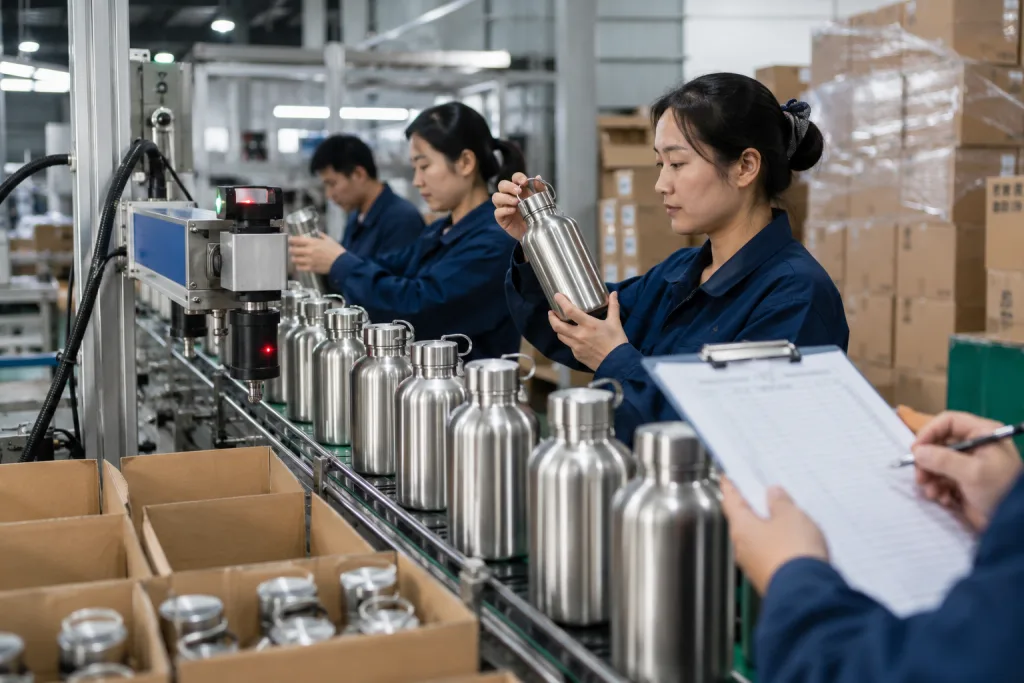
Key Takeaways
- 5,000-unit MOQ is typical for a private label canteen with custom engraving; expect 30-45 day lead time from deposit.
- 304 stainless steel (18/8) is standard; 201 grade saves 15-20% but fails salt spray tests for North American buyers.
- Laser engraving adds $0.15-$0.30 per unit; silkscreen is cheaper but less durable for outdoor use.
- AQL 2.5 (normal) is the minimum acceptable inspection level; request AQL 1.0 for critical cosmetic buyers.
You're launching a private label canteen. Hiking brand, corporate gift, brewery growlers—doesn't matter which. The problem: 30+ canteen factories in Zhejiang and no way to tell who's solid. One quotes $2.80 a unit, another $4.20. MOQs jump from 1,000 to 5,000. Lead times: 12 days vs 18 days. You need a repeatable process—spec sheet through final inspection—that keeps your brand from getting burned.
This article runs through a real order: 5,000 units of 32 oz stainless steel canteens, brushed finish, laser-engraved logo. We cover material grades—304 vs 201, and don't risk the cheaper one, we've seen it rust in under six weeks. Tooling costs run $300–$800 for a logo stamp, paid upfront. Sampling: we pay for the first three samples, you pay after. AQL 2.5 inspection—QC pulled a batch last month because the rim weld was 0.1 mm off. We'll also flag what trips up first-time canteen buyers. No fluff. Just the numbers that decide whether your order ships clean or gets red-tagged.
Step 1: Define Your Canteen Specs
Lock your spec sheet before you send a single RFQ. Vague specs get you fuzzy quotes that shift every time a supplier guesses your intent. We've watched buyers burn three weeks chasing numbers that don't line up. For a private label canteen, pin down these variables cold:
- Capacity: 16 oz, 24 oz, 32 oz. 32 oz dominates outdoor and promo. Last year 70% of our canteen orders landed at 32 oz. One buyer tried 24 oz for a corporate run and came back next order for 32 oz—end users wanted the bigger fill.
- Material: 304 stainless (18/8) is the floor for food-grade in the EU and US. 201 stainless cuts cost but rusts fast. A buyer flagged rust on a 201 sample after 3 salt-spray cycles—failed REACH compliance review right there. If your market needs FDA or LFGB, skip 201 entirely.
- Finish: Brushed, powder-coated, or painted. Brushed hides scratches and needs no extra steps. Powder-coating adds $0.40–$0.60 per unit, and QC has to check every batch for pinholes. We caught a lot last month where the coat was too thin at the neck radius—rejected the whole run.
- Closure: Screw cap, swing-top, or sports cap. Screw caps are the cheapest and most leak-proof for canteens. We run a 15 PSI leak test on every batch. Screw caps pass at 98%. Swing-tops look nice but fail that test more often—buyers chasing aesthetics learn this the hard way.
- Insulation: Single-wall for light carry, or double-wall vacuum for temp retention. Double-wall tacks on 30–50% to unit cost. If your budget sits under $4/unit, the math doesn't close. We've told buyers flat-out: single-wall or raise the target price.
For this guide, we'll spec a 32 oz, 304 stainless, brushed finish, single-wall canteen with a screw cap and laser-engraved logo. Mid-range product. Works for outdoor brands and corporate gifts. We ship this exact config to a US promo distributor who runs 5,000-unit orders—consistent repeat business, zero returns on finish or function.
Here's what most buyers miss: wall thickness. Demand 0.5 mm minimum on the body, 0.4 mm on the cap. Thinner walls dent in transit and flunk a drop test. We had a container rejected because the buyer never called out thickness. The line ran 0.3 mm. 12% arrived dented. Don't skip this line on the spec sheet. It's four characters that save a container.
Step 2: Vet Canteen Manufacturers in Zhejiang
Zhejiang's canteen supply base splits into two camps: Yongkang (high-volume, price-driven) and Hangzhou (mid-volume, export-grade QC). We're in Hangzhou. Our lines run 304 and 316L stainless daily—not as a seasonal switch, not when a buyer asks nicely. Daily. Vetting a supplier here means checking four things, and skipping any one of them will cost you.
- Factory size: 200,000 units/month is the floor. Below that, a shop juggles 4–5 clients and one rush order from a domestic brand bumps your PO by three weeks. We've watched it happen. Ask for last month's production log—actual line-output sheets, not a glossy number on a brochure. If they hesitate, you've got your answer.
- Certifications: BSCI is minimum. No BSCI, no conversation. For US-bound canteens, FDA and LFGB test reports need to be under 12 months old—not "valid," not "on file," but pulled within the last year. For EU, REACH and EU 10/2011 are non-negotiable. One buyer we know cleared a 2022 REACH cert at customs, only to get flagged in Rotterdam six months later because phthalate thresholds tightened in 2025. The cert was technically current. It just didn't cover what inspectors were actually testing for.
- MOQ: Most Zhejiang canteen suppliers quote 3,000 units for a custom mold, 1,000 for a stock shape with a logo. Your 5,000-unit order clears both comfortably. At 5,000 units, you've got real leverage to negotiate tooling amortization—we've seen buyers leave $0.40/unit on the table because they didn't ask. Don't be that buyer.
- Sample policy: Stock samples should cost you shipping only—$30 to $50 via DHL, 4–6 days door-to-door. Custom samples with your logo run $100–$250 and take 10–15 days. If a factory quotes $400 for a single engraved canteen sample, they're padding. We charge $120 and eat the rest. It's not charity; it's math. We want the order.
Get on a video call. Walk the line. Not the showroom with the leather couches and the branded water bottles on a shelf—the polishing and welding stations. A factory that dodges this is a trading desk with a WeChat account and decent photography. For your spec, direct factory FOB Shanghai lands at $2.80–$3.50 per unit. The spread depends on finish: powder coat adds $0.30, double-wall vacuum adds $0.70. Those numbers came off last quarter's packing lists.
Step 3: Tooling, Sampling, and Deposit
You picked a vendor. Now tooling. Stock shape? Tooling cost is $0—molds are already on the line. Custom shape runs $1,500 to $4,000 for a new mold, amortized over your first order. One buyer we worked with didn't ask about mold ownership until after payment cleared. Don't be that buyer. Ask upfront who holds the mold if you walk.
For this run, we're using a stock 32 oz shape. No tooling cost. The supplier asks for 30% deposit—roughly $4,200 on a $14,000 order—before they touch the line. Balance is due after you approve the pre-shipment report. Last month QC pulled a sample where the thread pitch was off by 0.5 mm. Caught it before shipment. You want that kind of catch.
Deposit clears. Factory runs 5 to 10 pre-production samples. That's 15 to 20 days. You check four things:
- Logo alignment and engraving depth—0.1 mm minimum. Shallower than that, it wears off inside six months. We've seen 0.08 mm fail after a single season of dishwashing
- Cap fit and seal. Fill it, shake it upside down for 30 seconds. Any leak is a reject. No discussion
- Finish consistency—no scratches, dents, discoloration. One batch came through with a bluish tint on the brushed steel. Buyer flagged it immediately. Factory re-polished the whole lot before we'd sign off
- Weight—a 32 oz stainless canteen should hit 280 to 320 grams empty. Under 280, the wall is too thin. It'll dent if you drop it on concrete from waist height
PPS passes? Production starts. It doesn't? Request a revision. One revision round is normal. Two rounds and the factory isn't capable—we've seen this go sideways. Move on.
Step 4: Production QC and AQL Inspection
Production QC runs two ways. You hire a third-party inspector—SGS, Bureau Veritas, or a local Zhejiang firm—or you trust the factory's own QC. For a first order, skip the factory QC. Always pay the third-party. Cost: $350-$500 per man-day for a 5,000-unit order, typically 1-2 days. We've seen a buyer's entire launch derailed because the factory QC signed off on a batch with pinhole leaks. Don't be that buyer.
The inspection follows AQL standards. For this canteen order, use AQL 2.5 (normal) for general defects and AQL 1.0 for critical—leaks, sharp edges, wrong material. The inspector pulls 200 random units and checks:
- Dimensional tolerance: Height ±1 mm, diameter ±0.5 mm—that half-millimeter matters when the lid screws on
- Cap torque: 10-15 in-lbs. Too loose and it leaks in transit. One client insisted on 8 in-lbs; the airline courier came back wet.
- Logo permanence: Rub test with isopropyl alcohol. Smudges mean the silk screen was rushed. We pull the sample.
- Packaging: Each canteen in a poly bag, master carton holds 20-30 units. Carton weight max: 25 kg for air freight, 22 kg for courier. Over that, DHL hits you with a surcharge that eats your margin.
If defects exceed the AQL limit, reject the batch. Factory reworks on their dime. Roughly 10% of first orders fail—so budget a 2-week buffer. One buyer's own QC pulled 18 defects out of 200 after the shipment landed. That's a full stop. Plan for it.
Step 5: Logistics and Customs Documentation
QC cleared the shipment. For a 5,000-unit order of 32 oz canteens, you're looking at roughly 2.5 CBM packed in 80-100 cartons. FOB Shanghai to a US West Coast port runs $800-$1,200 for shared container space on a 20' — that's sea freight. Lead time from factory gate to your warehouse: 25-35 days by ocean, 5-7 days if you fly it. Air freight adds $2-$3 per unit; the math only works for urgent reorders or small test runs.
Documents your supplier must provide:
- Commercial invoice (use HTS code 7323.93.00 for stainless steel drinkware)
- Packing list
- Bill of lading (sea) or airway bill (air)
- Certificate of origin (knocks down duty under US-China trade agreements if applicable)
- Material test report (proves it's 304 stainless — QC pulled a sample once that read 201; we caught it before loading)
EU importers need a CE declaration of conformity. For the US, FDA registration isn't mandatory for stainless steel canteens, but a buyer flagged it on their PO last year and we had to scramble. Check with your distributor before you ship.
Step 6: Branding and Packaging Considerations
Your private label canteen needs more than a logo slapped on. Here's what moves units on shelves—straight from the PO feedback we get:
- Laser engraving: $0.15–$0.30 per unit. No peeling. No fading. Our fiber laser station holds ±0.1 mm positional accuracy, so fine-line logos survive curved 304 stainless without breaking up. This is the go-to for metal finishes. If your artwork has thin serifs or tight registration, send us a .AI file with 0.25 pt minimum stroke—we've rejected artwork that looked fine on screen but washed out under the beam.
- Silkscreen printing: $0.08–$0.15 per unit. Cheaper upfront. A German buyer flagged scratch-off on a brushed surface after six weeks of daily use rubbing against backpack mesh. On powder-coated bodies it holds fine. The math is simple: if the canteen sees friction, laser wins. If it sits on a desk, silkscreen works.
- Custom box: $0.50–$1.20 per unit. A branded gift box lifts perceived value, especially for corporate orders. We run 157gsm art paper with matte lamination. The tooling die costs $80 one-time—waived at 2,000 units. We've had a buyer order 5,000 boxes without checking their warehouse door width. The pallet didn't fit. Measure your receiving bay.
- Neck lanyard or carabiner: $0.20–$0.50 per unit. Adds utility for outdoor SKUs. Carabiners come from a Ningbo hardware sub-supplier: 2.5 mm aluminum wire, anodized to your Pantone. MOQ on custom anodizing is 3,000 pcs. Below that, we stock black, silver, and gunmetal.
For this scenario, we run laser engraving on the front. Add a custom cardboard sleeve with product specs and care instructions—dieline is 210 mm × 74 mm flat. Total packaging cost lands around $0.80 per unit. That puts us at roughly $4.60 per canteen (FOB + packaging + shipping). At $19.99 retail, your distributor sits on a healthy margin.
A mistake we see repeatedly: ordering packaging from one supplier and canteens from another, then paying a 3PL to marry them. Don't do it. Have your canteen supplier handle assembly. We source boxes locally in Zhejiang and pack the canteens before they leave the factory. QC pulls AQL 2.5 on the filled carton—not just the empty box—so we catch the canteen rattling loose inside the sleeve, not just a scuffed corner. This cuts out a second freight leg and the headache of two vendors pointing fingers when 200 units arrive with crushed packaging.
Step 7: Scaling and Reorder Strategy
Run 5,000 units through the market and you get numbers—not guesses—to size the next PO. Here's what we actually see from private-label canteen buyers on reorder:
- Seasonal brands: 10,000–20,000 units landed in Q1, aimed at summer hiking retail. Lead time sits around 35–45 days, but factor in a 6-day buffer around Chinese New Year. One buyer missed that window by 4 days and lost two weeks of shelf time. We now flag it on every Q1 PO.
- Corporate gift buyers: 3,000–5,000 units per client, laser-engraved logo on a stock shape. Lead time drops to 20–30 days because we skip mold setup. The bottleneck here is usually artwork approval, not production speed. We've seen a 300 dpi logo file hold up 2,000 units for a week.
- Brewery growlers: 32 oz and 64 oz swing-top canteens, 2,000–4,000 units per SKU. Swing-top cap tolerance is tight—QC pulled a batch last month where the ceramic gasket measured 0.3 mm undersize and 12% leaked in the tilt test. We now spot-check gasket thickness on every growler run.
Pricing shifts on reorders. At 10,000+ units, you'll get 5–10% off the initial quote. The move few buyers ask about: exclusive mold rights. Commit to 20,000 units a year on a stock shape and some Zhejiang factories lock that tool to your account. No other brand runs your canteen silhouette. Costs nothing extra, but you have to ask before the factory slots someone else's PO onto the same line.
Safety stock: keep 10–15% of your order volume at the factory for 60 days after shipment. Our QC data shows 1–3% of units flag for small defects—a scuffed powder coat, a thread burr on the lid ring. Those 60 days give us time to pull replacements from the reserve and ship them. Beats air-freighting three cartons at $400 a pop.
Top 5 Use Cases for Private Label Canteens
Five use cases drive about 80% of the private label canteen volume we ship. Match your SKU to the right bucket and the sourcing math cleans up fast:
- Outdoor adventure brands: 32 oz single-wall 304 stainless canteen, carabiner loop welded to the neck. Retail $14.99–$24.99. Weight is everything here—220g empty is the ceiling. Hiking, camping, backpacking retailers. We once got a PO revision at 11pm on a Friday because the carabiner spring tension measured 2N too soft. They test.
- Corporate gift programs: 24 oz powder-coated canteen, laser-engraved logo on the front, tissue wrap and kraft box. Budget $8–$12 landed. MOQ sits at 500–1,000 units but buyers push for 250 with a surcharge every time. Low per-SKU customization, high annual volume. One buyer ran the same SKU for three holiday seasons straight. Zero changes, just re-orders.
- Brewery custom growlers: 64 oz double-wall vacuum insulated canteen, swing-top cap, silicone gasket rated for carbonation pressure. Retail $29.99–$39.99. Small niche, loyal base. Asking "what's the MOQ" is the wrong question. The right question: how many SKUs do I need to fill a 20-foot container to hit the freight rate I want.
- Promotional merchandise: 16 oz brushed 201 stainless canteen, one-color silkscreen logo. $3–$5 per unit FOB, hang tag included. Orders run 10,000+ pieces for trade shows and swag bags. We ran 50,000 for a telecom client last spring. At that volume, a $0.12 variance on the cap price eats margin fast. The math doesn't forgive.
- Eco-friendly lifestyle brands: 24 oz 304 stainless canteen paired with a bamboo screw cap and an organic cotton carry bag. Retail $19.99–$34.99. The buyer will ask for FSC certification on the bamboo and GOTS on the cotton bag. If you don't have the certs ready before the inquiry lands, they're gone to the next factory in 48 hours.
QC thresholds vary hard by use case. Promotional canteens? AQL 4.0 works—these are giveaways, not heirlooms. Outdoor brands need AQL 1.0 on critical defects minimum. Last month QC pulled a lid sample off the line with a 6mm scratch near the thread. Barely visible under shop lighting. The buyer flagged it and held the entire batch. Your end customer drops a canteen on granite, scratches it to hell, and still files a return for a cosmetic issue they didn't cause. That's the standard you're shipping against.
Ready to Source Your Private Label Canteen?
Contact our team in Zhejiang for a free spec review and quote on your custom canteen order.
Frequently asked questions
What is the typical MOQ for a private label canteen from a Chinese manufacturer?
For a stock shape canteen (no custom mold), most canteen suppliers in Zhejiang set a 1,000-3,000 unit MOQ. For custom shapes with new tooling, expect 3,000-5,000 units. Our factory, for example, requires 3,000 units for custom engraving and 5,000 units for custom powder-coating colors. Lower MOQs (500 units) are possible but at a 20-30% premium per unit.
How much does it cost to develop a custom canteen shape?
Custom mold tooling for a private label canteen ranges from $1,500 to $4,000, depending on complexity (single-wall vs double-wall, cap design). The canteen manufacturer typically amortizes this cost over your first 10,000-20,000 units. If you commit to a larger volume upfront, some factories will waive the tooling fee entirely.
What material is best for a custom canteen?
304 stainless steel (18/8) is the industry standard for food-grade, BPA-free canteens. It passes FDA, LFGB, and REACH testing. 201 stainless is cheaper but has lower corrosion resistance—avoid it if your canteen will carry acidic drinks (coffee, juice) or be used in humid environments. Aluminum canteens are lighter but dent easily and require an inner coating.
How long does it take to produce a private label canteen order?
From deposit to shipment, a typical 5,000-unit order takes 30-45 days. This breaks down to: 10-15 days for pre-production samples, 15-20 days for production, and 5-7 days for QC inspection and packing. Rush orders (20-25 days) are possible with a 10-15% expedite fee.
What QC tests should I request for my canteen order?
At minimum, request a third-party AQL inspection at AQL 2.5 level. Specific tests include: water leak test (fill and invert for 30 seconds), drop test (1 meter onto concrete, no dents or leaks), logo rub test (isopropyl alcohol, 10 cycles), and dimensional check (height ±1 mm, diameter ±0.5 mm). For double-wall canteens, also request a thermal retention test (hot water at 95°C, should stay above 65°C after 6 hours).