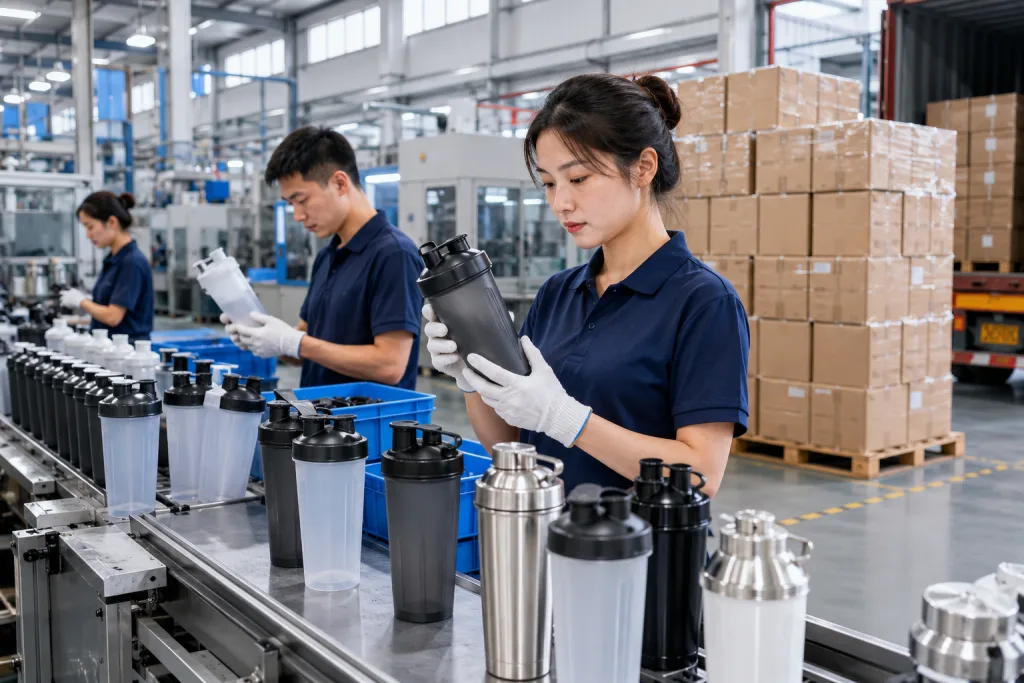
Key Takeaways
- A realistic MOQ for private label blender bottle orders is 1,000-3,000 units per color for standard molds
- PP, Tritan, and 304 stainless steel suit different price points, compliance needs, and retail channels
- AQL 2.5/4.0 inspection should include leak testing, logo adhesion, lid fit, carton drop, and barcode checks
- Normal production lead time is 25-35 days after artwork and deposit, excluding testing or new tooling
A private label blender bottle looks simple until you sign off a lid with only 1.2 mm thread bite, a mixing ball that rattles like scrap in a parts bin, or a logo that peels after 2 dishwasher cycles. One failed sample is not the real problem for B2B buyers. The real problem is 8,000 units landing 12 days late, 3 cartons leaking during 1.2 m drop testing, or a retailer rejecting the order because QC pulled the sample and found the gasket material missing from the test file.
We manufacture custom drinkware in Hangzhou, Zhejiang, and we run these checks every week for canteen distributors, sports nutrition brands, Amazon sellers, and corporate gift teams ordering 3,000 to 50,000 pcs. China has at least 200 canteen suppliers chasing blender bottle orders, but plenty are not built for food-contact testing, repeat Pantone matching, or private label packaging with barcode control on the line. Cheap quote? Wrong question. We’ve seen this go sideways over small details, like a PO typo changing “matte black lid” to “black body,” so use this guide as a practical buying checklist before you send an RFQ.
First question: what are you actually buying?
Buyers ask for a private label blender bottle, but that RFQ can point to 3 different items. One buyer means a protein shaker with a wire ball. Another wants a gym bottle with a flip lid and a plastic mixing grid. A third is pricing a stainless retail set with a powder capsule, barcode sticker, and gift box. Name the item first. Then ask for price. Last month QC pulled a 700 ml sample at the packing table because the PO said “blender bottle,” while the approved photo showed a plain sports bottle with no mixer. Wrong item. Wrong quote. Two emails wasted.
A useful starting spec is simple: 600 ml or 700 ml capacity, PP or Tritan body, screw lid, flip drinking cap, 304 stainless steel mixing ball, ml/oz measurement marks, single-color logo, individual polybag or color box, FOB Ningbo or Shanghai. Put the strange parts in the first email. Custom canteen shape, powder container, carry loop, cap lock — these change the mold choice and the unit cost. We run into this on the line; a 1.2 mm lid gasket, a 65 mm ball, or a 5,000 pcs MOQ can move the quote more than the logo method. Buyers often argue about logo cost. The cap structure is where the money goes.
The word “canteen” causes sourcing mistakes. In North America, a canteen custom project might mean an outdoor bottle, a military-style flask, or a promo water bottle for a campus event with a 2-color logo. In China factories, “canteen” gets used loosely for drinkware, so a sales rep can quote the wrong body from an old catalog page. Send drawings or reference photos if you ask several canteen manufacturers for prices. Product names are not enough. We saw this go sideways when the buyer flagged the sample as “too tactical,” while the supplier thought “canteen” meant army-style from day one; the carton mark was already printed on 38 boxes.
For distributor drinkware programs, the real question is stock mold or full custom design. Stock mold private label is faster, often 25-35 days after sample approval. New tooling can add 20-45 days and USD 1,500-8,000 depending on bottle body, cap, inserts, and mold complexity. The math does not work if you need 1,000 pcs but also want a new cap, new body ribs, and a custom powder cup. We ship stock-mold programs in cartons around 12-14 kg each; for new tooling, we check the 2D drawing, CNC sample, and pilot run before mass production. QC measures the first shot with a caliper, and a 0.3 mm cap mismatch is enough to stop the line.
Which material fits your channel?
Material choice sets the FOB target, test bill, grip feel, and how many after-sales emails land in your inbox after launch. Samples can lie. We run each bottle on a 0.01 g scale, check the mouth ID with a digital caliper in mm, then match the resin or metal to the sales channel and the food-contact file your buyer will request.
PP blender bottles are the budget workhorse. A 600-700 ml PP shaker usually fits gym chains and supplement giveaway orders where the target FOB price sits around USD 1.20-2.20 depending on lid, logo, and packaging. PP is light and impact resistant. Good for volume. The grip feels softer than Tritan, but the surface looks less crisp beside clear bottles on a retail shelf. Odor complaints start when users leave whey powder inside for 2-3 days. We had one buyer push back after QC pulled the sample and found protein smell still in the cup after a 24-hour wash test, so we now note that risk on PP samples before the buyer signs the carton mark.
Tritan bottles look clearer on the shelf, so they fit premium private label ranges and subscription-box drinkware better than PP. Expect a higher FOB range, often USD 2.20-4.50 for standard capacity and normal packaging. For Europe, ask for LFGB or EU food-contact documentation before you approve artwork. For the US, FDA food-contact suitability is the baseline. Small detail from the line: we check haze and black dots under a 6500K light booth, because 1 black speck near a 35 mm logo area is enough for a retail buyer to reject the carton photos. This is where cheap resin becomes expensive.
Stainless steel blender bottles serve a different buyer. They ship as double-wall insulated or single-wall bottles. A 304 stainless steel body with 0.4-0.5 mm wall thickness gives better perceived value but adds cost and carton weight. Stainless also supports laser engraving and powder coating, which gives the buyer a tougher retail story than a basic plastic shaker. It sits closer to custom growler and customized growler sourcing. The math does not work if the buyer wants a heavy 304 body, gift box, powder coat, and the same price as a PP shaker; we have seen that go sideways at PO stage when the carton GW jumps by 6-8 kg and the forwarder asks for revised freight before booking.
If your product line already includes a customizable canteen or customizable growler, keep the material wording consistent across the range. Retailers and distributors like clean families: one plastic fitness bottle and one stainless travel bottle, with the larger growler spec tied to the same finish language. A scattered material plan makes reordering harder, especially when a buyer sends a repeat PO with “same as last time” but forgets whether the lid was PP or Tritan. We ship smoother when the spec sheet lists resin, Pantone color code, MOQ, and logo method in one place; one PO typo on “TR lid” cost 3 days of checking before production release.
MOQ, pricing, and real lead times
MOQ kills 6 out of 10 RFQs before pricing even gets discussed. For standard molds, our floor runs 1,000-3,000 units per color on a private label blender bottle, depending on material and decoration. A Pantone-matched color needs 3,000 units minimum. Resin suppliers charge for small batches, and injection setup waste is real—last month the line scrapped 68 kg of PP before the color meter held tolerance. Stainless bodies with powder coating can run at 1,000 per color, but complex gradients or specialty coatings push that up. 500 pcs per color will not work. The math is not there.
FOB China pricing depends on the build. A basic PP shaker with a mixing ball and one-color silkscreen logo sits around USD 1.20-2.20. A Tritan version with better lid engineering and a retail color box runs USD 2.20-4.50. A stainless insulated blender bottle with 304 inner and outer steel, powder coating, and a laser logo ranges from USD 5.50-9.50. QC pulled a sample last week because the logo sat 3 mm off-center—the buyer changed the artwork file but not the PO version. That kind of detail costs time.
Our Hangzhou production line handles about 450,000 drinkware units per month across plastic and stainless categories. Capacity does not remove planning. Normal lead time: 25-35 days after deposit, approved artwork, and approved pre-production sample. Add 7-12 days for third-party testing before mass production. Add 20-45 days for new molds. Fast quotes sound nice; shipping is less forgiving. We ship cleaner when buyers approve the sample by day 5 instead of day 12. By day 12, the mold room and powder coating booth are already booked.
For distributor canteen and growler orders, ask your supplier to separate costs clearly: product, decoration, packaging, testing, inland freight, export carton, and FOB port. A low unit price that hides color box cost or logo setup cost is not a real quote. It is a future argument. We saw this go sideways when a buyer flagged a USD 0.18 color box charge after the export cartons were packed, 24 pcs per carton, sitting near the Ningbo truck bay.
Private label checklist before RFQ
Build a spec sheet, not a wish list. I've watched a buyer burn 11 weeks and seven sample rounds because the brief was three photos and "make it premium." Another buyer sent a one-page spec — production samples in 18 days. Complete briefs get faster quotes and tighter pricing. A photo alone? The factory fills the blanks with the cheapest mold on the shelf.
- Capacity: 500 ml, 600 ml, 700 ml, 800 ml, or 1,000 ml. Specify brimful or usable fill — the difference sits around 40 ml on most molds we run. A buyer ordered 700 ml "usable" but received 700 ml brimful. That's 660 ml of actual drink space. Return-rate problem, straight away.
- Material: PP, Tritan, 304 stainless, or mixed build. BPA-free is table stakes. The real call is food-contact standard: FDA for US retail, LFGB for EU. Pick one. A mixed PP body + Tritan lid is common, but flag it early — the bonding line changes the mold gate position, and that shifts the injection point by roughly 8 mm on our 700 ml tool.
- Mixing system: stainless ball, plastic whisk grid, internal agitator, or no moving parts. For protein shakes, skip the plastic grid. We ran a batch where 12% of grids cracked by month four. The stainless ball is one piece, no welds, survives the dishwasher. We ship these by the pallet and the failure rate sits below 0.3%.
- Lid function: screw lid, flip cap, carry loop, cap lock, straw lid, or leakproof gasket design. Test the gasket fit on your first sample. QC pulled 600 units last May — gasket was 0.3 mm undersized. Passed visual, failed the leak-down test at 40°C. That's a whole pallet quarantined over a $0.003 part.
- Decoration: silkscreen, heat transfer, pad print, laser engraving, embossing, or full-wrap sleeve. Under 5,000 units, silkscreen is the right call. Laser engraving only pops on stainless — on Tritan it's barely visible. A buyer once asked for laser on a white PP bottle and got ghosted text. We eat the rework when that happens, but it adds 9 days.
- Packaging: polybag, white box, kraft box, color box, retail sleeve, master carton, or FNSKU labeling. Selling on Amazon? Confirm the FNSKU barcode position in the art proof. We watched an ASIN get blocked because the barcode sat on a side seam — unreadable at the fulfillment center. 15-day hold, lost Buy Box. The fix was rotating the art 90 degrees on the same dieline.
- Compliance: FDA, LFGB, REACH, California Prop 65, BSCI audit, ISO 9001, or retailer-specific docs. "All certifications" is the wrong request. Name the two your compliance team actually checks. We can pull the LFGB lab report from the last production run and have it in your inbox same day. Prop 65 requires a separate heavy-metals panel — 5 working days, $280. Budget for it if California is in your distribution plan.
Give your annual forecast. A first order of 2,000 units with a yearly plan of 60,000 units changes the math on tooling, raw material contracts, and decoration method. The factory can lock PP resin pricing for 12 months and recommend a mold steel grade that handles the volume — S136 versus 718H, for example, and that's a $1,200 difference on a single-cavity tool. Say "best price" and you'll get the safest, most generic option — the one the factory uses when they don't trust the repeat order. I've seen that quote come back $0.12 higher per unit than the honest-volume quote.
Get mold and artwork ownership in writing. Some Chinese factories offer low tooling fees but keep full control of the mold. That works for a one-off seasonal promotion. It's the wrong move for a long-term private label asset. We've seen a buyer lose their entire product line when the mold owner switched factories mid-season — 11,000 units of stock, no mold, no backup. Ownership goes in the contract before the PO. Not in an email. In the contract.
Logo, color, and packaging choices
Pick a logo method that fits the bottle material and how long you want the print to last. Silkscreen is cheap for one- or two-color logos on flat plastic or powder-coated stainless. We ship a lot of canteen promotional orders this way. Pad printing handles curved or textured surfaces cleaner. Heat transfer gives you more colors, but we’ve had adhesion issues if the plastic surface isn’t prepped right. Laser engraving on stainless—that’s the most durable and looks premium, but it’s not cheap.
The common mistake on a private label blender bottle: putting a big logo across a flexible panel that users squeeze. That area flexes, the print cracks. Keep artwork on stable panels. If you need dishwasher resistance, ask for 20 dishwasher cycles at 65–70°C. That’s our internal benchmark. Not every order needs a full lab report, but we’ve seen buyers skip this test and the print peeled after two weeks. One PO had to be reprinted entirely—cost the client three weeks and an extra $0.18 per bottle.
Color matching takes discipline. A Pantone chip on coated paper looks different on PP resin, Tritan, a silicone gasket, powder coating, or printed carton. Get a physical chip or a pre-production sample, and check it under normal light, not a desk lamp. For canteen customizable programs with multiple SKUs, approve color families together. Approving one lid color and then a body color next week is how you end up with an “almost black” lid and a dark charcoal body. QC flagged that exact mismatch last month on a 12,000-unit run. The buyer didn’t notice until we sent photos.
Packaging isn’t decoration—it protects your margin. For Amazon FBA or retail, you need barcode placement right, FNSKU label size correct, suffocation warning on polybags if they’re used, carton weight under 15–18 kg, and drop-test specs. A beautiful color box with weak flute board will crush before the consumer sees it. We run 1.2m drop tests on every new carton structure. Twice a buyer flagged a corner crush that forced a redesign. The math is simple: a box that survives shipping costs $0.35. A box that doesn’t costs a chargeback and a lost shelf slot.
Quality control questions to ask
Quality control for blender bottles is more than scratching a surface. Leaking is the real killer. One leaking lid creates bad reviews, chargebacks, and distributor returns. Your purchase order should define inspection standards before production starts, not after.
Use AQL as a baseline. We run AQL 2.5 for major defects and AQL 4.0 for minor defects. Critical defects are zero tolerance—we don't ship them. For a 5,000-unit order, a final random inspection covers ten checks per sample: appearance, capacity, lid fit, gasket seating, logo position, print adhesion, packaging, carton marks, barcode scanning, and leak performance. Last month QC pulled a batch where the barcode didn't scan—the printer had a typo in the PO number. Caught at inspection, not at the dock.
A practical leak test is simple. Fill the bottle to 80-90% capacity, close the lid, invert for 5 minutes, shake for 30 seconds, and check the cap, thread, and flip opening. For blender bottles, also test powder mixing with 300 ml water plus powder substitute. It sounds basic, but it catches bad ball size, poor grid design, and caps that pop open under pressure. We once had a buyer flag a cap that held water but blew off during shaking. The mold had a 0.2 mm draft angle error. The line fixed it in three days.
Ask your canteen vendor for incoming material control and production checks, not only final inspection photos. For stainless steel, confirm 304 grade with material certificate or spot XRF testing when needed. For plastic, ask about resin batch control and odor checks—we've seen this go sideways when a supplier swapped resin grades without notice. If the canteen factory has ISO 9001 and BSCI, that helps, but certificates do not replace inspection. Zhejiang produces over 60% of China's stainless drinkware. The supply chain is strong. But the buyer still needs written quality criteria. The math doesn't work without them.
Best-fit options for common buyers
No universal "best" blender bottle exists. Only the build that fits your sales channel, your target FOB, and the number of after-sales emails your team can stomach. We run export orders for supplement brands, retail chains, and corporate buyers, so we sort options by landed cost, print durability, compliance workload, perceived value, and reorder stability. One buyer saved $0.12/unit on a flip cap, then paid $4,000 in return shipping after 300 caps cracked in transit. QC found the first crack at the hinge during a 20 kg carton compression check, but the PO had already been pushed through.
Best for supplement promotions
600–700 ml PP shaker with a 304 stainless mixing ball, one-color silkscreen logo, bulk carton or simple white box. Unit cost stays under $0.85 FOB at 3,000 units. We run these at MOQ 1,000, but 3,000 gives better carton loading and cleaner freight math. Simple works. Event giveaways and gym promos need a bottle that survives three months of whey powder, locker-room drops, and dish rack abuse without leaking into a gym bag. QC pulls 125 pieces at AQL 2.5 and flags thread flash above 0.3 mm when it catches on the cap gasket.
Best for retail private label
Tritan body, flip cap that snaps clean after 500 open/close cycles, clear measurement marks, and a color box with barcode placement checked before mass printing. Shelf presence matters here; the bottle has to look cleaner than the $9.99 competitor beside it. Build in six weeks of testing lead time for EU or US compliance. We had one buyer skip LFGB testing to hit a launch date, then redo the full order when German customs flagged the gasket material. The math doesn't work on shortcuts here. That buyer also flagged a 2 mm logo shift on the pre-production sample — much cheaper to fix before the line starts.
Best for premium corporate gifting
304 stainless, powder-coated finish, laser engraving. The bottle weighs 380 g empty. It feels expensive the second someone picks it up. Laser engraving holds through dishwasher cycles that peel a pad-printed logo in 12 washes. Cost sits above a PP shaker, but corporate buyers seldom argue over a $2.50/unit gap when the product will sit on a VP's desk for two years. We check coating thickness with a film gauge, usually 60–80 μm, because thin powder coat around the base ring is where complaints start.
Best for outdoor product families
If you already sell customized canteens, add a blender function to the same bottle family. We ship matching canteen, growler, and blender sets with shared cap threading, powder coat colors, carton dimensions, and brand language printed from the same approved artwork file. One buyer started with 2,000 canteens, added 1,500 blenders the next season, and cut per-unit freight by 18% because both SKUs palletized on the same 40HQ container. Distributors like ranges that look planned, not five unrelated canteen suppliers patched together. We have seen this go sideways when a PO lists "matte black" for one SKU and "black matt" for another; the line reads that as two finishes unless someone catches it. This is the wrong question to ask a factory that only runs one bottle type. You need a line that already handles mixed SKU production.
How to judge a supplier
I run a custom drinkware factory in Hangzhou. When a buyer sends an inquiry for 5,000 private-label blender bottles, here's what separates a supplier worth talking to from one you'll regret six months later: they ask annoying questions before they quote. Your target market — EU, US, or Southeast Asia — changes the gasket formulation. Your compliance requirement — LFGB vs FDA — changes the silicone supplier we use. Target FOB. Order schedule. Artwork method: silk screen or IML or heat transfer. Carton stacking limit for Amazon FBA. Retail blister pack or bulk polybag. If a supplier quotes your bottle in under 10 minutes without confirming PP resin grade, cap gasket durometer, or whether the carry loop needs a living hinge, slow down.
You need to know who you're actually talking to. Trading office that subcontracted the mold to a Ningbo workshop. Factory with three partner injection shops and one assembly floor. Full-line manufacturer running 18 injection machines and a clean room for silicone molding. None of those is automatically wrong — we've seen good and bad in every model. The question is control. Who owns the mold blocks. Who checks the lot number on the resin delivery before it hits the hopper. Who signs the AQL 2.5 inspection report at 10:00 PM when the container is loading. Who pays to fix 3% of caps that leak at the gasket seat — we've seen that happen on a 20,000-piece order. Good manufacturers answer these without deflecting. If they blink, walk.
For China sourcing, a video factory audit helps. I've watched too many walkthroughs that linger on the showroom wall and skip the rest. You want the camera on the injection line — look at the floor, look at the material dryer, look at whether the hopper labels match your spec sheet. Warehouse racks: are raw materials stacked on pallets or on concrete. QC bench: is there a caliper out and a go/no-go thread gauge, or just a coffee cup. The sample room where they store past defect references — the wall of shame every decent factory keeps. Ask for export carton photos from the last three shipments, customer info blacked out is fine. Push for a pre-production sample molded from mass-production tooling, not a hand-polished piece from the sales manager's desk drawer. They look different. I've had buyers send me a photo of the PPS and say "this isn't the same bottle." It wasn't.
Judge a vendor by sampling speed, not just how fast they send the proforma. If your canteen distributors reorder quarterly, you need a partner who tracks artwork version history, Pantone numbers, gasket durometer readings from batch to batch, carton KD dimensions so your 40HQ cube doesn't shift, and the defect log from your last order — so when you say "same as PO-0423 but with a matte finish" they know exactly what that means. A cheap vendor who forgets your last spec costs you money over 12 months of reorders, returns, and Amazon reviews. We've run that math. It fails every time.
Send your blender bottle specification for a factory quote
Share capacity, material, logo, packaging, market, and target quantity. We will reply with MOQ, FOB pricing, lead time, and sampling options.
Frequently asked questions
What is the usual MOQ for a private label blender bottle?
For standard molds, a realistic MOQ is usually 1,000-3,000 units per color. PP shaker bottles can sometimes start at 1,000 units if the color is standard and the logo is simple. Pantone-matched resin often needs 3,000 units because injection molding setup and resin purchasing have minimums. Stainless steel versions may start around 1,000 units per color for normal powder coating. New molds are different: the MOQ and tooling cost depend on the body, lid, gasket, and mixing structure. If your launch quantity is small, use a stock mold first and reserve tooling investment for the second or third order.
How long does production take after sample approval?
For a standard private label blender bottle, plan on 25-35 days after deposit, final artwork, and approved pre-production sample. Add 7-12 days if you need third-party food-contact testing before production or shipment. If you require a new mold, add roughly 20-45 days for design, tooling, trial injection, adjustments, and sample approval. Peak season can add another week, especially before major holidays in China. Ocean freight is separate: to Europe or North America it may take 25-45 days depending on port, route, and congestion. Do not promise a retail launch date until sampling, testing, production, and freight are all scheduled.
Which logo method is best for blender bottles?
For plastic bottles, one-color silkscreen is the most common choice because it is economical and clean on simple artwork. Pad printing works better on small curved areas or cap parts. Heat transfer can handle more colors, but you should test adhesion, especially if the bottle flexes during use. For stainless steel blender bottles, laser engraving is the most durable and gives a more premium result. Powder-coated stainless can also use silkscreen, but artwork placement matters. If you claim dishwasher-safe decoration, request a practical test such as 20 cycles at 65-70°C, then check fading, peeling, and edge lifting.
What compliance documents should we ask for?
At minimum, ask for food-contact documentation suitable for your market. For the US, FDA food-contact material suitability is common. For Europe, many buyers request LFGB or EU 1935/2004 related testing, and REACH may apply to certain components or coatings. If selling through large retailers, you may also need BSCI, ISO 9001, carton drop testing, Prop 65 review for California, or retailer-specific restricted substance forms. Do not accept a random old test report without checking material, color, model, and date. A report for a clear Tritan bottle does not automatically cover a black PP lid with silicone gasket and printed logo.
Can one supplier make blender bottles, canteens, and growlers together?
Yes, if the supplier has a broad custom drinkware supply chain and clear QC control. Many buyers combine a private label blender bottle with a customized canteen, stainless travel tumbler, or customized growler to build a full product family. The advantage is consistent color, packaging, logo control, and reorder management. The risk is assuming every factory can make every category well. Plastic injection, stainless steel forming, powder coating, and glass production are different processes. Ask which items are made in-house and which use partner workshops. A good supplier will explain the split and still manage inspection under one AQL standard.