Key Takeaways
- Start with use case: 600-750 ml PP bottles suit school, gym, and promo programs better than hot-fill use
- Typical MOQ is 3,000-5,000 pcs per color for standard molds and 20,000+ pcs for private mold work
- PP is light and economical, but Tritan, stainless steel, and glass win when buyers need premium feel
- Set AQL, food-contact testing, barcode rules, and carton drop standards before paying the deposit
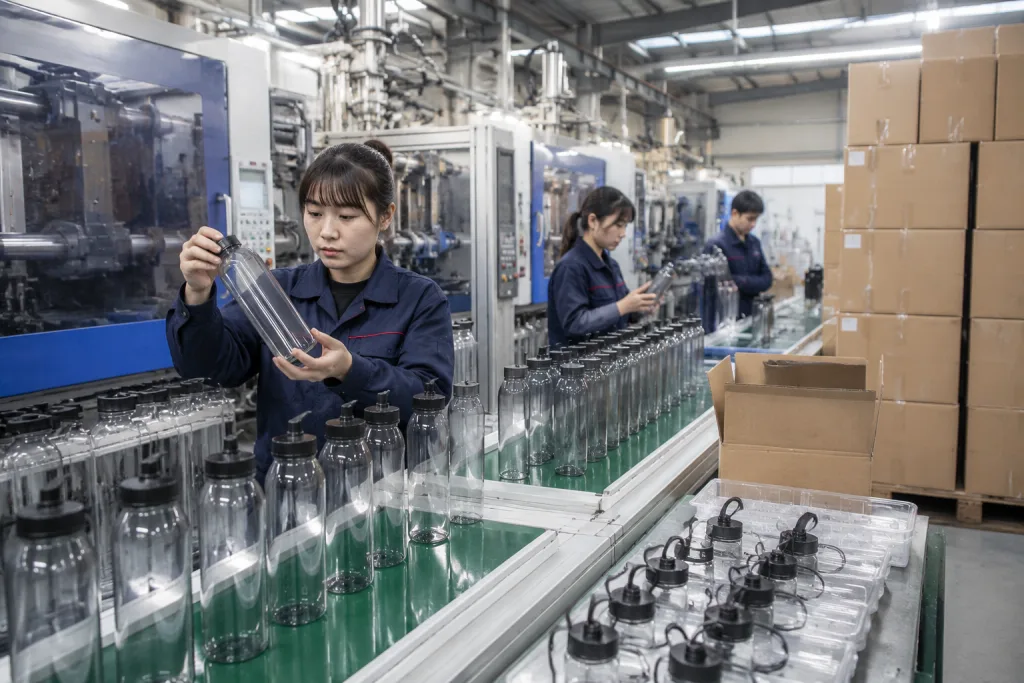
PP looks simple until you need 20,000 bottles with your logo, a retail barcode, a lid that passes a 24-hour inverted leak test, and a color within about 1.0 ΔE of last year’s campaign. For pp water bottles custom projects, the bottle body is only one line on the cost sheet. The real bill includes PP resin lot control, mold tolerance in mm, lid thread fit checked with a go/no-go gauge, rub-resistant printing, export cartons, and paperwork clean enough to avoid a hold at Ningbo.
At our Zhejiang factory, we see buyers lose 7 to 12 days by asking for “a custom canteen” before they decide the use case. Wrong question. A school giveaway and a retail distributor bottle do not run the same spec: wall thickness, cap style, barcode position, and MOQ planning all change. Last month QC pulled a pre-production sample because the silicone ring sat 0.6 mm proud of the groove; after filling, that would have turned into lid complaints. We can run the line for these bottles, but we need the spec before any quotation means anything.
Decide the bottle job first
Decide the bottle’s job before shape or logo size. For a school canteen program, a pp water bottles custom order gets judged on food-contact safety, landed unit cost, and whether staff can wash 800 bottles before the next lunch shift. We run into this every March: the buyer asks for a “nice shape,” then QC pulled the sample and the straw brush stopped at the shoulder. Bad sign. For an outdoor retail distributor, the cap needs more bite, the grip texture cannot feel slippery after a water spray test, and the shelf pack has to survive hands pulling it in and out 20 times. An event canteen customized for 90 days of use is one job. A retail SKU facing returns, online reviews, and 10 kg master cartons is another job.
PP, or polypropylene, fits briefs that need light weight, food-contact safety, controlled flex, and a price point the purchasing team can sign off without three rounds of arguing. We ship it for sports squeeze bottles, kids bottles, simple canteen customizable designs, and wide-mouth bottles. Cold water is fine. Boiling water is the wrong question. PP will not give heat retention or a premium metal handfeel; if the buyer expects that, the math does not work. For insulation, quote stainless steel. For crystal clarity, check Tritan or glass. On the line, we check PP mouth roundness with a go/no-go gauge before cap fitting, because a 0.4 mm warp can become a leak complaint after the cap torque test.
Use this rough decision split before you ask for pricing:
- Promotional giveaway: standard mold, 500-750 ml, one-color silkscreen, polybag or bulk pack; safest route when MOQ is tight and the PO says “ship before fair date.”
- Retail distributor drinkware: stronger cap, hang tag, barcode, color box, carton drop test; the buyer will flag crushed corners faster than a small color difference, especially after a 1.2 m drop on the corner seam.
- School or youth program: BPA-free PP, rounded edges, simple straw or flip lid, ASTM or applicable food-contact documents; we check the mouth edge by hand because sharp flash gets rejected.
- Outdoor custom canteen: thicker wall, carry loop, leak test, textured grip, spare gasket control; ask for gasket color and quantity on the PO, or this goes sideways.
Tell the canteen supplier the use case first. You will get cleaner quotations and fewer sampling surprises. Last month one buyer wrote “canteen bottle” on the PO but meant a kids lunch bottle; tooling changed, cap torque changed from the first setup, and packing moved from bulk carton to color box. We had already printed the sample label with the wrong item code, one digit off. That cost 12 days, not 2.
Pick PP grade and construction
PP bottles do not feel the same in hand. We see this on the line almost every month: the bottle passes the light-box visual check, then the carton compression test leaves oval bodies after 5-layer stacking. For most 600-750 ml PP bottles, we run a body wall around 1.0-1.5 mm, depending on shoulder shape and grip area. A squeeze sports bottle can run thinner because flex is the selling point. A rigid retail canteen needs more bite in the side wall. Simple test. If QC can dent it with one thumb during the pre-pack check, the buyer will flag it after the first pilot shipment.
Ask your canteen manufacturer which PP grade is on the machine and whether it matches food-contact rules in your sales market. For Europe, buyers usually ask for LFGB or EU 10/2011 related documentation, with REACH checked for accessories and colorants. For the United States, FDA food-contact compliance is normally requested. Check the BOM line by line if the cap has silicone, TPE, or a metal pin. The body is not the full risk. We once had a PO say “PP lid,” but the sample room fitted a TPE sealing ring; compliance had to be rechecked before shipment, and that cost us 6 days.
Talk about color before tooling trial. Natural translucent PP is easier to control and often costs less. Solid custom colors need masterbatch, and MOQ can jump to 3,000-5,000 pcs per color because the injection machine, hopper, and resin batch need cleaning between runs. On a 120T injection machine, one color change can eat 45-70 minutes when the last color is dark blue or black. That matters. If you need Pantone matching, agree on a tolerance range before the deposit is paid. PP will not match coated paper Pantone chips 100%, especially in translucent finishes. “Can you match 100%?” is the wrong question to ask. Ask for a signed color limit sample under D65 light.
Construction checks should cover cap thread engagement with a torque meter and gasket fit after assembly. For flip lids, we also test hinge life after repeated opening, straw pull force in N, and bottom flatness on a glass plate. A good canteen factory in China should run basic functional tests before mass packing: 100% leak test for certain lid types, torque check for screw caps, and random fill-and-shake testing with real water. Cheap checks. Write them into the purchase order. If the PO only says “no leakage,” the line will not know whether that means 30 seconds upside down or 2 hours inside a packed carton, and we have seen that go sideways during AQL 2.5 inspection.
Choose mold route and MOQ
The second big decision is simple: use an open mold or pay for a private mold. For 8 out of 10 B2B buyers, we start with the standard mold. Good call most of the time. Existing PP bottle molds cut sample time to about 5-10 days for available colors and 10-15 days for custom color samples; on the line, we confirm color with a Pantone book under a D65 light box before we release the sample. Mass production for normal orders runs 25-35 days after deposit and sample approval. At BottleForge Industrial in Hangzhou, Zhejiang, our practical MOQ for standard pp water bottles custom projects is usually 3,000-5,000 pcs per color, with monthly output around 300,000 mixed plastic drinkware units depending on decoration load.
Private mold makes sense when you need a protected shape, special cap system, unique measurement marks, or a design that a distributor growler or canteen distributor can own for several seasons. It is not magic. A private PP bottle mold can cost several thousand USD to much more, based on cavity count, cap parts, and whether we run blow molding or injection molding. Tooling lead time is commonly 30-45 days before proper testing. Then we still need trial shots, cap torque checks with a torque meter, 1.2 m drop testing, and leak testing on a 24-hour water-filled sample rack. We have seen this go sideways when the buyer approves the 3D file but later flags the grip width after the steel is already cut.
A standard mold can still be customized in practical ways:
- Custom body color with Pantone reference, checked against a molded PP color chip rather than only a paper swatch.
- Logo by silkscreen, heat transfer, IML, or sticker label, with print position measured in mm from the bottle base.
- Custom lid color or matching strap, if the cap resin and body resin accept the same color tolerance.
- Retail packaging, barcode, FNSKU label, or carton mark, including Amazon carton wording when the PO shows the correct SKU.
- Insert card for canteen promotional campaigns, packed by the line before final carton sealing.
If a canteen vendor pushes private tooling before checking your sales volume, push back. This is the wrong question to ask on a first order. Prove the market with a standard customizable canteen, then move to a private mold when repeat orders cover the tooling and inventory risk. QC pulled one sample last year where the buyer wanted a new cap mold for a 3,000 pcs test order; the math did not work. We shipped an open-mold bottle with custom color, logo, FNSKU label, and a clean carton mark instead.
Match decoration to the sales channel
Logo method is where custom drinkware projects go sideways. Pick the decoration to match the sales channel, not the one that looks best in a pitch deck. On PP, silkscreen printing is still the workhorse. It handles one to three colors on curved surfaces without issues, and works for promotional and school orders. For a 5,000 pc run, one-color silkscreen adds roughly USD 0.12 per unit, depending on artwork size and bottle shape. Our operator runs 1,200 pieces per hour on a four-station semi-auto silkscreen machine. We've seen projects go over budget because the buyer picked pad printing for a curve that silkscreen handles fine.
Heat transfer handles multi-color graphics and wraparound effects. It costs more—expect USD 0.25 to USD 0.40 per unit for a four-color wrap. Adhesion testing is non-negotiable; we had a buyer flag lifting on the curved shoulder of a 500ml bottle. QC pulled the sample and found the transfer hadn't bonded at the 90-degree transition. In-mold labeling looks clean for large programs—50,000+ pcs—but requires six-week lead times and higher MOQs because the label is molded into the wall during injection. Laser engraving on PP gives poor contrast versus stainless steel. Skip it.
For retail and distributor canteen programs, think past the logo. You need a UPC barcode, FNSKU for Amazon fulfillment, country-of-origin marking (PP is made in China unless you specify), recycling symbol (resin code 5), warning text, or an instruction insert. Canada requires bilingual packaging. EU requires the Triman logo. If your canteen distributors supply corporate clients, carton-level sorting by logo or color matters more than you think. One client ignored this and spent a weekend repacking 300 cartons by hand—each carton had a different logo on the lid and the side panel, and the line had mixed them.
Send vector artwork in AI, EPS, or PDF. Give print size in millimeters, not "large on front." Ask for a digital proof and a physical pre-production sample when the logo is brand-critical. For repeat orders, keep an approved color chip and printed sample in both your office and the China factory. That stops arguments six months later when your buyer insists the blue shifted—but the chip matches last year's PO.
Price the full landed order
FOB unit price looks cheap until packaging, testing, freight, or rework blows up the total. For standard PP bottles from a Zhejiang canteen supplier, expect FOB between USD 0.70 and 2.20 per piece — capacity, cap design, wall thickness, decoration, and packaging push that range. A 600 ml one-color promo bottle in bulk pack sits near the bottom. A 750 ml retail bottle with flip lid, silicone gasket, color box, and four-color print lands at the top.
Compare quotes off one spec sheet. Ask if the price covers custom color masterbatch, logo setup, sample cost, inner box, polybag, desiccant, barcode label, and export carton. Confirm carton quantity and gross weight. We saw a buyer save USD 0.08 per bottle once, but the carton collapsed in transit — the math doesn't work.
FOB Ningbo or FOB Shanghai is standard for Zhejiang drinkware exports. EXW reads cheaper but dumps local handling on you. For North America, calculate landed cost: ocean freight, duty, customs broker fees, warehouse receiving, and marketplace prep. For Europe, add VAT handling, compliance file review, and packaging waste reporting — that one catches people.
Payment terms for new B2B buyers: 30% deposit, 70% before shipment after QC passes. Large repeat canteen distributors can negotiate better terms after three clean orders. Be realistic — your canteen factory buys resin, packaging, and labor weeks before you see the goods. A quote that's far below market? Check material grade, weight, testing, and carton strength first.
Set quality rules before production
Set quality rules before production. "Good quality" means nothing to the line. For PP water bottles custom, you define the inspection method, defect categories, testing requirements, and acceptable limit. Most export buyers run AQL General Inspection Level II — critical defects at 0, major at 2.5, minor at 4.0. Adjust it, but put the numbers on the purchase order. We've seen orders go sideways when the buyer assumed AQL 1.0 and the factory worked to 4.0.
Critical defects cover unsafe sharp edges, contaminated material, serious leakage, wrong material, or failed food-contact tests. Major defects: wrong logo position, missing gasket, cap won't close, serious color mismatch, heavy scratches, deformed bottle, or a barcode that won't scan. Minor defects include small flow marks, light print dust, or tiny scuffs within an agreed tolerance. One buyer flagged a 0.3 mm scratch as major — so define tolerance early.
Functional tests must match the product. A screw-cap bottle needs inverted leak testing for 2-4 hours. A flip lid gets open-close cycle checks — we run 5,000 cycles on new molds. Kids bottles need review for small detachable parts. Retail packaging requires carton drop testing, usually 60-80 cm depending on carton weight and buyer standard. If you ship to Amazon or similar, carton strength and label accuracy are not optional. QC pulled a sample last month where the label shifted 2 mm — the buyer rejected the whole batch.
Ask your canteen vendors for production photos, in-line checks, and final inspection reports. For larger orders, hire a third-party inspector in China before balance payment. The cost is small compared with a failed container. Zhejiang factories run AQL inspections daily, but they still need your exact standard on paper. If you negotiate standards after defects appear, both sides lose time — and the factory has the leverage.
Qualify the supplier, not only the sample
A good sample proves a factory can make one bottle. It does not prove they can make 30,000 consistent bottles, pack them correctly, and ship on time. When qualifying canteen suppliers, skip the marketing deck and ask real questions: Are they the actual canteen factory or a trading company? Do they own injection machines on the floor, assembly lines, and printing equipment? What is their monthly capacity in units? Which audits can they support — BSCI, ISO 9001, or just a self-declaration? Can they pull food-contact test reports from recognized labs for similar PP materials?
Working through a canteen vendor is fine if they are transparent and competent. Some vendors handle packaging and multi-SKU consolidation well. The math breaks when the supply chain is hidden and nobody takes ownership for defects. For custom canteen projects, you need one accountable contact who reads an artwork file, understands resin grades, knows the production schedule, can pull QC reports, and gets export paperwork right. One person. Not a handoff chain.
Ask for a capability sheet, current factory photos (not the ones from 2019), a machine list with make and age, and recent export references by region. Confirm whether they have run distributor drinkware programs, retail packaging with barcode labels, and mixed-color 20-foot container shipments. If you plan to add a customizable growler or customized growler line down the road, check whether the supplier handles stainless steel fabrication or only plastic. A broader drinkware manufacturer keeps your brand consistent across PP bottles, sports bottles, and custom growler lines — same color standards, same QC protocol.
At BottleForge Industrial, we tell you straight what fits our line and what does not. That is how a responsible canteen manufacturer should work. If PP is not the right call for your project, we flag it early rather than win a bad order and deal with the fallout.
Build a repeatable buying file
A buying file stops a reorder from becoming a re-negotiation. We've seen a distributor accept a 5 mm cap height variance because the file was missing — and that 5 mm changed the fit inside the end customer's cup holder. The spec sheet should include approved drawings, resin grade (exact polymer code, not just "PP"), Pantone reference, logo artwork in AI or PDF, print position with measurements from the base and seam, packaging dieline, carton mark, the AQL inspection checklist, test requirements, and the pre-production sample number with approval date.
First orders skip this piece every time. Buyer sends artwork over WeChat. Factory prints a sample. Someone says "looks fine." Six months later the purchasing contact has moved on and nobody can find the original file. The reorder lands with a slightly different cap thread pitch or a shade of blue that's two Pantone chips off. A clear buying file kills that problem. For promotional agencies running the same bottle across three clients, the file means you swap the logo and nothing else moves.
On a first run, keep the spec tight. Two capacities. Three colors max. One lid system — pick a proven one, not the new design the factory hasn't run at volume. We've had a buyer push for six colors and two lid types on a 3,000-unit trial. The line spent more time on changeovers than on filling. After sales data comes in, expand. Add a third capacity. Introduce upgraded gift-box packaging. If you also move stainless tumblers or glass bottles, align the color palette and packaging language across categories now — retrofitting that later costs real money.
Zhejiang's drinkware supply chain is deep, but depth doesn't replace clear decisions from the buyer side. Decide the job scope, the material spec, the mold route (family mold vs. dedicated cavities), decoration method, landed cost model, QC rules, and who owns sign-off at each gate. We run AQL 2.5 on every PP water bottle custom line — same inspector, same light booth, same go/no-go gauge set. That turns a sourcing project into something repeatable.
Send your PP bottle brief for factory review
Share capacity, quantity, logo, target market, and packaging needs. We will reply with practical MOQ, FOB pricing, and sampling steps.
Frequently asked questions
What MOQ should I expect for pp water bottles custom?
For standard molds, expect 3,000-5,000 pcs per color for most PP water bottle projects. If you need a custom Pantone color, some factories may require 5,000 pcs because resin cleaning and masterbatch setup take time. Private mold projects usually need 20,000 pcs or more to make sense commercially. For mixed colors under one logo, ask whether the canteen supplier can combine production, but do not assume four colors at 1,000 pcs each will price like one 4,000 pc color run.
Is PP safe for food-contact drinkware in Europe and North America?
PP is widely used for food-contact drinkware, but you still need documentation. For the EU, ask for EU 10/2011 or LFGB-related test support depending on your market and buyer requirement. For the U.S., ask for FDA food-contact compliance information. Also check the lid gasket, straw, colorant, and printed ink, not only the PP body. If your customer is a large retailer, they may request REACH, PAHs, or heavy metal testing. Budget 7-10 working days for lab testing if no current report matches your exact material and color.
Which logo method works best on PP bottles?
For most canteen promotional and school orders, one-color or two-color silkscreen printing is the safest and most economical method. It works well on simple curved surfaces and keeps setup cost reasonable. Heat transfer is better for full-color graphics or larger wrap designs, but it needs adhesion testing and costs more. In-mold labeling can look very clean for high-volume programs, often 20,000 pcs or more, but it requires earlier planning. Laser engraving is usually not recommended on PP because the mark has weak contrast compared with metal products.
How long does sampling and production usually take?
For an existing PP bottle mold, a plain available-color sample can often ship in 5-7 days. A custom color and logo sample normally takes 10-15 days after artwork and Pantone approval. Mass production is commonly 25-35 days after deposit and pre-production sample approval. Add another 3-7 days if you need third-party inspection, special retail labeling, or multi-SKU sorting. Private mold work is longer: allow 30-45 days for tooling and trial samples before normal production time begins.
How do I compare canteen manufacturers without only chasing price?
Compare the complete specification: bottle weight, PP grade, wall thickness, cap design, gasket material, logo method, packaging, carton strength, testing, MOQ, lead time, and FOB port. A quote at USD 0.95 may be worse than USD 1.12 if it uses thinner material, weak cartons, or excludes barcode labels. Ask whether the supplier is a factory, trading company, or hybrid. Request AQL inspection support, food-contact documents, and production photos. A reliable canteen manufacturer should explain trade-offs clearly instead of saying yes to every request.