Key Takeaways
- PP bottles usually fit 3,000-5,000 pcs MOQ, while new mold projects often start above USD 2,500 tooling cost
- Choose PP for lightweight promotional and school use, not for premium clarity or high-temperature dishwasher positioning
- AQL 2.5/4.0 inspection, LFGB or FDA food-contact testing, and 1.2 m drop testing should be agreed before deposit
- Distributor drinkware programs need carton, barcode, FNSKU, and mixed-SKU packing confirmed before the proforma invoice
A pp water bottle manufacturer fits specific projects—and it’s a bad match for others. PP is light, food-safe, tough, and cheap to run at volume. But it molds differently than Tritan, handles hot-fill worse than HDPE, and won't polish to glass-clarity the way PET does. Starting the conversation with unit price is the wrong question. We've seen a buyer chase a USD 0.06 per-unit “saving,” then fail a 1.2 m carton drop test with 3% scuff rejects. QC pulled the sample and the leak wasn't from the bottle body. It was the silicone gasket groove—undersized by 0.15 mm, because the cheaper mold didn't hold the tolerance.
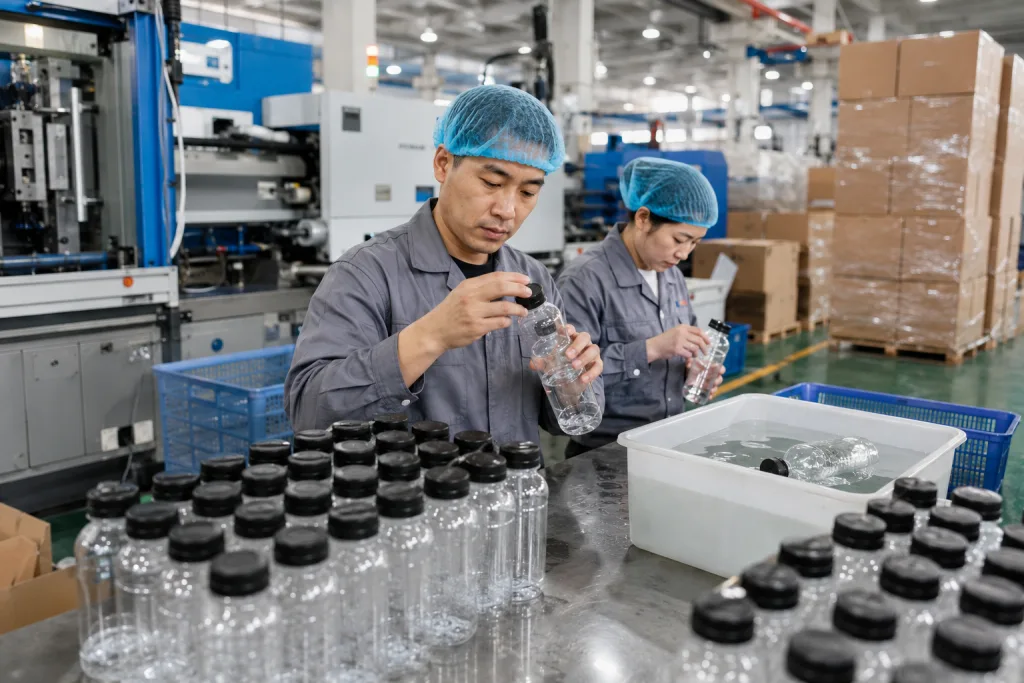
From our plant in Hangzhou, we see the same mistake 8 or 9 times a season: the buyer says “custom drinkware” before telling us where the bottle lives. A school canteen bottle needs scratch-resistant printing and a flip lid a kid can operate. A gym shaker needs a tighter thread, enough clearance for a 55 mm mixing ball, and a shake-leak test at 200 cycles. A distributor growler needs a 1.8 mm wall, double-corrugated cartons, and an MOQ the buyer can actually sell through—not just what the factory lists. Last month a PO came in with 500 ml in the artwork and 550 ml in the spec sheet. Our tooling engineer caught the mismatch and stopped the quote before CNC cutting. The comparison below is how I'd brief a new B2B buyer before quoting from China.
PP versus other bottle materials
Before you sign a PO with a pp water bottle manufacturer, run the material against the actual job. PP is polypropylene — semi-crystalline, density around 0.90 g/cm³. A finished 750ml PP bottle weighs roughly 78g. Same mold geometry in Tritan comes out 82–85g. That 5–7g delta across a 40,000-unit shipment to Hamburg isn't rounding error. It's real freight cost. PP also shrugs off acids, isotonic sports drinks, and dishwasher detergent residue better than clear plastics do. The trade-off: PP is milky. Not cloudy — milky. On a retail shelf it reads utility, not premium. If your packaging brief says "crystal clear," stop reading PP right here.
Here's the material comparison we walk canteen distributors and brand owners through before they lock the PO:
| Option | Best fit | Typical MOQ | Main caution |
|---|---|---|---|
| PP water bottle | School, outdoor, low-cost promotional | 3,000-5,000 pcs | Milky appearance, not premium clear |
| Tritan bottle | Retail clear bottle, gym, lifestyle | 2,000-3,000 pcs | Higher resin cost |
| HDPE canteen | Military-style or outdoor custom canteen | 5,000 pcs | Softer surface, less refined finish |
| Stainless bottle | Insulated drinkware, gift sets | 1,000-3,000 pcs | Higher unit price and longer process |
| Glass bottle | Premium table or office use | 2,000 pcs | Breakage and freight weight |
For a canteen promotional program — youth camp, supermarket chain, loyalty reward — PP usually wins. Weight stays low, landed cost drops. We ran 28,000 PP canteens for a French supermarket campaign last year at 0.42 USD FOB Ningbo. Mid-order the buyer asked about switching to Tritan. The math didn't work. Resin cost jumped 18% and the retail ceiling was fixed at 4.99 EUR. We kept the line on PP and shipped on time. If your buyer needs a transparent bottle with shelf presence, Tritan is the safer call. A 750ml Tritan bottle in a four-color box reads like a 19.99 EUR gift item. PP in the same box reads like a 2.99 EUR utility buy. Different channels, different tooling, different margin structure.
One more thing. If your brief says custom growler or customized growler for beer, PP is the wrong material. Full stop. Carbonation pressure will bulge the sidewall. We've seen caps pop on a 5,000-unit novelty run for a craft brewery in Colorado. The buyer flagged it during QC inspection — bottle deformed at 45 psi, well below what a filled and conditioned growler sees in summer transit. We switched them to Tritan for the re-order.
Spec table for real buying decisions
A quote without specs is a guess. One photo, one price — and that price is the cheapest build they can scrape together, usually a 1.0 mm wall and a generic screw cap that leaks at 38°C. Lock these numbers before anyone mentions MOQ: capacity tolerance, cap design, wall thickness, resin grade, color, decoration method, and packing. That's how factories separate from trading desks.
| Spec item | Economy PP | Retail PP | Outdoor canteen |
|---|---|---|---|
| Capacity | 500-650 ml | 700-1,000 ml | 750-1,500 ml |
| Wall thickness | 1.2-1.6 mm | 1.6-2.0 mm | 2.0-2.8 mm |
| Lid | Screw cap | Flip straw or push button | Tethered cap |
| Decoration | 1-color silkscreen | Pad print, sleeve, label | Embossed logo or screen |
| Leak test | Inverted 30 min | Vacuum or pressure test | Shake plus 1.2 m drop |
| Typical FOB | USD 0.65-1.10 | USD 1.15-2.40 | USD 1.30-3.20 |
When I review a canteen project, I check two things first: neck diameter and cap gasket material. A cheap PE gasket passes a quick desk leak test but deforms after 45 minutes in a hot container. We saw this go sideways on a 12,000-unit order for a Dutch retailer last July. For baby, kids, or school use, confirm BPA-free, odor control, and age-grading. Europe buyers should ask for LFGB or EU 10/2011 food-contact testing. North America? FDA food-contact declarations plus CPSIA if the user is under 12. Don't skip the specific age — we've had QC pull samples for lead in the pad print on a batch labeled "general use."
Best fit by buyer type
I tell every buyer the same thing: the best bottle for you depends on who's opening the box, not what you like in a sample. Your sales channel dictates the spec.
A distributor running a canteen program cares about replacement cap availability and compliance paperwork. A public-tender supplier needs EN 14350 and a mill certificate for the resin. A DTC seller on Amazon lives and dies by carton drop-test results, FNSKU placement, and a return rate below 3%. Asking "which bottle is best" without stating the channel is the wrong question. Here's how we actually match options to buyer types.
Promotional volume. Economy PP, 500–750 ml, single-color logo. Individual polybag or bulk inner carton. This is a giveaway item and the end user knows it — so the math has to work at scale. We run these on dedicated 24-cavity molds. MOQ in our Hangzhou plant is 5,000 pcs for a custom body color and 3,000 pcs if you take a stock color with your logo. Lead time is 18–22 days for custom color, 12–14 days for stock. Cheap, fast, no surprises.
School and camp canteen programs. PP or HDPE with a tethered cap, a name-panel recess, and a 2.0 mm wall. Simple shape. No sharp draft angles that crack when a kid drops it on concrete. Do not over-design the lid. I've seen renderings with five small components — sliding lock, hinge, straw port, two silicone seals — and they always fail. Last year a buyer insisted on exactly that lid. QC pulled the first shot off the line at 8 a.m., pressure-tested the straw port seal, and found a leak at 1.5 psi. We shipped without the feature. The buyer paid for the tooling change. A single-piece flip lid with one seal ring would have saved six weeks.
Retail custom drinkware. Tritan or a heavier PP grade with a polished mold finish (SPI A-2 or better). Retail box, barcode on the base, printed use-and-care insert. Perceived weight matters on a shelf. A USD 0.30 unit saving disappears the moment a customer picks up the bottle and thinks "cheap." One DTC brand we ship for switched from a 2.0 mm wall to 2.3 mm after Amazon reviews called their bottle "flimsy." The cost difference was 8 cents per unit. The math works. Their return rate dropped from 4.1% to 1.8% in the next quarter.
Distributor growler programs. Stainless steel almost always beats PP here. If the brief includes insulation, carbonation tolerance, or craft-beer branding, plastic is the wrong substrate. A growler needs to feel substantial — heavy cap, thick wall, no flex when you grip it. We had a client try a PP growler for a brewery promo run. Carbonation pushed the cap off during transit. The buyer flagged it as a packaging failure. We replaced the order with double-wall 304 stainless. The original PO had a typo on the capacity — 32 oz specified, but the die line read 35 — and that was a separate mess. But the switch to steel fixed the real problem.
Tooling, MOQ, and lead time
Tooling catches more first-time buyers than anything else. Pick an existing mold from a PP bottle factory in China and the timeline is tight: logo sample in 5–7 days, pre-production sample in 7–10 days, then 25–35 days for production once artwork is approved and the deposit clears. New custom shape? Budget 25–35 days for the mold alone, then 7–10 days for first-article correction — we pulled a sample last month that needed gate trimming and a 0.3 mm wall adjustment before the buyer signed off. Complex flip lids add another week, minimum. This isn't a surprise if you've done it before, but it blindsides buyers who think "custom" means swapping a color.
Our Hangzhou partners run 450,000–600,000 units a month across injection and blow molding lines. That's real capacity. What it isn't is instant. Injection machines, blow molders, silk-screen fixtures, and packing teams all need to line up. A buyer asked for 10,000 fully customized bottles in 7 days during September peak — the factory that says yes is cutting a corner, probably skipping a QC gate or calling a stock bottle with a sticker "customized." The math doesn't work.
MOQ numbers we actually use: 3,000 pcs for a stock bottle with logo, 5,000 pcs for custom color, 10,000 pcs for a special resin or lid color, and 20,000 pcs is where private mold economics stop being a headache. Tooling runs USD 2,500–8,000 for a simple body mold; multi-part lid molds go higher. A mold quote at USD 800? Ask three questions: who owns the mold, how many cavities, and is maintenance included in the price. We've seen a buyer skip that last question and get billed USD 400 six months later for a worn ejector pin repair.
Branding methods head to head
Decoration is where customized drinkware projects lose money. We've seen buyers write off $8k in branded bottles because the ink peeled on the first wash. The logo method must match the bottle surface, order quantity, and washing expectation. PP has lower surface energy than some plastics — around 34 dynes/cm versus 38+ for PET. Ink adhesion needs proper treatment. Corona treatment or flame treatment may be required before printing. If your canteen manufacturer does not mention surface treatment, ask. If they say "it's fine," get it in writing.
| Method | Good for | MOQ impact | Risk |
|---|---|---|---|
| Silkscreen | Simple 1-2 color logos | Low | Registration limits on curved bodies |
| Pad print | Small logos on caps or handles | Low | Small print area |
| Heat transfer | Full-color art | Medium | Higher setup and adhesion control |
| In-mold label | Large repeat programs | High | Requires tooling and volume |
| Embossed logo | Private mold branding | High | Not flexible for multi-client distributors |
For canteen customizable programs sold by distributors, silkscreen is the easiest. It lets you serve multiple customers from one bottle mold. For a brand-owned retail line, an embossed logo plus printed sleeve can look more controlled. If you need customized canteen orders for different teams, do not promise photographic artwork on a cheap curved PP body without testing. We tried it once on a 500ml curved bottle — the registration slipped 2mm and QC pulled the whole batch. Ask for a tape test, rub test, and dishwasher positioning in writing. "Dishwasher safe" should not be printed unless the bottle and decoration have passed 60 cycles at 55°C with drying. The math is simple: if the buyer flags peeling on cycle 45, you eat the chargeback.
Compliance is not a PDF hunt
A test report is only as good as the batch it was pulled from. We've seen PDFs that matched the color and resin code on the PO — but the actual run used a different masterbatch lot, and the shade shifted. QC caught it on the line because the operator flagged it during the first 500-piece sampling. If the lab report references a resin batch that never touched your mold, it's not compliance. It's a file.
Lock the inspection terms into the PO. We use ANSI/ASQ Z1.4, general inspection level II, AQL 2.5 for major defects, 4.0 for minor. Critical defects go to zero. No gray area. Write it out: leaking cap, sharp flash on the lip, wrong material, off odor, missing warning label, bad barcode scan, failed drop test. Leave criticals undefined and you're not running an inspection — you're having a meeting. We've had buyers push back on the sample size, but 500 pieces on a new mold tells you more in 15 minutes of cap torque testing than a stack of COAs ever will.
Physical testing catches what lab reports miss. For PP bottles, run a 1.2 m drop test on full bottles, a 30-minute inverted leak test, cap torque check, 3M 610 tape adhesion on the print, and a carton drop test on export packs. Amazon-bound orders add FNSKU placement, master carton weight under 18 kg, and scan checks. Most distributor drinkware failures aren't the bottle body — they're the packing. One client ran 12% carton damage on a shipment because the inner dividers spec'd at 2 mm instead of 4 mm. The math didn't work, and the pallet told us before the customer did.
How pricing really moves
FOB pricing moves on six levers: resin cost, mold cycle time, cap complexity, logo colors, packaging, and order quantity. PP resin trades cheap—hovering around RMB 7,500–8,200/tonne lately—but the bottle isn't just resin. A flip straw lid can outprice the body. We quoted a buyer last quarter and watched them blink at USD 0.55 extra per unit for that lid alone. Run a custom color under 5,000 pcs and you're generating regrind waste. The vendor prices that straight into your order because the purging compound, the downtime, the scrap rate all land on your PO. A retail box lands between USD 0.18 and USD 0.45 per unit, driven by paper grade and print coverage. Skip the box and you shave real money. We've seen a buyer cut packaging entirely and drop FOB by 18% on a 20,000-pc run.
For a working FOB China comparison: an economy 600 ml PP promotional bottle runs roughly USD 0.65–1.10. A thicker 900 ml canteen with tethered cap and 1-color logo sits at USD 1.20–2.20. A retail-ready bottle—flip lid, color box, barcode, better finish—hits USD 2.00–3.50. These are ranges, not binding quotes. Resin fluctuates. Exchange rate shifts. Decoration specs change. We update pricing weekly because the math doesn't hold still. A buyer once asked us to lock a quote for 90 days. That's the wrong question to ask when PP moves 3% in a month.
Landed cost is where the cheap bottle often dies. We've watched a bulky design lose its freight advantage fast: a 40HQ might pack 28,000 units instead of 38,000. That gap eats margin. Ask your manufacturer for carton dimensions, gross weight, units per carton, and CBM per 1,000 pcs. For ocean freight, CBM runs the show. For air freight samples or urgent replenishment, gross weight and volumetric weight both bite—we had a 50-kg air shipment bill at 82 kg volumetric and the buyer learned that one the hard way. If you're a distributor buyer, request mixed-carton rules early. Splitting 12 colors across 2,000 pcs creates far more labor than one color across 10,000 pcs. QC pulled the sample on a recent order and flagged exactly that—labor cost spiked and the timeline slipped. The math doesn't work on tiny color splits, and we tell buyers that upfront.
Questions to settle before deposit
Send a technical brief. One page. Not a Pinterest board. Capacity in ml, target FOB (say $1.45 Ningbo), market (EU / US / JP), user age band, vector logo file, Pantone references, lid spec (flip-top, screw, straw), the compliance standard your market demands (LFGB, FDA, GB 4806.7), packing diagram, barcode format, and your target ship date. A pp water bottle manufacturer who knows their tooling will push back on wall thickness or thread pitch inside 48 hours. That's engineering. If you get silence and "yes we can" on every line, walk. We've seen that movie. The tooling mod comes back at pre-production sample stage and suddenly you're 14 days late.
Ask the supplier straight: do you run the injection machines, or are you a trading company coordinating sub-vendors? Neither model is wrong. The answer changes who touches the mold. A factory with their own 16-cavity hot-runner tool can turn a gate vestige issue around in an afternoon — we've had a QC guy grab the shift supervisor, tweak the holding pressure, and re-sample before lunch. A trading company gives you one throat to choke across PP bottles, stainless tumblers, and a custom Tritan growler on a single PO. In Zhejiang you'll see hybrid setups: PP molding in-house, double-wall stainless subbed out to a sister plant in Yongkang. That works. But ask where the QC inspector sits. If QC reports to the production manager, the guy who gets a bonus for hitting daily output, you don't have a check. You have paperwork. We've flagged this on three factory audits last year alone.
Before the wire goes out, lock five things in the PI. Approved sample photo with reference number. AQL — we default to 2.5 major / 4.0 minor, but if you're shipping to a Japanese buyer, push for 1.5 major. Packaging drawing with outer carton dimensions and per-piece weight. Delivery term — FOB Ningbo or FOB Shanghai, confirm which port because the trucking delta is real. And who eats the cost of a failed inspection. Spell it out. If you're building a canteen distributor line, add a 2% spare cap allowance. It costs almost nothing. A late shipment gets remembered once. A leaking lid gets remembered every morning at 7 a.m. when coffee hits the car seat.
Send your PP bottle brief for a practical quote
Share capacity, target price, logo, market, and ship date. We will reply with mold options, MOQ, lead time, and compliance notes.
Frequently asked questions
What MOQ should I expect from a pp water bottle manufacturer?
For an existing mold, a realistic MOQ is 3,000 pcs with a printed logo and 5,000 pcs if you need a custom Pantone body color. If the lid, strap, or body shape is private mold, expect 10,000-20,000 pcs to make the tooling cost sensible. Some China suppliers quote 1,000 pcs, but the unit price is usually high and color options are limited to stock. For distributor drinkware, I suggest testing one stock mold at 3,000 pcs before opening a private mold.
Is PP better than Tritan for custom drinkware?
PP is better when you need lightweight, low-cost, impact-resistant bottles for school, outdoor, or canteen promotional use. Tritan is better when you need glass-like clarity, retail shelf appeal, and a more premium hand feel. A 700 ml PP bottle may quote around USD 0.80-1.60 FOB, while a similar Tritan bottle may be USD 1.60-3.20 depending on lid and packaging. If your brand promise includes clear appearance, do not choose PP just to save USD 0.50.
Can I make a fully customized canteen from PP?
Yes, but “fully customized” usually means new tooling. A custom canteen body mold can cost roughly USD 2,500-8,000, and a complex lid mold can add more. Mold lead time is commonly 25-35 days, followed by sample correction and mass production. If you only need a canteen customized with logo, color, and packaging, use an existing mold. That keeps lead time closer to 25-35 days after approval and avoids private mold risk.
What tests should I require before shipping?
Use AQL inspection plus practical performance tests. A typical order should have ANSI/ASQ Z1.4 general level II, AQL 2.5 for major defects and 4.0 for minor defects. Add 1.2 m drop testing on filled bottles, 30-minute inverted leak testing, cap torque checks, print tape testing, odor check, and carton drop testing. For Europe, confirm LFGB or EU food-contact reports when needed. For North America, request FDA food-contact documentation and CPSIA review if the product is for children.
Can one supplier handle canteens, bottles, and growlers?
A capable custom drinkware exporter can coordinate PP bottles, custom canteen programs, and stainless growlers, but not all items should come from the same production line. PP bottles use plastic molding equipment; stainless growlers need metal forming, welding, vacuum testing if insulated, and different finishing. A hybrid supplier in Zhejiang or broader China can manage the program if they disclose which items are made in-house and which are from partner factories. Ask for separate QC plans for each category.