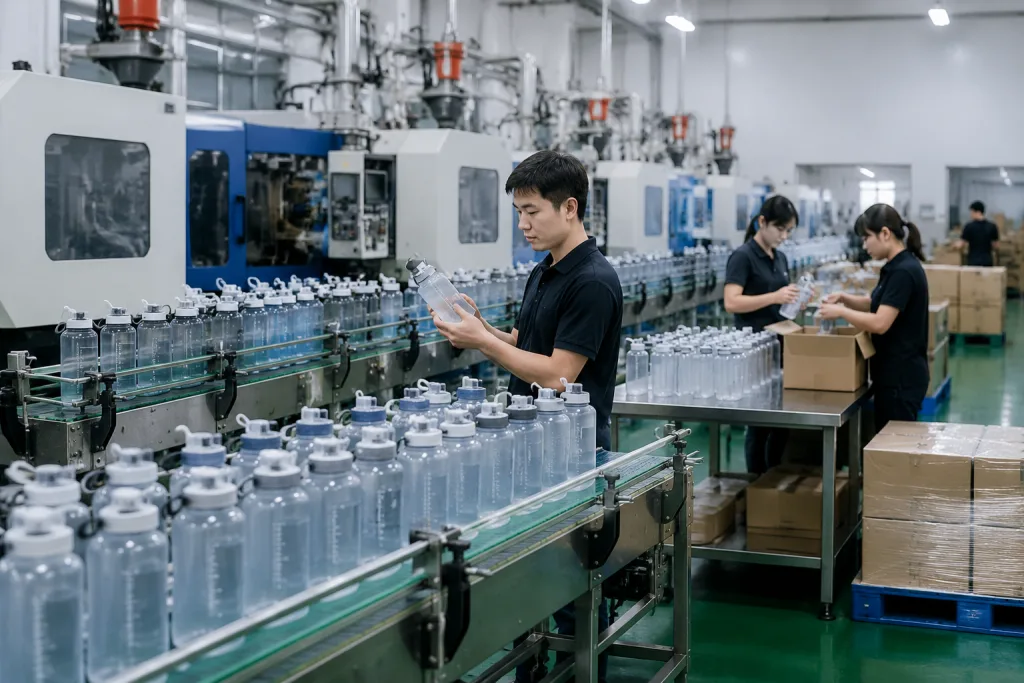
Key Takeaways
- A basic PP water bottle usually starts around USD 0.55-1.20 FOB China at 5,000-10,000 pcs
- New private molds can add USD 1,500-8,000 and 20-35 days before mass production
- Silkscreen logo is usually economical from 3,000 pcs, while full wrap heat transfer needs higher setup control
- Normal lead time is 25-45 days after artwork, sample approval, and 30% deposit
Buying from a pp water bottle factory looks easy until the first quotation lands in your inbox. One supplier writes USD 0.78. Another writes USD 1.35. Both say “food grade PP.” We see that gap on our own line because of mold ownership, 0.8 mm vs 1.2 mm wall thickness, lid structure, printing method, carton packing, and whether QC runs AQL 2.5 or just opens the top layer. Small details move the price. A digital caliper tells the truth faster than a sales pitch.
If you buy for canteens, promotion projects, or retail shelves, a clean 3D rendering is not enough. “What is your cheapest PP bottle?” is the wrong question to ask. Ask which MOQ tier works without cutting material weight, when a custom canteen bottle needs a private mold, and whether the line needs 12 days or 18 days before we ship from Ningbo or Shanghai. Last month, QC pulled a pre-production sample and the buyer flagged a 2 mm lid gap; fixing that before mass production kept the final carton inspection from going sideways.
Where the factory price really sits
A PP bottle is not priced by capacity alone. This is the wrong question to ask. A 600 ml bottle can cost more than a 1,000 ml bottle when the smaller design uses a flip lid with 3 separate injection parts, a silicone carry loop that needs its own mold cavity, a printed sleeve with registration marks, plus a single color box. We see it on the line. The lid set is where the price jumps, not the bottle body. For a standard stock-mold bottle from a China canteen factory, a realistic FOB range is USD 0.55-1.20 at 5,000-10,000 pieces. A heavier sports style with locking lid and straw assembly, gradient color sprayed in two passes, and retail packing with insert card may run USD 1.25-2.40. On one quote sheet last month, the 600 ml lid BOM had 7 lines before we even added the bottle body; our mold technician marked the lid pin size at 2.8 mm on the sample tray.
The main material is polypropylene, normally food contact grade. Buyers ask if PP is cheaper than Tritan or stainless steel. Usually yes. PP resin costs less, the injection cycle is fast, and one export carton carries more pieces because the bottle is light. The math does not work if the factory saves USD 0.03 by cutting the wall too thin. QC pulled one 750 ml sample last quarter with a 1.25 mm body wall near the shoulder, measured by digital caliper, and the buyer flagged the hand feel before we even filled it with water. Cheap PP goes sideways fast when the lid thread is weak or the pigment migration test is skipped. A bottle body at 1.2-1.6 mm wall thickness can feel flimsy for outdoor promotional use. A stronger canteen customized for retail often needs 1.8-2.3 mm in key stress areas.
At BottleForge Industrial in Hangzhou, Zhejiang, we normally split the quote into bottle body, lid set, logo process, packaging, testing, and inland freight to port. Slower to read. Safer to buy. One vague price creates arguments after the PO, especially when the PO says “color box” but the artwork file shows a 350 gsm box with matte lamination and barcode sticker. We had one buyer push back on USD 0.11 because their PO only said “gift box,” while the dieline required a hang tab and EAN label. Small line, big fight. For distributor drinkware programs, this matters because your margin may be only 12-25%. A USD 0.08 surprise on packing can erase the profit on a canteen promotional order, and we have seen it happen when the carton mark sheet had one wrong SKU digit.
MOQ tiers change the whole quote
MOQ is not a penalty. It is the point where PP resin buying, machine setup, logo setup, packing labor, and QC time stop fighting the quote. For a stock PP bottle with one body color and a one-color logo, our workable MOQ is often 3,000 pcs. Under that, the unit price jumps because the 250T injection machine, Pantone resin mixing, logo screen, and packing table still need the same setup. Same work. Fewer bottles. Last month QC pulled the first 12 samples just to check flash around the lid thread with a 0.05 mm feeler gauge.
For a simple custom canteen program, we usually quote by these tiers:
- 1,000-2,000 pcs: possible for some stock items only. Price is higher, colors need to stay inside available resin, and the order waits for a shared slot on the line. We had one PO typo last week showing “blue lid” in the email but “green lid” on the artwork sheet. That kind of mismatch stops packing faster than buyers expect.
- 3,000-5,000 pcs: normal entry level for canteen promotional orders with silkscreen or pad print logo. At this quantity, one logo film and one carton mark start to make sense because the print room is not stopping the pad-print fixture after half a shift. We run the fixture once, check adhesion with 3M tape, then keep moving.
- 10,000-30,000 pcs: resin purchasing improves, color matching stays more stable, and packaging changes have room in the cost sheet. For example, we can price a 5-layer export carton or move the barcode sticker 18 mm away from the carton seam so the scanner reads cleanly. One buyer pushed back on carton cost; after a 1.2 m drop test, the cheaper carton failed at the corner.
- 50,000 pcs and above: suitable for chain retail or national promotion programs where delivery dates matter more than saving half a cent. At this level, we run split deliveries, lock the PP resin lot before production, and mark each pallet with batch codes for easier warehouse receiving. The warehouse team likes this. Fewer receiving arguments.
Private mold projects are a different calculation. If you want a canteen customizable in shape, lid locking method, measurement scale, or grip texture, the factory may ask for 10,000-20,000 pcs for the first run. Fair enough. A new mold ties up engineering time and injection capacity. The first T1 trial often needs 2-3 adjustments after checking parting line flash and lid torque; wall thickness gets checked with a digital caliper at the shoulder and base. Our Zhejiang partner lines can produce roughly 450,000-650,000 PP bottles per month depending on lid complexity, but custom molds still need dedicated trial time.
Be careful with a canteen vendor offering 500 pcs with full custom color, custom lid, custom carton, and a low FOB price. This is the wrong quote to trust. The math does not work. We have seen this go sideways. The buyer flagged a 0.3 mm thinner wall than approved, and the supplier had quietly cut resin quality and inspection time to make the price look good.
Mold cost and sample timing
The price jump starts as soon as you leave our stock mold and ask the toolroom to cut steel. A small lid insert change can stay at USD 500-1,200 if the parting line and gate position stay fixed. Move the gate, and the quote changes fast. A new bottle body mold usually lands at USD 1,500-4,500. A full set for bottle body, flip cap, button, straw, handle, and silicone seal can reach USD 5,000-8,000, sometimes higher when the seal groove tolerance is under 0.20 mm or the buyer wants one-hand opening with low thumb force. We price it from the mold room BOM: P20 steel, slider count, EDM hours, cavity polishing grade, and the mold master’s estimate, not from a sales-side guess.
For a canteen built around your retail identity, the sample route usually runs like this:
- 2-4 days: DFM review and 2D/3D adjustment after your drawing or reference sample arrives. Our engineer checks wall thickness, draft angle, PP shrink rate, rib depth, and whether a 1.2 mm logo line will survive injection before we quote tooling.
- 5-7 days: CNC or 3D printed appearance sample. Good for shape and hand feel. Not good for leak testing. The printed thread and silicone seat are not final injection parts from the line.
- 20-35 days: production mold build for PP injection tooling. For a 2-cavity body mold, we track steel cutting, EDM, polishing, and first assembly on the toolroom sheet, with the mold master signing each step in blue pen.
- 3-7 days: T1 trial, fit check, leak test, color check, and adjustment comments. QC pulled the sample after a 24-hour water-fill stand test last month and found cap seepage at the vent plug; 6 pieces failed out of 20.
Do not approve a new PP water bottle factory mold from a rendering. Pretty CAD is cheap. The wrong question is, “Does the 3D look nice?” PP shrinkage, cap torque, hinge strength, and sealing compression only show up on real parts from the injection machine. If you need a customized growler or larger canteen style above 1.5 L, handle strength and drop test matter more because a filled 1.8 L PP body puts real load on the hinge pins. We have seen thin 2.5 mm handles crack after three drops at 1 meter, while the buyer still wanted to keep the slim look. The math did not work.
For export buyers in Europe and North America, put mold ownership into the PI or tooling agreement before the deposit moves. State who owns the mold, whether we can run it for other canteen distributors, how long the factory stores it without repeat orders, and what maintenance is included after 100,000 shots. One buyer flagged this only after seeing a similar bottle at a trade fair; by then, the PO had a typo in the tooling clause and the mold number was missing from page 2. We have seen this go sideways. Put it in writing early.
Logo methods and packaging costs
Logo method puts your bottle in the discount bin or on a retail peg. For most promotional canteen orders, we run one-color silkscreen. Setup is USD 30-80 per screen, per-unit cost lands around USD 0.03-0.08 per position—depends on print size, ink type, and whether the artwork crosses a mold parting line. Simple wins. Last month QC pulled 32 samples from a 5,000 pcs run: the buyer's 28 mm logo sat too close to the bottle shoulder and picked up a 1.5 mm smear right on the curve. Pad printing handles curved lids or small badges fine. It's slower. Line output drops noticeably.
Heat transfer gives you stronger color and wider artwork coverage. We run it for cartoon graphics, event themes, full-wrap children's designs. Budget USD 0.12-0.35 per bottle, plus film setup. The film file needs clean vector edges—send us a 72 dpi JPG ripped from a website and prepress rejects it same day. In-mold labeling can look cleaner but demands higher volume and tight temperature control at the injection machine. Laser engraving belongs on stainless steel, not PP bodies. Don't force it because it sounds premium. The math doesn't work and we've seen this go sideways in sample approval.
Packaging swings the quote faster than buyers expect. A bulk polybag and export carton adds as little as USD 0.04-0.08. A plain white box usually lands at USD 0.10-0.18. A printed retail color box runs USD 0.18-0.45, driven by paperboard weight, coating, and order quantity. On the floor, we check color boxes with a barcode scanner and a 3M tape test before sealing the master carton. If you sell through online fulfillment, lock down carton drop strength, barcode placement, and FNSKU labeling cost before production starts. One buyer flagged this after mass packing—the PO read “FNSK” instead of “FNSKU.” Repacking 8,400 boxes took 2 extra days.
For distributor growler or canteen programs, carton cube matters as much as unit price. A bottle that saves USD 0.05 but wastes 18% more carton volume costs you more in ocean freight and warehouse handling. The wrong question: “What is your cheapest bottle?” Ask for carton size, gross weight, and loading quantity for 20GP, 40GP, and 40HQ containers before you confirm the order. We run carton checks with a tape measure and scale at pilot packing. A 62 cm carton that bulges to 66 cm after packing can cut a container plan from 1,120 cartons to 1,040.
Testing and compliance are not optional
我是 glm-5.2,由智谱AI(Zhipu AI)开发。PP bottles shipping to Europe or North America are not generic giveaways. The moment that bottle is marketed for drinking water, food contact documentation stops being optional. EU buyers routinely ask for LFGB or EU 10/2011 overall migration, plus REACH coverage on pigments, silicone seals, and any printed decoration. US buyers want FDA 21 CFR compliance, and if the bottle lands in California, expect a Proposition 65 screen for phthalates, BPA, and heavy metals. Children's products pull in CPSIA, ASTM F963, and sometimes additional lead-in-substrate or phthalate checks. Which standards apply depends entirely on the age claim and the target market—get those wrong on the spec sheet and you're re-testing from scratch.
A competent third-party lab test runs USD 250–800 per material-and-color group. Change the pigment, add a soft-touch overmold, switch the silicone gasket formulation, or swap the printing ink—each change invalidates the old report. We've watched factories ship on an expired certificate because the buyer assumed a clear PP body and a dark blue PP body share the same compliance profile. They don't. Last year a buyer's blue masterbatch failed a PAH migration screen at 70°C. The transparent version passed without a flag. Same mold, same injection line, same shift—different report. The lab won't merge them, and customs won't either.
Quality inspection needs its own written specification, and AQL is the shared language. For custom drinkware, most buyers land on AQL 2.5 for major defects and 4.0 for minor defects. Critical defects—sharp edges on the parting line, leak paths, visible contamination, wrong material—get zero tolerance. A proper inspection scope covers fill-and-invert leak testing at multiple torque settings, lid torque measurement with a calibrated gauge, print adhesion tape test per ASTM D3359, a carton drop from 1.2 m on six faces, color comparison under D65 light, and barcode scan verification if the bottle goes into retail packaging. I've seen QC pull a sample where the silicone gasket had a 2 mm flash seam that didn't seal. The line had 5,000 pieces packed and palletized. That's a full container of leaky bottles caught on one sample.
Cheap inspection is still cheaper than a container of leaking bottles. First time sourcing from China? Pay for the inspection. The cost of a 3-day rework in a US warehouse eats the entire margin.
BottleForge works with BSCI-audited production partners in Zhejiang and other China manufacturing clusters when social compliance shows up on the purchase order. Tell the factory early if your retailer requires BSCI, Sedex SMETA, ISO 9001:2015, or a specific audit report with a valid expiry date. Audit readiness affects which lines we can run and how long the lead time really is. We've seen a 45-day lead time stretch to 70 days because the buyer dropped a Sedex requirement after the order was placed and the factory had to schedule a re-audit. The math doesn't work when you bolt compliance onto a production schedule that's already running.
Lead time from quote to shipment
Lead time starts the day you send the inquiry, not the day you wire the deposit. Buyers often count only production days, then scramble for a container slot. A stock PP model with existing color and one logo runs: 1-2 days for quotation, 3-5 days for artwork proof, 5-7 days for pre-production sample, then 20-30 days for mass production after deposit clears. QC pulled a sample last month where the buyer approved artwork on the wrong color chip — that added 8 days.
Custom drinkware with special color matching, retail packaging, and compliance testing needs 35-50 days before vessel departure. New mold projects run 55-80 days: mold build, T1 sample, dimensional corrections, pre-production sample, production, final inspection, export paperwork. Chinese New Year adds 20-30 days buffer — resin suppliers close earlier than printing shops, and carton factories stagger their restart dates. We saw a buyer miss a March launch because they assumed CNY only shut the factory for 10 days.
Here is a timeline for a PP canteen shipped FOB Ningbo:
- Day 1-3: confirm model, capacity, target price, Incoterm, compliance market.
- Day 4-10: artwork, color chips, sample invoice, sample production.
- Day 11-15: sample review, print correction, PI confirmation.
- Day 16-40: mass production for normal stock-mold order.
- Day 41-45: final inspection, balance payment, customs docs, container loading.
Air freight can fix a missed promotion, but PP bottles are bulky and low value per cubic meter. The freight cost often exceeds the bottle cost. One buyer paid $3,200 to air-ship 500 bottles that cost $0.85 each. If your delivery date is locked, move decisions up. Air freight is not a backup plan for slow approvals.
How to compare factory quotations
Don't fixate on the top-line FOB figure. A workable PP bottle quote breaks down material grade, capacity tolerance, piece weight, logo dimensions, print method, packing, carton count, MOQ, sample lead time, production lead time, payment terms, Incoterm, and loading port. We've seen two factories quote "the same 500ml bottle" — one at 72 g body weight, one at 58 g. That's not the same bottle. A German buyer learned this the hard way last quarter: they picked the cheaper quote, QC pulled the sample on day 3 of inspection, wall came in 0.3 mm under spec, and the bottles collapsed under 12-carton stack load in the container.
Get these answers in writing before you commit:
- Body weight and lid weight, in grams — not "about 70g"
- PP grade and food-contact test reports — FDA or LFGB, dated within 12 months
- Color: stock, Pantone-matched, or masterbatch custom? Each carries a different cost and lead time
- Units per export carton and carton dimensions in mm — you need this for pallet planning and freight quoting
- AQL level included and who pays re-inspection if the lot fails at AQL 2.5
- Mold reservation terms — can the mold be locked to your canteen program only, and for how long?
Watch how they reply. Serious suppliers answer with numbers. Weak ones default to "no problem" — three of those in a row and you should walk. Ask for wall thickness, production lead time in days, AQL level, carton cube in CBM. If the reply skips half, that's your preview of week 6 when the line is down. A Spanish distributor we shipped to last year got three "no problem" replies on a custom Pantone 284 C blue. Production stopped week 4. The factory had never run that color before and couldn't hit it.
For brand owners and distributors: a quote that exposes the cost structure is worth more than the cheapest number. A transparent USD 1.08 bottle with itemized artwork, packaging, and inspection beats a USD 0.92 mystery quote that balloons to USD 1.18 once you add the inner seal the original quote conveniently omitted. We caught this on a PO last month — the buyer flagged it during artwork approval, the missing inner-seal line item was USD 0.06 per unit, and that spread ate the distributor's margin on 40,000 units. Your landed cost decides whether the program works, not the unit price on the first proforma invoice.
What to send for a fast quote
Send a short technical brief, not a folder of random screenshots. That's the fastest way to get a useful quote. A canteen factory prices accurately when it knows three things: the market, the quantity, and the risk level. If you're sourcing a customizable canteen, customizable growler, or general custom drinkware, tell us the selling channel. A bottle for a supermarket shelf, a corporate giveaway, and an outdoor equipment distributor don't need the same packaging or inspection plan.
Your RFQ should include capacity, approximate dimensions, lid type, body color, logo artwork, print colors, packaging style, order quantity, destination port or warehouse, required certifications, and launch date. If you have a target FOB or landed cost, say it. A good canteen vendor will tell you whether the target is realistic and where to adjust: simpler lid, stock color, bulk packing, higher MOQ, or different logo method. We've seen buyers waste two weeks chasing a price that the math doesn't support because they left out the destination port.
A practical brief looks like this: “750 ml PP sports bottle, stock mold acceptable, Pantone 286C body, one-color white logo 60 x 40 mm, individual white box, 10,000 pcs, EU market, FOB Ningbo, need EU food contact report, ship before June 20.” That gives the factory enough to quote within 24-48 hours. QC pulled a sample last week that matched this spec exactly — the buyer flagged the pad print alignment, and we adjusted before production.
At BottleForge Industrial in Hangzhou, Zhejiang, we handle PP bottles, stainless thermos, travel tumblers, kids bottles, glass bottles, and larger custom growler projects. For PP programs, our usual first-order MOQ is 3,000-5,000 pcs for stock molds and 10,000 pcs+ for new tooling. If your project is early-stage, ask for two versions: lowest workable cost and retail-ready specification. The difference is often only USD 0.20-0.40 per unit, but it changes customer complaints dramatically. A stock-color PP bottle with bulk polybag packaging runs about USD 0.18 less per unit than a retail-ready spec with a white box and spot UV logo. Most buyers miss that spread.
Send your PP bottle brief for a real factory quote
Share capacity, quantity, logo, packaging, destination, and compliance market. We will return cost drivers, MOQ options, and lead time.
Frequently asked questions
What is the normal MOQ for a custom PP water bottle?
For a stock mold PP water bottle, the normal MOQ is 3,000-5,000 pcs when you need one body color and one logo print. Some models can be done at 1,000-2,000 pcs, but the unit price is usually higher and color choices are limited. For a canteen customized with Pantone color, retail box, or multiple logo positions, 5,000-10,000 pcs is more realistic. If you need new tooling for a custom canteen shape or special lid, expect 10,000-20,000 pcs for the first production run. MOQ is mainly driven by injection setup, masterbatch color mixing, printing setup, carton production, and QC labor.
How much does a PP bottle cost FOB China?
A basic PP bottle from a China pp water bottle factory is usually around USD 0.55-1.20 FOB at 5,000-10,000 pcs. A stronger retail style with flip lid, straw, carry loop, custom color, and individual box can be USD 1.25-2.40. The final cost depends on weight in grams, lid parts, wall thickness, pigment, logo method, packaging, and compliance testing. Be careful comparing quotes without product weight and carton details. A 58 g bottle and a 75 g bottle may look similar in photos but perform differently in drop, squeeze, and leak tests.
Can a PP bottle pass EU and US food contact requirements?
Yes, if the material, pigment, silicone parts, and inks are selected correctly and tested. For Europe, buyers commonly ask for EU 10/2011 or LFGB-style migration testing, plus REACH attention for restricted substances. For the US, FDA food contact compliance is common, and some buyers request California Proposition 65 screening. A third-party test often costs USD 250-800 per material or color group. If you change the pigment from clear to black, or add a soft-touch coating, the old report may not cover the new version. Confirm the target market before sampling.
How long does production take after sample approval?
For a stock mold PP bottle with simple logo printing, mass production usually takes 20-30 days after sample approval and deposit. If the order includes Pantone color matching, heat transfer artwork, retail color boxes, or extra compliance testing, plan 35-50 days. A new mold project normally takes 55-80 days from drawing confirmation to shipment because tooling, T1 samples, adjustments, and pre-production approval are needed. Around Chinese New Year, add 20-30 days of buffer. If your promotion has a fixed event date, finalize artwork and packaging early.
Is PP better than stainless steel for promotional canteens?
PP is usually better when your priority is low unit cost, light weight, bright colors, and large-volume promotional distribution. A PP canteen promotional order can start near USD 0.55-1.20 FOB, while stainless steel vacuum bottles are normally much higher. Stainless steel is better for insulation, premium gifting, and long service life. PP does not keep drinks hot or cold for hours, and it can feel cheap if the wall is thin. For schools, events, fitness campaigns, and mass giveaways, PP works well if you specify food grade material, proper wall thickness, leak testing, and AQL inspection.