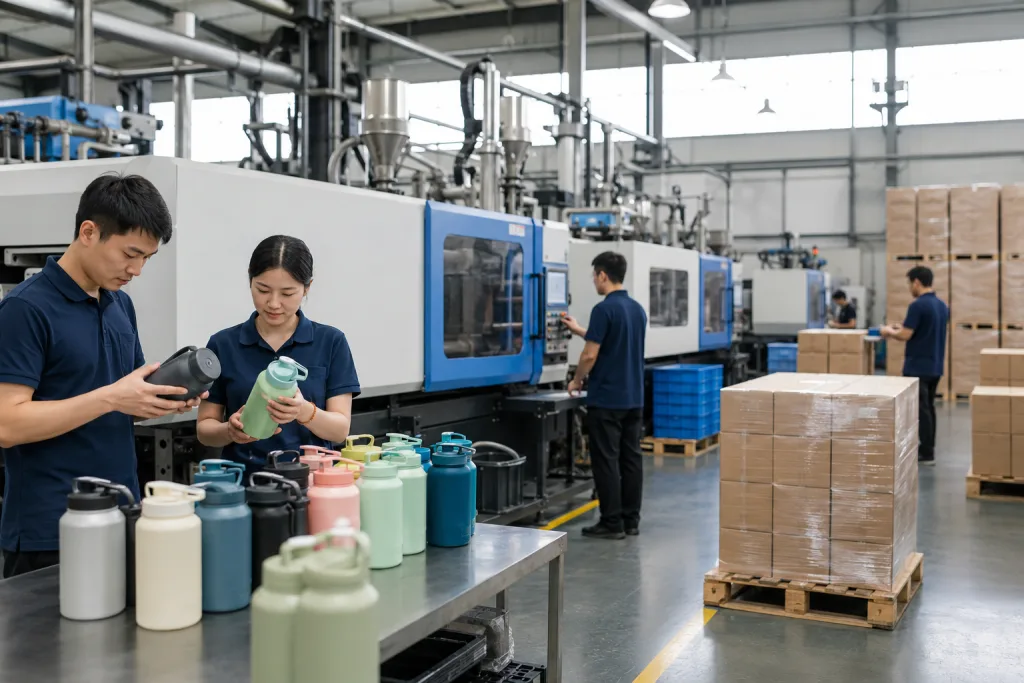
Key Takeaways
- PP bottles usually fit promotional and school orders at 3,000-5,000 pcs MOQ with FOB pricing often from USD 0.75-1.80
- Tritan costs more but gives better clarity and retail shelf appeal than standard polypropylene
- Stainless options suit premium distributor drinkware programs but need longer lead times and higher freight weight
- For PP, specify food-grade resin, AQL level, cap leak test, and print adhesion test before confirming bulk production
PP looks simple until you buy 20,000 units with a logo, Pantone match, barcode, and a delivery window tied to a retail launch. Then the small parts decide the order: 1.2 mm vs 1.6 mm wall thickness, cap resin, print adhesion, carton burst strength, odor control, and whether the canteen supplier can issue clean export documents without us chasing them 3 times. QC pulled a pre-production sample last month because the screw cap passed the bench water test, then seeped after 6 hours in a 45°C carton stack. Small leak. Big problem.
We manufacture custom drinkware in Hangzhou, Zhejiang, and most buyer mistakes happen before the PO is signed. A buyer picks a bottle shape because the FOB looks low; then the line finds the lid leaks in transit, the Pantone color is 2 shades off under a D65 light box, or the logo rubs off after 20 dishwasher cycles. Cheap is the wrong question to ask. We’ve seen this go sideways on launch orders, especially when the PO says “blue” but the artwork file says PMS 2925C. This guide compares PP water bottle custom options against Tritan, stainless steel, and PE sports canteens, so you choose the right product before we cut sample tooling and burn 12 days instead of 3.
The real comparison buyers need
Most buyers asking for a pp water bottle custom quote start with unit price. Wrong question. PP works for school programs and low-cost promo bottles, but it is the wrong material for some custom canteen or customized growler briefs. Last April, a school distributor rejected a cheaper PP sample after QC pulled the sample and found a 0.6 mm flash line on the cap mouth with a go/no-go gauge. That tiny burr matters. A canteen distributor selling to schools carries different risk from a distributor growler seller supplying outdoor retail. A gym chain pushed us on 15-day lead time and logo rub resistance after 3M tape testing. A supermarket buyer pressed harder on bottle clarity, 1.2 m drop testing, REACH documents, and carton crush results because their warehouse stacks 5 layers high.
This is the head-to-head sheet we run with buyers in China before we cut steel for molds or confirm Pantone colors on the injection line:
| Option | Typical FOB range | MOQ | Best fit | Main risk |
|---|---|---|---|---|
| PP water bottle | USD 0.75-1.80 | 3,000-5,000 pcs | School programs and budget promo events | Lower clarity, possible odor if resin is poor |
| Tritan bottle | USD 1.80-3.80 | 2,000-3,000 pcs | Retail fitness bottle or corporate gift program | Higher material cost |
| PE sports canteen | USD 0.55-1.30 | 5,000 pcs | Sports events and cycling giveaway orders | Softer body, lower perceived value |
| Stainless bottle | USD 3.20-8.50 | 1,000-3,000 pcs | Premium outdoor channel or corporate gift order | 22-35 day production and higher freight |
These ranges move when resin jumps USD 80 per ton, when the RMB shifts, or when the buyer changes from a single-color silkscreen logo to a full-wrap heat transfer print. Carton spec also bites; a 5-ply export carton costs more than the thin domestic box some buyers ask for. Fair starting point. Last week one PO showed “PP clear” in the item name but “milky white” in the artwork file; that typo cost 2 days in sampling before a single carton was packed. We see this go sideways. If your target landed cost sits under USD 1.50, PP or PE is the practical lane. If you need a premium customizable drinkware line, Tritan or stainless steel gives retailers cleaner shelf pricing and better margin room.
Where PP wins and loses
Polypropylene works when the brief is safe, light, low-cost drinkware with a short production cycle. With the right food-contact resin, we run PP for school bottles and office giveaway bottles that need a clean logo area and low carton weight. A typical 600 ml PP bottle weighs around 75-110 g, depending on wall thickness and cap type. Freight bites fast. On a 10,000 pcs sea shipment or an FBA-style carton plan, even 12 g per bottle shows up on the booking sheet; last month QC weighed a 24 pcs carton at 3.1 kg gross on the floor scale, and the buyer flagged the freight estimate before the PO typo was even corrected.
PP is easy to control for color. If your brand needs a solid Pantone body, PP takes masterbatch color matching well, and we check first shots against a Pantone C book under a D65 light box before the line keeps running. For 3,000 pcs canteen promotional projects, color match matters more than glass-like clarity because the buyer is comparing shelf impact and unit cost, not luxury feel. A matte PP body with a one-color silk screen logo can look clean and stay cost-controlled. Simple sells.
Where PP loses is premium feel. Standard PP is translucent or opaque, not crystal clear. If your buyer expects a high-end retail bottle, Tritan will look better; this is the wrong question to ask if the shelf sample must look like glass. PP also has a lower heat resistance profile than stainless steel and can deform under improper high-temperature sterilization; we have seen a cap oval out after a 100°C test in a small lab kettle. For dishwasher claims, test the exact bottle. Not the resin brochure.
For export orders from Zhejiang, we ask buyers to define three points before quotation: capacity tolerance in ml after filling, wall thickness target in mm at the shoulder and body, and cap leak requirement after 30 minutes of inversion. A 500 ml bottle with 1.2 mm average wall thickness is not the same product as a 650 ml bottle with 0.8 mm walls. The math doesn't work when a quote is 8% lower but the factory saves it back through thinner walls, a loose silicone gasket, or a 5-ply carton changed to weaker paper. We check with digital calipers on the line before sealing the golden sample.
Best fit by sales channel
The right custom canteen depends on the sales channel, not a blanket “best material” answer. For a school-board distributor order at 10,000 pcs, we run safe pricing, simple packing, and carton labels that match the PO line by line; one PO last quarter had “blue lid” typed in Chinese on page 2 and “black lid” on page 5. Retail sports bottles get judged harder on gloss, lid fit, and shelf scuffs. Ask where it ships first. “Which plastic is best?” is the wrong question.
Best for mass promotional volume: PP
For event giveaways, youth programs, corporate onboarding kits, and basic canteen promotional campaigns, PP is usually the safer pick. MOQ stays manageable, color matching holds within the approved Pantone swatch on the injection line, and the unit cost works for 5,000-50,000 pcs runs. We pack each bottle in an OPP bag, or bulk pack 50 pcs per carton when the buyer needs faster handout at site. Fast is not magic. QC pulled one PP sample last month because the logo sat 3 mm too low after pad printing; small issue, big headache if it reaches carton sealing.
Best for retail shelf appearance: Tritan
Tritan fits when the bottle needs clear walls, bright color, and a cleaner retail look. For gyms, lifestyle retail, or brand stores, it gives stronger perceived value than PP on the shelf, especially under LED store lighting. You pay more. The math still works when the buyer protects sell-through price; it goes sideways when they expect Tritan looks at PP pricing. We’ve had buyers flag 0.5 mm black dots inside clear Tritan bodies, so we check resin drying temperature at the hopper dryer and blow off dust before mass production.
Best for premium outdoor gifting: stainless steel
For a custom growler, customized growler, or vacuum bottle program, stainless steel is the practical premium choice. It supports laser engraving, powder coating, and insulation claims, but cost, weight, and timing need approval before the deposit. A stainless item may need 35-50 days after sample approval, while a PP bottle can often run in 20-30 days if the mold exists. Do not skip this check. On the floor, we check coating thickness with a film gauge and weigh cartons because one 24 pcs carton can jump several kg compared with plastic.
Best for squeeze sports use: PE
PE works for cycling, team training, and race handouts where squeeze matters. It is not elegant. It works. If your buyer expects a soft sports bottle, PP will feel too rigid, even if the quote sheet looks better by USD 0.08 per pc. We had one race organizer reject PP after pressing the sample twice and saying, “This doesn’t squeeze,” so we now confirm grip feel before we open the order.
Spec table before you quote
Send the spec sheet before asking a canteen factory for price. No spec, no clean quote. Five canteen manufacturers will quote five different bottles, and the cheapest one may only look cheaper because it is thinner, lighter, or packed loose. At BottleForge Industrial in Hangzhou, Zhejiang, we run existing plastic bottle lines at around 450,000 plastic drinkware units per month, but costing still depends on small items: resin grade with supplier code, lid style with gasket requirement, wall target in mm, carton pack count. Last week our Mitutoyo caliper check showed a 0.2 mm wall change added 6 g per bottle. On a 30,000 pcs order, that is 180 kg more PP. That changes the quote.
| Spec item | Recommended buyer instruction | Why it matters |
|---|---|---|
| Material | Food-grade PP, BPA-free test requirement, odor-controlled resin with no recycled resin unless approved in writing | Stops low-grade material substitution and smell complaints after filling |
| Capacity | 500 ml, 650 ml, 750 ml, or 1 L, with overflow capacity and tolerance stated | Changes mold choice, part weight, carton count, and freight CBM |
| Wall thickness | 0.9-1.4 mm is the normal PP bottle range; confirm target point and minimum point | Controls hand feel, drop strength, and hot-warehouse deformation risk |
| Cap | Screw cap, flip cap, straw lid, or carry loop; include gasket material and color if needed | The cap is where leaks start; QC checks torque and seal first on the line |
| Decoration | Silk screen, heat transfer, in-mold label, or sticker; give artwork size in mm, print position, and Pantone code | Changes MOQ, unit cost, rubbing test result, and dishwasher claim risk |
| Packing | Bulk pack, single polybag, color box, PDQ tray, or master carton; state pack count per carton | Sets retail readiness, compression strength, and damage rate during loading |
If you are a canteen distributor or distributor drinkware buyer, ask the canteen manufacturer to quote EXW and FOB as separate lines. FOB Ningbo or Shanghai is common for Zhejiang and East China shipments. EXW looks cheap on paper. We have seen this go sideways when the buyer flagged the inland trucking bill after the PO was already signed; Hangzhou to Ningbo port is not free, and export documents still need a person chasing them. One PO last month even wrote “FOB Hangzhou port.” There is no such ocean port for this shipment. Wrong question.
Ask for gross weight, carton dimensions, and units per 20GP or 40HQ. Simple check. Our warehouse team measures cartons with a tape before loading because a 58 x 39 x 42 cm carton and a 62 x 42 x 46 cm carton do not book the same container space. QC pulled one pre-shipment sample where the carton print said 24 pcs, but the line packed 30 pcs after a packing change. A USD 0.08 saving per bottle can disappear if the carton is oversized or underfilled. The math doesn't work.
Decoration choices are not equal
Logo decoration is where about 3 out of 10 PP water bottle custom projects get into trouble. A flat stainless tumbler is easy to laser engrave. A curved PP bottle with a 0.3 mm textured skin is not. Short version: control the print window. For a clean logo, the bottle needs a locked fixture position and stable radius control. Do not put a 90 mm wide logo on a tapered body and expect the jig to rescue it. We tried that on the line, and QC pulled the sample for a 2 mm left-side drift.
Silk screen printing is the safer pick for one- to three-color logos. It keeps unit cost under control and prints cleanly on solid PP colors. Typical setup runs USD 40-80 per color, based on artwork separations and the bottle fixture. For canteen customized orders around 1,000-5,000 pcs, we run this first in most cases. One buyer flagged a batch because the PO said Pantone 286C, but the AI file showed 287C. Small typo. Big delay.
Heat transfer printing fits full-color graphics or wider coverage. It costs more and needs real adhesion testing, not a polished sample-room photo. For kids’ bottles or school bottles, we ask for a tape test and rub test before mass production. We run 3M tape pulls after curing, then a 500-cycle rub check with a 500 g weight. If the edge lifts, the math doesn't work for a back-to-school order.
In-mold labeling can look sharp, but it is the wrong question to ask for small trial orders. Tooling and setup only make sense when the volume is high and the artwork repeats. If you are testing a new customizable canteen line, start with silk screen or transfer print first. We ship IML jobs when the buyer can hold the design for at least 2 production runs, not when marketing is still changing the mascot every Friday.
Embossed or molded logos require mold changes. They fit long-term private label programs, not quick campaigns. A simple insert modification may cost a few hundred USD; a new mold can run much higher based on shape and cavity count. Last season, one buyer wanted a molded 38 mm badge added after T1 sampling. The mold shop needed 12 days vs 18 days if we changed the full cavity block, so we pushed back hard.
For PP, we run print adhesion checks after curing and again after 24 hours. If the product is sold as dishwasher safe, test printed samples through real wash cycles, not a sink rinse. Our QC team loads 6 printed bottles into a 70°C wash program and checks logo edges with a loupe after the cycle. Marketing words are cheap; failed logos create chargebacks.
Compliance and QC expectations
For Europe and North America, PP drinkware should not ship on trust or a friendly email. Ask your canteen suppliers for material declarations and test reports tied to the exact market and resin grade. Last month QC pulled a random PP pellet bag and matched the lot number against the SGS report before we let the line start. For the EU, buyers often request LFGB or EU food-contact testing plus REACH/SVHC where applicable. For the United States, FDA food-contact compliance and, for children’s products, CPSIA-related requirements may apply. If the bottle is for children, be stricter on small parts, cap pull strength, warning labels, and 0.5 mm sharp flash around the spout.
Factory audits matter. BSCI, Sedex, ISO 9001, or retailer-specific audits do not make a bottle perfect, but they tell you whether a canteen manufacturer has basic process control on paper and on the floor. A trading office can collect samples. A real canteen factory should control injection molding temperature, assembly torque checks, print curing time, and packing inspection. We run cavity checks with a digital caliper, and the buyer once flagged a 2 mm height difference between the golden sample and mass production. Fair point.
Set an AQL plan before production. Common practice: AQL 2.5 for major defects and 4.0 for minor defects. Retail orders often need tighter limits if the shelf price is above USD 8. Define defects clearly instead of writing “good quality” on the PO. The math does not work when 12,000 bottles are already packed. Use plain defect calls: leaking cap, black spots, sharp flash, color mismatch, poor print registration, odor, warped body, loose straw, wrong barcode, crushed carton. QC needs a checklist, not guesswork.
Leak testing should be specific. Fill to nominal capacity, close cap, invert for 30 minutes, then shake for 30 seconds. Drop testing should state height and surface — 1.0 m onto plywood or concrete simulation, depending on your sales channel. We usually mark test cartons with a red QC sticker and record the bottle weight in grams before the drop. Without written criteria, you and the canteen vendor will argue after production, when a rework table of 18 workers still cannot save the ship date.
MOQ, price, and lead time
For existing PP bottle molds in China, realistic MOQ is usually 3,000 pcs per color for simple logo printing. Some canteen vendors may accept 1,000 pcs, but the unit price jumps — color change, print setup, packing labor, and export handling get spread over fewer pieces. For a fully custom color body, 5,000 pcs is a more practical minimum. For new mold development, think 10,000-30,000 pcs annual demand before it makes commercial sense. One buyer asked us to match a 500-pc MOQ from a local printer — the math doesn't work when you factor in the mold steel alone.
A typical PP bottle timeline: 3-5 days for quotation and artwork review, 7-10 days for pre-production sample if using an existing mold, 20-30 days for mass production after sample approval and deposit, and 3-7 days for inspection and export loading. Peak season before summer and back-to-school can add 7-14 days. We had a buyer last year who approved the sample on a Friday and then expected the line to start Monday. That math doesn't work. The line was booked solid for the next two weeks on a 10,000-pc run for a Korean promo agency.
Price drivers are predictable. More resin weight costs more. Complex caps cost more. Multiple print colors cost more. Individual color boxes cost more than bulk packing. A stronger 5-layer export carton costs more than a thin carton, but it can cut damage claims. If your procurement scorecard only rewards the lowest FOB number, the factory will remove cost somewhere. QC pulled a sample last month where the carton flute was too thin — the buyer flagged it after three corners crushed in transit. That edge crush test failed at 4.2 kN/m instead of the spec'd 6.0.
Payment terms for new buyers are commonly 30% deposit and 70% before shipment or against copy documents. Established canteen distributors with repeat orders may negotiate better terms after several clean shipments. For first orders, don't spend weeks squeezing another USD 0.03. Lock the sample, QC checklist, and shipping schedule. A buyer once held up production for a week negotiating USD 0.02 on a 5,000-pc order — the delayed shipment cost them more in air freight than the discount saved.
How to brief the factory
A good RFQ saves everyone time. Send capacity, target FOB price, market, certification needs, logo artwork, Pantone color, packing method, annual forecast, and required delivery date. If you're comparing canteen manufacturers, send the same brief to each one. Otherwise, you're not comparing suppliers — you're comparing assumptions.
For a PP water bottle custom order, include the intended user. "650 ml PP bottle for school children aged 8-12, EU market, one-color logo, bulk packed, must pass EU food-contact testing" beats "send best price for plastic bottle" every time. If you need a canteen customizable range with several lid colors, state the color split early. We've seen splits as small as 100 pieces per color create hidden MOQ problems — a 500-piece order with four lid colors can push the minimum from 500 to 1,500 units. The molding line has to purge resin between color runs, and that waste eats into margins fast.
Ask for photos or video of the actual production line, not just showroom samples. Ask whether the supplier is a canteen factory, a trading company, or mixed operation. A trading company can manage a project well, but you need to know who controls molding, printing, and final inspection. QC once pulled a sample from a trading company's warehouse — the cap thread was 0.5 mm off from the PP bottle body. Our line would have caught it during the first dry-cycle test. The wrong question to ask is "Do you have a factory?" The right question is "Which parts of the process do you control directly?"
At BottleForge Industrial, we prefer buyers to approve a signed golden sample before bulk production. That sample should show resin color, logo artwork dimensions, cap fit with torque test data, gasket material, packing detail, and barcode if used. Keep one sample at the factory and one with you. When there is a dispute, the golden sample settles it faster than a long email chain. We've had buyers flag a 0.5 mm logo shift on the golden sample — easy fix. Same shift on 10,000 pieces is a rework, and the rework cost eats your margin.
If you want a long-term customized canteen or customizable growler program, build a small matrix: budget PP bottle, clear Tritan bottle, stainless premium bottle, and optional custom growler. That gives your sales team a good-better-best range without forcing one material to do every job. The math works better too — one production line running two materials hits 85% efficiency. One line trying to run four materials drops to 60% because of changeover time and cleaning. We've seen that go sideways fast.
Send your PP bottle spec for a factory quote
Share capacity, logo, quantity, market, and deadline. We will return practical options, MOQ, FOB pricing, and sampling timing.
Frequently asked questions
What is the normal MOQ for a PP water bottle custom order?
For an existing mold, a realistic MOQ is 3,000-5,000 pcs per color with logo printing. If you accept a stock body color and simple one-color silk screen logo, some factories may quote 1,000-2,000 pcs, but the unit price will be higher. For a custom Pantone body, 5,000 pcs is more practical because the injection machine needs color setup and material purging. New mold projects usually need a serious annual forecast, often 10,000-30,000 pcs or more, to justify tooling cost.
Is PP better than Tritan for custom drinkware?
PP is better for low-cost promotional, school, and event bottles where color, weight, and price matter more than clarity. Tritan is better for retail and fitness products where buyers expect a clear, premium-looking bottle. A PP bottle may quote around USD 0.75-1.80 FOB depending on capacity and cap. Tritan often starts closer to USD 1.80 and can exceed USD 3.50 with better lids and packaging. If your channel is mass giveaway, choose PP. If your channel is retail shelf, Tritan usually sells better.
Can a PP bottle pass EU or US food-contact requirements?
Yes, if the resin, color masterbatch, and additives are correctly selected and tested. For the EU, buyers commonly request EU food-contact or LFGB testing plus REACH/SVHC documentation where relevant. For the US, FDA food-contact compliance is typical. If the bottle is for children, check additional requirements such as CPSIA-related limits and labeling. Do not rely only on a verbal “BPA-free” claim. Ask for test reports tied to the material and, ideally, test the final decorated product before mass shipment.
Which logo method works best on PP canteens?
For most custom canteen orders, silk screen printing is the most reliable and cost-effective method, especially for one- to three-color logos. Heat transfer is better for full-color graphics but needs stronger adhesion testing. In-mold labeling can look premium, yet it usually requires higher volume and stable repeat artwork. Laser engraving is not suitable for normal PP bodies. Before production, approve print position, logo size, Pantone colors, and run a tape test or rub test. For dishwasher claims, test real printed samples through wash cycles.
How long does production take from a China canteen supplier?
For an existing PP bottle mold, expect 7-10 days for a pre-production sample and 20-30 days for mass production after sample approval and deposit. Add 3-7 days for final inspection, export packing, and loading. During summer promotion season or back-to-school demand, add 7-14 days of buffer. Sea freight to Europe or North America then depends on route and port congestion. If you need a new mold, tooling and sample adjustment can add 25-45 days before bulk production even starts.