Key Takeaways
- For a 5,000 pc custom thermos order, lock material, lid PP grade, test method, and carton spec before paying deposit
- 304 stainless steel inner wall at 0.4-0.5 mm is the safe baseline for outdoor retail programs
- AQL 2.5/4.0 inspection plus 100% leak testing catches more real problems than a nice pre-production photo
- Typical China FOB lead time is 30-40 days after approved sample, not after first inquiry
You are not buying a bottle. You are buying a repeatable retail or promo program. A pp vacuum flask supplier can send a quote in 2 hours, but the order is won or lost on 304 stainless thickness, PP lid odor, vacuum loss after the 95°C hot-water test, logo rub resistance, 5-ply carton strength, and the ship date. Last month QC pulled one sample on the line with a loose silicone ring at 0.6 mm tolerance, checked with a feeler gauge. Small gap. Fast complaint email.
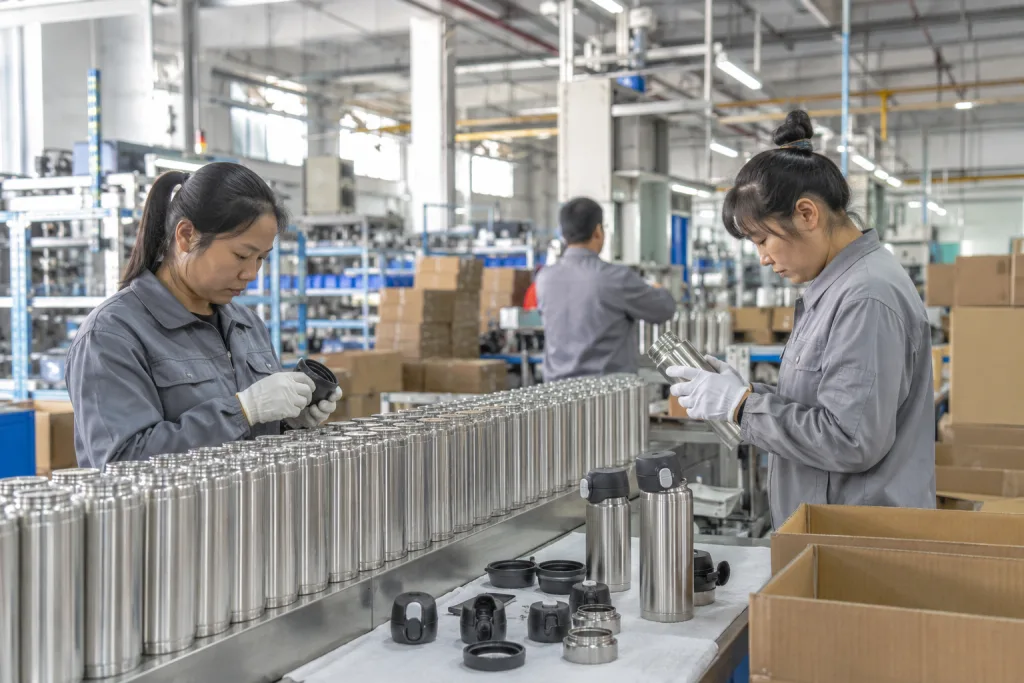
Take a real order: 5,000 pcs of 500 ml stainless vacuum flasks for an outdoor retailer or promotional brand. BottleForge Industrial works from Hangzhou, Zhejiang, with production partners across Zhejiang and China. We run stainless thermos MOQ from 1,000 pcs per SKU, and standard custom thermos lead time is 30-40 days after sample approval. The buyer asked us to cut 7 days from the schedule; we’ve seen this go sideways when tooling, logo proofing, vacuum testing, and the 1.2 m carton drop test all stay in the plan. The math doesn’t work.
Start with the buying job
Show up with a spec sheet, not a price question. The first mistake is emailing a thermos supplier "your best price" before you know what you're actually buying. Wrong question. A promotional thermos for a two-week event is not built like a retail outdoor flask expected to survive one winter in a backpack. In the catalog, both look close. On the line, the difference shows up in steel grade, lid fit, coating thickness, and how tight QC holds the leak test. Last month QC pulled 32 samples from a 500 ml run because the PP lid thread felt loose after the torque gauge hit 1.2 N·m.
Here is the scenario. You source a 500 ml customizable thermos with stainless steel body, PP lid, silicone seal, powder-coated finish, and one-color logo. The channel is outdoor retail, with distributor thermos volume for corporate gifting. That means shelf appearance matters, food-contact documents must be ready, and the flask has to handle normal drop and leak complaints without turning into a claims file. We have seen this go sideways when a buyer asked for a retail look but accepted promo-grade coating; after 18 days in transit, the cartons arrived with rubbed corners and 7 scratched bottles in the first inspection pull.
A practical request to a pp vacuum flask supplier should include:
- Capacity: 500 ml measured to brim or usable fill line
- Body: double-wall vacuum stainless steel, 304 inner and 201 or 304 outer
- Lid: food-grade PP, preferably marked as BPA-free with LFGB or FDA supporting documents
- Finish: powder coating, spray paint, or stainless brushed finish
- Logo: laser engraving, silk screen, UV print, or heat transfer
- Packaging: white box, kraft box, color box, or retail gift box
- Incoterm: FOB Ningbo or Shanghai, or EXW if your forwarder consolidates in China
If the supplier thermos quote skips these points, you are not comparing factories. You are comparing guesses. We run quotes from a spec sheet, not from a WhatsApp sentence. One PO came in with "500ML" typed as "5000ML," and the merchandiser caught it only because the carton CBM looked impossible for the MOQ.
Define the flask before price
I can quote a thermos in 20 minutes. But I won't—not until we pin down the four things that actually move cost: steel grade, wall thickness, lid construction, and packaging. On a 500 ml order, switching the outer shell from 201 to 304 stainless adds USD 0.20–0.45 per unit. A push-button lid instead of a screw cap? Another USD 0.25–0.60. That range depends on whether we pull from our existing mold library or you're paying tooling on a new one—and tooling for a single lid cavity runs about USD 2,800 here in Hangzhou.
For an outdoor retailer, we run 304 inner at 0.4–0.5 mm, 304 or 201 outer at the same wall, and a plain PP screw lid with a silicone gasket. Boring structure. Stable product. I've had buyers send over renderings with a flip-top spout and three silicone seals. Looks great. QC pulls the first off the line and the drinking valve sticks after 200 cycles. Every hidden gasket, every spring—that's an inspection point you didn't price in. AQL 2.5 won't catch it unless you call it out explicitly on the spec sheet. I've learned to flag these the hard way.
Vacuum performance needs to be a test condition, not a marketing line. A standard 500 ml stainless flask, filled at 95°C and held at 20°C ambient, lands between 45°C and 55°C after 12 hours. Premium builds push past that. When a supplier says "keeps hot 24 hours," ask for the curve. Ask for the test report from the third-party lab—we use TÜV Rheinland out of Shanghai for ours. Agree on a pass/fail threshold before you sign the PO. We had a shipment held at the port over a 3°C gap between the claim and the actuals. That was a 12,000-unit order sitting in Hamburg while we argued over test methodology.
For a promotional piece, 201 outer steel and a single-color spray coat hit the budget. For retail outdoor, spend on better steel, a 60–80 micron powder coat, and cartons that survive 40 days of container humidity. I've seen a buyer save USD 0.18 on the flask unit cost and eat USD 3.00 per unit on a replacement air shipment because the coating bloomed with rust spots by the time it hit the warehouse. That math doesn't work. Never has.
Choose customization without drama
Artwork delays kill custom thermos programs — not the steel. Lock down logo size, Pantone, position, and print method before we open a pre-production sample. "Use our logo attached" shows up on POs constantly. It's not enough. Send AI, PDF, or EPS files. Don't try to cram four lines of 6pt text into a 20mm print area. The screen will fill it in solid. We'll flag it.
On powder-coated stainless flasks, laser engraving is the safest long-term choice. It burns through the coating, exposes bare 304 below, and doesn't peel. We ran 12 commercial dishwasher cycles — no visible wear. We still spec hand wash on packaging for most vacuum products because the lid gasket and vacuum seal don't love repeated heat cycles. Silk screen is cheaper and works for one- or two-color promotional jobs. Abrasion resistance depends entirely on the ink and curing time — we've seen silk screen logos ghost after 6 months in a lunch bag. UV printing gives you gradients and Pantone matching. Setup runs higher and the unit cost jumps at quantities under 3,000 pcs.
For a 5,000 pc custom thermos run, a 500 ml flask FOB in Zhejiang runs roughly USD 3.20–5.80. Grade, coating type, lid complexity, and box all move the number. Laser logo adds $0.10–0.25 per unit. Color box packaging adds $0.18–0.60. These aren't prices. They're sanity filters. When one supplier quotes $2.10 and another quotes $4.30 for "the same item," the items are not the same. We've seen a $2.10 quote use 0.4mm wall steel and a single-wall lid. The buyer flagged it after the first drop test failed — the lid popped clean off at 1.2 meters.
Get a physical approval sample with your real logo printed. Digital mockups are good for layout only. For outdoor retailers, ask the supplier to photograph the sample next to a ruler, on a scale, under normal warehouse lighting. Glossy studio shots hide orange peel on the coating, lid gaps over 0.3mm, and print that landed 2mm off center. QC pulled a sample last month — lid gap looked fine in the photo but measured 0.6mm on the bench. The buyer caught it before production. That's the kind of check you want.
Put compliance in the order
I tell buyers this: compliance goes in the PO, not in a follow-up email. Lock material grades and test requirements into contract line items. Your cost, lead time, and supplier list all shift — make that shift at the sample stage, not two weeks before shipment.
Half the problems land on the PP lid. You're buying from a PP vacuum flask supplier, not just a stainless thermos shop. The lid touches the mouth. PP is light, molds clean, handles 100°C without deforming, and keeps unit price reasonable. That's why we run it. But "PP" on a drawing is a placeholder, not a spec. Virgin food-grade or recycled? If the masterbatch isn't food-contact rated, the color itself fails. Does the silicone ring have a migration test report from the last 18 months, or is the factory hoping nobody asks? We had a buyer reject an entire FCL because the gasket color on the PO said "white" and the factory ran translucent — same material, different batch. Container sat at the port for three weeks.
Promotional brands and distributor orders change hands two or three times before hitting a shelf. The compliance file needs to travel with the goods. Bundle it: material declaration, test reports under two years old, BSCI or social audit summary if your market requires it, and product photos of the actual tested article — not a similar SKU from a different line. If factory audit status matters to your buyer, ask on the first call. A BSCI-registered supplier emails the audit summary in half a day. Trying to line up a last-minute inspection two weeks before loading? I've seen that fail more times than it works.
One thing I've learned on the factory floor: a low-price supplier listing doesn't always run the same approved material as the test report they attached. The report has to match the item, the lid, the gasket, the interior coating, and the color family as tightly as you can get. If the report covers a different bottle with a different lid assembly, it's noise — not proof. QC pulled a sample last month. Lid PP and test-report PP were two different batches. The buyer caught it before we did.
Sample approval is a contract
A pre-production sample is your contract. Not a Word doc. Not a WeChat message. The physical bottle locks shape, color, logo position, lid fit, carton, and acceptable finish. On a standard thermos order we run one blank sample first—assuming the mold already exists—then one logo sample before bulk. You can combine those steps if lead time is tight, but you accept the extra risk. A buyer skipped the blank sample once; the lid thread was 0.3 mm off and 12,000 bottles had to be reworked.
Inspect the sample like a buyer who just got burned, not a product manager in love. Fill it with 95 °C water, cap it upside down for 30 minutes, weigh the empty flask, measure actual capacity, look at the inside weld seam and rim. Run your fingernail across the logo edge. Open and close the lid 50 times. Throw the flask in a backpack pocket and pull it out—does the coating scratch against the zipper tape? These take 15 minutes total. They tell you more than any spec sheet. QC pulled a sample last month that passed all dimensional checks but leaked at the vent hole on the 47th open-close cycle.
Color is where most approvals go wrong. Use Pantone references but accept that powder coating on a curved stainless cylinder won't match ink on flat coated paper. It never does. We set a visual tolerance under D65 light, or we compare against a signed master sample. If you need strict retail color consistency across repeat orders, keep one golden sample at your office and one here on the factory floor in Zhejiang—split them so a fire doesn't kill both. One buyer lost his only master to a pipe burst in the warehouse. We had to rematch from photos. The math doesn't work there.
Never approve a sample with "small issues to fix in bulk" unless you write those issues down. A useful approval note reads: "Approved shape and logo; mass production must improve lid flash at the seam, reduce black specks visible on white coating, and match carton mark per attached PDF." That gives our production team a measurable target, not a vague promise. We've seen this go sideways when a buyer wrote "fix finish" and we guessed wrong on the gloss level.
Control production before inspection
A QC inspector at the dock is the last checkpoint, not the first. 80% of what goes wrong has already gone wrong by then. A stainless thermos hits ten stations on our floor—incoming steel and plastic, body forming, welding, vacuum draw, polishing, coating, printing, assembly, leak testing, packing. Each station either catches a defect or locks it into the carton. Inspecting finished goods means you're paying to inspect scrap.
On a 5,000 pc order at BottleForge Industrial, here's the clock after deposit clears. Days 3–5: material confirmation—we pull a coil sample and a resin batch card, verify SUS304 cert against the PO spec. Days 7–12: body forming and vacuum processing. Days 5–7: coating and printing. Days 3–5: assembly and packing. Total 30–40 days from sample approval. That's real line time. Five orders ahead of yours, yours ships five orders later. Zhejiang is fast, but it's not magic.
Three factory-side controls matter. First, 100% vacuum performance screening. We fill at 96°C, seal, measure external wall temp at 6 hours. Below 48°C on a 500ml unit? It fails. Some shops use pressure decay, some use suction. The method matters less than whether every single unit goes through. Ask for the setup photo, not the certificate. Second, 100% leak test after assembly. Third, visual inspection before packing. For powder coating, ask if the line runs cross-hatch tape adhesion on random pulls—we do five per batch, and a buyer once rejected 800 pcs because the checker missed it. For logo printing, demand rub testing. A bottle riding in a truck bed all day sees more abrasion than any lab sim.
Carton strength is not decoration. Standard export carton is 5-ply corrugated, 12–24 pcs per master, with edge protectors for gift boxes. Keep each master under 15–18 kg. That single number prevents more damage claims than any inspection report. FBA warehouses flag overweight cartons before they open them. We learned that the hard way on a Houston shipment in 2023.
Inspect with AQL and real use tests
AQL 2.5 on majors and 4.0 on minors—that's what 90% of our repeat buyers settle on after the first order. It works. Criticals stay at zero. Leakage, a burr on the rim that draws blood, a chemical smell the second you unscrew the lid, 201 stainless where 304 was on the PO, glass fragments from a blown inner wall. We had a buyer pull out an XRF gun during final inspection two years ago and flag 201 stainless on a batch of 500 ml flasks. That shipment never left the loading dock.
Your inspection sheet needs specifics. Carton count and FNSKU barcode scan come first—wrong barcode means Amazon warehouses reject the pallet and we eat the return freight. Then product dims, net weight, declared capacity. Logo registration against the signed-off Pantone. Coating inspection under 600-lux light. Lid thread engagement, gasket seating, leak test (fill to 90%, invert, wait 3 minutes). Thermal test on a subset. Odor check—open the lid and inhale. Packaging drop test at 76 cm. If you need ISTA 3A transport validation, flag it before quoting. That test might force us from B-flute to double-wall corrugate, and double-wall changes the piece price by $0.12–$0.18 depending on the SKU.
For a 5,000-piece lot, a third-party inspector pulls roughly 200 units under ANSI/ASQ Z1.4 Level II. This is a snapshot audit, not a factory replacement. One inspector has maybe 6 productive hours on-site. You cannot thermal-test 200 flasks across an 8-hour cycle inside that window. We pull 12 to 20 units for heat retention and run the full leakage and visual checks across the 200-piece sample. The math doesn't work any other way.
Outdoor retailers need to test cap torque wearing liner gloves. Check that the grip texture isn't slick when wet. Drop the flask into the actual cupholder it's supposed to match—we've seen a 68 mm base jam in a 70 mm holder because the powder coat added 0.3 mm. Promo buyers: logo consistency across colors trips people up every season. A white imprint on matte black isn't the same as white on glossy navy. Check both. Distributors running repeat programs need defect rates tracked by SKU from order one. If the first shipment lands at 1.8% minor coating defects and the customer doesn't complain, fine. But that 1.8% becomes your ceiling. Second order shouldn't drift to 2.4% because nobody logged the baseline. We track it. You should too.
Ship, reorder, and improve
Inspection passes. Now shipping details decide whether a clean order arrives clean. For FOB Ningbo or Shanghai, we deliver to the port warehouse or container yard under agreed terms. Your forwarder handles the ocean or air leg. For urgent promotional thermos launches, air freight may solve timing but it destroys margin — a 500 ml stainless flask is not light once packed. Stick with ocean unless the event date is truly immovable.
For retail, label control matters. Confirm the inner box barcode, master carton shipping mark, country of origin, warning language, and any recycling marks before cartons get sealed. If your 3PL needs FNSKU labels, do not leave this to warehouse workers guessing from a spreadsheet. Send a label placement diagram. One wrong barcode creates more trouble than a small cosmetic defect — we have seen pallets held at Amazon inbound for a missing "Made in China" stamp.
After delivery, collect real feedback: leak complaints per 1,000 pcs, coating scratches, lid breakage rates, return reasons, and customer notes on heat retention. A good thermos distributor turns that data into a better reorder. Maybe the next run needs a wider mouth, a stronger hinge on the lid, a matte coating instead of gloss, or a lower carton quantity so your warehouse can shelf it faster. The best supplier relationship is not about squeezing USD 0.05 per unit; it is about reducing surprises every shipment.
China remains strong for stainless drinkware because the supply chain is concentrated. Steel processing, vacuum workshops, PP injection molding, coating lines, printing, packaging, and export logistics are all within an hour or two of each other in Zhejiang. From Hangzhou, we can manage sample reviews, factory audits, and shipment follow-up without pretending every order is simple. Custom thermos sourcing works when you specify clearly, inspect honestly, and treat the first order as the start of a controlled program — not a one-off test.
Send your thermos spec before you request price
Share capacity, lid type, logo, market, and target quantity. We will return a practical China factory quote and QC plan.
Frequently asked questions
What MOQ should I expect from a pp vacuum flask supplier?
For existing stainless vacuum flask molds, a realistic MOQ is 1,000 pcs per SKU and color. Some thermos suppliers will accept 500 pcs for a trial order, but the unit price, logo setup, and inland handling usually rise. For a fully customized thermos shape or private mold, expect 5,000-10,000 pcs per first run, plus mold cost. If you need multiple colors, do not split 1,000 pcs into five colors unless the factory confirms coating line feasibility. For outdoor retail, 2,000-5,000 pcs is a healthier first order because you get better carton planning, more stable color control, and stronger attention from the production line.
Is PP safe for vacuum flask lids?
Food-grade PP is commonly used for vacuum flask lids because it handles normal hot drink contact, molds cleanly, and keeps cost reasonable. The key is not the letters “PP”; it is whether the supplier uses new food-contact PP, compliant color masterbatch, and a suitable silicone gasket. For EU buyers, ask for LFGB or EU food-contact migration support. For North America, FDA food-contact documentation is usually requested. Avoid recycled PP for drink-contact lid parts. Also check odor after filling with hot water for 2 hours. A strong plastic smell is a warning sign, even if the material name sounds correct.
How long does a custom thermos order take in China?
For an existing mold with one logo and normal packaging, plan 30-40 days after approved sample and deposit. Sample preparation usually takes 5-10 days, depending on logo method and coating color. If you need a new lid mold, special retail box, or lab testing, add 10-25 days. Shipping is separate: ocean freight to Europe or North America may take 25-45 days port to port, plus customs and inland delivery. The date that matters is sample approval, not first email. A professional thermos manufacturer should give you a timeline with sample, production, inspection, and vessel cutoff dates.
Which logo method is best for outdoor promotional thermos orders?
For outdoor use, laser engraving on powder coating is usually the safest because it will not peel like ink. It works well for simple logos and text, with a typical added cost around USD 0.10-0.25 per unit on bulk thermos quantities. Silk screen is cheaper and good for event giveaways, but it needs proper curing and rub testing. UV print is useful for multi-color logos, gradients, or detailed brand artwork, but it costs more and may be more exposed to abrasion. If your flask will sit in backpacks, bike cages, or campsites, choose durability over a complicated print effect.
What defects should I reject during final inspection?
Reject any critical defect: leakage, missing gasket, sharp rim, broken lid, strong chemical odor, wrong material, contamination, or unsafe loose parts. Major defects include wrong logo, poor coating adhesion, large dents, failed barcode, wrong capacity, or lid threads that do not close smoothly. Minor defects include small specks, light scratches, or slight color variation within the approved limit. AQL 2.5 major and 4.0 minor is common for a supplier thermos order, but critical defects should be zero. Always include a leak test, capacity check, visual inspection, packaging check, and at least a small thermal retention test sample.