Key Takeaways
- For most pp vacuum flask custom orders, 304 stainless inner wall plus PP food-contact lid is the safest baseline at 1,000 pcs MOQ
- 500 ml and 750 ml models fit outdoor retail better than 350 ml if buyers expect 12-18 hour heat retention
- Powder coating usually adds USD 0.35-0.80 per unit but improves grip and shelf appearance
- Promotional thermos projects should lock logo method, carton drop test, and AQL level before paying for bulk production
If you searched pp vacuum flask custom, you are not pricing a retail bottle. You are checking whether a polypropylene lid, cup, handle, straw cap, or push-button set belongs on a stainless vacuum flask that will sit on outdoor retail shelves, go into promo handouts, and come back through distributor returns. A sample photo can look clean. Then QC pulls the pre-shipment sample, slides in a feeler gauge, and finds a 0.35 mm cap wobble, heat retention below spec, or a logo that scratches off after 7 days in a carton rub test. We have seen 8,000 units stuck in the warehouse over loose caps. Painful.
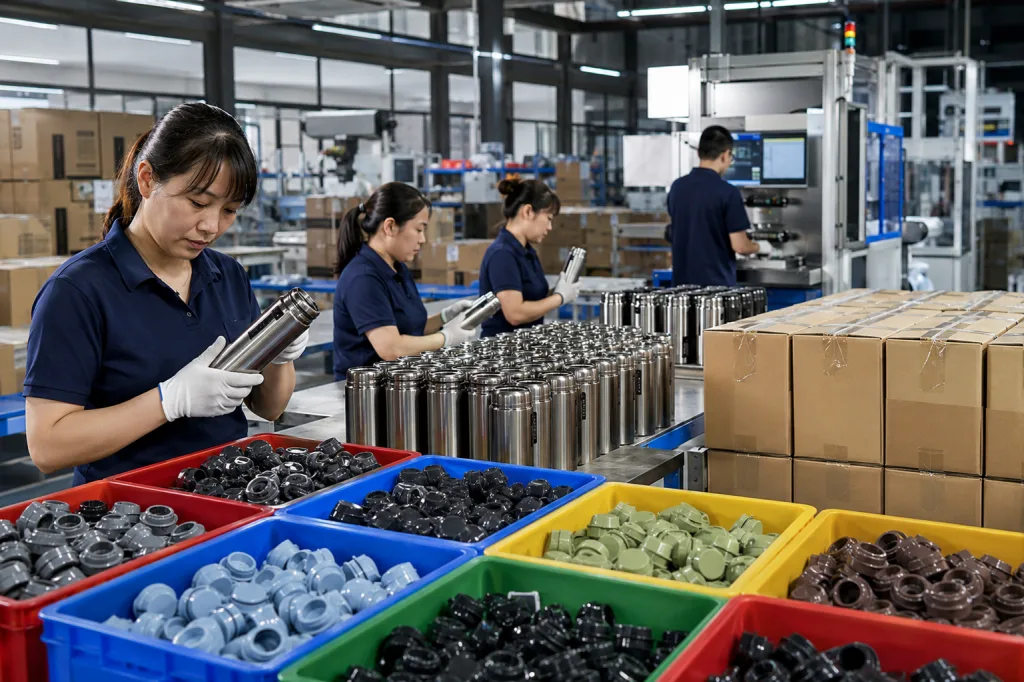
At BottleForge Industrial in Hangzhou, Zhejiang, we run custom thermos programs for outdoor retailers and promotional brands that need trade-offs, not catalog talk. A typical thermos bulk order starts at 1,000 pieces per color, with production lead time around 30-40 days after artwork approval. China can make almost any shape, but this is the wrong question to ask first; the line needs the channel spec before we open tooling or confirm the PP mold tolerance. Last month a buyer flagged a PO typo, “PP cup” instead of “PP lid,” and that small line almost changed the packing test and cost sheet.
What PP changes on a flask
PP means polypropylene. It is not the vacuum layer. On a stainless thermos, PP usually sits in the lid, cup, handle, inner stopper, straw cap, and push-button drinking parts. Heat retention still comes from the double-wall stainless body, usually 304 inside and 201 or 304 outside depending on the price target. For a pp vacuum flask custom project, do not ask, “Can we add PP?” Ask three sharper things: where the user’s mouth or hand touches plastic, whether your Pantone tolerance is 0.5 mm or 1 mm under the light box, and whether the part needs molded logo tooling or another lab test. Details bite. Last month QC pulled a lid sample with a 0.6 mm color gap against the buyer’s Pantone chip. Small gap. Big delay. Approval stopped for 3 days.
PP works well because it is light, survives daily drops better than brittle plastic, and stays suitable for food-contact parts when the resin grade is correct. It also handles hot water better than the cheaper plastics still seen on low-end drinkware. For Europe and North America, ask for food-contact documents before deposit payment, not after we book the injection line. For EU buyers, REACH and LFGB-related checks need to sit in the test plan from day one. For US promotional brands, the importer or retailer usually asks for FDA food-contact compliance wording on file. We run these parts with resin lot numbers on the injection sheet; one PO typo on “PP food grade” versus “PP ordinary” once caused a full document reissue before shipment.
PP is not the weak point. The lid design is. A 9-part push-button lid with silicone gaskets, PP shell, spring, axle, and decorative ring gives the line more places to make a mistake than a simple screw lid. Leaks show up fast. QC once found 7 leaking lids in a 200-piece pre-shipment pull because the spring seat was 0.3 mm off after tool repair. If your distributor thermos program goes into outdoor retailers, cleaning access matters. If the order is a short-term corporate gift, cost and logo visibility may matter more. We’ve seen this go sideways when buyers choose the fancy lid first and ask about cleaning only after the retailer flags it.
Our Zhejiang factory view is simple: use PP where it improves function, not just where it cuts cost. A cheap PP cup lid on a heavy 1,000 ml flask feels wrong in hand, and the math does not work if returns rise by even 2%. A well-molded PP stopper on a 500 ml customized thermos keeps the product affordable and reliable. On the line, we check stopper fit with a go/no-go gauge before packing; if the PP part rocks inside the mouth by 1 mm, the buyer will notice before the end user does.
Head-to-head spec table
We put this table in front of new buyers before any sampling PO is cut. FOB China ranges are working references, not menu prices; steel grade, order quantity, coating, carton spec, and RMB/USD rate still move the quote. Small changes bite. In Hangzhou, our line runs about 350,000 units per month across bottles, tumblers, and flasks. QC checks incoming coil with a Mitutoyo thickness gauge, then pulls samples at vacuum test, printing, and final packing. Last month one PO said “mat black” instead of “matte black.” We caught it before powder coating.
| Option | Best fit | Typical MOQ | FOB range | Main risk |
|---|---|---|---|---|
| 304 inner + 201 outer, PP screw lid | Promotional thermos or budget distributor thermos where the buyer needs a low shelf price | 1,000 pcs/color | USD 3.20-5.10 | Outer wall dents more easily, especially after 3A carton drop testing |
| 304 inner + 304 outer, PP cup lid | Outdoor retail and camping flask orders that need stronger corrosion resistance | 1,000 pcs/color | USD 4.60-7.80 | Higher landed cost; one EU buyer flagged it when freight added USD 0.38/pc |
| 304/304 with push-button PP stopper | Office, travel, or branded gift set with daily opening and closing | 2,000 pcs/color | USD 5.20-8.60 | Lid leakage if gasket tolerance drifts by 0.2 mm |
| Wide-mouth 750 ml PP handle lid | Hiking and sports retail where ice cubes and powder scoops need easy access | 1,500 pcs/color | USD 5.50-9.20 | Handle fatigue under drop impact; QC pulled the sample after a corner hit cracked the hinge |
| Full custom mold PP lid | Private label manufacturer thermos program with a fixed annual forecast | 5,000-10,000 pcs | Tooling extra | Development is 25-45 days in normal cases, not the 12 days buyers hope for |
First thermos order? Do not start with a full custom lid mold unless the silhouette is the reason people buy it. This is the wrong question to ask on a trial PO. We have seen this go sideways when the buyer approved the CAD, then changed the drinking angle by 3 mm after T1 samples. A standard body with custom color, laser logo, printed packaging, and a proven PP cap ships cleaner on the first run. New lid tooling adds 25-45 days for mold development, plus USD 1,500-6,000 depending on slider structure, gasket seat, and polishing work. On the tool bench, a 0.15 mm mismatch at the PP stopper seat can turn into a leak complaint after hot-water cycling.
For a bulk thermos order, rank the spec by the actual use case. Backpacks need leak resistance first. Outdoor retail needs coating durability after 24-hour cross-hatch and rub testing. Promotional brands should lock the logo method before color matching, because a 0.5 mm thin font can disappear under powder coating. We run the tape test before we argue about Pantone. For distributors thermos shipments going to 3 or 4 warehouses, carton strength matters more than buyers expect, and the math does not work if 2% of outers arrive crushed. One buyer pushed for a lighter K=A carton to save USD 0.06/pc; after the drop test, the corner compression mark was already 11 mm deep.
Outdoor retail versus promotional use
Outdoor retailers and promotional brands type the same keywords: custom thermos, factory thermos, thermos custom, stainless flask. They are not buying the same bottle. A retailer selling at USD 24.99-39.99 needs weight in the hand, clean shelf finish, and fewer returns after a cold February weekend. A promotional agency ordering 10,000 pieces for a conference pushes us on logo size and ship date first. We see this every month. Last spring, one buyer flagged a 0.3 mm logo position shift on the pre-production sample, while the outdoor buyer cared more that QC pulled the sample and found a small dent near the shoulder after drop packing.
For outdoor retail, we run a safer build: 304 stainless inner wall, 304 outer wall, powder coating, plus a simple PP lid with silicone gasket. Wall thickness around 0.4-0.5 mm on the outer shell is common for mid-market flasks. A thinner shell can reduce FOB cost by USD 0.20-0.45, but the math does not work if store staff reject cartons with dented bodies. Calipers tell the truth. On the line, our QC team checks shell thickness with a digital micrometer and records heat retention with 95°C water, 20°C ambient temperature, and temperature after 6, 12, and 24 hours.
For promotional thermos orders, a 304 inner and 201 outer can be acceptable when the item is not sold as premium outdoor gear. Put the budget into screen printing and the gift box instead. A customized thermos with one-color silkscreen logo may add USD 0.08-0.18 per unit, while laser engraving usually adds USD 0.15-0.35 depending on logo size and line time. We have seen this go sideways when the PO says “Pantone 286C” but the artwork file says “286U”; the buyer flagged it only after the first 500 pcs were printed.
Distributors need a middle path. A thermos distributor often buys one neutral model in black and white, then adds navy only if the MOQ clears 1,000 pcs per color. For this channel, choose stock powder colors, avoid push-button lid tricks, and keep master cartons under 15 kg gross weight. Warehouse teams notice carton weight before they admire your lid design. One distributor in Germany asked for a fancy flip lid, but our packing test showed 18 lids cracked after a 1.2 m carton drop, so we shipped the simple PP screw lid instead.
Lid design decides complaints
Lid problems drive more returns than any other failure on a custom pp vacuum flask. Not the body. We've tracked complaint data across three years of export orders: caps account for roughly 70% of field defects. A double-wall stainless body rarely fails if the factory does hot water testing at 95°C and a vacuum decay check before packing. Lids, though—they sneak through. A lid can torque down fine on the assembly bench and still dribble water when someone throws the flask sideways into a backpack. The usual culprit: a gasket that's too thin (1.5 mm instead of 2.5 mm) or seated by hand with inconsistent pressure.
Three lid types cover most custom orders. Screw lid with a silicone gasket is the workhorse. Fewer parts, simple mold, easy to strip down and wash. One-hand operation isn't its strong suit, but for hiking and camping that trade-off makes sense—we've shipped 200,000+ screw-lid flasks to European outdoor brands and the defect rate sits below 0.3%. Cup lid gives the traditional thermos feel and works cleanly in 500 ml to 1,000 ml sizes. The PP cup needs to seat without rattle, and the thread shouldn't grind—buyers flag a gritty thread feel immediately. Push-button stopper looks slick on a shelf, but it's the highest-risk option. We've seen a spring supplier change mid-production push leakage from 0.5% to 4% in one shipment. The tolerances stack up fast: button mechanism, spring tension, gasket compression.
When you spec a custom lid, don't settle for a photo. Ask the factory for an exploded parts drawing. Minimum: PP grade (polypropylene copolymer vs. homopolymer matters for cold impact), silicone hardness (Shore A 50–60 is our default for drinkware gaskets), gasket cross-section diameter, spring material if it's a push-button design, and whether the end user can replace those parts. For kids' products or family outdoor gear, skip lids with blind corners that trap gunk. EU and US retail buyers are inspecting cleanability now—we've had two RFPs this year where the buyer disassembled the lid during the audit and checked for residue traps.
Pre-production, we run three checks: lid torque to a set N·m value, inverted leak test (filled, capped, laid on its side for 4 hours), and random assembly pull-apart. For large custom programs, put AQL 2.5 on major defects and AQL 4.0 on minor cosmetic in the PO. That one line saves you a two-week email chain when the shipment lands and the buyer's QC finds scuffs on the cup rim.
Logo and finish compared
A custom thermos isn't custom until the finish and branding survive the real world. The cheapest logo turns into the most expensive mistake when it peels off in a customer's dishwasher video. We see four finish groups on stainless: raw brushed steel, powder coating, spray painting, and rubberized or textured coatings. For outdoor brands, powder coating hits the sweet spot. It grips concrete drops, and buyers read it as premium.
Silkscreen printing works for simple logos and promotional runs under 3,000 units. It handles flat or gently curved areas fine. But multi-color registration on a tapered bottle? That needs tight artwork control. We had a buyer flag a 0.4mm color shift on a two-color print last spring. Heat-transfer handles complex graphics, but abrasion resistance depends on film quality and cure time at 180°C. Laser engraving is the clean play on powder-coated surfaces. It burns through to the 304 stainless underneath. Less colorful. It skips every ink compliance question and looks professional.
Pantone color matching matters for thermos promotions. Expect a tolerance discussion, not a guarantee. The buyer shows us Pantone 186 C and wants it on both the PP lid and the powder-coated steel body. The math doesn't work. Plastic PP and powder-coated steel reflect light differently, even with the same Pantone reference. A serious supplier sends color chips or pre-production samples. If your brand guide is strict, approve the PP lid and steel body separately. We run separate sign-offs for exactly this reason.
Packaging belongs in the same decision. A plain white box works for distributor inventory. Outdoor retail needs printed kraft boxes, barcodes, warning text in at least two languages, and a hangtag with string that won't snap in transit. For Amazon prep, confirm FNSKU labeling and carton marks before packing starts. We've seen this go sideways: a client changed FNSKU format after we sealed 5,000 cartons. Reworking sealed cartons is a brutal, avoidable cost. Lock the packaging spec at pre-production, not after the line starts running.
Testing, compliance, and inspection
I tell every buyer the same: the quote gets you a price. The test plan gets you a product you can sell. For stainless vacuum flasks, our standard checks cover material verification—304 vs 201 stainless, caught with a handheld XRF gun on incoming coils—food-contact migration, vacuum decay rate, coating cross-hatch adhesion, leak integrity, odor panel, and drop survival from 1.2 m. Carton compression gets added when the freight forwarder has a reputation for stacking heavy. We rejected a 0.02 mm under-spec stainless coil last month on the micrometer.
There is no single certificate that clears a flask for every market. The file depends on your claim, your retailer, and where you sell. A 750 ml thermos for REI-style outdoor retail needs different paperwork than a corporate gift run for a bank in Frankfurt. LFGB, REACH, and specific migration limits for the EU. FDA 21 CFR for the US. California Prop 65 screening if your powder coat pigment supplier can't document cadmium and lead levels. Before you cut a sampling PO, ask your retailer for their compliance manual. We saw a 5,000-piece shipment held at Rotterdam over a missing barcode placement spec the buyer never forwarded. That was a $2,400 detention fee before the first unit moved.
Factory-side QC runs on a schedule, not on hope. At BottleForge, a bulk thermos line gets: incoming stainless thickness checked with a micrometer at coil receipt, PP lid visual and fit check on first shots, vacuum insulation sampling at 12-hour and 72-hour intervals, 100% leak orientation on flip-lid models, print adhesion tested with 3M 600 tape, and final random inspection pulled to AQL 2.5. For 3,000 pieces, that's about 200 units on the table. Less if the buyer specifies AQL 1.5 and a Level II draw. QC pulled a sample last week where the logo was off-center by 3 mm—rejected the whole shift's output.
Third-party inspection earns its cost when the order value tops $15,000 or your delivery window has zero slack. A failed pallet in your warehouse costs more than the inspection fee. Don't send a generic "check quality" brief. Tell the inspector exactly what bit us before: cap gasket seating, logo placement within 2 mm of the proof, carton label scan, gross weight matching the packing list, and a barcode test with a Zebra scanner. Vague instructions get you a report that says "passed." That report doesn't help when the goods land wrong—we've seen a buyer pay $600 to re-palletize because the carton labels didn't match the ASN.
MOQ, price, and lead time
MOQ kills deals faster than any other spec in thermos sourcing. A factory can run a single approval sample, but production minimums hit hard once you factor in steel body tooling, coating line setup, PP injection color matching, printing fixture costs, and packaging. For our standard BottleForge models, we ship 1,000 pieces per color for logo-only customization. Special coating colors need 2,000 pieces. Custom PP lid color — where we're injecting a Pantone-matched resin — starts at 5,000 pieces. We had a buyer last quarter pushing for 500 pieces with a custom PMS lid. Can't do it. The mold changeover and resin waste eat the entire margin before the first unit ships.
For pricing, a 500 ml stainless thermos — 304 inner, 201 outer, PP lid, one-color logo, white box — lands between USD 3.20 and USD 5.10 FOB Ningbo or Shanghai. Volume drives where you fall in that range. Step up to a 750 ml 304/304 powder-coated thermos with laser logo and retail color box, and you're looking at USD 5.80 to USD 9.50 FOB. Add a premium lid, a carry handle, copper lining, or tighter AQL inspection, and the price ticks up. Anyone quoting a single fixed number without asking for your spec sheet is either guessing or padding. We saw a quote come through last month at USD 2.90 for a thermos — buyer later discovered it excluded the inner wall coating, and the box label had a typo. QC flagged it during pre-shipment inspection, but the back-and-forth cost them three weeks.
Lead time has three layers. Sampling: 5-10 days for a stock shape with a simple logo, 12-20 days if you need custom color and packaging mockups. Mass production: 30-40 days after deposit and confirmed artwork. Sea freight to North America or Europe tacks on 25-45 days port to port, depending on route and whether it's peak season. Air freight saves a deadline but kills the margin on heavy thermos bulk orders. One buyer air-freighted 2,000 thermoses to Germany — the freight bill came in higher than the product cost. That's a tough call to explain to your finance team.
Payment terms: for new buyers, it's 30% deposit and 70% before shipment, with inspection completed before the balance clears. Long-term distributors running steady volume can negotiate, but nobody extends credit on a first order from a China thermos factory. That's a hard stop.
Best spec by buyer type
Pick your sales channel first. That question will shape your pp vacuum flask custom spec faster than any feature list. A good spec is one where user expectations and what we can actually run on the line don't fight each other. If they do, QC pulls the sample, the buyer flags it, and everyone loses a week.
- Outdoor retailers: 750 ml, 304 inner and 304 outer, powder coating, PP screw or cup lid, laser logo, printed retail box. This runs about 15% above our baseline spec. Complaint rates drop under 0.5%. The end user reads it as outdoor gear, not a giveaway.
- Promotional brands: 500 ml, 304 inner and 201 outer, PP screw lid, one-color silkscreen, individual white box. Keeps unit cost tight. The buyer still gets a custom thermos they won't be embarrassed to hand out at a trade show.
- Distributors: 500 ml and 750 ml from the same tooling family. Three neutral colors, standard PP lid. Keep blank stock and offer logo as an add-on service. We've watched a distributor sit on 2,000 pieces of bright orange for 18 months because they guessed wrong on the tint. This spec avoids that.
- Premium private label: 304/304 body, custom PP lid accent (color-match is fine; dual-injection isn't necessary on the first run), powder coating, laser logo, FSC-style paper packaging if the target market demands it, plus a third-party pre-shipment inspection. Inspection runs roughly $280 per container. Small cost for what it catches.
Watch out for "unique" shapes. A narrow base looks elegant on a render. It tips over on the first campsite use. A chunky PP handle reads tough on the shelf, but we've seen the rib design crack at the root in a 1.2-meter carton drop test. Mirror finish photographs beautifully. It also shows every fingerprint from the moment it leaves the warehouse floor. Good thermos development isn't about stacking features. It's about removing the reasons a buyer returns the unit.
For your first order, stick to two body sizes, one lid family, and two decoration methods. Test-sell those. Collect real feedback—call it 90 days of actual sales data, not a single wholesale buyer's opinion. If the volume justifies it, invest in private tooling later. A reliable supplier relationship comes down to boring details: signed samples, artwork approval in writing, AQL 2.5/4.0 on the PO, lead times you can defend, and cartons that arrive with the correct shipping labels. That's the math that works.
Send your thermos spec and target landed cost
We will compare body, PP lid, finish, logo, MOQ, and FOB options before you commit to tooling or bulk production.
Frequently asked questions
What does pp vacuum flask custom mean in factory terms?
In factory terms, pp vacuum flask custom usually means a stainless vacuum flask using polypropylene parts, most often the lid, cup, stopper, handle, or straw cap. The vacuum insulation is still created by the double-wall stainless steel body, not by PP. A common build is 304 stainless inner wall, 201 or 304 outer wall, silicone gasket, and PP cap. Customization can include PP lid color, bottle coating, logo, packaging, barcode, and sometimes a new injection mold. For a first bulk thermos order, we suggest using an existing PP lid mold and customizing color and logo. That keeps MOQ near 1,000-2,000 pieces instead of moving into 5,000-10,000 pieces plus tooling cost.
Is 304/201 stainless acceptable for a promotional thermos?
Yes, 304 inner wall with 201 outer wall can be acceptable for a promotional thermos if the product is positioned as a practical gift rather than premium outdoor equipment. The liquid touches the 304 inner wall, while the 201 outer shell helps reduce cost. The trade-off is dent resistance and corrosion performance on the exterior, especially if the coating is damaged. For conference giveaways, corporate gifts, and short-term campaigns, the savings can be useful. For outdoor retail or a distributor thermos line with repeat sales, 304/304 is usually safer. The FOB difference may be around USD 0.40-1.20 per unit depending on size, finish, and order quantity.
What MOQ should I expect for a customized thermos order?
For standard stainless thermos bodies with logo customization, expect 1,000 pieces per color as a normal MOQ from a China thermos supplier. If you need a special powder coating color, MOQ often moves to 2,000 pieces because the coating line setup and powder purchase must be justified. Custom PP lid color can require 3,000-5,000 pieces if the resin color is not already used in production. A completely new PP lid mold may need 5,000-10,000 pieces plus tooling. Sampling one or two pieces is possible, but the unit sample cost will be much higher than the bulk price because printing, setup, and courier charges are separate.
Which logo method is best for outdoor retail thermos programs?
For outdoor retail, laser engraving on powder coating is usually the safest logo method. It is permanent, clean, and does not rely on ink adhesion in the same way as silkscreen printing. The downside is that it is normally one-tone, showing the stainless color under the coating. Silkscreen is cheaper and works well for simple promotional thermos designs, usually adding about USD 0.08-0.18 per unit for one color. Laser may add USD 0.15-0.35 depending on logo size and production speed. If your design needs full-color artwork, heat transfer is possible, but you should request abrasion testing and approve a production sample before mass production.
How do I reduce risk before shipping thermos bulk orders?
Start with a signed golden sample, approved artwork, and a written QC checklist before deposit. Your purchase order should state steel grade, capacity tolerance, lid material, logo size, packaging, barcode rules, carton marks, AQL level, and required tests. For thermos bulk orders above 3,000 pieces, third-party pre-shipment inspection is usually worth the cost. Ask the inspector to test leakage, lid fit, coating defects, logo position, barcode scanning, and carton condition. If the order is for Europe or North America, confirm compliance documents before production, not after shipment. Fixing test failures after 5,000 units are packed is expensive and usually delays delivery by weeks.