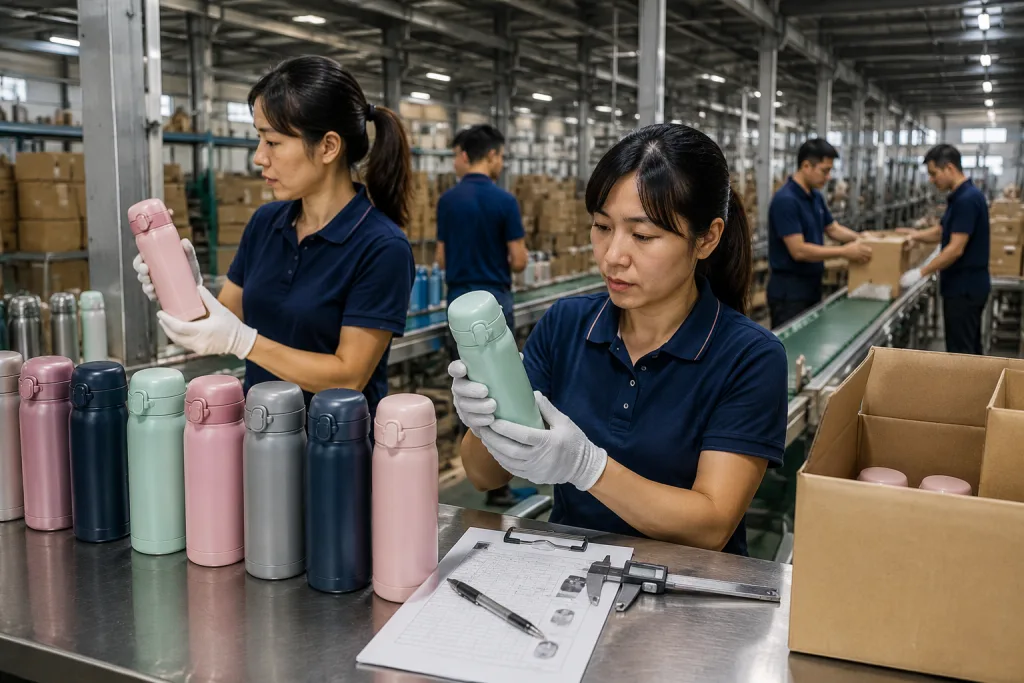
Key Takeaways
- Confirm whether PP means lid, stopper, handle, or shell before approving a 1,000-unit MOQ
- 304 stainless steel inner walls at 0.4-0.5 mm are the normal baseline for retail thermos bulk orders
- Use AQL 2.5 for major defects and AQL 4.0 for minor defects on distributor thermos inspections
- Custom thermos lead time is usually 25-35 days after artwork and pre-production sample approval
You're sourcing PP vacuum bottles at wholesale volume. You're not buying one bottle. You're stocking a retail program, a dealer catalog, a corporate gift campaign, or a seasonal promotion — one wrong material call and you're sitting on 5,000 units of customer returns. The catch is that "PP vacuum bottle" means different things to different factories in China.
It can mean a stainless vacuum thermos with a PP lid. A PP handle. A PP inner stopper. Or a plastic shell that looks like a thermos but holds no vacuum at all. From our Hangzhou floor, we run 304 stainless insulated bottles with food-contact PP components — shipped to Europe and North America. Last month QC pulled a sample where the PP lid flunked LFGB migration testing. The buyer flagged it before the line ran. Our standard MOQ is 1,000 per color, 25–35 days production after sample approval. If a supplier quotes 12 days, the math doesn't work — you're getting a stock mold, or you're getting lied to.
What does PP actually mean?
Buyer question: “When a supplier says PP vacuum bottle wholesale, what exactly am I getting?”
Get this straight before you negotiate a unit price. PP is polypropylene — the plastic we injection-mold into lids, inner plugs, handles, straws, carry loops, and occasionally outer sleeves. It’s food-contact grade. It is not the vacuum layer. A real vacuum bottle is a double-wall stainless body: 304 stainless inside, 201 or 304 stainless outside, air evacuated between the two walls. Zero plastic in the insulation path. We run the copper-sealed vacuum test on every batch. If the copper ring tarnishes inside, the vacuum’s blown and the line stops.
For outdoor retailers and promo brands, the phrase you want is “stainless steel vacuum bottle with PP food-contact lid.” That tells the supplier you expect a metal insulated body and a PP component — not a fully plastic bottle. We’ve seen quotes come in at USD 1.20 FOB for something the buyer called a “PP bottle.” They got a single-wall plastic bottle. No vacuum. No insulation. The correct build — 304 inner, PP lid, silicone gasket — lands closer to USD 2.50–2.80 per unit at wholesale volumes. That’s a $1.30 spread per piece. On 5,000 pieces, you’re out $6,500 if you buy the wrong thing. The math doesn’t work.
Our rule: don’t approve a quote until the BOM lists every contact surface. Inner wall material, outer wall material, lid material, gasket material, coating, capacity, packing method. Last month a buyer flagged a quote where the lid spec just said “PP” — no grade, no gasket detail. The vendor couldn’t produce an LFGB test report for that lid. We walked. If a thermos supplier can’t give you that BOM, they’re not ready for a serious distributor program.
- Body: 304 stainless steel inner wall, 0.4–0.5 mm typical thickness
- Lid or stopper: food-grade PP, usually with a silicone gasket
- Coating: powder coating, spray painting, or bare stainless
- Testing: LFGB, REACH, FDA food-contact, or BPA-free declaration depending on market
Which bottle spec should you choose?
Buyer question: “What specification works for outdoor retail and promotional thermos projects?”
Three capacities actually move in outdoor retail: 500 ml, 750 ml, 1,000 ml. Odd sizes collect dust in the warehouse. 500 ml clears backpack side pockets and standard car cup holders — we see near-zero returns on “doesn’t fit.” 750 ml feels like a proper trail bottle. It’s our top SKU for hiking chains in Northern Europe, reordering every 8–10 weeks during peak. 1,000 ml works for campsites, construction crews, and club merch, but the cartons bulk up fast. A 20-foot container loaded with 1,000 ml units fits about 18% fewer pieces than the same container packed with 500 ml bottles. Freight per unit jumps. Run the landed-cost math before you commit to a big-cavity bottle.
Promotional thermos buyers ask one question on every call: “Can you shave the wall gauge to hit a lower price?” Wrong question. A body that dents when a courier drops the parcel on a porch makes your logo look like a clearance-rack item. Last year we ran a domestic-parcel test on 0.3 mm outer-wall samples — 4 of 10 arrived with visible dents, and one had a cracked inner shoulder. For mid-range custom runs, we ship 0.4 mm inner 304 and 0.5 mm outer 201 or 304, depending on the shape. Deeper draws on slim profiles thin the wall at the shoulder, so we measure three points on the first-off sample with a wall-thickness gauge and log each one. Outdoor-grade bottles step up to 0.5 mm inner and outer. Unit cost rises roughly 8–12% and carton weight ticks up about 140 g per piece. Buyers who skip the spec sheet end up comparing three quotes for what look like the same bottle but aren’t.
Insulation numbers need a reality check. A 500 ml vacuum bottle, filled at 95°C and tested at 20°C ambient, should hold above 60°C at the 6-hour mark. That’s a pass. Brochures printing “12 hours” or “24 hours” without stating the starting temperature, ambient temp, or lid type are cherry-picking. A wide-mouth 500 ml bottle loses heat roughly 1.5–2°C more per hour than a narrow-mouth thermos of the same capacity. The larger opening lets heat escape through the stopper. Lid design matters as much as the vacuum. We had a buyer flag a 12-hour claim, tested it in their own lab, and found 8.5 hours — still a solid bottle, but the brochure overpromised and almost killed the PO. Set a test protocol upfront, before the lab report lands on your desk.
Quick specification checklist
- Capacity: 500 ml for gifts, 750 ml for outdoor retail, 1,000 ml for camping
- Inner material: 304 stainless steel, passivated and cleaned
- Outer material: 201 stainless for budget, 304 stainless for premium
- PP lid: food-contact grade with silicone sealing ring
- Leak test: 100% inline test before packing
- Carton drop test: ISTA-style internal test for export cartons
A manufacturer’s thermos quote should list these points line by line. If the sheet says “high quality material” and nothing else, ask for the mill cert. No cert, no order.
How should you compare prices?
Buyer question: "Why are three suppliers thermos quotes so far apart for the same picture?"
Because the picture hides every cost driver. A pp vacuum bottle wholesale price splits into steel grade, wall thickness, lid construction, coating type, logo method, packing spec, inspection level, and Incoterm. We ran two 750 ml bottles off different lines last quarter: one landed at USD 3.20 FOB Ningbo — 201 stainless, plain white box. The other hit USD 5.80 FOB Ningbo — 304/304 steel, textured powder coat, laser-etched logo, color box, plus a spare silicone gasket. That's a 44% gap. Both quotes were honest for what got loaded into the container.
Line up every thermos manufacturer's quote at FOB Ningbo or FOB Shanghai unless your logistics team specifically asks for EXW. Trucking from a Zhejiang factory to Ningbo port costs about USD 180–220 per 40HQ, and the run takes 3 hours. We're in Hangzhou, running roughly 180,000 stainless vacuum bottles a month across standard shapes and custom logo orders. Last month QC pulled a buyer's sample off the line: steel grade checked out, but the inner wall measured 0.30 mm instead of the 0.40 mm on the spec sheet. At that wall thickness, the supplier's price didn't add up — and the thermal retention test confirmed it. The bottle lost 12°C more than spec over 6 hours.
Unit price alone is the wrong question. A weak carton saves USD 0.08 per unit on the proforma and costs you USD 2,000 in crushed retail boxes by the time the pallet hits Rotterdam. Cheap coating survives the sample photo. It fails after 200 rubs in a basic abrasion test. We flagged this on a distributor order in 2023: the buyer cut USD 0.12 per bottle on the coating spec, and 400 pcs came back with peeling lids. I'd rather quote high and ship clean than explain a return authorization to a warehouse manager in Hamburg. Your real cost is landed, usable stock — not the lowest number on page one of the invoice.
Ask every thermos factory to quote the same steel grade, same capacity, same logo process, same carton spec, same AQL 2.5 inspection, and same Incoterm. If they push back or refuse, you're not comparing factories. You're comparing stories.
What custom options are safe?
Buyer question: “How far can we customize without making the project risky?”
Safe customization pulls from an existing mold and swaps the color, logo, lid color, sleeve, packaging, or accessory set. That’s the sweet spot. You get brand control without dropping USD 3,000–12,000 on new tooling or waiting 45–60 days for mold trials. The math doesn’t work for a 2,000-piece test run.
Logo choice should match your sales channel. Laser engraving is durable and clean on powder-coated stainless bottles. It won’t peel. It’s not always bright, though—on matte black 304 stainless, the mark reads as dark grey, not white. Silk screen printing is cheaper for large flat logos and works best for one-color promotional thermos orders. But if the coating underneath is poor, it scratches. We’ve seen this go sideways on a rush order where QC pulled the sample over a 0.3 mm scratch on a white logo, right at the Pantone 186C border. Heat transfer gives full-color artwork but needs careful adhesion testing—we tape-test every batch with 3M 610 tape before signing off. Embossing on PP lids is possible but usually requires a mold insert and a higher MOQ, around 5,000 pieces.
Before sampling a thermos custom project, we lock the following in writing: Pantone color, logo size in mm, logo placement measured from bottle base or centerline, packaging dieline, barcode position, and whether the product needs FNSKU labeling for marketplace fulfillment. If you sell into North America, carton labels must include SKU, quantity, gross weight, net weight, and country of origin. For Europe, add recycling marks and importer details. A buyer once flagged a missing PET symbol on a lid—the line stopped for an afternoon while we re-ran labels. That’s a 4-hour delay you don’t want.
- Lowest risk: laser logo on existing powder-coated bottle
- Best for color branding: Pantone powder coating plus laser or silk screen
- Best for gift sets: color box, sleeve, instruction sheet, and spare gasket
- Higher risk: new lid tooling, new body mold, complex full-wrap graphics
Which compliance papers matter?
Buyer question: "What documents should I request before placing a bulk thermos order?"
Start with the market. Europe: ask for LFGB food-contact testing if the bottle touches drink or food, plus REACH for coatings and restricted substances. North America: request FDA food-contact compliance for stainless steel, PP, and silicone parts. If the bottle targets children, ASTM F963 can apply — small parts, coating adhesion, and lead content need a separate look.
Factory audits matter, but a certificate is not a magic wand. BSCI, Sedex, ISO 9001 — these tell you whether the thermos manufacturer runs basic management systems. They do not tell you whether your custom thermos holds water at 80°C for 12 hours, or whether that PP lid passed migration testing. Product testing and factory audits solve different problems.
For a promotional brand, the practical document set: material declaration, test report for the same material family, factory audit if your client demands one, pre-production sample approval record, and final inspection report. For a retailer, add packaging compliance, warning language review, barcode verification, and carton drop record — we once caught a 4 kg drop failure on a handle that the buyer's spec sheet missed.
Here is where buyers get burned: they accept an old report for a different lid material. PP from one resin supplier is not the same as PP from another. Black PP uses colorant — that changes the migration profile. A serious thermos supplier should link test reports to the actual BOM and production batch, not hand you a generic PDF from two years ago that covers a different lid.
How do you inspect before shipment?
Buyer question: "What should our QC team check on a thermos bulk order?"
AQL 2.5 on major defects, 4.0 on minor, zero critical. That's the floor, not the ceiling. If your line is positioned at the $28+ retail bracket, dial major down to 1.5 and add a 32-piece function-test pull. We've watched distributors accept 4.0 across the board and eat a 7% return rate six months later. The math doesn't work. Inspection fires at 80% packed, rest finished — inspector sees real export cartons, not staged samples from the top of a pallet.
Don't let inspection become a cosmetic review. A bottle can look perfect under the warehouse lights and fail where it counts. Vacuum integrity. Lid seal compression. Last year a buyer flagged peeling on a matte black coating after 500 units hit their Amazon FBA center. A $12 cross-hatch test with 3M 610 tape at the factory would have caught it before the container sailed. Logo position gets measured against the approved sample at ±0.5mm. Color gets checked against the signed Pantone chip, ΔE ≤ 1.5. Cartons need to survive 14 days of trucking, port storage, and three-high stacking in a distributor's back room — if the outer box bows at 40kg stacking weight, it fails.
Pre-shipment checklist
- Measure capacity, height, diameter, and mouth opening against approved sample — we check 32 per SKU minimum
- Check logo size, color, and position on at least 32 pieces per SKU
- Run leak test by filling, closing, inverting, and shaking for 30 seconds
- Test insulation on sampled units for 6 hours where required
- Check coating adhesion with cross-hatch or tape test if specified
- Confirm carton marks, barcodes, FNSKU labels, and inner packing
- Record dents, scratches, weld marks, dirty interiors, and loose gaskets
Every bottle on our Zhejiang line hits an inline pressure decay leak check before it touches a carton. QC pulls random finished goods for vacuum retention. We run a 24-hour hold test on 5 units per batch. It slows the line. It also cuts the after-sales claims that cost distributors shelf space and category-buyer trust.
What MOQ and lead time fit?
Buyer question: “Can I start small, or do factories only want huge orders?”
For existing models, the real MOQ sits at 1,000 units per color on a custom thermos with logo. Some lines will take 300–500, but the unit price jumps 18–22% because coating setup, screen burning, and packing labor don't scale down. We've done 500-piece runs. The math gets tight. If you need a fresh Pantone powder coat, 1,000 units is the floor—below that, the powder supplier charges us a small-batch fee and we pass it through. For a new PP lid color, figure 2,000–3,000 units. Resin mixing purges the barrel, and the first 15–20 shots go to scrap. Waste adds up fast.
Lead time breaks into three chunks: sampling, production, shipping. Logo sample: 5–7 days after artwork sign-off. Pre-production sample with custom color: 10–14 days—longer if the Pantone needs two passes in the booth. Mass production runs 25–35 days after PP-sample approval on standard 304 stainless vacuum bottles. Then ocean freight. Shanghai to Rotterdam took 34 days last month; LA was 28 days during the same week. Customs clearance can tack on another 4–6 days. Quote 45 days door-to-door minimum and you won't get burned.
If you're buying for a holiday promo, work backward from the in-store date—not the ex-factory date. Add 7 days for AQL 2.5 inspection, booking, customs docs, and possible rework. We've seen a buyer approve artwork 9 days late, then ask the line to "catch up." That order shipped with the logo scaled to 78% of approved size. QC caught it at final audit, but the container had already closed. Promo deadlines break process control. Wrong logo scale, wet coating, cartons that collapse under stacking—this is when those failures happen.
First order with a new partner in China: keep the design simple and the timeline conservative. Prove the supplier process. One body color, one lid, one printing position. Then expand into gift boxes, exclusive shapes, and new colorways once you have sell-through data. The factory relationship works better when the first PO lands clean.
Who is the right factory partner?
Buyer question: “What separates a real thermos factory from a trading-style thermos vendor?”
A real factory answers questions about tooling, welding, vacuuming, coating, injection-molded PP parts, gasket fit, AQL, and carton compression without forwarding your email to three other companies. We own the line. I can pull a sample from the leak-test station mid-shift and send you a photo within 10 minutes. Not every exporter needs to own every machine. For gradient matte finishes, we use a specialist coating partner whose line runs at ±3°C—our QC team audits them monthly. But we control the full process and we carry the warranty. If a batch arrives with condensation under the PP over-mold, you call one contact, not four.
Ask hard questions. How many units did you actually ship last month—not “capacity,” units that cleared final inspection? Our line did 48,000 500ml bottles in March. What's your defect rate after AQL 2.5? On our last three audits, it ran below 0.8%. Show me the last three inspection reports. Send photos of the welding bay, the vacuum-pull gauges, and the packing tables—not the showroom. Do you archive golden samples for every SKU? We keep them in a locked cabinet by PO number. What happens if 3% of goods fail leak testing during inspection? We re-sort the lot at our cost. 3% means something shifted on the line and we need to find it before you do. That's not a negotiation point.
For outdoor retailers, pick a manufacturer that understands repeat orders, spare lid gaskets packed at 2% over the PO, and packaging that doesn't change between runs. We've seen a buyer's Amazon listing tank because the box art shifted slightly between batches—same supplier, no heads-up. That's a $40,000 mistake over two months of stranded inventory. For promotional brands, find a supplier that can turn artwork in 48 hours, print carton labels with 12-digit internal codes, and pack mixed SKUs without mixing them up. If you need FBA-ready shipments, make sure the factory can apply FNSKU labels, master carton labels, and polybag suffocation warnings without you reworking pallets in a 3PL. We've had buyers learn this the hard way when a warehouse in Dallas charged $1.80 per unit for relabeling.
BottleForge Industrial manufactures and exports from Hangzhou, Zhejiang, with standard stainless thermos, travel tumbler, sports bottle, and kids bottle lines. We are not the cheapest option in China. That's deliberate. We quote 304 stainless when the spec says 304, not 201 with a higher nickel flash. We quote PP lids with the correct gasket durometer for hot liquids, not the softer compound that warps after 200 dishwasher cycles. We'd rather lose a PO on price than ship goods that fail at your warehouse and cost you a season. We've walked away from six-figure orders over this. The math doesn't work any other way.
Send your thermos spec before you request pricing
Share capacity, quantity, logo method, market, and delivery date. We will quote the practical factory route, not just the cheapest shortcut.
Frequently asked questions
Is a PP vacuum bottle the same as a stainless steel thermos?
Not always. In wholesale sourcing, “PP vacuum bottle” often means a stainless steel vacuum bottle with PP parts such as the lid, stopper, handle, or straw. The vacuum insulation normally comes from a double-wall stainless steel body, not from PP plastic. Before ordering, ask for a BOM showing 304 stainless steel inner wall, outer wall material, PP grade, silicone gasket, coating, and packaging. If the supplier quotes only “PP bottle,” you may be getting a plastic bottle rather than a true insulated thermos. This single wording issue can change the FOB price by more than USD 1.50 per unit.
What MOQ should I expect for custom stainless thermos wholesale?
For existing stainless thermos models, 1,000 units per color is a practical MOQ for custom logo production. If you need a standard factory color with laser engraving, some suppliers may accept 500 units at a higher unit price. For new Pantone powder coating, 1,000 units is more realistic. For custom PP lid color, expect 2,000-3,000 units because injection molding setup and resin color mixing create waste. New body tooling is a separate project and can require USD 3,000-12,000 in mold cost, plus 45-60 days before stable production.
Which logo method is best for outdoor retail bottles?
Laser engraving is usually the safest for outdoor retail because it is durable, clean, and resistant to peeling. It works especially well on powder-coated stainless steel bottles. Silk screen printing is cheaper for simple one-color logos and large promotional orders, but it depends heavily on coating quality and curing. Heat transfer is useful for full-color artwork, yet it needs adhesion and rub testing before bulk production. For a 750 ml powder-coated custom thermos, many buyers choose laser logo around 35-60 mm wide, depending on bottle diameter and artwork shape.
What inspection standard should I use for thermos bulk orders?
AQL 2.5 for major defects and AQL 4.0 for minor defects is a common starting point for thermos bulk orders. Critical defects, such as unsafe sharp edges, wrong material, contamination, or serious leakage, should be zero. The inspector should check packed goods when at least 80% of production is completed. Include capacity measurement, logo placement, leak testing, coating appearance, carton marks, barcode scanning, and packaging verification. For premium outdoor retail, add 6-hour insulation testing on sampled units and a coating adhesion test if the finish is powder coated or spray painted.
How long does a customized thermos order take from China?
A normal customized thermos order from China takes about 5-7 days for logo sample preparation, or 10-14 days if you need a custom Pantone color sample. After you approve the pre-production sample, mass production is usually 25-35 days for existing stainless vacuum bottle molds. Add 7 days for inspection, booking, and export paperwork. Ocean freight to North America or Europe often adds 25-40 days depending on port and season. If your promotion has a fixed launch date, plan at least 75-90 days from artwork approval to warehouse delivery.