Key Takeaways
- PP-shell vacuum bottles usually target USD 2.40-4.20 FOB at 3,000 pcs, while 304 stainless thermos builds often sit at USD 3.20-7.80 FOB
- For outdoor retail, 304 stainless inner and outer walls give better dent resistance and longer 6-12 hour heat retention claims
- For promotional thermos programs, PP components reduce cost and add color flexibility, but logo durability must be checked
- A practical custom thermos timeline is 7-10 days for pre-production samples and 30-45 days for mass production after approval
If you're sourcing for an outdoor retail range or a promotional campaign, the phrase pp vacuum bottle custom trips up buyers two ways. It can mean a PP plastic shell vacuum flask, or a stainless vacuum bottle with a PP lid, handle, bumper, or inner stopper. That wording ambiguity cost us real quoting time last spring — a buyer in Tokyo flagged it on a 2,400-piece PO. The PO had "PP shell" written where they meant "PP lid only." We caught it before the line ran, but barely.
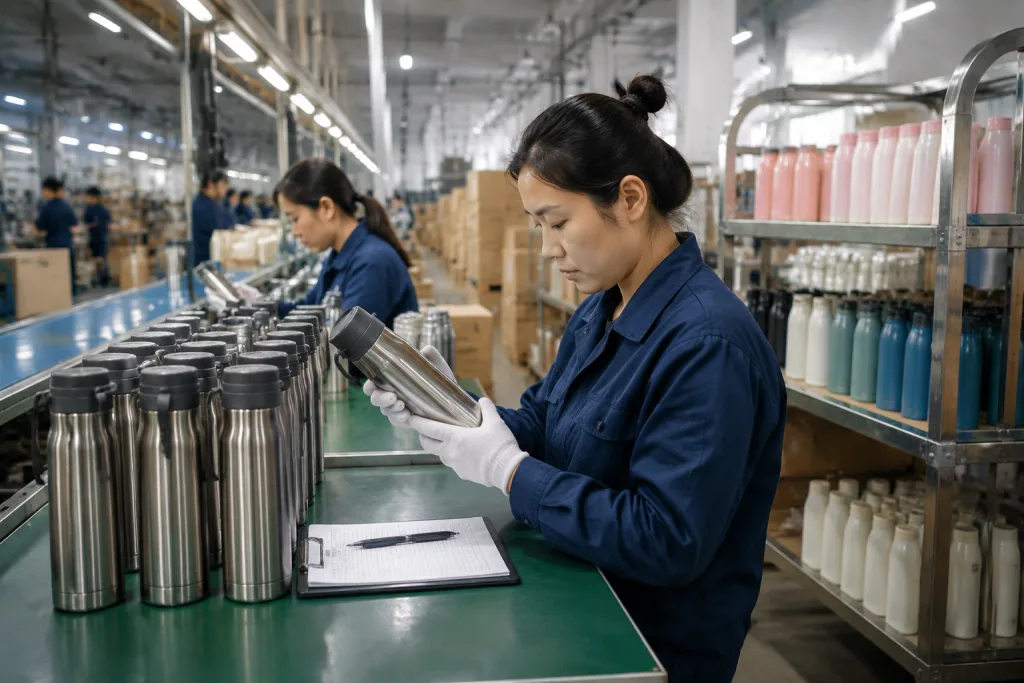
At our Hangzhou factory, the practical question is not "which bottle looks nice?" It is which construction fits your retail price, your logo method, your compliance files, your shipping carton, and your failure risk. A bulk thermos order at 3,000 pieces behaves nothing like a 300-piece sampling run. The QC pull rate jumps from AQL 2.5 to 4.0 on small batches. The silk-screen alignment tolerance shifts by 0.5 mm. Even the carton dimensions change — we had to re-cut a flute pattern last December because a buyer's 300-piece sample fit one per carton but the 5,000-piece production needed six per carton. The math doesn't work if you don't ask the right questions upfront.
What buyers actually mean by PP
Buyers send us RFQs for pp vacuum bottle custom. Nine times out of ten we stop, reply, and ask for a photo or a target retail price. PP—polypropylene—is not a vacuum insulation material. It shows up on the outer shell, lid, cup, handle, straw, bumper, or inner stopper. The vacuum performance always comes from a double-wall structure, usually 304 stainless steel inside.
In China sourcing, you run into three constructions:
- PP outer shell with stainless inner liner: lower cost, light hand-feel, strong color options. We ship these mostly into school and office promotional thermos programs. One buyer flagged last month that the PP shell scratched in transit—we added a PE bag liner and it fixed it.
- Stainless steel body with PP lid: this is the mainstream custom thermos for outdoor retail and corporate gifting. Lid color matching is where QC usually catches a 0.5 delta on Pantone.
- Full stainless body with silicone or TPE parts: higher perceived value. Better for hiking, camping, and premium distributor thermos lines. The math works better at 3,000+ units.
The problem: all three get labeled "vacuum bottle" in a catalog. A thermos quote that says “PP vacuum flask, 500 ml, logo” is not enough. You still need the steel grade, wall thickness, lid material, coating method, test standard, packing, and Incoterm. We saw a buyer order 2,000 pieces based on that short description and got ABS lids instead of PP. The PO had a typo—they wrote "PP" but meant "PP shell." That mistake cost three weeks.
Our Zhejiang production line runs about 380,000 stainless vacuum units per month across bottles, tumblers, and food jars. For a manufacturer thermos project, the most common MOQ is 1,000 pieces per color for existing molds and 3,000 if you need a custom Pantone powder coat. New mold work starts at 5,000-10,000 pieces depending on body shape.
Head-to-head spec comparison
I've had distributors ask "which one is better?" — that's the wrong question. The right one: what does your channel actually need? A 5,000-piece corporate gift run doesn't need the 0.5mm wall thickness we'd spec for a EUR 29.99 retail bottle. But put a flimsy lid on a distributor's thermos line, and you'll get complaint emails by week three. We've seen it.
| Spec | PP-shell vacuum bottle | Stainless custom thermos | Best fit |
|---|---|---|---|
| Typical body | PP outer, 304 inner liner | 304 inner and 304 or 201 outer | PP for budget color programs; stainless for retail |
| FOB China range | USD 2.40-4.20 at 3,000 pcs | USD 3.20-7.80 at 3,000 pcs | Depends on margin and warranty risk |
| Heat retention | Often 4-8 hours above 50°C | Usually 6-12 hours above 50°C | Stainless wins for outdoor claims |
| Logo options | Pad print, silkscreen, sticker, molded color | Laser, silkscreen, UV print, powder coat | Stainless wins for logo durability |
| Retail feel | Light, colorful, more promotional | Heavier, cleaner, more premium | Channel decides |
| Recycling story | Mixed material can be harder | Stainless body is easier to position | Stainless is simpler for sustainability copy |
Push one answer to every buyer and someone gets burned. A 20,000-piece event giveaway with a 3-week delivery window? PP parts help you hit budget — we ran a similar order in 17 days flat by skipping the stainless outer tooling. But if you're selling through outdoor stores at EUR 19.99–34.99, stainless is the safer product story. QC pulled a batch last month where the PP outer cracked during the 1.2m drop test. Three cartons, all failed at the base weld.
Ask for the test report format before you approve the artwork. Heat retention numbers mean nothing if conditions don't match. Our lab runs 95°C start, 20°C ambient, checked at 6, 12, or 24 hours. Two suppliers quoting "6-hour retention" with different starting temps — one using 85°C, another using boiling — are not giving you comparable data. I've flagged this on three RFQs this quarter. Get the lab sheet, not the catalog number.
Ranking criteria for use cases
We rank a custom thermos spec by five factors—not what looks good in the catalog, but what actually holds up on the shipping dock. First is channel fit: retail shelf, outdoor kit, employee gift, event giveaway, or loyalty reward. Second is insulation claim. Third is decoration durability. Fourth is compliance documentation. Fifth is landed cost after cartons, duties, and defect allowance.
Best for outdoor retail: 304 stainless inner and outer, 0.45-0.55 mm outer wall, copper coating inside the vacuum layer, powder coat finish, laser engraved logo, and leak-proof PP lid with silicone seal. We run these through a 10-minute tilt test on the line—if the seal holds at 45°, it ships. This is the strongest choice for a thermos distributor who wants repeat sales rather than one-time volume.
Best for promotional brands: 304 inner with 201 stainless or PP outer, silkscreen logo, standard white box, and 500-750 ml capacity. The math is simple: for a 10,000-piece campaign, going with 201 outer saves USD 0.40 per unit. That's USD 4,000 back in your pocket. One buyer flagged a silkscreen rub-off at QC last quarter—we bumped to a two-coat process at no extra charge.
Best for kids and school programs: PP outer shell, stainless inner liner, push-button lid, optional strap, and smaller 350-500 ml body. The buyer should check ASTM or relevant local requirements if the product is marketed to children. Our QC pulls three samples per batch and runs a lid-lock torque check—if it fails under 2 Nm, we rework the whole lot.
Best for corporate retail packs: stainless travel thermos plus printed gift box, barcode, and color sleeve. For Amazon or retailer warehouses, add FNSKU or EAN labels and carton drop testing. The math is simple: packaging can add USD 0.25-0.90 per piece, so a good thermos vendor should quote these items separately. We've seen this go sideways when a distributor didn't spec the sleeve material, and it tore before hitting the shelf.
Material choices that change risk
We run 304 stainless on the inner wall of every thermos that leaves our line—no exceptions. Coffee sits at ~85°C in a preheated bottle, tea brews acidic around pH 5, and sports drinks drop lower. 304 handles that. 201 does not. We've seen 201 inner walls pit after six months of daily coffee use. A buyer once asked us to quote 201 inner + 304 outer to shave USD 0.40 per unit on a 50,000-piece order. We pushed back hard. The saving disappears the moment a single carton leaks in a warehouse in Rotterdam.
For the outer wall, 201 shows up in budget bulk quotes and it's fine there if you're upfront with your team. It welds, it polishes, it holds a logo. The cost difference between 201 and 304 outer on a 500ml bottle runs about USD 0.25 at our volumes. Some buyers take it; most on premium programs don't.
PP lids are the workhorse. Light, moldable, color-stable across Pantone ranges. A single PP lid mold can carry a push-button, a flip cap, a carry loop, and a cup structure—all in one shot. The tradeoff: stress whitening near the hinge after 3,000 open/close cycles, scratches from keys in a bag, and distortion if someone runs it through a dishwasher at 70°C. We mark every PP lid program hand-wash only. No coating fixes the heat-deflection problem at that price point.
Silicone seals are where the risk hides. A gasket costs USD 0.03. We spec food-grade silicone, Shore A 50–60. Too soft and it extrudes under compression; too hard and it won't conform to the rim. During inline inspection, our QC pulls 125 pieces per AQL 2.5 and runs a lid torque test plus a hot-fill leak check at 90°C. One batch last year failed because the seal durometer drifted to Shore A 42. The mold temperature had crept up overnight. Small shift, big problem. We caught it before palletizing.
If the bottle ships to Europe or North America, ask for LFGB or FDA food-contact docs before you wire the deposit. Coating, lid plastic, silicone—all three need paperwork. REACH applies on the coating side. We've seen buyers skip this step and then scramble when the freight forwarder flags missing declarations at the port. A material declaration isn't decoration. It's part of the product. If the supplier can't produce it on request, expect delays you can't afford.
Decoration methods compared honestly
Decoration is where thermos projects get expensive fast. A curved powder-coated bottle isn't a flat notebook—your logo sits on a radius, under 60–90 microns of coating, and QC will catch problems the renderings never showed.
- Laser engraving: best on bare 304 stainless or powder-coated bodies. Clean, permanent, no consumables. Runs USD 0.08–0.25 per unit depending on logo area. No full color. If your brand spec calls for Pantone 186C, stop here—laser can't hit it.
- Silkscreen printing: works for one- or two-color logos. Cost flips favorable above 1,000 pieces. We always run adhesion testing on the powder coat before production—matte finishes are the worst. We've seen silkscreen peel inside six months on a matte black bottle that passed initial QC.
- UV printing: handles multi-color artwork and smaller runs better than silkscreen. Print quality can be sharp, but edge adhesion and scratch resistance need a real test protocol—not a thumbnail scratch. A buyer flagged edge peeling on a 5,000-piece order last year. We now run a 3M 610 tape test and 100-cycle abrasion on every UV pre-production sample.
- Pad printing: common on PP lids and curved plastic parts. Fine for small logos on lids. Won't survive a dishwasher cycle the way laser does on metal. If the bottle goes through commercial dishwashers, skip it.
- Embossed or molded PP parts: strongest brand integration—the logo is the part. Tooling cost and MOQ jump: typically 5,000–10,000 pieces. Worth it if you're running the same design for two seasons. For a single promotional drop, the math doesn't work.
For outdoor retail, laser over powder coat is the safest bet we ship. For a one-time promotional thermos that lives on a desk, silkscreen or UV is fine—just don't expect it to survive three years in a backpack. For distributor-channel bottles, we run the full gauntlet: 3M tape test, alcohol rub, and 100-cycle abrasion before anything leaves the line.
Need an exact brand color? Ask for a Pantone-coated flat chip first, then a curved bottle sample. Powder coat thickness runs 60–90 microns. Below 60 chips too easily. Above 100 and you risk lid fit problems—we re-cut threads on a batch where coating drifted to 110 microns. Thread feel went from smooth to gritty, and the buyer caught it at inspection.
MOQ, price, and lead time
A reliable supplier quotes body, lid, decoration, packaging, testing, and shipping as separate line items. A single low number is rarely a better deal. FOB Ningbo or FOB Shanghai out of Zhejiang is what we run; EXW looks cheaper on paper but dumps inland freight and export customs clearance on your desk.
On existing molds, our practical MOQ runs 1,000 pieces per SKU. We can do 500 on some stock-color 304 models if you take a higher unit price. PP color matching pushes MOQ up — the injection line needs a stable resin buy and a full machine setup. A new lid mold for a custom thermos runs USD 1,500-6,000 depending on part complexity.
Typical timing: 3-5 days on a blank sample, 7-10 days for a logo sample, 10-15 days for a new color match, and 30-45 days for production after sample sign-off and deposit. In peak season before Q4, add 7-14 days. If a factory says 20 days for a new color, custom logo, printed gift box, and 10,000 pieces in October, ask what they are cutting.
The price drivers are straightforward. Capacity, steel grade, lid complexity, coating, logo method, packaging, inspection level, and order quantity. A 500 ml bottle takes 0.18-0.24 kg of steel; a 1,000 ml outdoor bottle takes 0.32-0.45 kg. When steel prices shift, your FOB number shifts with them.
A cheap bulk thermos is only cheap if the lid seals, the coating doesn't peel, and the carton holds through the container ride.
Quality checks before shipment
Quality checks start on the incoming material rack, not at the sealed carton. We run incoming stainless coil and PP granule inspection, vacuum decay testing on the line, coating adhesion cross-hatch, assembly leak checks at 3 stations, and final AQL sampling. For B2B orders, the standard we ship to is AQL 2.5 on major defects and 4.0 on minor—unless your retail compliance team pushes for 1.5/2.5. We've done that for a German discount chain. It adds about $0.12 per unit in inspection time.
On a PP vacuum bottle custom run, the non-negotiables are vacuum retention, lid leak, coating adhesion, odor, capacity, logo placement, barcode scan, carton drop, and salt spray if there's exposed metal hardware. Vacuum retention: sample units get 95°C water, sealed, then measured at 6 hours and 12 hours. We record ambient temp because a 22°C office vs a 10°C warehouse shifts the curve. Leak testing depends on lid type. Flip-top lids get filled, closed, inverted, and shaken 20 times. Screw lids with silicone seals sit inverted under a 2 kg weight for 10 minutes. Thread-lock lids with a straw port? Those leak at the silicone puncture if the slit tolerance drifts past 0.3 mm. QC pulled a batch last month where the slit was 0.45 mm—passed visual, failed the shake test.
For outdoor-use bottles, we add a drop test that lab certs skip. Filled bottle, 90 cm onto 12 mm plywood over concrete. Then check lid function and coating. It's not a replacement for ISTA or lab drop protocol, but it catches brittle PP hinge pins and thin powder-coat edges in about 30 seconds. We've seen lid hinges survive 10,000 cycle tests and snap on the first real-world drop because the mold temperature was 10°C low at the hinge gate.
If your brand requires BSCI, ISO 9001, REACH, LFGB, FDA, or California Proposition 65 documentation, flag it before sampling. The wrong time to discover a coating compliance gap is after production. We had a buyer request third-party testing post-production on a PP exterior coating—lab found a phthalate over the REACH limit. 8,000 units. Reworking the coating meant stripping and re-spraying, which cost more than the original PO margin. For North American retail, keep packaging claims conservative. Do not print "24 hours hot" unless your test data holds that number under a defined ambient condition. Print the condition on the box. If your data shows 18 hours at 20°C ambient, print that. The chargeback for a claim that doesn't hold is worse than a modest number on the shelf.
Choosing the right factory partner
The best thermos factory for you is not always the largest one. A distributor buyer needs stable repeat production, spare lids, carton consistency, and fast communication when a retailer changes packaging mid-cycle. A promotional buyer needs aggressive cost control and fast logo proofing — ideally under 48 hours. An outdoor brand needs engineering discipline and fewer surprises; we had one client who skipped the pressure test and got leaking bottles at retail.
When you compare thermos suppliers, send the same RFQ sheet to each factory: capacity, material grade, lid type, finish, logo size, packaging, compliance market, target FOB, and annual volume. Ask for the net weight of the bottle, not just the capacity. Ask whether the inner wall is 304 stainless and whether the outer wall is 304 or 201 — we see 201 outer specs on low-cost RFQs all the time. Ask for real production photos from our Zhejiang line, not only catalog renderings. Our QC pulled a sample last month where the render showed a brushed finish and the actual bottle was mirror — the buyer caught it on the QC photo.
Check how the supplier handles changes. If your first PO is 2,000 pieces and the next order is 20,000, can they hold the same powder coat color? We ran into this with a U.S. buyer — the second batch came back with a slight matte shift, and the buyer flagged it. Can they store approved golden samples? Can they provide replacement lids at 1-2% of order quantity? These small operational details matter more than a beautiful quotation page. The math doesn't work if you're chasing a 2-cent savings on a lid that doesn't fit.
For a pp vacuum bottle custom program, we usually suggest starting with two parallel samples: one PP-heavy cost option and one stainless retail option. Put both in your buyer meeting with actual FOB, carton size, logo method, and compliance notes. The better choice becomes obvious when your sales channel — not the catalog — makes the decision.
Send your thermos spec and target FOB today
We will compare PP-shell and stainless options with MOQ, lead time, logo method, and compliance notes for your market.
Frequently asked questions
Is a PP vacuum bottle safe for hot drinks?
Yes, if the liquid-contact surface is food-grade stainless steel and the PP parts are used for the outer shell, lid, cup, or handle. For hot coffee or tea, we recommend 304 stainless steel for the inner wall, food-grade PP for lid components, and silicone seals. Ask for FDA or LFGB food-contact documentation, and confirm the maximum recommended water temperature. Many lids are designed for hot drinks, but not all are dishwasher safe. For retail packaging, avoid vague claims. State hand-wash only if the coating, PP lid, or printed logo cannot pass dishwasher testing.
What MOQ should I expect for a customized thermos?
For existing stainless thermos molds, 1,000 pieces per color is a normal MOQ from a China factory. Some stock models can start at 500 pieces with a higher unit price. For a Pantone powder-coated body, expect 1,000-3,000 pieces. For PP injection color matching or a new molded lid part, MOQ often moves to 5,000 pieces or more because resin purchase, tooling, and machine setup need scale. If you are testing a new distributor thermos line, start with an existing mold and custom logo before paying for new tooling.
Which logo method is best for outdoor retail thermos bottles?
Laser engraving on powder-coated stainless steel is usually the most durable option for outdoor retail. It resists scratching better than basic printing and gives a clean premium look. The trade-off is that it is normally single-color, showing the metal or underlayer. Silkscreen is cheaper for simple artwork and can work well on large runs, but you should request adhesion and abrasion testing. UV printing is useful for full-color logos, especially on short promotional runs. For PP lids or shells, pad printing is common, but it should be tested with a tape pull and alcohol rub.
How long does a bulk thermos order take from China?
A normal timeline is 7-10 days for a logo sample after artwork approval, then 30-45 days for mass production after deposit and sample sign-off. Add 7-14 days during peak season, especially before Q4 promotional shipments. Sea freight to Europe or North America may add 25-40 days depending on port and service. If you need Amazon or retailer-ready cartons with FNSKU, EAN labels, inserts, or drop-test packaging, include that in the first RFQ. Late packaging changes are a common reason bulk thermos orders miss delivery windows.
Should I choose PP-shell or stainless body for a promotional thermos?
Choose PP-shell construction if the campaign is highly price-sensitive, color-heavy, and used mainly for giveaways. It can reduce FOB cost by roughly USD 0.40-1.20 per unit compared with a heavier stainless body, depending on size and lid. Choose stainless if the product represents your brand for more than a single event, especially for outdoor, travel, or retail channels. Stainless gives better perceived value, stronger insulation claims, and more durable logo options. For many promotional brands, the best compromise is a stainless body with PP lid and silicone seal.