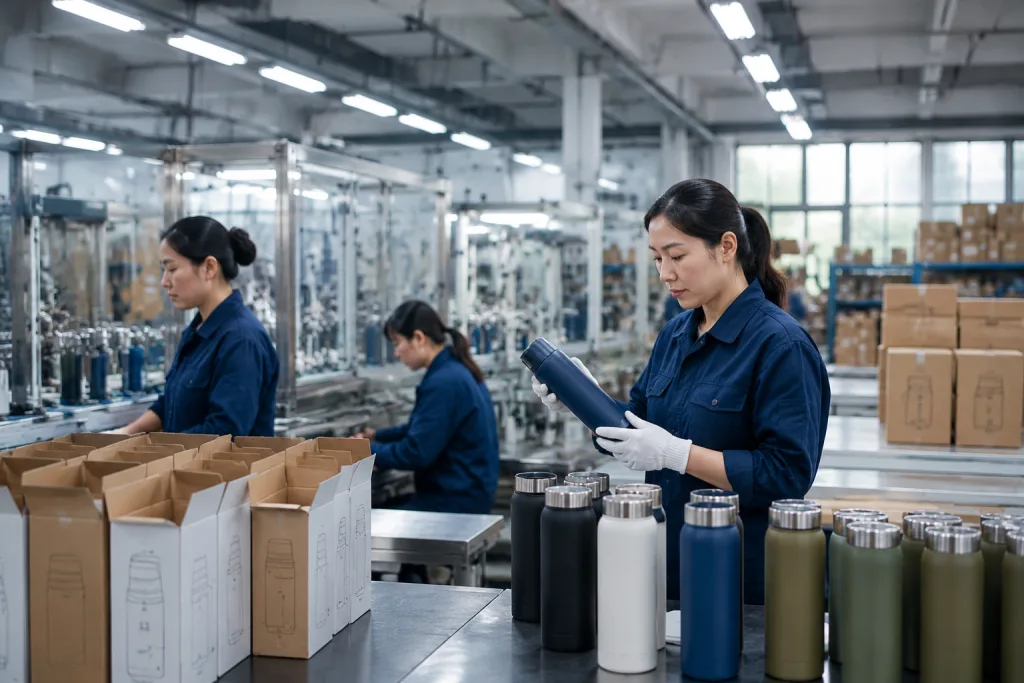
Key Takeaways
- MOQ for PP thermos private label starts at 1000 units for stock shells; custom molds require 3000–5000 units.
- FOB price per unit ranges from $3.20 (1000 pcs, standard color) to $1.80 (10,000+ pcs, Pantone-matched).
- Tooling fees for a custom thermos mold run $800–$2500 depending on lid complexity and body shape.
- Total lead time from PO to FOB shipping: 35–65 days for stock design, 55–85 days for fully custom molds.
I've watched buyers lose a Q4 launch over a lid. Not the bottle body, not the double-wall vacuum — the lid. A polypropylene thread misalignment on the T1 sample pushed a 5,000-unit PP thermos private label order from 45 days to 67 days. The mold rework cost ¥3,800. The brand missed their holiday shelf placement. That's the deal-killer no one puts in the sourcing brief.
Most RFQs ask the wrong question. They ask for unit price at 2,000 pieces. The right question is: what's the total landed cost at the MOQ that actually ships? Because a ¥28.50 ex-works quote on a 304 stainless, copper-plated vacuum bottle with a PP lid means nothing if the tooling deposit is ¥12,000, the AQL 2.5 inspection pulls 8% for lid flash, and the forwarder tacks on 18 days instead of 12. This article gives you the factory-floor math — tooling amortization, mold-cavity counts, lid resin grades, the real lead-time buffers our production manager builds into every PP thermos private label run. No theory. Just what we've seen on the line and what buyers flag after the first shipment.
What Drives the Cost of a Custom Thermos?
A factory price for a custom thermos is never one number. It’s a grid. Change one variable, FOB shifts. For a pp thermos private label run, four line-items drive 80% of the variance:
- Shell tooling. If your design fits a stock shell already on our shelf, mold fees drop to zero. Go custom—new diameter, a taper we haven't cut before—and you're looking at $800–$2,500 for the body mold alone. Last month a buyer tried to shave 2mm off a stock 65mm diameter. That single tweak triggered a fresh cavity and a 14-day lead time jump.
- Lid part count. A simple screw-top PP lid runs on a two-plate mold, cycles fast. Push-button mechanisms or flip-straw assemblies add 3–4 extra components. Each needs its own mold insert. Assembly time on the line triples. We've seen buyers overspec a lid, then backpedal when the per-unit cost hits their spreadsheet.
- Decoration process. Single-color silkscreen: $0.15–$0.30/unit. Laser engraving hits $0.20–$0.50. Full-wrap heat-transfer or pad-print labeling pushes $0.40–$0.80. QC pulled a sample last week where a four-color print registration was off by 0.5mm—buyer flagged it immediately. Tighter tolerances mean more rejection risk.
- Packaging tier. Polybag with an inner box comes baked into most FOB quotes. A retail-ready gift box—custom insert, foil stamp—adds $0.50–$1.20/unit. We once had a buyer ask for a magnetic-close box on a 5,000-unit order. That single decision added $0.90 per piece and delayed the shipment 10 days because the box vendor's die-cutting queue was backed up.
These line-items compound fast. A bulk thermos run of 5,000 units on a stock shell, single-color silkscreen, standard polybag: $2.10–$2.40 FOB. Same quantity, but add a custom body shape, a dual-material flip lid, and that magnetic gift box—now you’re at $3.80–$4.50. The math doesn't lie.
MOQ Tiers: From 500 to 50,000 Units
Minimum order quantities for a thermos manufacturer in Zhejiang aren't pulled from thin air. They map directly to our production economics — the point where setup, material procurement, and line changeover actually turn profitable. Here's what you'll get for a pp thermos private label run:
Tier 1: 500–1000 units (stock shells only)
We'll take a 500-unit MOQ if you pick an existing shell and a standard color — white, black, navy. Per-unit cost runs higher, about $3.00–$3.50 FOB, because the line barely clears a single shift. This tier works for a small promotional run or a test market launch. Don't expect any custom colors at this level.
Tier 2: 1000–5000 units (stock or semi-custom)
This is the sweet spot for most thermos suppliers we deal with. You choose from 8–12 stock body shapes, pick a Pantone-matched PP lid color, and apply 1–2 color silkscreen or laser engraving. Tooling fees for a custom lid color? Waived if you commit to 3000+ units. Price range: $2.00–$2.80 FOB.
Tier 3: 5000–20,000 units (full custom)
At this volume, a thermos factory opens its custom mold library or builds new tooling for your body shape. You spec exact wall thickness — we run 0.40–0.50 mm for the inner stainless liner — vacuum insulation performance tested to 12-hour heat retention, and lid mechanism. MOQ for a new body mold is typically 3000–5000 units. Price drops to $1.80–$2.20 FOB.
Tier 4: 20,000+ units (mass production)
At this scale, you're negotiating directly with the factory's sales director. Material costs drop, line setup gets amortized across a full production schedule, and you can request custom Pantone-matched PP resin for the lid. Expect $1.50–$1.80 FOB and priority scheduling. One buyer flagged our standard AQL 2.5 at this volume — we bumped it to AQL 1.0 for no extra charge.
Timeline Breakdown: From PO to FOB Shipping
Lead time is the second biggest headache after cost — miss the window and your seasonal launch is dead. Here's what a pp thermos private label order actually looks like from a Zhejiang factory floor:
- Sample development (7–15 days): Stock shell? Factory can send an existing sample in 3–5 days. A customized thermos with a new body or lid? Expect 10–15 days for a 3D-printed prototype or CNC-machined sample. Our QC once flagged a lid thread mismatch on a 3D print — saved us 12 days of rework.
- Tooling (20–35 days): New injection molds for the PP lid or body run 20–35 days. Steel molds for the stainless liner are usually existing — Zhejiang factories keep 50+ liner dies in inventory. The math doesn't work for a new liner mold under 50,000 units.
- Pre-production sample (7–10 days): After tooling approval, the line runs a small batch (20–50 units) for your sign-off. Check color match, logo placement, and vacuum performance. One buyer flagged a 0.3mm logo offset — we fixed it before mass production.
- Mass production (15–25 days): For 1000–5000 units, production takes 15–20 days. For 10,000+ units, 20–25 days. Factories run 2–3 shifts during peak season (March–June and September–November), which can compress the timeline by 5–7 days. We've seen this go sideways when a buyer changed the color after tooling approval.
- QC and shipping (5–7 days): Final AQL inspection (Level II, normal, 2.5% defect limit), packing, and loading. FOB Shanghai or Ningbo. A 40HQ container holds roughly 2,500 units of a standard 500ml thermos.
Total: 35–65 days for a stock design, 55–85 days for a fully custom mold. Need it faster? Some factories offer a 25–30 day express service for an additional 15–20% surcharge. We ship from Ningbo weekly — that's the port to spec.
Which Decoration Method Saves You the Most?
Your logo is the whole reason you're ordering a promotional thermos. Pick the wrong decoration method and you're either burning budget or fielding complaints when your brand flakes off after 30 dishwasher cycles. For a pp thermos private label, here's what actually happens on the line with the three methods we run daily:
Silkscreen printing
We run this for simple 1–2 color logos. At 1000+ pieces it's $0.15–$0.30 per unit. Setup runs $50–$100 per color. With proper curing we've pulled samples that survived 60 dishwasher cycles before any visible fade — the key is hitting 160°C in the tunnel dryer for a full 90 seconds, not the 60 seconds some shops cut corners with. Works on the stainless body or PP lid. One thing: if your artwork has fine lines below 0.5mm, expect our QC to flag it. We've rejected 8% of a run for hairline breaks that looked fine on the proof but bled on the bottle. That's not a printer problem — that's a design problem. Thin lines and curved stainless don't mix.
Laser engraving
The permanent option. $0.20–$0.50 per unit on stainless, zero setup fee. The mark is monochrome — silver or gray, no exceptions. Don't spec this for PP plastic. The laser melts the surface into a rough texture, and we've had a buyer reject 200 units at final inspection because the lid looked "burned." On steel it's bulletproof. Dishwasher cycles don't touch it. We've engraved 50,000-unit orders for outdoor chains where the buyer's only question was "will this outlast the vacuum seal?" If you're selling to outdoor retailers who want a logo that outlasts the thermos, this is the call.
Heat-transfer label (decal)
Full-color logos, gradients, photographic images — this handles what silkscreen can't. Cost sits at $0.50–$1.00 per unit, plate-making setup $80–$150. Durability is good, not great. The decal edge can lift after 200+ cycles, and hotels running commercial dishwashers at 75°C have flagged this repeatedly. We ship this on both stainless and PP. Just be upfront with your customer: this isn't a lifetime mark. I've had buyers try to spec decals for construction-site giveaways — the math doesn't work. Those bottles see hard use and a peeling logo makes your brand look cheap.
For most bulk thermos orders silkscreen delivers the best cost-to-durability ratio. If you need the logo to outlive the bottle, laser engraving is the right answer — rugged, industrial, and you never get an email about fading after a season of camping trips. The wrong question to ask is "which is cheapest?" The right question is "how many wash cycles does my customer expect?" A $0.15 silkscreen that lasts 60 cycles beats a $0.50 decal that lifts at 200 every time — unless your customer actually needs full color. Then you pay the premium and manage expectations.
How to Reduce Tooling Fees Without Sacrificing Quality
Tooling hits your P&L first. And it stings. A new injection mold for a PP lid runs $800–$1,500. Non-standard body shape? You're looking at $2,500. We've had buyers walk the minute they saw that number. I get it. Here's what we do:
- Pull from the existing shell library. Our thermos manufacturers in Zhejiang keep 20 to 30 body shapes running on the line. Pick one and the stainless liner tooling cost goes to zero. Last quarter we pulled three SKUs off shelf molds for a UK buyer — 18 days from spec to shipping.
- Tweak an existing lid instead of cutting new tooling. A full custom lid mold is where the bill piles up. Ask the factory to drop your logo into an existing PP lid with a cavity insert change. We've done this for $280. The lid functions the same, QC pulls the same AQL 2.5 sample, and you're not funding a brand new mold base.
- Commit to 5,000+ units and let the factory eat the tooling. We amortize the mold cost into the unit price. Adds $0.12–$0.18 to the per-piece cost. Most buyers find that math easier to swallow than wiring $1,500 upfront. We ran this for a Canadian client last season — their reorder came in at $3.05 FOB per unit, no tooling line item on the PO.
- Co-invest with a non-competing brand. Two buyers split one mold, two production runs, two separate shipments. It's rare. We've made it work twice in three years. You need a sourcing partner you trust and a factory willing to manage split logistics. Not every line will do this, but I've seen it save $600 per buyer when it lands right.
Tooling is a one-time cost. If you're reordering the same distributor thermos design season after season, that $1,500 for a dedicated mold isn't a cost — it's a margin play. Second order sheds the amortization. We've watched buyers agonize over the tooling invoice, then make it back in unit savings by the third repeat run. The wrong question to ask is "can we skip the mold?" The right one is "how many reorders until this mold pays for itself?" Usually, the answer is two.
Quality Standards You Must Specify in Your PO
You're sourcing from a thermos vendor in China. Their default quality is rarely what your buyers signed off on. To cut returns and chargebacks, put these specs into your PO for a pp thermos private label:
- Vacuum insulation test: Demand a 12-hour heat retention test — 95°C water in, 20°C room, final temp ≥60°C. Ask for the actual QC lab printout, not a verbal OK. We pulled a sample once that read 52°C at hour 10 and the factory rep said "close enough." No. 60°C.
- PP material grade: Food-grade, BPA-free polypropylene for the lid only. Request a material certificate — FDA or EU 10/2011, take your pick. One buyer's shipment failed UK import because the cert was missing a stamp. A stamp.
- Stainless steel grade: 304 (18/8) for the inner liner — that's the baseline. 201 is cheaper but pinholes show up after six months of outdoor use. Write "304" in your PO line item, not "stainless steel." QC will run a PMI gun on the liner if you ask for it.
- AQL inspection: ANSI/ASQ Z1.4-2008, Level II, normal. Set 2.5% AQL for major defects, 4.0% for minor. If your order hits $20,000+, bring in a third party — SGS or Bureau Veritas. One factory tried to swap our sample with production-line leftovers. QC caught it at the dock. Saved us a container of scrap.
- Dishwasher cycle test: Silkscreen or decal logo? Require a 100-cycle test per ASTM D4008. The math is simple: 100 cycles = roughly one year of home use. We've seen logos peel at cycle 37 and the buyer flagged it as a defect.
Any reputable factory thermos supplier in Zhejiang keeps these test reports on file. If they hesitate or ask "is that really necessary," that's your red flag. Walk. There are 70 factories within 20 km of us that will write 304 into the PO without blinking.
Pitfalls to Avoid When Negotiating with a Thermos Factory
I watched a buyer wire $8,000 for a custom thermos mold off a CAD render. The sample arrived and leaked right at the seam. Here's what we see go sideways most often, and how to avoid it:
- Paying for tooling before touching a sample. Don't send 100% upfront. We run 50% with the PO, 50% after sample approval. Better yet: push for a pre-production sample before any tooling money moves. One buyer skipped that step — the mold came back 0.3mm off on the lid thread, and the factory wanted another $2,000 to re-cut it. That's not a defect; that's a business model if you let it be.
- Assuming stock shells are identical. Two factories can show you the same 500ml thermos body. Wall thickness might be 0.35mm from one, 0.45mm from the other. Weld penetration varies. PP lid fit? Night and day. QC pulled a sample last month — the lid cross-threaded on three out of five units. Always get a physical sample in your hand. Photos lie. A spec sheet with no sample is just a wish.
- Ignoring the lid seal. The silicone gasket in the PP lid fails first. Every time. Specify food-grade silicone (FDA 21 CFR 177.2600) and run a simple leak test: fill with water, invert for 2 minutes, no drips. We had a buyer skip this. 30% of their first shipment leaked in transit. That's not a QC issue at that point — it's a design decision you made by omission.
- Skipping the QC inspection. Even with a supplier you trust, third-party inspection before shipment runs $300–$500 per visit. On a $50,000 order, that's 1% or less. One client said no to inspection — we found 12mm burrs inside the bottle neck on the line. He paid air freight to avoid missing his launch date. The inspection would have cost less than the air freight surcharge alone.
- Not clarifying Incoterms. FOB Shanghai or Ningbo is standard here. If the factory quotes EXW, you're paying inland freight, export customs clearance, and port wait time — add $200–$500 to your total. One buyer flagged a $370 surprise charge on a $6,000 order. It was in the fine print. We've seen this buried in proforma invoices more times than I can count.
Skip these traps and the math works. Ignore them and you're paying twice — once for the product, once for the lesson.
Why Zhejiang Factories Dominate the PP Thermos Market
Search for a thermos manufacturer and the map pins cluster over Zhejiang. Not by accident. Yongkang, Wuyi, and Hangzhou have been the center of stainless drinkware production for over 20 years. If your pp thermos private label is going to work, understanding why matters.
- Vertical integration that actually shortens your lead time. The factory we run in Hangzhou stamps 304 stainless tube in-house, molds PP lids two buildings over, and pulls vacuum in ovens running 24/7. No subcontractor handoffs. We caught a misaligned lid thread at 3pm on a Tuesday — the mold tech adjusted the gate position before the shift ended. When everything lives under one roof, 35-day lead times don't balloon to 55 because a sub-contractor is overloaded.
- Supply chain measured in kilometers, not provinces. PP resin, silicone gaskets, 0.4mm stainless coil, carton stock — all sourced within a 50-km loop. Material costs run 10–15% lower than what a Guangdong or Shandong factory pays after freight. On a 50,000-unit order, that gap is real money. It either becomes your margin or funds a better gasket spec without touching your target FOB.
- Export compliance isn't a seminar topic here. It's daily. Zhejiang factories ship to EU and North America by the containerload. ASTM, FDA, REACH, BSCI — the buyer-side auditor expects to see the certs, and most mid-sized plants keep ISO 9001 and BSCI current. Last month a German buyer flagged a phthalate question on the PP lid. Our lab pulled the batch record and emailed the test report within the hour. That's not exceptional. That's Tuesday.
- Capacity numbers that hold up in August. A mid-sized Zhejiang thermos factory runs 200,000–500,000 units a month. The big ones top 1 million. Peak season still stretches lead times — count on 45 days instead of 35 from June through September — but the line doesn't stop. We've added a night shift for a 300k-unit private label order and shipped on schedule. Two 12-hour shifts, six days a week, QC pulling AQL 2.5 samples from both lines.
Choosing a Zhejiang-based thermos supplier plugs you into the densest drinkware supply chain on the planet. The catch: not every factory ships what the pre-production sample promised. Skip the third-party inspection and the math works until it doesn't. We've watched a 20,000-unit shipment get rejected at Rotterdam because the lid seal spec drifted between sample and production. Request samples, then send an inspector to the line before the container seals.
Get a Custom PP Thermos Quote in 48 Hours
Send us your target MOQ, logo artwork, and preferred body shape. We'll reply with FOB pricing, lead time, and free samples.
Frequently asked questions
What is the typical MOQ for a PP thermos private label order?
For stock shells (existing body shapes and lid designs), the MOQ is 500–1000 units. For a fully custom thermos with a new body mold and custom PP lid, the MOQ is 3000–5000 units. Some factories accept 2000 units for a semi-custom design where only the lid color or logo changes. If your order is under 500 units, expect to pay a premium of 30–50% per unit, and you'll likely be limited to stock shells with existing logos (overruns or blank stock).
How long does it take to get a sample before placing a bulk order?
For a stock shell thermos, the factory can send an existing sample within 3–5 days via DHL or FedEx. For a custom design with a new body or lid, a 3D-printed prototype or CNC-machined sample takes 10–15 days. After sample approval, a pre-production sample (20–50 units) takes another 7–10 days. Always request a pre-production sample before mass production — it's the only way to verify vacuum performance, lid fit, and logo placement.
What is the FOB price range for a 500ml stainless thermos with PP lid?
For a 500ml stainless thermos with a standard PP lid and single-color silkscreen logo, FOB prices range from $2.20 per unit at 10,000+ units to $3.50 per unit at 500–1000 units. A custom body shape, dual-color lid, and retail gift box add $1.00–$1.50 per unit. These prices are FOB Shanghai or Ningbo, excluding ocean freight, insurance, and import duties. Always ask for a full breakdown including tooling fees, packaging, and QC costs.
Can I get a custom Pantone color on the PP lid?
Yes, most factories in Zhejiang can match any Pantone color for the PP lid. The cost depends on the quantity: for 1000–3000 units, there is usually a color-matching fee of $50–$100 and a minimum material purchase of 25–50 kg of colored PP resin. For orders of 5000+ units, the color-matching fee is typically waived. The lead time for colored PP resin procurement is 5–7 days. Note that dark colors (black, navy) are standard and incur no extra cost.
What certifications should my PP thermos private label have for the EU or US market?
For the EU market, your thermos should comply with EU 10/2011 for plastic materials (PP lid) and EC 1935/2004 for food contact materials. Stainless steel must be 304 grade with a declaration of conformity. For the US market, require FDA 21 CFR 177.1520 for PP and FDA 21 CFR 175.300 for stainless steel. Additionally, many retailers require BSCI social compliance audits and REACH or Proposition 65 compliance for California. Request these certificates from your factory before placing a PO.