Key Takeaways
- MOQ for custom stainless thermos from a pp thermos manufacturer typically starts at 1,000 units per design, with longer lead times for fully customized thermos orders below 3,000 units.
- Injection-molded polypropylene (PP) components must be REACH and FDA compliant; request material test reports before sample approval.
- A factory that produces 500,000 units per month can usually offer better per-unit pricing on bulk thermos than a smaller shop, but may have less flexibility on small custom orders.
- Laser engraving and pad printing are the most durable customization methods for promotional thermos; screen printing on powder-coated surfaces requires a primer layer to avoid chipping.
You have a line of outdoor gear or a promotional campaign that needs a custom stainless thermos. The problem is not finding a factory that makes them—it is finding the right pp thermos manufacturer who understands export specs, can hit your MOQ, and delivers consistent quality across a bulk order. You have probably already seen quotes that vary by 40%, lead times that slip by two weeks without warning, and samples that arrive with scratches the photos never showed.
This guide is built around the real questions a procurement manager asks when vetting a thermos manufacturer in Zhejiang. Each section gives a direct answer plus a checklist you can take to a factory floor. By the end, you will know exactly what to ask, what to look for, and how to shortlist a supplier thermos partner that fits your brand and budget.
})();What makes a PP thermos manufacturer different from a stainless steel factory?
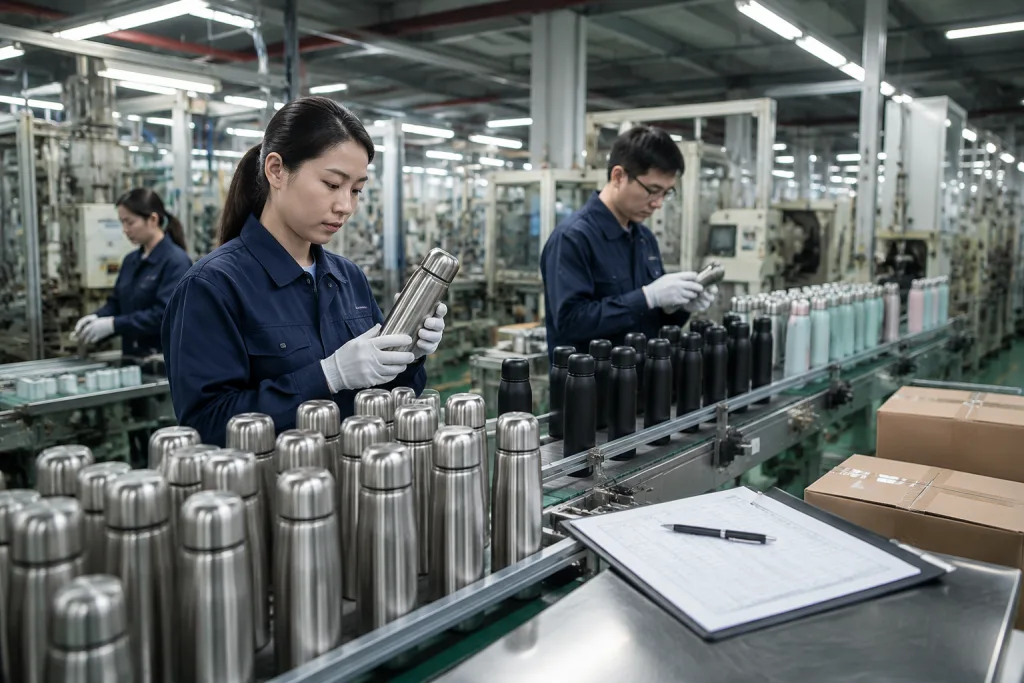
A stainless shop usually outsources the plastic bits. A pp thermos manufacturer runs the whole thing—stainless body forming and injection molding of lids, straws, base cups, seals—on one floor. This matters for two practical reasons. First, the fit between the stainless liner and the PP lid has to pass a 12-hour heat retention test (ASTM F1972: drop from 95°C to no colder than 62°C). We've had buyers ship back containers because the seal gap was 0.3 mm off. Second, when you order a custom lid color or a molded straw, having one factory handle both materials cuts the risk of dimensional mismatch. The math is simple: two factories, two sets of tolerances, one problem.
Zhejiang is full of factories that started as stainless bottle makers and bolted on PP injection lines later. A real pp thermos manufacturer keeps at least six injection molding machines running lid and component production, not a couple of units shared with bottle caps. Ask for the number of injection presses and what percentage of output goes to PP parts. If it's under 30%, you're talking to a stainless shop that subcontracts the plastic work. We've seen that go sideways—QC pulled a sample once where the subcontractor used a different shrink rate, and the lid wouldn't snap.
Checklist for vetting PP capability:
- Request a list of PP grades used (polypropylene homopolymer vs. copolymer; copolymer is preferred for impact resistance in lids).
- Ask whether the factory performs in-house ultrasonic welding on PP parts or outsources it.
- Verify that the PP material supplier is a tier-1 petrochemical company (e.g., Sinopec, LyondellBasell) and not a recycled-content supplier unless you explicitly request post-consumer recycled PP.
MOQ and pricing: what a realistic bulk thermos order looks like
I've been on calls where the first 90 seconds are just "what's your MOQ?" Here's the real answer. Standard body color—black, white, navy—with a simple laser-engraved logo: 1,000 units per SKU. Most factories in Zhejiang will quote that without blinking. You want a custom Pantone-matched body, a PP lid molded in your brand color, and a silicone gasket to match? MOQ hits 3,000 per design. The injection mold for that custom PP lid alone is a $2,000–$5,000 line item. We don't amortize tooling into the unit price unless the order volume justifies it.
A 500ml stainless vacuum thermos with a PP lid at 3,000 units runs $4.20–$6.80 FOB Shanghai or Ningbo. The $2.60 gap isn't random. Wall thickness—0.4mm vs. 0.5mm—shifts the thermal retention by hours and the per-unit cost by about $0.50. Powder coat vs. PVD finish is another $0.80. Standard PP parts vs. custom-molded PP parts is the rest. At 10,000+ units on a single SKU, we can drive pricing to $3.50–$5.00. But you're signing a 12-month production schedule. We had a buyer last quarter push for that price at 5,000 units and a 90-day delivery window. The math doesn't work. Our factory controller just laughed.
Checklist for pricing negotiations:
- Get a separate line item for tooling cost (PP injection mold and any silicone gasket molds).
- Ask if the price includes AQL 2.5 inspection (normal level II) or if that is charged separately.
- Confirm whether FOB includes export packing (brown box with polybag) or if retail packaging is an add-on.
Customization options: from laser engraving to full-color printing
You source from a pp thermos manufacturer and think you're stuck with a sticker on a blank bottle. Not even close. Here's what we actually run for promotional thermos orders:
- Laser engraving – Best for stainless steel surfaces. Creates a permanent mark that will not peel. Suitable for logos, text, and simple line art. Cost per unit is negligible after the $50–$150 setup fee. Not suitable for powder-coated bodies unless the coating is removed first.
- Pad printing – Works on both stainless and PP surfaces. The ink bonds well to PP if a corona treatment or flame treatment is applied before printing. Maximum of four colors per design. Setup cost around $80–$200 per color.
- Screen printing – Ideal for large, bold designs on the stainless body. On PP lids, screen printing is possible but requires a primer layer to prevent the ink from rubbing off. Durability is good for indoor use; for outdoor promotional thermos, pad printing or laser engraving is more reliable.
- Full-wrap digital transfer – Allows photographic images and gradients. The transfer is applied to the stainless body and then baked. Cost per unit is higher (adds $1.20–$2.00 per bottle), and the minimum order is usually 500 units.
If you're selling a customizable thermos to outdoor retailers, forget visual complexity. A scratched logo on a hiking trip is a free advertisement for your supplier's QC, not your brand. Laser engraving or pad printing with a UV-resistant ink will hold up better than a full wrap. We've seen full wraps peel at the seam after 60 days in a truck glovebox.
Checklist for customization:
- Request abrasion test results (Taber abrasion: at least 100 cycles with a CS-10 wheel and 500g load without ink removal).
- Ask for a sample of the exact customization method on the exact surface finish you plan to order.
- Confirm that the factory can apply your logo to both the stainless body and the PP lid in the same production run.
Quality standards: AQL, drop test, and thermal performance
We inspect at three gates: incoming materials, in-line after assembly, and pre-shipment. Our standard for drinkware is AQL 2.5 Level II on critical defects, AQL 4.0 on minor. A critical defect stops the whole lot—leakage past the silicone gasket, a dead vacuum, a burr on the PP lid gate sharp enough to cut a finger. Minor might be a 3mm scuff on the body or a lid color half a shade off the Pantone. Our QC team uses a calibrated lightbox for color matching. Warehouse lighting alone misses it every time.
Every production batch goes through three tests before we release the container:
- Vacuum retention test – We use a high-frequency induction coil. Each bottle passes through the station. About 98.5% pass. The 1.5% that fail get pulled immediately, tagged, and scrapped. No rework on a blown vacuum.
- Drop test – Bottle filled with 50°C water, dropped three times from 1.2 meters onto a concrete pad. The PP lid must survive without cracking or popping off. Some buyers ask for 1.5 meters—we'll do it, but the failure rate climbs fast and the lid design usually needs a thicker hinge pin. We've had one buyer push for 1.8 meters; the math didn't work, and we told them outright.
- Thermal performance test – We test to GB/T 29606. A 500ml bottle filled with 95°C water must hold at least 65°C after 6 hours. If you need ASTM F1972 numbers instead, we can run that protocol. The delta between the two standards is small, but some US buyers' labs flag it. We keep both protocols on file.
For EU shipments, request REACH compliance docs on all PP and silicone parts before you place the PO—not after. Same for US: FDA 21 CFR on the lid and seal. A factory that sends these with the quote is organized. One that promises them "after the order" is betting you won't check. We've seen that go sideways—a buyer's 3PL flagged a pallet at Rotterdam and the paperwork didn't exist. Don't let that be your shipment.
Lead time and production planning for distributor thermos orders
12 weeks. Count backward from your in-hand date. Anything tighter and you're paying for air freight—we've run it for panic reorders, but the unit economics break for most distributor campaigns.
- Weeks 1–2 – Quote, sample pull, artwork sign-off. The bottleneck is the color chip. Our PP compounder in Yuyao needs 5 working days to match a Pantone. If you spec a custom lid color, start here. I've watched a 3-day delay on a RAL 5012 chip push an entire 15,000-unit order into Chinese New Year.
- Weeks 3–4 – Tooling. Standard lid molds sit on the shelf—we pull them and shoot samples same week. A custom PP flip-top or a silicone overmold means cutting new steel. 3 to 4 weeks on the EDM, no shortcuts. One buyer pushed for 2 weeks last year. The mold shop refused to warranty the cavity. We ran it anyway and the parting line flashed after 8,000 shots.
- Weeks 5–6 – Pre-production sample. Open the box. Thread the lid on and off 20 times. Check logo registration under a loupe. We ship PP samples DHL, 4–5 days to your desk. Approve or redline. A second round adds 10 days, and we've had buyers burn 3 weeks chasing a Pantone that looked fine under D65 but shifted green under office fluorescents.
- Weeks 7–10 – Mass production. 5,000 units runs about 3 weeks on the line. At 20,000 units, we split across two assembly lines and it stretches to 5–6 weeks. The vacuum furnaces are the constraint—each batch cycle is 8 hours. You can't rush annealing. We tried shortening the ramp-down phase on a 10,000-unit run once. QC pulled 12% with micro-crazing on the inner wall. Full rework.
- Weeks 11–12 – QC inspection, palletizing, vessel cut-off. AQL 2.5, Level II. Sea freight Ningbo to LA runs 25–30 days port-to-port. Add 5 days for customs clearance when CBP is backed up. We've had containers sit at Long Beach for 11 days during a staffing shortage.
Trade show or retail promo with a hard date? Pad this schedule by 2 weeks. A 3-day port strike ate our entire buffer on a Mother's Day promotion two years ago. Flip side: bulk thermos, stock PP lid, no new tooling, no custom color—we ship 6 to 8 weeks from PO confirmation. We keep blank 304 stainless bodies in WIP inventory for exactly that. It's not sexy, but it works.
How to evaluate a thermos manufacturer before placing an order
Don't just trust Alibaba stars or a factory's homepage. Here's how our buyers actually vet a pp thermos manufacturer before writing a PO:
- Request a video call walkthrough. Specifically ask to see the PP granule storage and the injection molding floor. A serious manufacturer can show you the raw material bins, the injection machines running, and the line where the PP lid gets pressed onto the stainless body. One buyer had us zoom into the hopper to confirm we use food-grade PP, not regrind.
- Ask for client references in your region. A factory shipping to German outdoor brands keeps AQL 2.5 documentation and LFGB reports on file. One selling only domestically won't have that. Ask for two references that ship to your country and call them. We had a buyer from Poland call a reference in Germany — that call saved them from a supplier who couldn't handle EU paperwork.
- Order a standard sample first. Don't jump into custom tooling. Buy the factory's bestseller, test it yourself. Fill with 95°C water, check temperature at 6 hours, drop it from 1.2m onto concrete, and see if the lid leaks when tipped. We had a sample pass everything but seal test twice before QC caught a burr on the PP rim. If the standard product fails, your custom version will not magically pass.
- Check social compliance certs. European buyers require BSCI or Sedex. If your brand needs a specific audit, ask if the factory passed it within the last 12 months. Skipping this step cost one buyer a customs flag and a 4-week delay. The math doesn't work when your launch date is locked.
A factory doing 500,000 units per month with 8+ years in business usually has stable QC and experienced line workers. Newer shops quote lower — but we've seen delivery delays of 3 weeks and batches that failed seal tests. We run 24 injection machines on two shifts, and QC pulls 50 lids per shift for leak testing.
Common mistakes when sourcing customized thermos from China
We've watched seasoned buyers burn six-figure POs on mistakes that could've been caught with one email before tooling started. Here's where it usually goes sideways:
- Wrong wall thickness on the spec sheet. A 0.3mm stainless body dents under a pallet stack—had a buyer in Hamburg flag a whole pallet where the outer wall caved in at the base after 14 days of ocean freight. Outdoor or distributor-grade thermos? Run 0.4mm minimum on the inner wall, 0.5mm on the outer. Our B2 line ships this spec daily. No returns on wall integrity in 18 months.
- Thinking all PP lids are equal. The PP grade and gasket pairing decide whether the lid survives 200 cycles or cracks at the thread root. Virgin PP with a food-grade silicone gasket holds. Regrind PP with a TPE seal doesn't—we pulled a batch where lids started thread-cracking at cycle 180. Ask for the PP grade number and the gasket durometer in writing. "Is it food-grade?" is the wrong question. The right one is "What's the PP grade and what durometer is the seal?"
- Overlooking the gasket material entirely. Silicone holds elasticity from -40°C to 200°C. TPE costs less but hardens after repeated hot fills. QC pulled a TPE sample after 50 hot-fill cycles—compression set was 30%, meaning the seal wasn't sealing anymore. For a daily-use thermos with a 3-year target lifespan, TPE is a false economy. Go silicone.
- Skipping the pre-production sample off the actual tooling. A hand-made prototype isn't a sample, it's a sales prop. We tested one where the hand-made lid passed leak test at 95%. The production run from tooling hit 82%. That gap is your margin evaporating. Demand a pre-production sample pulled from the real mold, and run your own leak test before you release the PO.
Final checklist before you sign the contract with a thermos vendor
We run this list with every buyer before a PO signs. Miss one item and the headache lands on your desk three weeks before the goods are due, not during the kickoff call.
- MOQ alignment. 1,000 units for standard colors, 3,000 for full custom with your own mold. Don't let a sales rep shake on "we'll do 500" and then go silent when the ERP won't release the production order. We've seen it happen twice this year.
- Lead time on paper. Not buried in a WeChat voice memo. We bake 35 days production plus 18–22 days sea freight to Long Beach as a line item in the quotation. If they quote "30 days" without specifying FOB port, ask again until you get a port code.
- Customization method tested on a sample. Laser engraving on a matte PP body reads different than on gloss—the contrast drops noticeably. We ship a pre-production sample with your exact Pantone and your exact surface finish. You sign off on it. Then the line starts.
- PP material compliance docs. REACH for EU. FDA for US food-contact. Don't accept a lab report older than 12 months. We pulled a batch last year where the supplier's certificate was dated 2019—the formulation had been updated twice since then and nobody told us.
- AQL level locked in. AQL 2.5 is our default on finished goods. Decide whether it's included in the unit price or quoted as a separate line. If separate, get the per-man-day inspection rate upfront. Some third-party inspectors in Ningbo charge ¥3,200/day and bill travel on top—that adds up fast on a 20-day inspection window.
- Payment terms. 30% deposit, 70% against copy of B/L is the standard we work with. 100% upfront is a red flag no matter how good the sample looked. We've seen factories sit on a fully-paid order for six weeks while they prioritized a bigger client who paid on terms.
- Audit validity. BSCI or equivalent social compliance audit dated within the last 12 months. A certificate expiring next month is not the same thing. Check the annex for zero-tolerance findings—one fire-safety fail and that audit is worthless, period.
- Named contact. You need one person who speaks your language and replies within 24 hours. Not a generic "sales@factory" inbox. When the lid gasket dimension is off by 0.3mm on a Saturday, you want a name and a WhatsApp that rings.
If all eight boxes check out, you've got a supplier worth scaling with. The contract is just the first handshake. What keeps the quality consistent on order #12 is the relationship—regular visits, honest volume forecasts, and enough margin on both sides that nobody cuts corners.
Ready to source your custom stainless thermos?
Contact our team in Hangzhou for a quote and a standard sample within 5 business days.
Frequently asked questions
What is the minimum order quantity for a custom stainless thermos with a custom PP lid color?
For a fully customized thermos where the PP lid is a custom color (not a standard black or white), most manufacturers thermos suppliers in Zhejiang require a MOQ of 3,000 units per design. This covers the cost of the injection mold for the lid, which typically runs $2,000–$5,000. If you choose a standard lid color, the MOQ drops to 1,000 units per SKU.
How long does it take to get a sample from a pp thermos manufacturer?
A standard sample (using existing molds) can be shipped within 5–7 business days after you pay the sample fee, which is usually $30–$80 including DHL or FedEx shipping. A custom sample that requires new tooling takes 3–4 weeks for the mold and another week for sample production. Always request a pre-production sample from the actual production tooling before approving the full order.
Can I get a custom thermos with my logo on both the stainless body and the PP lid?
Yes. The most common approach is laser engraving on the stainless steel body and pad printing on the PP lid. The factory can apply both in the same production run. For the PP lid, the surface must be corona-treated before printing to ensure ink adhesion. Confirm with your thermos manufacturer that they have in-house pad printing capability for PP surfaces.
What is the difference between a vacuum-insulated thermos and a double-wall air-insulated bottle?
A vacuum-insulated thermos has the air removed from the gap between the inner and outer stainless walls, which virtually eliminates heat transfer by conduction and convection. It keeps liquids hot for 12+ hours. A double-wall air-insulated bottle simply traps air in the gap, which provides some insulation but loses heat much faster—typically 4–6 hours for hot liquids. For a distributor thermos aimed at outdoor users, vacuum insulation is the standard.
What certifications should a pp thermos manufacturer have for export to Europe or the US?
For Europe, the factory should provide REACH compliance documentation for all polypropylene and silicone materials, plus a Declaration of Conformity for food contact materials. For the US, FDA 21 CFR compliance for the PP lid and silicone gasket is required. Additionally, a BSCI or Sedex social compliance audit is often requested by European retailers. The factory should be able to provide these documents before you place the order.