Key Takeaways
- A realistic custom stainless thermos MOQ is 1,000 pieces per color for standard models
- PP lids should be food-grade, odor-controlled, and tested with silicone seals before bulk production
- Laser logo is usually safer for outdoor use than screen print on powder coating
- Plan 30-45 days for mass production after sample approval, not after first inquiry
I've yet to see a buyer lose money because their thermos didn't photograph well. The real damage is quieter. A lid gasket that deforms at 85°C — we caught this on line 3 last May. A logo that ghosts after two dozen dishwasher cycles. A shipment that lands 18 days past the campaign window, because someone misread the FOB Shanghai pallet charge on the PI.
A pp thermos flask wholesale order looks straightforward on a spec sheet. Then you're comparing 304 vs 201 stainless — and 201 rusts at the weld if the pickling bath runs cold. TPE lid seals vs silicone: TPE costs $0.03 less but hardens below -5°C. Pad-print vs UV coating adhesion on a matte PP body — we've seen both fail AQL 2.5 when the QC inspector uses 3M tape instead of the buyer's own test. The 1-meter drop test from EN 12546-1 isn't optional when your customer sells into the school-lunch channel.
We run stainless vacuum bottles in Hangzhou, Zhejiang. Most new buyers show up with the same six questions. Realistic MOQ — 1,000 or 3,000? (Answer changes if you need a custom PP outer sleeve molded, not just a stock color.) Which PP component cracks first under repeated thermal cycling? What's the per-unit adder for a PANTONE-matched logo, and does the factory include one colour-match round or charge for two? And what does QC need to flag before you wire that 70% balance? This is the straight version. No gloss.
What does PP mean here?
PP in a thermos flask spec stands for polypropylene. Not the bottle body. The cap, the inner stopper, the flip lid, the push button, the drinking spout — those are the PP parts. The body is stainless. When a supplier quote says "PP thermos," they mean the accessory components are polypropylene, not that the whole flask is plastic. Get the material breakdown per component before you commit.
A standard vacuum thermos from our line: 304 inner wall, 201 or 304 outer wall, food-grade PP lid assembly, silicone sealing ring, sometimes a 304 stainless tea filter. For EU shipments, push for LFGB or EU food contact compliance on every plastic part. North American orders? FDA food contact material declarations. Children's products need ASTM or CPSIA documentation — we've had a buyer's lab flag a PP spout for phthalates because the supplier never submitted the right paperwork.
PP quality shows up in three places: odor, deformation, and lid fit. Cheap recycled PP stinks the moment you pour 95°C water in. We pulled a sample last year where the lid warped at 88°C — the spec called for 100°C tolerance. Thin PP hinges crack at 500 open/close cycles. We spec 1,000+ and test to failure on every new mold. A factory that knows what they're doing gives you the PP grade (we use virgin PP, typically Sinopec or Formosa), the masterbatch supplier, and the exact heat deflection temperature. Before any bulk thermos order leaves, we run lids through 95°C water for leakage and odor — 24 pieces per cavity, AQL 2.5.
PP isn't the problem. It's light, molds clean, and keeps the per-unit cost where it needs to be. The problem is nobody watching the material. If a supplier's thermos quote lands 8–12% below the next three bids, the gap came from somewhere. PP regrind, thinner silicone, a wall thickness shaved by 0.1mm, a coating skip. Ask for the material certs upfront.
Buyer questions before you quote
You can’t quote a serious thermos order from "send me your best price." We need use case, volume, finish, packaging, and compliance nailed down first. Outdoor retail and promotional thermos projects do not share the same priority list. Retail buyers need shelf-ready packaging, scannable barcodes, cartons that survive a pallet drop, and repeatable color across production runs. Promotional brands chase fast delivery, logo registration within 0.5 mm tolerance, and flexible mixed cartons per shipment.
Run this checklist before you request a pp thermos flask wholesale quote:
- Capacity: 350 ml, 500 ml, 750 ml, 1,000 ml, or 1.2 L.
- Thermal target: 6 hours, 12 hours, or 24 hours heat retention claim.
- Body material: 304 inner only, or 304 inner plus 304 outer.
- Outer finish: powder coating, spray paint, polished steel, brushed steel, or rubber paint.
- Logo: laser engraving, silk screen, heat transfer, UV print, or embossing on PP lid.
- Packaging: white box, kraft box, color box, PDQ tray, or mailer box.
- Incoterm: FOB Ningbo, FOB Shanghai, EXW Zhejiang, or DDP if your forwarder requires it.
Keep the spec identical when comparing thermos suppliers. A 500 ml bottle with 0.4 mm outer wall, 304 inner, 201 outer, one-color logo, and white box is a different product than 0.5 mm 304/304 with powder coating and color box. The math is straightforward — the gap runs USD 0.45-1.20 per piece at factory level. QC pulled samples on a 201/304 comparison last year and the buyer flagged the wall thickness variance.
Our Hangzhou, Zhejiang line capacity is about 450,000 stainless bottles per month across thermos, travel tumbler, and sports bottle models. Standard MOQ is 1,000 pieces per color for stock molds. Mass production runs 30-45 days after we sign off on the pre-production sample.
Top 5 choices by use case
Shortlists built from renderings miss the point. We rank by use case. When matching a distributor to a model, we run five checks: leak risk, perceived value at retail, logo area, carton utilization, and price stability across three repeat orders. That beats shopping for the lowest FOB. The cheapest unit often costs more after a 15-day delay at the port because a carton collapsed.
1. 500 ml screw-lid stainless thermos
The workhorse promotional size. Fits backpacks, office bags, gift boxes. We ship more 500 ml units than any other SKU. A typical build — 304 inner, 201 outer, PP screw lid, silicone ring, powder-coated body, one laser logo — runs USD 3.20–4.60 FOB depending on finish and order quantity. At 3,000 pcs, you're closer to 4.20. At 10,000, the powder-coating line runs smoother and unit cost drops.
2. 750 ml outdoor flask with cup lid
Better for outdoor retail chains. The cup lid adds perceived value — two functions, one SKU — but it also adds two inspection points on the line. We check lid thread engagement on 20 random samples per 1,000 pcs. Loose threads are the #1 complaint from end users. Carton volume on a 750 is about 18% higher than a 500, so freight per piece climbs. If your landed cost target is tight, run the DIM weight before you commit to this size.
3. 1 L thermos for camping sets
Works well for bulk programs and bundled outdoor kits. The larger body gives excellent logo real estate — a 60 mm × 40 mm laser mark reads clearly at arm's length. Downside: coating defects are more visible on a 1 L surface. A pinhole or 2 mm scratch invisible on a 350 ml body stands out here. We set AQL 2.5 on surface inspection and still flag about 4–6% for minor scratches. Plan for that in your buffer stock.
4. Slim 350 ml retail flask
Good for boutique retail and corporate onboarding gifts. Low capacity keeps weight under 280 g and FOB under USD 3.00 at volume. The trade-off is heat retention — a slim 350 ml body sheds heat faster than a wider 500 ml. We've seen buyers print "24 hours hot" on the box and get returns. If you haven't run an independent thermal test, keep the claim conservative. 12 hours is honest.
5. Wide-mouth food thermos
Useful for outdoor and school channels, but the PP lid and inner stopper assembly is more complex than a standard screw lid. Three separate mold tools instead of one. For children's markets, ask about small parts risk, lead, phthalates, and applicable ASTM/CPSIA checks early — don't wait until the shipment is packed. We once had a buyer flag a stopper gasket as a small-part hazard two days before the container was booked. The rework cost swallowed the margin on the whole order.
The best manufacturer thermos option is the one with fewer surprises at the inspection table. Pretty renderings don't survive a drop test.
Customization that survives outdoor use
A logo slapped on a thermos doesn't make it field-ready. The decoration method has to match where it's being sold. For outdoor retailers, we run laser engraving on powder coat almost exclusively. The beam cuts through the coating down to bare metal. No peeling. No fade after 18 months rattling around a truck cup holder. We've seen silk-screen logos lift after one season of dishwashing — a buyer flagged it on a 2,000-unit reorder and we ate the remake cost.
Custom options we quote daily:
- Laser engraving: clean edge, MOQ 100, works on stainless and matte powder coat. QC checks depth with a 0.1 mm feeler gauge. This is the go-to.
- Silk screen: cheap at 5,000+ units, but we tape-test 5 random pieces per batch. One-color logos only unless you enjoy registration drift. Fine for giveaways, wrong choice for gear that gets washed.
- UV printing: handles CMYK artwork, but the ink sits on top of the coating. On curved tumblers with glossy finish, adhesion drops at the edges. Not our first recommendation for outdoor gear — we've had to explain this to three buyers this quarter.
- Heat transfer: full-wrap graphics. Setup runs $200–$400. The line needs a steady hand on temperature and dwell time. We pulled a sample last month where the wrap shifted 1.5 mm — subtle, but visible. The operator adjusted dwell by 0.3 seconds and it locked in.
- Custom PP lid color: 3,000–5,000 pcs per color. The pigment masterbatch is the bottleneck. You're not paying for the color, you're paying for the minimum batch the masterbatch supplier will run.
- New mold lid: only pencils out above 20,000 pcs/year. Below that, amortizing the $4,000–$8,000 tooling kills the unit cost. We tell startups to pick a stock lid and differentiate elsewhere.
For brand-color thermoses, ask for a Pantone target and accept a commercial tolerance. Powder coat shifts under different light — a warm gray at noon goes cool under fluorescent. PP lids won't match the metal body perfectly. The base material absorbs pigment differently, period. A Delta E target below 2.0 looks good in a spec sheet but usually blows the budget on a promotional run. For most distributor programs, visual approval under a D65 light booth is the sensible standard. If the buyer's happy with what they see in the booth, the end user won't notice the difference.
Always approve a physical pre-production sample. Digital mockups confirm logo placement. They tell you nothing about depth, texture, or how the color reads on a curved wall. A rendering looks flat and perfect. A physical sample shows you the orange-peel in the powder coat and the 0.5 mm halo where the laser hit. If a vendor pushes you to sign off mass production from a rendering alone, pause the PO. We've corrected too many shipments that started that way — and factory retooling is always slower than the timeline they promise.
Steel, vacuum, and heat claims
Most buyers ask if they need 304 or 304 stainless. The answer depends on what they're selling and where it ends up. A standard factory build is 304 inner wall with a 201 outer wall. That works fine for promo runs — only the inner wall touches the drink. For retail shelf, especially if the bottle ships to a coastal market or sits in a humid warehouse, 304 outer wall cuts corrosion risk. We've seen 201 rust spots on containers stored near salt air for 3 months.
Wall thickness is a real spec call. Typical vacuum flask walls run 0.35–0.5 mm per layer. Below 0.35 mm and dent complaints climb fast. Above 0.5 mm and you're paying for weight you don't need. On 750 ml and 1 L models we push for 0.4 mm outer wall minimum unless the buyer signs off on the tradeoff. One client ignored that, got a 2% dent rate at inbound QC, and had to air-freight a replacement batch.
Heat retention claims need a defined test method — not just "keeps hot 24 hours," which creates a loophole. A defensible protocol: 95°C water, ambient 20°C ± 5°C, fill to rated capacity, lid on, measure at 6, 12, and 24 hours. A 500 ml bottle holds above 60°C for 6–8 hours. 24-hour performance depends on size, lid seal geometry, and how clean the vacuum is. We tested bottles that dropped 40°C overnight because the copper coating was uneven.
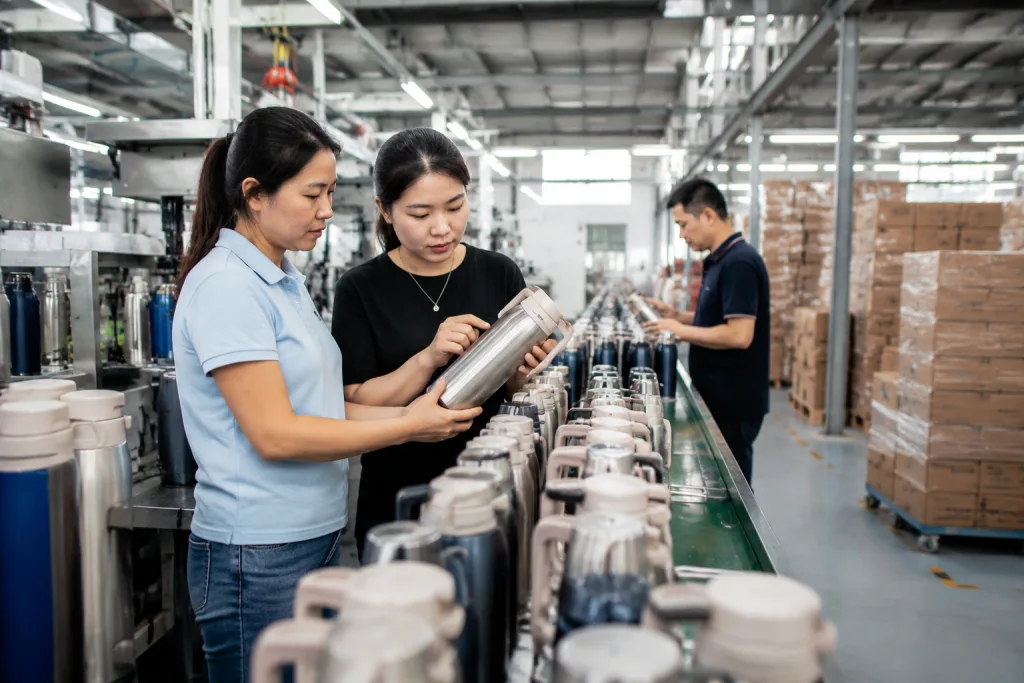
Ask your supplier for vacuum process records, not a marketing PDF. We check vacuum pump logs, run infrared heat leak scans, water leak test every unit, and pull random thermal retention samples per batch. On the line we also do a full appearance check before packing — coating dust and micro-dents show up more often than buyers expect. Fixing them after shipment costs everyone.
MOQ, pricing, and freight reality
MOQ breaks down across four levers: body color, lid color, logo setup, and packaging. If you pick a stock mold in an existing color, 1,000 pieces per SKU works. Custom powder coat pushes that to 2,000–3,000 pieces. Custom PP lid color is the real pain point — 3,000–5,000 pieces. The injection barrel needs purging between colors, and we burn 8–10 kg of resin just clearing the last shade. A buyer once asked us to skip the purge to save cost. QC pulled 600 units with streaky lids. All scrap.
A 500 ml stainless vacuum thermos with a PP lid lands around USD 2.80–5.20 FOB China. The spread comes from steel grade, coating, logo method, packaging, and volume. A 1 L outdoor flask runs USD 5.00–8.50. These are planning bands. If a supplier quotes well under that, ask the right question: what moved? 0.3 mm steel instead of 0.4 mm? Vacuum time cut from 40 minutes to 20? 1-ply cartons where 3-ply was spec'd? We had a Shenzhen buyer who chased a low price, signed off, and then watched his QC inspector run a drop test on sealed pallets. The bottles failed. Steel gauge was off. He didn't catch it until the container was already packed.
Freight eats into landed cost faster than decoration does. A 500 ml bottle packs 24 per carton, roughly 46 × 31 × 27 cm. The 1 L flasks go 12 or 24 per carton depending on box layout. If you're selling e-commerce, request carton drop testing and inspect inner box crush strength before the line starts. We've seen first shipments arrive with collapsed cartons because the buyer assumed the box was fine. Amazon FBA sellers need FNSKU labeling, carton weight limits, and barcode placement locked before production. One missing barcode triggers a USD 40 repack fee per carton at the fulfillment center. Across a 40-foot container, that's real money.
Payment terms: 30% deposit, 70% before shipment after inspection. That's standard for new buyers. Don't burn time chasing credit terms that won't happen. Spend that energy locking down a sample approval sequence, AQL 2.5, clear defect definitions, and photo/video reporting before you release the balance. That's the part that saves you cash. Last quarter a buyer skipped the photo report and approved on trust. Fifteen percent of the lids arrived with flash lines. QC caught it later, but the payment was already gone.
Quality checklist before shipment
AQL inspection isn't paperwork theater. It's the difference between opening a container and finding 3,000 sellable units versus 3,000 units with a lid defect nobody caught. Last September we QC'd a shipment where 12% of lids cross-threaded by thread #3. Buyer would have returned the whole lot. For thermos wholesale orders, we default to AQL 2.5 on major defects and AQL 4.0 on minor. Critical defects: zero tolerance. Lock these categories down before the inspector walks onto the floor. You're paying someone to find problems you haven't defined otherwise.
Here's what we run on every shipment from our Hangzhou facility:
- Leak test: fill with 95°C water, close lid to torque spec, invert, shake 30 seconds. Any drip is a major defect. We reject the lot if more than 2 samples fail. QC pulls samples from the middle of the pallet, not the top layer the line supervisor set aside.
- Thermal test: sample bottles pulled at random, measured at 6 hours and 12 hours against the agreed delta. ±3°C is our internal trigger for rechecking vacuum quality on the line. We caught a batch last March where the 12-hour reading drifted 7°C—turned out the getter activation in the vacuum furnace was off by 15 seconds.
- Coating adhesion: cross-hatch or 3M 610 tape test on printed logos and colored body coatings. One buyer flagged peeling after 2 weeks of dishwashing—we added this test permanently. Now it's in our pre-production checklist before the first coat hits any bottle.
- Logo position: measure height from base with calipers and check angular alignment against a printed jig. Visual guesswork doesn't cut it when your brand team has a spec sheet with ±0.5mm tolerances.
- PP lid odor: hot water contact test, seal for 30 minutes, then smell. We've rejected an entire PP batch because the plastic had residual off-gassing from a supplier's mold release. The mold release was a cheaper grade the molder switched to without telling anyone. Now we spec the release agent by name on the BOM.
- Thread fit: open-close cycle 20 times per sample. Listen for grinding, watch for wobble. A loose thread on day one becomes a leak on day thirty. Our QC lead uses a torque driver set to 0.8 N·m—if the lid slips before hitting torque, it fails.
- Carton strength: verify 5-ply export-grade corrugate. Sea freight stacking in a humid container will crush cheap carton. We've seen 3-ply boxes collapse at the third tier in a warehouse. Burst strength below 12 kgf/cm² won't survive a 40HQ crossing the equator.
- Barcode scan: EAN, UPC, or FNSKU scanned on final retail packaging. One misprinted digit on an FNSKU label cost a client $1,800 in Amazon inbound rejection fees. We scan every barcode on the packing line with a Datalogic reader—no phone apps, no excuses.
Compliance needs to match your market. Europe: REACH, LFGB, food contact migration test reports. North America: FDA food contact declaration, and if you're selling through retail channels in California, Prop 65 is not optional—it's a shelf-access issue. Social compliance audits like BSCI or Sedex take 4–6 weeks to schedule. Don't ask for the certificate the week after production wraps. A good supplier team needs runway to align raw material docs, accredited lab slots, and audit dates. The wrong question is "Can you send me all certificates now?" The right question is "Which ones do we line up before tooling starts?"
Third-party inspection around Zhejiang ports is straightforward. Here's the rule we tell every buyer: book the inspector when goods are 100% produced and at least 80% packed. If the inspector arrives and sees half the order still sitting in loose bulk on the floor, you're paying for a preview, not an inspection. We've had buyers push for early checks to "save time"—it never saves time. What does save time: having the packing list ready with carton numbers matched to pallet positions before the inspector's car pulls into the lot.
How to brief the factory
Send a short RFQ with a launch date. Include capacity, quantity per color, logo file in AI or PDF, packaging reference, destination port, compliance needs, and a target price if one exists. Hiding the target price does not give you power — we've seen that waste three days while the factory guesses the wrong construction and quotes a silver liner instead of 304.
Try this brief:
“We need 3,000 pcs of 500 ml stainless vacuum bottle, 304 inner, powder coated black, laser logo one side, individual kraft box, FOB Ningbo, EU market, LFGB support required, delivery before 20 September. Please quote standard model and closest alternative.”
That message gives our thermos team enough to work with. We check mold availability, sample cost, lead time, carton size, and whether your delivery date is realistic. Standard model sample lead time runs 5-7 days with an existing color, 10-15 days for custom coating. Mass production starts after sample approval and deposit.
Comparing three manufacturers? Ask each for the same line items: unit price, MOQ, lead time, sample cost, steel grade, PP material statement, logo method, carton packing, gross weight, and inspection support. The cheapest quote is not automatically wrong, but it must explain itself. A reliable supplier should tell you where every USD 0.30 comes from — thinner steel, cheaper PP, or a lower AQL standard.
Send your thermos specification and target launch date
We will review MOQ, PP lid options, logo method, packaging, and realistic FOB China pricing before you commit to sampling.
Frequently asked questions
What MOQ should I expect for pp thermos flask wholesale?
For standard stainless thermos models, a realistic MOQ is 1,000 pieces per color with one logo. If you need a custom powder coating color, plan for 2,000-3,000 pieces. If the PP lid must be molded in a custom Pantone color, MOQ often moves to 3,000-5,000 pieces because injection machines need setup time and color purging. New lid molds are a different conversation; tooling can cost USD 2,000-8,000 depending on structure. For first orders, we usually suggest using an existing lid and customizing body color, logo, and packaging first.
Is 304 stainless steel required for both inner and outer walls?
Not always. For many promotional thermos orders, 304 stainless steel inner wall with 201 stainless steel outer wall is acceptable because the liquid touches the inner wall. For outdoor retail, 304/304 is stronger from a corrosion-resistance point of view, especially if products may be used near salt water or stored in humid warehouses. The price difference can be around USD 0.25-0.80 per piece depending on size and steel market. If your brand promises premium outdoor durability, choose 304 outer. If the product is a short campaign gift, 304 inner may be enough.
Which logo method is best for a custom thermos?
For outdoor use, laser engraving is usually the safest. It is durable, clean, and works well on powder-coated stainless steel. Silk screen is cheaper for simple one-color logos, but it needs adhesion testing, especially on textured coatings. UV print can handle multi-color artwork, though curved surfaces and coating chemistry can affect durability. For a 1,000-piece customized thermos order, laser setup cost is often modest, while full-wrap heat transfer may require higher setup and more sampling. Always approve a physical sample; a digital mockup cannot show engraving depth or print adhesion.
How long does production take after I approve the sample?
For stock mold stainless thermos orders, mass production is usually 30-45 days after sample approval and deposit. Existing color samples can often be prepared in 5-7 days. Custom coating samples may take 10-15 days. Add time for third-party lab testing if you need LFGB, REACH screening, or other compliance documents for Europe or North America. Sea freight from China to Europe or North America may add 25-45 days depending on port and season. For seasonal outdoor launches, start sourcing at least 90 days before your warehouse deadline.
Can you support Amazon FBA or retail barcode packaging?
Yes, but it must be planned before production packaging is printed. For Amazon FBA, provide FNSKU files, carton label requirements, bundle rules, and maximum carton weight limits. A typical stainless thermos carton may hold 12-24 pieces depending on capacity and box size. For retail, we can apply EAN or UPC barcodes on color boxes and scan-test samples during inspection. If you require drop-tested mailer packaging, say so early because it changes box material, carton size, and freight cost. Do not treat labeling as a final-week task.