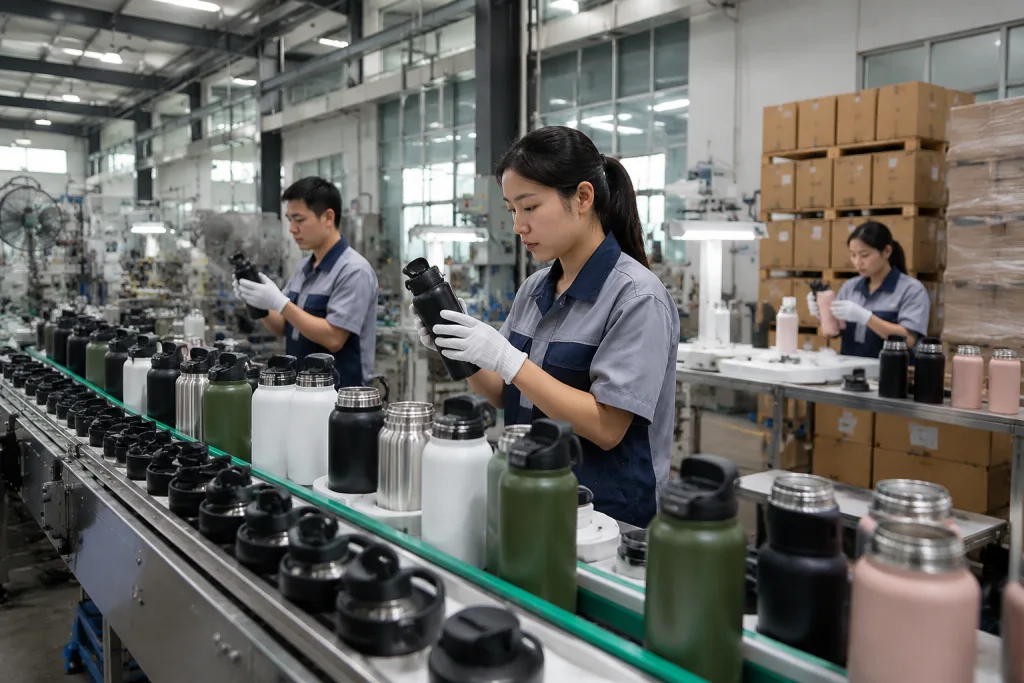
Key Takeaways
- Normal MOQ for a customized thermos is 1,000-3,000 pcs per color, depending on coating and lid tooling
- PP lid and stopper parts should be checked for food-contact grade, odor, fit tolerance, and drop resistance
- A realistic custom thermos lead time is 25-35 days after sample approval, not including sea freight
- For promotional thermos projects, laser engraving is safer below 5,000 pcs; full-body printing needs tighter artwork control
We get the RFQ every week: "pp thermos flask factory." The buyer usually means a stainless vacuum thermos with PP lid, PP inner stopper, or PP overmolded handle. The distinction matters. The metal body gets quoted on gauge and vacuum spec. The plastic contact parts get quoted on mold cost and cavity count. The decoration gets quoted on print stations and cure time. Mix these line items into one blanket PO and QC will flag it at first article — we've had a shipment held three days over a stopper material callout that said "PP" but the spec sheet said "tritan."
Most outdoor retailers and promo brands arrive with the same problem: a custom thermos that looks right, passes basic compliance, and lands before the shelf date. Our Hangzhou team runs 3,000-piece orders regularly — two colors, logo on body, leakproof lid, FOB Ningbo or Shanghai. The bottleneck is usually the PP mold fitting the vacuum-seal timeline. We run 12 days on standard tooling. Add a silicone gasket change and it bumps to 18 days. The buyer who asks for a third-color handle at week two learns this the hard way.
What does PP mean here?
A buyer asks for a pp thermos flask factory — we stop and clarify the material scope before we quote. A real stainless vacuum thermos is not a PP bottle. The body is 304 stainless inside and 201 or 304 outside. PP goes into the lid shell, push button, stopper, handle, drinking spout, or tea filter frame. Silicone handles the sealing rings. If a supplier thermos quote just says "PP thermos" with no stainless grade, wall thickness, or vacuum performance target, ask again.
For outdoor retail, the build is 18/8 304 inner wall, 0.4-0.5 mm inner thickness, 0.5 mm outer, copper-coated vacuum layer, PP lid, and food-grade silicone gasket. On a promotional thermos, some buyers switch to 201 outer steel to trim cost — the inner food-contact wall stays 304. A low-cost thermos factory may quote 201 inner steel. We don't recommend it for Europe or North America. Rust complaints burn margin fast, even when the unit price looks good.
Your first checklist — keep it tight:
- Confirm inner stainless grade: 304, not vague “stainless steel”.
- Confirm PP parts are food-contact grade and odor controlled — we once rejected a batch because the lid smelled like solvent.
- Confirm silicone gasket hardness, usually 50-60 Shore A.
- Confirm capacity tolerance, typically ±5% for 500 ml and 750 ml models.
- Confirm whether the lid stays leakproof inverted for 30 minutes. A buyer flagged this on a PO typo last quarter.
In Zhejiang, plenty of factories can assemble a factory thermos. Fewer control both vacuum brazing and plastic lid fit with consistency. That is where most hidden quality issues start.
The buyer questions we answer first
I get this question every week. Before anyone talks price, I ask: how are you selling this?
A distributor thermos bound for outdoor shops versus a one-time event giveaway face completely different risks. Retail — you worry about repeat complaints, shelf packaging, barcode labels, carton strength. One wrong carton flap and the buyer flags it. Promotional brands care about logo clarity, fast approval, mixed carton marks, keeping the landed cost predictable. Two different conversations. Make one wrong assumption and the math doesn't work.
Question: What capacity sells best?
For outdoor channels, 500 ml, 750 ml, and 1,000 ml. That's it. A 500 ml custom thermos works for corporate gifting and commuter kits. A 750 ml or 1,000 ml stainless thermos for camping, hiking, jobsite, winter sports. If you want one opening order, run 500 ml plus 750 ml. Five SKUs? We've seen that go sideways — too many capacities and QC pulls the wrong sample, inventory splits into fractions, inspection takes twice as long.
Question: What is the realistic MOQ?
Our line in Hangzhou runs like this: 1,000 pcs for laser logo on existing stock colors. 2,000 pcs per color for custom powder coating. 3,000 pcs if you need a new PP lid color matched to Pantone. Some suppliers will quote 500 pcs. They use stock bodies and charge higher decoration cost. That works for a test. Not for a stable retail program. The buyer who tried 500 pcs from a smaller shop found out when the second order had a different lid texture — factory swapped the mold between runs.
Question: What should I send for a useful quote?
Send capacity, lid style, logo file, target price, market, packaging type, compliance needs, delivery term. A one-liner like "price for bulk thermos" forces the vendor to guess. Guessed quotes look cheap at the start. They become arguments later — I have the email threads to prove it.
Good sourcing is not finding the lowest line item. It is removing the unknowns before the deposit is paid.
Checklist for custom thermos specifications
A spec sheet gets coffee stains — it doesn't need to be pretty. One page. Measurable requirements only. Before we cut a single sample, lock these down: body material, lid material, finish, performance targets, logo method, packaging type, and inspection standard. I've watched a PO sit dead for 19 days because "black matte" was texted on WeChat and nobody specified the coating chemistry. Ambiguity like that costs the buyer. Not us.
Here's the checklist we run when qualifying a thermos supplier:
- Capacity: 350 ml, 500 ml, 750 ml, 1,000 ml, or 1,200 ml. Define the fill method. Brim-full vs. functional capacity differs by roughly 30 ml on a 500 ml body. QC will flag that delta at final inspection. The report lands on your desk and you'll be the one explaining it to your team.
- Steel: 304 inner wall — non-negotiable for food contact. Outer wall can be 201 or 304. Body thickness runs 0.4–0.6 mm. At 0.35 mm, the deep-draw tooling on 750 ml starts producing wrinkles around the shoulder radius. We've scrapped trial runs for that. The steel coil weight alone was 2.3 tons.
- Insulation: Hot water fill at 95°C, measured at 6 hours and 12 hours. For a 500 ml flask, target is above 60°C at the 6-hour mark. Drop below 55°C and the end customer notices. Returns follow. This isn't a debate — we've pulled warranty data.
- Lid: PP body, silicone gasket. Leakproof requirement needs the fill volume stated and the orientation test defined — inverted, on-side, 4 hours minimum. One-hand opening? Specify it. A twist lid and a flip lid run on different tooling schedules: 18 days vs. 28 days. Get this wrong early and your timeline collapses. We had a buyer who circled back after 22 days asking to switch — too late. Tooling was already on the CNC.
- Finish: Powder coating, spray painting, polish, brushed steel, or full-wrap print. Coating thickness tolerance matters. A 0.15 mm variance shifts how the logo sits against the body curvature. We measure this with a coating thickness gauge at first-article inspection — Elcometer 456, nothing fancy.
- Logo: Laser engraving, silk screen, heat transfer, UV print, or emboss on PP lid tooling. Registered color like PMS 186C? Silk screen on textured powder coat is the wrong call. Dot gain destroys edge definition. Laser on powder coat gives you a clean silver mark with sharp edges. That's what holds up on a retail shelf.
- Packing: White box, kraft box, color box, sleeve, hangtag, or retail-ready carton. We had a shipment flagged at Rotterdam because the sleeve barcode didn't match the outer carton marking. Two lines in the spec would have prevented the hold. The demurrage charge alone was €1,200. Ask me how I know.
- Inspection: AQL 2.5 major / 4.0 minor is our default. Selling on Amazon? Bump to AQL 1.5 major. A 4.0 minor lot generates a return rate that chews through margin inside the first 90 days. The math doesn't work.
The biggest failure mode in bulk thermos orders isn't a bad factory. It's approving a pre-production sample in one finish, then switching finishes mid-run without a new sign-off. Powder coating and spray paint behave completely differently under laser. A black powder-coated body engraves to a clean silver mark. Silk screen on that same textured surface loses edge sharpness within the first 50 prints. I've watched a 5,000-piece order get rejected outright — buyer approved a glossy spray-paint sample in May, factory switched to matte powder in June, no re-approval. If your promotional thermos carries text under 1.5 mm, skip the PDF mockup. Demand a logo proof lasered onto the actual finished surface, photographed under daylight, signed off by both sides. That single step has saved more shipments than any contract clause.
How we rank the top five use cases
We rank by what actually causes problems after the container clears customs: insulation hold time, lid seal failure rate, print or engrave rejection rate, freight cube utilization, and retail return frequency. Not how the sample looks on a conference table at 10 a.m. Each use case below earns its spot because we've shipped it, QC'd it, and dealt with the buyer's email when something went sideways.
1. Outdoor retail 750 ml stainless thermos
Hiking, camping, winter travel lines. Spec it with 304 inner steel, powder-coat exterior, carry-handle PP lid, and a retail color box. MOQ typically 2,000 pcs per color. The 750 ml body gives you margin to work with. Here's what bites buyers: the lid assembly. We've seen stopper threads strip after a waist-height drop. Pull 5 random samples from the line, fill them, cap them, drop them. If the seal fails on sample 3, stop the run. Don't trust the factory's in-house test video—we run our own.
2. Corporate 500 ml promotional thermos
Events, employee kits, loyalty programs. Laser engraving on stock black, white, or navy bodies. MOQ can start at 1,000 pcs. This is the wrong spec to customize PP color on. We've watched a 35-day turnaround stretch to 62 days because QC pulled the first batch, held it against a Pantone chip, and rejected the whole lot for a shade drift. If you're doing a thermos promotional campaign with a hard event date, stick to stock colors and laser. The unit lands on time and the logo looks sharp.
3. Jobsite 1,000 ml rugged thermos
Workwear distributors and outdoor equipment programs. Thicker outer steel—1.0 mm wall instead of 0.4 mm—plus a cup-style PP lid and reinforced carton packing. Unit cost runs higher, no question. But return rate drops compared to the commuter bottle that dents on day one and shows up in a returns pallet. We had a buyer flag lid thread cracking at 5,000 units. QC traced it to a worn mold cavity. Switched to a reinforced mold with wider thread pitch, re-ran 10,000 pcs, zero returns on that failure mode since.
4. Gift-box 350-500 ml set
Seasonal retail and premium campaigns. The bottle itself is usually straightforward. The packaging is where cost runs away. A decent gift box adds USD 0.35–1.20 per unit, and cheap ink on the box sleeve will transfer to the bottle surface inside a shipping container that hits 55°C. Run a 24-hour rub test with the box closed. We've seen chargebacks land six weeks after delivery because the bottle arrived with gray smudges from the sleeve print. Also check corner crushing. A crushed box on a gift set kills shelf appeal and the retailer will reject the shipment.
5. Budget thermos bulk order
Price-led distribution. Use the existing mold, existing lid, standard coating, plain carton. Don't add a silicone base. Don't spec a foil-stamped sleeve. The buyer who needs a USD 1.80 landed cost isn't paying for premium cues. A clean, honest spec reduces disputes with your thermos distributor customers. We've seen POs go sideways when a factory "upgraded" the spec thinking it'd help—buyer opened the container, saw extra cost they didn't approve, and docked 8% on the invoice. Ship what's on the sheet, nothing more.
Price, MOQ, and lead time reality
At our Hangzhou plant, a 500 ml custom thermos runs USD 3.20–3.80 FOB. That's 304 stainless body, standard PP lid, single-color laser logo. Same 500 ml with a copper-coated double-wall inner, gradient spray finish, and silicone-wrapped base hits USD 5.50 and up. The 750 ml outdoor models we ship for two European accounts sit between USD 4.80 and USD 7.20. The spread depends on the carabiner clip and whether they spec the chunky silicone bumper—those two add-ons swing the BOM by about USD 1.40. Last month we quoted a 1,000 ml bottle with a tea-infuser lid and matte soft-touch coating at USD 8.60. The buyer came back hard on price. We didn't budge. That coating line runs 14 manual inspection checkpoints and the reject rate on matte soft-touch sits at 3–4%. At that defect rate, shaving 60 cents off the unit price means the factory loses money by the third pallet.
We ship 300,000 units a month across standard tooling. Production lead time is 25–35 days from artwork lock and sample sign-off. Where the schedule stretches: a new PP lid mold adds 20–30 days for tooling, T0/T1 sampling, and fit testing across 12 different body thread profiles. A Pantone-matched lid color we haven't run before eats 7–10 days. The injection molder needs three trial shots minimum to lock in color stability and shrinkage. Skip that step and the lids either jam on the thread or discolor after a few 60°C dishwasher cycles. We pulled a batch off the line in March where exactly that happened—QC flagged it at AQL 2.5, 200 lids warped. Root cause: the molder rushed the second trial shot to meet a shipping deadline.
MOQ logic. Laser engraving on existing stock works at 1,000 pcs. Setup is 15 minutes, zero consumables—the fiber laser just burns it. Custom coating is a different animal. The spray line loses 200 ml of coating mix just priming the nozzles per color change. Below 2,000 pcs per color, the waste cost chews through the margin on the entire run. New lid tooling or an embossed logo pushes economic MOQ to 3,000–5,000 pcs, because the mold cost has to amortize. A USD 4,200 mold spread across 500 units adds USD 8.40 per piece. That math doesn't work. If a supplier quotes 300 pcs on everything, you're paying sample-room labor rates or they're offloading leftover components from a cancelled order. Ask for the BOM breakdown. The line-by-line one, not the summary. You'll spot the filler items fast.
Packaging runs on its own clock. Plain white box: 3 days. A color box with FSC chain-of-custody paper, barcode, warning text in four languages, and an ISTA drop-test report? That's artwork approval plus 10–12 days print time. For Amazon FBA or EU retail, tack on FNSKU labeling, carton marks that match the pallet manifest, and a palletization diagram. We learned this one the hard way. A full container got rejected at Rotterdam because the master carton was missing a "stack no higher than 4" icon. The buyer ate USD 2,400 in rework fees on the dock. Now we pre-check every carton mark against the retailer's inbound routing guide before the container seals.
Compliance questions you should ask
Compliance is boring until a shipment gets stopped at customs. I've watched a full container sit in Rotterdam for three weeks because the buyer assumed a generic LFGB report covered a matte-finish coating. It didn't.
For Europe, ask for LFGB or EU food-contact testing, plus REACH for coatings and components. Packaging requirements if applicable. For the US: FDA food-contact expectations, California Prop 65 if you sell there, and ASTM or CPSIA only if the product is clearly for children—a kid's bottle is a different compliance path from an adult stainless thermos.
A factory worth working with hands over material declarations and recent test reports for the specific stainless grade and PP compound you're actually using. BSCI, Sedex, or ISO 9001 audit docs are a bonus, not a substitute. One old test report does not cover every new coating, lid pigment, or silicone color. We've seen buyers assume a test from last year's black lid covers this year's red coating. It doesn't. If your thermos uses a new red coating or new black PP lid, confirm whether testing should be repeated. Our QC once flagged a silicone seal that changed color between batches—the original report didn't mention that shade, and the buyer had zero documentation to fall back on.
Pre-shipment inspection covers cosmetic and functional checks. We normally run AQL 2.5 for major defects and 4.0 for minor. Major: leakage, vacuum failure, sharp edges, wrong logo, serious dents, coating peeling, missing gasket, failed barcode. Minor: small dust points, light scratches within agreed limits, slight box scuffs. For outdoor retailers, add a drop check—filled bottle, lid closed, dropped from 80–100 cm onto a hard surface. Not every model passes every abuse test. We had a client insist on a 120 cm drop for a 750 ml bottle and the seam split on sample three. The test method needs to be agreed before production starts, not argued about after the inspection report lands.
China has thousands of thermos suppliers. Documentation discipline varies. Zhejiang factories are usually strong on metal drinkware supply chains, but you still need written standards. A verbal "no problem" is not an inspection criterion. One buyer learned that the hard way when his "approved" sample matched nothing in the production run—different lid thread pitch, different gasket material, and a 40 g weight difference nobody caught until the QC photos came back.
Logo and packaging decisions
Decoration trips up more thermos projects than anything else on the spec sheet. The body is a simple cylinder, but the curved surface warps artwork as soon as it wraps. Fine lines below 1pt drop out. QR codes under 12mm fail scan. Full wraparound designs need print registration within 0.5mm or you get a visible seam. For a promo buy, pick the decoration method with the fewest failure points that still fits the campaign budget.
Laser engraving is the safest bet: durable, no ink, no compliance paperwork. We run it mostly on powder-coated 304 bodies. MOQ starts at 1,000 and runs clean to 10,000. Silk screen keeps unit cost low for one-color marks—a single Pantone logo on a 500 ml flask—but registration drifts on tapered bodies. We've had QC pull the whole run when the print walked 2mm. Heat transfer and UV printing give full color, but the buyer should sign off on a Taber abrasion test first. For retail shelf presence, a stainless badge or embossed PP lid beats print every time, but add $800–$1,200 tooling and the MOQ jumps to 3,000.
Packaging decisions depend on where the bottle lands. A distributor order heading to REI or Decathlon needs a color box with UPC/EAN, care insert, country-of-origin mark, and SKU-level carton labels. We've had containers held at customs because the "Made in China" stamp was 8pt instead of the required 10pt. A promo run for a trade show can ship in plain white boxes with only a master carton mark. E-commerce is its own beast: FNSKU label, polybag if Amazon requires it, carton edge-crush rating over 32 lbs for last-mile, and never glossy boxes—courier handling scuffs them in transit and the 1-star review lands on your listing.
Demand a pre-production sample with your final logo on your final packaging. A blank bottle sample only proves the mold works. It does not prove your brand execution. We've seen buyers approve a blank, then reject the production run because the decal shade didn't match the Pantone chip. For orders of 5,000 pcs or more, hold one signed golden sample at your office and one at the factory. When the inspector shows up, pull out that sample. Don't argue over photos on a phone—the lighting lies, and the math doesn't work.
How to compare suppliers without guessing
Comparing suppliers by unit price alone gets you nowhere. Normalize the quote first. Every factory bids on the same baseline: 304 inner, 201 outer, identical capacity, same lid design, same powder-coat finish, same logo imprint area, same individual box + master carton spec, AQL 2.5 inspection, same Incoterm. We've watched buyers put FOB Ningbo next to EXW Yongkang and scratch their heads over a $0.40 gap. A 24-piece carton versus a 12-piece carton changes your landed cost—more handling, higher damage exposure, different warehouse stacking. The quote isn't comparable until the carton config matches.
When a buyer sends us an RFQ for a stainless thermos, here's what we want them to pin down:
- Existing mold or new mold? New tooling for a 500ml body runs about $2,800 and takes 25–30 days. That line item should show up separately if it applies.
- Inner steel grade confirmed in writing—304 only. We had a shipment flagged at the port last year because the PI said "stainless steel" but the lab report needed "304 (18/8)" explicitly. Customs doesn't guess.
- PP and silicone parts: LFGB or FDA? The gasket inside the lid is the part that fails first. Ask for the food-contact certificate by part number, not a blanket statement. A generic "FDA compliant" on the cover page means nothing when the silicone is what touches the liquid.
- Logo cost: buried in the unit price or a separate setup charge? Screen printing a one-color logo on 3,000 pcs is about $0.08/pc. Laser engraving runs higher. Get the breakdown. If the factory won't split it out, assume they're padding somewhere.
- Packaging spec: retail-ready with a barcode sticker and hang tag, or export-safe brown box? If it's going on a shelf in Germany, the box needs to survive a 1.2m drop test. We've had a buyer's 3PL reject an entire pallet because the retail box corners crushed during transit.
- Test reports: recent ones. An LFGB report from 2022 isn't worth much. Ask for the batch number on the report and match it to a shipment within the last 6 months. A lab certificate with no batch traceability is just decoration.
- Defect policy if inspection fails: AQL 2.5 major, 0 critical. Who covers the rework labor? Who pays the re-inspection fee—$350 for a third-party re-check isn't trivial, and it kills your margin on a 5,000-piece order.
- Rework and re-inspection cost allocation: put it in the PO, not in a WeChat message. We've seen buyers skip this and eat a $1,200 sorting charge at the warehouse because there was no signed agreement to enforce.
A decent factory won't flinch at these questions. The ones who push back are telling you something. We'd rather a buyer ask all eight before the deposit than discover a material mismatch at QC. If you're building a distributor program with repeat orders over 18 months, go deeper: spare lid availability, silicone gasket replacement cycles, and color matching across production batches. A 500ml matte black thermos produced in March should look identical to one produced in October. When the Pantone drifts by half a shade, consumers notice—and they return product. For outdoor and promo buyers, the right supplier relationship is uneventful. Samples arrive on time. Docs match the shipment. Cartons stack clean. The loading supervisor doesn't call you at midnight with a problem. That's the standard.
Send your thermos spec and target landed cost
We will check the model, PP lid options, MOQ, logo method, packaging, and FOB China pricing before you commit to sampling.
Frequently asked questions
Can a pp thermos flask factory make the whole bottle from PP?
A true vacuum thermos body is normally stainless steel, not PP. PP is used for the lid, stopper, handle, button, or drinking spout because it molds well and handles normal beverage temperatures. If you want insulation for 6-12 hours, specify 304 stainless steel inner wall, vacuum structure, PP food-contact lid parts, and silicone sealing rings. A double-wall PP bottle can be lightweight and cheap, but it will not perform like a stainless vacuum thermos. For Europe and North America, we recommend written food-contact confirmation for PP parts and a hot-water odor check before approving production.
What MOQ should I expect for a custom thermos order?
For existing stainless thermos models, 1,000 pcs is a realistic MOQ for laser engraving on stock body colors. If you need custom powder coating, plan on 2,000 pcs per color. If you need Pantone-matched PP lid parts, new lid tooling, or embossed branding, 3,000-5,000 pcs is more practical. Small 300-500 pcs orders can be done in some cases, but the unit price is higher and options are limited. For a first outdoor retail test, many buyers choose 2,000 pcs of one 750 ml model instead of spreading budget across too many colors.
How long does a customized thermos project take from China?
For an existing model with standard color and laser logo, sample approval may take 5-7 days and mass production usually takes 25-35 days after deposit and artwork approval. Custom coating adds around 5-10 days if color matching is required. New PP lid tooling can add 20-30 days before mass production starts. Sea freight to North America or Europe often adds 25-45 days depending on port and season. If you need goods for a fixed event date, give the factory the arrival deadline, not only the ship date.
Which logo method is safest for promotional thermos orders?
Laser engraving is usually the safest for promotional thermos orders between 1,000 and 10,000 pcs. It is durable, clean, and avoids ink adhesion issues. Silk screen is good for simple one-color artwork, but it needs a smooth coating and sensible logo size. Heat transfer or UV print is better for full-color graphics, but you should request abrasion testing and a production sample. For small text, keep line width above 0.25 mm and text height above 1.5 mm where possible. Always approve the logo on the real bottle surface, not only a digital mockup.
What inspection standard should I use for bulk thermos orders?
For thermos bulk orders, a common standard is AQL 2.5 for major defects and AQL 4.0 for minor defects. Major defects should include leakage, vacuum failure, wrong logo, missing gasket, sharp edge, serious dent, coating peel, and wrong barcode. Minor defects can include small dust marks, slight scratches, or minor box scuffs within agreed limits. Add functional tests: fill with hot water, invert for 30 minutes, check lid fit, check capacity, and inspect carton labels. For outdoor retail, a controlled drop test from 80-100 cm is worth discussing before production.