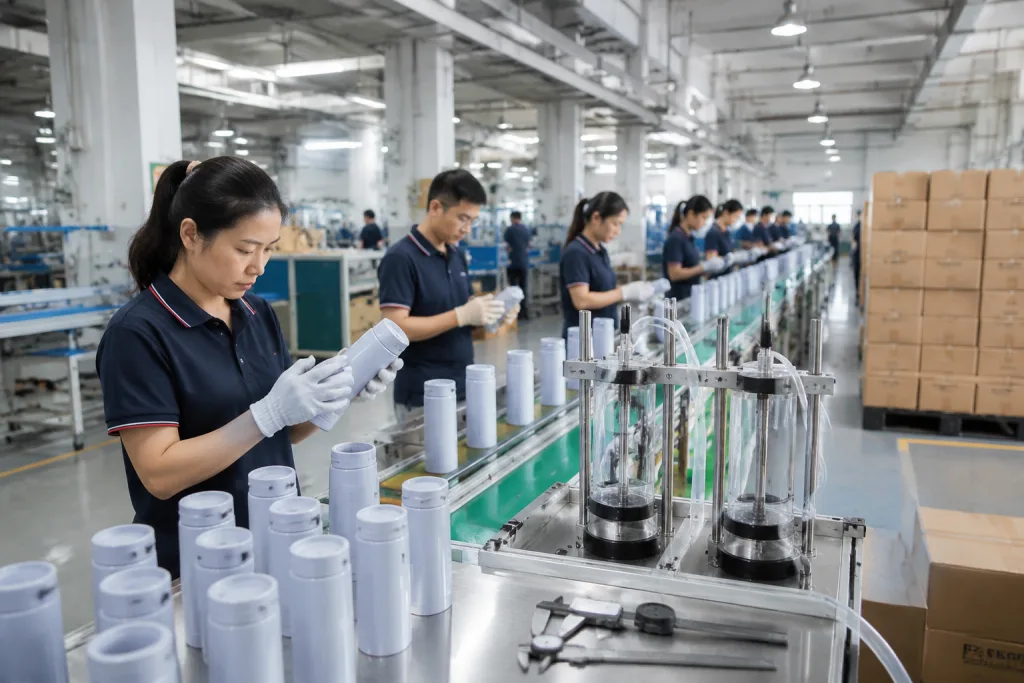
Key Takeaways
- Qualified PP thermal bottle manufacturers in Zhejiang typically run 50,000–200,000 units per month and accept MOQs starting at 500–1,000 pieces for stock molds
- Request a factory video showing the injection molding floor and vacuum insulation station—not just the showroom—before placing a sample order
- Structure your PO with at least 3 milestone payments: 30% deposit, 40% after pre-shipment inspection, 30% against B/L copy
- A proper pre-production sample (PPS) takes 10–14 days and costs $80–$150 including courier to North America or Europe
You spent weeks scrolling Alibaba and Google for a PP thermal bottle manufacturer. Every supplier claims they're the best. The real problem isn't finding a factory—it's knowing which one will actually deliver 5,000 units matching your approved sample, on time, without surprise costs buried in the final invoice. I've watched brand owners learn this the hard way after wiring a 30% deposit. One buyer got samples that looked perfect, then the production run showed flash lines at the spout—QC pulled the sample, but the factory had already shipped.
This guide covers the sourcing workflow I'd use if I were in your position right now: writing an RFQ that filters out trading companies posing as factories, evaluating PP molding capability during a video walkthrough of their injection line, negotiating realistic MOQs (most won't drop below 3,000 for a custom color), and structuring a purchase order with payment milestones tied to inspection sign-offs. No theory. Just the steps that matter when you're dealing with manufacturers in Zhejiang's drinkware cluster.
Why PP Thermal Bottles Need a Specialist Manufacturer
Most drinkware factories can't actually make a quality PP thermal bottle. The construction is fundamentally different from stainless steel vacuum bottles. A PP thermal bottle uses a double-wall polypropylene body with an air gap or foam insulation layer between the inner and outer walls. Getting that insulation right—consistent wall thickness, no voids, proper bonding—requires injection molding experience that a standard stainless steel canteen factory simply doesn't have.
When you're sourcing a canteen custom project with PP construction, look for a manufacturer that runs multi-cavity injection molds daily. In Zhejiang, the specialized PP thermal bottle manufacturers cluster around Taizhou and Yongkang. These factories typically operate 15–30 injection molding machines with 160 to 500 tons clamping force. The math is simple: a factory running 20 machines can turn your 3,000-piece order in 18 days. A smaller shop with 5 machines might need 35 and still deliver inconsistent wall thickness. We've seen buyers get burned on this.
Ask the manufacturer directly: "How many injection molding machines do you run, and what percentage of your monthly output is PP thermal bottles versus stainless steel?" A genuine specialist will answer without hesitation—something like "22 machines, 70% PP production, 30% stainless." A generalist canteen supplier who dabbles in PP will hedge. That hesitation is your signal to keep looking.
Write an RFQ That Filters Out Trading Companies
The first email you send a pp thermal bottle manufacturer either gets you on the molding floor, or it gets you 18 days of pricing ping-pong with a trader who's never seen an injection screw up close. We see RFQs that are two lines: "2,000 custom bottles, best price please." That's a broadcast invitation for every middleman with a gold-supplier badge to quote you $1.80 FOB with no tooling cost breakdown, no cycle time, no nothing.
Write the RFQ so a factory can answer it cold. A trader will stall. Here's what we need to see on our side to send you real numbers:
- Target spec with a hard tolerance: "500ml PP double-wall thermal bottle, food-grade virgin PP body, 18/8 stainless steel inner liner, 0.4mm wall thickness. Keep-hot: fill 95°C water, 6-hour mark — 60°C minimum. We log this on the incoming bench with a K-type probe at three points." A trader will Google what a K-type probe is. A factory already has one on the QC table.
- Decoration spec tight enough to trip someone: "Single-color silk screen on body, 40×60mm print area, Pantone sent after PO. No wrap-around prints. Pre-production sample with mesh count noted — 120T is our default. We've rejected samples at 90T when the buyer didn't specify." A trading company asks why mesh count matters. A factory sends you the screen stretched on the frame.
- Quantity and lead time, no cushion: "PO #1: 2,000 units. Repeat forecast: 5,000/qtr. FOB Ningbo. 30 days from sample sign-off — we count from the day the signed sample lands on the production manager's desk, not the day it ships." We've had buyers lose 11 days to a "sample sign-off" that sat in a trader's inbox. Don't let that happen.
- Compliance with a date stamp: "FDA 21 CFR, EU 1935/2004, REACH. Attach third-party lab reports from the last 12 months. Not the certificate — the actual test sheets with lot numbers matching the raw-material batch." A factory has these in a folder on the shelf above the SGS inspector's desk. A trader scrambles.
- Factory verification that can't be faked from a catalog shoot: "3–5 photos of the injection molding workshop, shot this week, machines running. We'll schedule a 20-minute video walkthrough of the molding floor before we authorize samples. We'll ask to pan to the machine control panel showing the cycle counter — so don't send renders." We asked for this on a 50,000-unit order last year and caught a trader who'd rented a meeting room and called it "our office." The video call killed the deal in 4 minutes.
An actual canteen factory replies in 48 hours with machine photos, a spec sheet with handwritten notes, and an FOB number that breaks out tooling amortization. A trading company sends a glossy catalog and asks what quantity you "really" need. Delete that email. Skip the video call and you're buying blind — we've watched too many shipments land with the wrong liner material because nobody walked the floor.
Evaluate PP Molding Capability Before You Pay for a Sample
You're about to drop $100–$200 on a sample plus DHL. Before you authorize that payment, verify the canteen manufacturer actually runs the molding machines. I visited a Zhejiang factory last year that claimed to be a manufacturer. They outsourced injection molding to a subcontractor three towns away. A buyer's production order ran two weeks late—the factory blamed the sub. Buyer had zero leverage. That's not a scenario you want.
Request a 15-minute live video call. Skip the pre-recorded tour. On the call, ask to see:
- The raw material storage area—look for branded PP resin bags (Sinopec, Formosa, Sabic) with visible batch numbers. Generic unmarked sacks? That's recycled or blended material. QC flagged a batch like that last quarter—the lids warped under 60°C fill.
- At least one mold change happening or a mold storage rack with 50+ molds. A factory running genuine custom canteen customizable projects keeps a large mold library. I saw one shop with 120 molds on racks—they could swap a tool in under 20 minutes.
- The quality inspection station. Look for a digital caliper, a go/no-go thread gauge for lid fitment, and ideally a vacuum decay tester if they produce hybrid PP-stainless bottles. Without those, you're guessing on seal integrity.
One indicator I trust: ask them to show you a current production run for another client's custom drinkware order. If they refuse citing confidentiality, that's a good sign—it means they take IP seriously. If they eagerly show you a dozen branded bottles from recognizable companies, those are likely samples they collected, not orders they produced. We've seen that one go sideways—a buyer paid for tooling based on photos of bottles the factory had never made.
Understand MOQ Realities for Custom PP Thermal Bottles
The MOQ number on a factory website — 500, 1,000, whatever — is the starting point for a conversation, not the final answer. What you actually get depends on three things: stock mold or new tooling, how many colors you're printing, and what extras you add (straw lids, carabiners, silicone boots).
We run 80,000–120,000 units a month across our lines in Hangzhou. Here's what the real MOQ looks like:
- Stock mold, single-color silk screen: MOQ is 500–1,000. We swap the screen and run your order alongside another buyer's. At 1,000 pcs, a 500ml PP thermal bottle lands around $2.80–$4.20 FOB Ningbo. That's the price for the base bottle, no custom packaging.
- Stock mold, full-wrap UV or IML: MOQ jumps to 2,000–3,000. Setup takes longer, and material waste on the line runs higher. Unit price goes to $3.50–$5.50. I've seen a buyer push back on this — the math still works if you're selling into retail at $15+.
- Custom mold (your own shape): Mold cost is $3,000–$8,000, depending on cavity count and side-action complexity. First-run MOQ is 5,000–10,000. The mold stays in our tool room under your name. You own it. We ship it back if you switch factories — but I've never seen that happen cleanly.
For a canteen distributor testing a new region, the smart move is stock mold + custom decoration. Validate demand at 1,000 units before you drop $6,000 on a mold. One tactic that works: ask for a stepped MOQ. You pay the 1,000-unit price but take delivery in two 500-unit batches, 30 days apart. Some canteen vendors in Zhejiang will agree if you cover warehousing — typically $0.08–$0.15 per unit per month. QC pulled a sample on batch two last month because the silk screen shifted 0.5mm. That's the kind of thing you catch on a split delivery, not a single run.
The Sample Stage: Pre-Production vs. Off-the-Shelf
You'll meet two sample types when sourcing from a pp thermal bottle manufacturer. Mix them up and you'll pay for it. An off-the-shelf sample is a bottle we pull from stock—good for checking lid thread fit, wall thickness, and whether the vacuum hold is real. Useless for confirming your decoration. A pre-production sample (PPS) runs on the actual line using your material spec, your Pantone color, your artwork.
Always request a PPS. Pay for it. Free samples on a custom canteen project are stock bottles with a sticker. We've seen buyers accept those, then get a 5,000-unit shipment with a completely wrong print registration. A real PPS runs $80–$150 including DHL and takes 10–14 days. The sample should arrive with:
- A sample tag showing material grade (e.g., 304 stainless body, PP#5 cap), batch number, and production date
- Your decoration applied as specified—check registration, Pantone match, and adhesion (rub the print with your thumb 20 times; if it flakes, reject the lot)
- At least 2 identical units: test one, keep one as your golden sample
Once you approve the PPS, sign and date the sample tag, photograph it, email it back. That photo is your contractual reference. Any bulk goods deviating from the approved PPS is rejectable under AQL 2.5, Level II—spell that out in your PO. We had a buyer last March skip this step. QC pulled the sample, found a 3mm color shift on the logo, and the buyer had no signed reference to enforce. They ate the loss.
Structure Your Purchase Order to Protect Your Deposit
Chinese canteen manufacturers default to 30% deposit, 70% before shipment. You pay 100% before the container clears the gate. We've seen shipments land with 15% defect rates—scratched liners, misprinted logos, seals that leak—and the buyer has zero leverage. The factory already has your money.
The standard two-payment split is the wrong structure. Negotiate three:
- 30% deposit with PO issuance. Tied to raw material procurement. The factory buys PP resin and silicone seals against your order number. No surprise substitutions. We once caught a factory trying to swap in a lower-durometer silicone on seal rings because the spec'd grade had a 3-week lead time. Deposit terms that link materials to the PO number shut that down before it starts.
- 40% after passing pre-shipment inspection. Hire a third-party inspector—AsiaInspection, QIMA, Bureau Veritas—to run AQL 2.5, Level II random sampling at the factory. The inspection report triggers this payment. Half-day inspection at a Zhejiang factory runs $300–$400. Last month QC pulled a sample with a 0.3mm flash line on the rim. Buyer caught it before payment released. $400 saved a full container of rework.
- 30% against copy of Bill of Lading. The factory ships faster when that final 30% is waiting. You keep leverage until the container is on the water. No B/L copy, no final payment.
Your PO needs specifics. Product dimensions with tolerance: ±1.5mm on height, ±0.5mm on diameter. Material grades spelled out: PP grade, silicone grade for seals, stainless steel grade if hybrid. Decoration specs with Pantone codes. We had a buyer flag a PO where "navy blue" meant PMS 2768 to the brand and PMS 539 to the factory. Two different colors. The factory shipped what their ink supplier calls navy blue. The dispute dragged six weeks. Packaging: individual polybag, master carton dimensions, FNSKU label if Amazon-bound. Inspection standard stated plainly. A customized drinkware PO that runs three pages protects you. A one-page PO with "as per sample" is a dispute that hasn't happened yet. We've seen it go sideways enough times to stop counting.
Quality Control: What to Inspect and When
Three inspection gates on a customizable canteen order. Skip one and you're not buying insurance—you're just hoping. Hope doesn't survive a container crossing the Pacific.
Inline inspection (during production): We run this around day 5–7 of a 20-day production schedule. By then, the line has 1,500–2,000 bodies molded and the first decorated units are coming off. If something's wrong—say the injection barrel temperature drifted 8°C from the PPS parameters—you've caught it before 5,000 defective units stack up in the warehouse. The inspector checks three things cold: molding parameter logs against the PPS sheet, decoration registration on the first 200 units (off-center prints are the quiet killer), and lid-to-body thread torque. We had a buyer flag a batch last year where the lid threads bound on production units but not on the PPS. Root cause: the mold cooling channels hadn't been flushed between runs. A 45-minute cleaning saved 3,200 lids from scrap.
Pre-shipment inspection (100% production complete, before packing): AQL 2.5, Level II. For a 2,000-unit order, that's 125 random units pulled. Defect limits: 0 critical, 3 major, 6 minor. A major defect on a PP thermal bottle isn't subtle. Visible weld line on the body seam—reject. Insulation failure—we test 10 units with 98°C water; if any single unit drops more than 15°C in 4 hours, the lot fails. Print adhesion failure—a tape test on the decoration pulls ink off, it's done. If major defects hit 4 out of 125, reject the lot. Don't negotiate this. The math doesn't work if you ship borderline product.
Container loading supervision: For FCL shipments, send someone to watch the floor. I've seen a canteen distributors shipment arrive with crushed carton corners and scuffed bottle shoulders because the forwarder's crew used the wrong clamp truck attachment. Loading supervision runs $200–$300. That's less than the chargeback you'll eat on 80 damaged units. Cheapest insurance you'll buy on the whole PO.
Logistics, Labeling, and Amazon FBA Readiness
I've watched a full container sit at an Amazon FC for three weeks—untouchable—because the buyer's PO referenced their retail packaging guide instead of FBA prep rules. Your distributor drinkware manual and the warehouse receiving dock speak different languages. The canteen factory needs the warehouse's version.
Four items belong in your PO packaging section. Miss one and the clock starts ticking:
- FNSKU labeling: Scannable FNSKU barcode on every polybag or individual box. We apply these on the packing line with thermal-transfer printers—not your 3PL two weeks later at $0.35 per relabel. One buyer's shipment left our floor clean, but 80% humidity at Ningbo port turned the labels into unreadable smears. QC caught it mid-load. We reprinted on polypropylene stock. Ask your manufacturer what label substrate they're using.
- Carton dimensions: Amazon invoices by dimensional weight, not dead weight. A standard 500ml PP thermal bottle ships 24 units per master carton at 52×35×28cm, 9–11kg. We shaved 18mm off the height on a recent run by switching to a thinner divider insert—dropped 0.03 cubic meters per pallet. Across 200 cartons, the freight difference was $340. Make your factory test a tighter layout before cutting the PO.
- Suffocation warning: Any polybag with an opening over 5 inches must carry a printed suffocation warning in English. Many small factories don't stock compliant bags. We once air-freighted $80 worth of compliant polybags to a supplier in Yongkang to avoid a customs hold. Cheaper than a stranded container. If your factory can't source them, ship the bags yourself.
- Country of origin: "Made in China" permanently marked. Not a sticker. US Customs rejected a buyer's pallet last year because the adhesive failed in transit and the stickers ended up on the container floor. Laser engraving on the bottle base costs pennies per unit and survives everything. Molded text in the base tooling works too—one-time mold charge, zero recurring cost.
Ocean transit from FOB Ningbo or Shanghai to US West Coast runs 22–28 days. Drayage and customs clearance add 5–7. Door-to-door to an Amazon FC in California: 30–35 days from our loading dock. LCL? Add 7–10 days for consolidation and deconsolidation at both ends. The math doesn't lie. If your launch date can't absorb a 5-week lead time, you're ordering too late.
Send your custom PP thermal bottle specification for a factory-direct quote
Get FOB pricing, sample timeline, and MOQ confirmation from our Zhejiang production team within 24 hours.
Frequently asked questions
What's the typical MOQ for a custom PP thermal bottle with my logo?
For a stock mold PP thermal bottle with single-color silk screen decoration, the realistic MOQ at most Zhejiang manufacturers is 500–1,000 units. Some smaller canteen factories will accept 300 units but charge a 15–20% surcharge per unit. If you need a custom mold for a unique bottle shape, expect an MOQ of 5,000–10,000 units on the first production run plus a separate mold fee of $3,000–$8,000 depending on cavity count and complexity.
How long does it take from order placement to delivery for a custom drinkware order?
Standard timeline: 3–5 days for artwork confirmation and mold preparation, 10–14 days for pre-production sample, 20–25 days for bulk production after PPS approval, and 22–28 days ocean freight to US West Coast. Total door-to-door is approximately 60–75 days. Rush production can compress factory time to 15–18 days for a 20–30% surcharge, but ocean transit time remains fixed unless you opt for air freight at roughly $2.50–$4.00 per unit.
How do I verify a PP thermal bottle manufacturer is a real factory and not a trading company?
Request a live video call showing the injection molding workshop with machines in operation, not just the showroom. Ask to see raw material storage with branded PP resin bags. Request their business license—a manufacturer's license will list 'manufacturing' as the business scope, while a trading company's license states 'trading' or 'import/export.' Cross-check the factory address on the license with the video call location. A real canteen manufacturer in Zhejiang will have no issue with these requests.
What certifications should a PP thermal bottle manufacturer have for the EU and US markets?
For the US market, the manufacturer should provide FDA 21 CFR compliance documentation for food-contact materials and CPSIA compliance if the product is marketed to children. For the EU, require EU Regulation 1935/2004 compliance and REACH SVHC testing. BSCI or Sedex social compliance audit reports are standard for European buyers. The factory should provide third-party lab test reports from the last 12 months—not just a self-declaration letter. Expect to pay $200–$400 for additional testing if reports are outdated.
What's the price range for a 500ml custom PP thermal bottle from China?
For a stock mold 500ml PP double-wall thermal bottle with single-color silk screen decoration at 1,000 units, FOB Ningbo pricing typically ranges from $2.80 to $4.20 per unit depending on wall thickness, insulation performance, and lid complexity. At 5,000 units, expect $2.20–$3.40. Custom mold projects start at $4.50–$7.00 per unit at 5,000 units. These are FOB prices—ocean freight, customs duties, and inland trucking add approximately $0.80–$1.50 per unit to your landed cost.