Key Takeaways
- A practical pp sport bottle wholesale MOQ is usually 3,000-5,000 pcs per color for custom logo orders
- Virgin food-grade PP is the safer default for EU and North American retail channels
- You should lock cap thread, gasket material, and leak test method before approving samples
- FOB China pricing only means something when packaging, logo, AQL, and compliance scope are included
PP sport bottle wholesale looks simple until 12 quotes land on your desk and not one lines up. Supplier A prices virgin PP. Supplier B runs recycled feedstock they call "food grade" — but won't show the certificate. Supplier C leaves the lid gasket, the carton drop test, and the logo plate cost out of the unit price. You find those on the final invoice, buried three rows down.
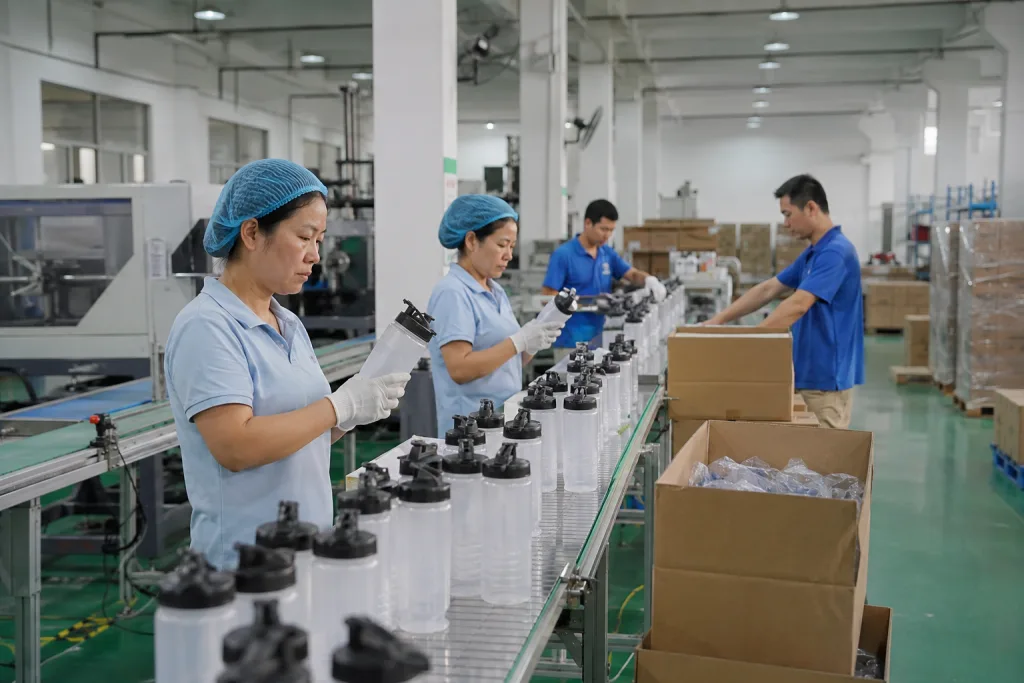
For retail brands, promo programs, sports clubs, or distributor catalogs: margin lives or dies in the spec sheet. We're a drinkware factory in Hangzhou with 14 lines running. We see buyers lock in 5,000-unit MOQs before they understand tooling cost, then act surprised when per-unit price jumps 18% at order confirmation. One buyer last quarter pushed back hard — "this wasn't in the quote" — but it was, just not in the number they wanted to read. Weak specs and skipped testing are the two fastest ways to create a quality claim you can't write off. We've shipped enough containers to know the pattern: a $0.03 gasket that fails LFGB wipes out a $12,000 order. The math doesn't work.
Start With The Buying Job
Stop asking for price first. Ask what job the bottle has to do. A 650 ml PP sport bottle for a school track team is not the same as a 1,000 ml cycling bottle, even if both sit under drinkware wholesale on a supplier spreadsheet. We've seen buyers assume "same plastic" equals "same product." The math doesn't work that way.
For PP sport bottle wholesale, define five points before you request a quote: capacity, cap style, wall thickness, logo method, and packing method. A common wall is 1.2–1.6 mm for mid-range PP. Below 1.0 mm, the bottle passes a photo check but feels thin in hand. We had a batch deform in carton compression at 0.9 mm. QC pulled the sample. For caps: flip-top, screw cap, push-pull, and straw lids each carry different mold costs and leak risks. A buyer flagged a push-pull cap leak at 50°C during a hot-fill test last quarter.
Procurement managers ask us: is PP the best wholesale drink bottle material? For lightweight, low-cost sports programs, yes. PP is impact resistant. It handles dishwasher heat better than PET. It takes translucent or solid colors well. It is not the right material for vacuum insulation, hot coffee positioning, or premium metal drinkware bulk orders. That is the wrong question to ask if you are sourcing canteens or growlers.
If your catalog includes bulk canteen, canteen wholesale, or wholesale growler lines, keep the PP sport bottle spec separate. Canteen bulk orders need shoulder straps, wider caps, and thicker body geometry—often 2.0 mm wall minimum. A bulk growler or beer growler wholesale project may run stainless steel, glass, pressure caution labels, or alcohol-related warnings. Mixing those into one RFQ slows replies and weakens pricing. We ship each category on its own line.
What MOQ Is Actually Realistic
A realistic MOQ for standard PP sport bottles out of China lands at 3,000 pcs per color—stock mold, one-color logo. Bump that to 5,000 pcs per color if you need custom color matching. The resin mixing loss is real. We lose about 1.8 kg of raw material just purging the injection barrel between color runs, and the machine sits idle for 35–40 minutes while QC dials in the shade against the Pantone chip. That time isn't free.
Private mold runs start at 10,000–20,000 pcs for the first production batch, depending on cavity count and bottle gram weight. Our Hangzhou line pushes roughly 450,000 PP units a month when the mold schedule isn't stacked. Logo samples take 7–10 days. Mass production runs 25–35 days after deposit clears and the pre-production sample is signed off. If a supplier tells you 10 days for 20,000 custom-printed units in August, they're either bumping another buyer's order off the line or skipping the AQL 2.5 inspection. Neither ends well.
Decoration choice drives MOQ harder than most buyers expect. One-color silkscreen is the easy one—low setup, fast changeover. Heat transfer and full-wrap printing add a separate station, longer setup, and higher reject rates on curved bottle walls. We've flagged 8–12% scrap on first-run heat transfers when the artwork wrap angle wasn't right. Laser engraving on PP doesn't work the way it does on stainless. We've had buyers send a metal tumbler engraving brief for a PP bottle and it's a straight no-go—the surface chars, the mark looks dirty, and the factory won't sign off on it.
Mixed-category orders change the math, not the rules. You can stuff pp sport bottles, beer tumbler wholesale items, alcohol flask wholesale bulk, and canteen wholesale products into one 40HQ. The freight savings are real. But each SKU carries its own production MOQ because resin, printing screens, and assembly line setup don't consolidate. We've seen first-time buyers calculate MOQ at the container level and then get surprised when the 500 pcs they wanted of one flask style won't even cover the printing plate cost. Consolidated shipping is about logistics. MOQ is about the factory floor.
Material Questions Buyers Should Ask
PP is not one universal material. For retail and brand programs, ask for food-grade virgin PP, the specific grade number if the supplier will share it, and the test standard they support. Europe means REACH and food contact compliance. The US means FDA expectations, and for children’s items, CPSIA or ASTM. If the bottle is marketed to kids, get strict on small parts, straps, and cap components — we’ve seen a buyer’s QC reject an entire 40-foot container over a 2mm strap tab. The wrong question is "is it food grade?" The right question is "what test standard, and can I see the report dated within 12 months."
Ask whether the cap, gasket, straw, and carry loop are also food contact compliant. Most leakage complaints come from the lid assembly, not the bottle body. Silicone gaskets are standard, but cheap TPE gaskets show up in some low-cost drinkware bulk quotes. TPE is not automatically bad, but it must be specified and tested. Do not accept “eco material” as a spec. It means nothing without a material name and a test report. We once had a buyer flag a quote that said “eco” — the supplier meant recycled content but had zero documentation. QC pulled the sample and the gasket hardness was wrong, too soft at Shore A 45 versus the spec.
Recycled PP is possible, but rarely the cleanest choice for a first retail order unless your channel has clear rules. PCR content can shift color consistency, odor profile, and compliance paperwork. If your brand is built around sustainability, discuss recycled content early and budget for testing. A cheap recycled claim on a product page will not satisfy a European distributor. The math doesn’t work: 30% PCR adds roughly 12 days to lead time for color approval alone. We run it when we have to, but we warn buyers the first production run often needs a second pass on color.
Color is another material issue. Pantone matching in PP is approximate, not magic. For solid custom colors, expect tolerance around Delta E under 1.5–2.0 if the resin and masterbatch are stable. Translucent PP is less exact. Approve a physical color chip or pre-production sample under daylight and office light before mass production starts in China. A screen match is not a match. We had a buyer approve a color on a phone screen — the actual run came out olive instead of forest green. That container sat in Yiwu for three weeks awaiting rework.
Price Checks That Prevent Surprises
A PP sport bottle wholesale quote should list per-unit price, logo cost, packaging, testing if included, sample fee, mold charge when applicable, Incoterm, and validity period. If the quote reads "USD 0.68 FOB Ningbo," you don't have a quote. You have a conversation starter.
For a basic 650–750 ml PP sport bottle, FOB China pricing runs USD 0.55–1.20. That spread depends on part weight, cap complexity, print method, and carton spec. A 1,000 ml bottle with flip lid, silicone gasket, carry handle, and two-color print sits above that band. Retail packaging, barcode labels, and FNSKU application add material and labor. A plain OPP bag is cheap. A color box with an instruction leaflet and a carton drop-test requirement is not. One buyer flagged a carton that collapsed at 0.8m — the fix added USD 0.04 per unit.
Use this checklist when comparing quotes:
- Resin: virgin PP or recycled PP, food-grade documentation available or not.
- Weight: bottle body and cap weight in grams, not just capacity in ml.
- Logo: silkscreen, heat transfer, pad print, or in-mold label if applicable.
- Packing: polybag, hangtag, color box, master carton, pallet option.
- Inspection: AQL level, leak test count, and who pays for reinspection.
- Trade term: FOB Ningbo/Shanghai, EXW Zhejiang, or DDP if arranged through a forwarder.
If you are also sourcing beer tumblers, alcohol flasks, or growlers in bulk, do not force all items into the same target price logic. Stainless steel, glass, and PP have different material cost drivers. A low price on one line does not prove the supplier is strong across the whole drinkware range. The math doesn't work that way — we've seen buyers lose margin on glass trying to match PP pricing they saw in a spreadsheet.
Samples Need More Than Photos
Photos help you shortlist. They don't prove function. For PP sport bottles, request two physical samples before approval: one plain material sample and one logo sample. If the order clears 10,000 pcs, a pre-production sample from the actual resin color and production mold is worth the extra 5 days. We've seen buyers approve a photo sample, then get a container where the resin batch shifted tint—the math on rework did not work.
Check the sample like a user and like an inspector. Fill it with water, close the cap, invert it for 30 minutes, shake it hard for 20 seconds, and leave it on white paper. Test the lid with one hand. Open and close the cap 100 times if it is a flip-top design. Put the bottle in a backpack with paper towels around the cap. These tests catch more real complaints than a glossy sample photo. Our QC once pulled a sample that looked perfect until a 20-second shake popped the flip-top—the latch was 0.2 mm undersized.
Record weight, total height, body diameter, mouth diameter, cap thread fit, logo size, and color reference in a procurement file. If the sample weighs 72 g and mass production averages 63 g, you will feel the difference. Add a tolerance to the approved spec. Body weight 45 g ± 3 g, capacity 750 ml ± 20 ml. Without tolerances, every dispute becomes subjective. A buyer in Germany flagged a 5 g variance as a defect—we shipped the QC report with the tolerance line, and it settled the claim.
Approve artwork at 100% scale. Curved bottle bodies distort logos, especially tall vertical marks. A 45 mm wide logo may look balanced on a flat PDF and too large on a tapered bottle. For brand owners, this is where custom-logo work deserves attention. A poor print placement makes a good bottle look like a giveaway product. One client approved art on a flat mockup, then the conical body compressed the logo by 8 mm—we had to recut the screen.
Quality Control Before Shipment
For wholesale drinkware, inspection happens before the balance payment and before the cartons leave the factory. We run ANSI/ASQ Z1.4 with General Inspection Level II and AQL 2.5 for major defects, 4.0 for minor defects. For critical safety defects, it's 0. That means no sharp plastic flash on the mouth, no contaminated interior, and no cap parts that detach into a choking risk for children. QC once pulled a sample where the flip-top hinge broke clean off — that got the entire lot rejected.
A good PP sport bottle inspection covers appearance, assembly, leakage, capacity, odor, print adhesion, barcode scan, carton markings, and packing count. For print adhesion, we use a 3M tape test right on the floor. Press, pull, check. For cartons, ask for a drop test if the shipment hits parcel or FBA-style handling. Carton wall strength matters: 5-ply export cartons handle heavier mixed drinkware wholesale shipments. 3-ply works for lightweight PP bottles under controlled pallet shipping, but we've seen it go sideways when pallets get stacked six high.
If you sell online, include FNSKU or barcode placement in the inspection checklist. A perfect bottle with 8% unreadable barcodes still creates receiving delays — that's not a bottle problem, but your buyer's warehouse will flag it. If you sell to European retailers, carton labels, country of origin, recycling marks, and product warnings must be settled before mass packing. One buyer flagged a missing recycling symbol on a 40-foot container; we had to relabel 2,800 cartons at the dock.
Factory audits are part of risk control, but BSCI and ISO 9001 documents only show whether a factory has systems on paper. They don't guarantee every bottle is good. In Zhejiang and other China manufacturing regions, many capable factories are not famous online. The practical question is whether they can show process control, traceable production records, and corrective action when defects appear. We ask for the last two QC reports on a similar bottle. If they hand us a blank sheet, we walk.
When To Expand Beyond PP
PP sport bottles work where the math is simple: low cost, light weight, runs above 10,000 units. The moment a buyer mentions temperature retention, you're out of PP territory. Switch to stainless vacuum bottles or travel tumblers—double-wall, copper-lined if the spec calls for 12-hour heat. Table-service presentation or premium gifting? That's glass. It brings a different set of headaches: higher breakage in transit, inner-box foam inserts, and MOQs that spike to 3,000 just to amortize the mold. Outdoor alcohol, camping, brewing—these pull you into alcohol flask wholesale, beer growler bulk, and beer tumbler wholesale bulk. Wrong material for the category kills a shipment before QC even pulls the sample.
Expanding categories makes sense only when you segment by production line, not by color SKU. A wholesale canteen for outdoor retail runs on 18/8 stainless or Tritan, needs a 55 mm mouth, a silicone-gasketed lid, and a webbing strap that won't fray after six weekends. A bulk beer growler hits 1.9 L. The cap design has to hold carbonation pressure—we've seen POs go sideways because the buyer assumed a standard screw-top would seal. Carton drop tests matter here: double-wall corrugated, 32 ECT minimum. A beer tumbler bulk program isn't a decorated PP bottle. It's powder coating, laser engraving registration within 0.5 mm, and vacuum insulation spot-checks at AQL 2.5. These run on separate lines, separate QC checkpoints, separate lead times. Treating them as extensions of the same PP order is the fastest way to get a rejection notice.
I tell brand owners the same sequence every time: launch one or two PP sport bottle SKUs, sell through, then add adjacent wholesale drinkware items that match the same buyer. A gym brand adds shaker bottles and stainless sports bottles—same factory floor, same blending-ball supplier. A camping distributor adds canteen bulk, bulk growler, and alcohol flask bulk, all from a partner facility that already ships outdoor hardware. A beverage merchandiser adds beer tumbler in bulk and beer growler wholesale bulk packs, and the carton markings carry the same retail-facing branding. Skip the step where you prove sell-through, and you're sitting on inventory that moves at half the forecast.
One thing I push back on hard: suppliers who send a 300-page catalog before your first container lands clean. A good China supplier tells you where their own lines run and where they use partner factories—flat-out honesty. Our PP line does 50,000 units a day. Stainless vacuum we run in-house. Glass and copper-plated flasks go to a partner plant we audit quarterly. That matters more than a catalog thick enough to stop a door. If a supplier won't name which SKUs they actually control, walk.
A Practical RFQ Checklist
Most RFQs fail before they reach a supplier's inbox. Too long, nobody reads it. Too short, three quotes come back with three different interpretations of what you want. For PP sport bottle wholesale, strip it to what matters: capacity, material, cap type, logo format, order quantity, packaging spec, destination port, compliance market, and the date you need it on the water. Trade term goes in the first paragraph. FOB Ningbo from a Zhejiang factory is what we default to. If you need DDP to a US warehouse, state it—then expect the factory to quote FOB anyway and let your forwarder handle the domestic leg. We see this weekly: buyer skips the Incoterm, three quotes arrive, one includes freight to LA, one doesn't, and the "cheapest" isn't cheap at all.
Here is the checklist I'd send for a 10,000-piece first order:
- Product: PP sport bottle, 750 ml, flip-top lid with silicone gasket. Not a screw cap. We've had buyers mix these up on a PO and the line built the wrong SKU for three shifts.
- Material: virgin food-grade PP body, no regrind. Cap and gasket both food-contact compliant with migration test reports attached to the quote.
- Color: Pantone 19-4052 Classic Blue and Pantone 18-1662 Flame Scarlet, 5,000 pcs per color. Send a physical swatch batch before production—screen calibration lies.
- Logo: one-color silkscreen, artwork in AI or PDF with outlined fonts, print area 45 × 35 mm. We've had a 2 mm shift in placement flagged as a major defect at inspection. Specify the tolerance.
- Packaging: individual polybag, 100 pcs/carton, carton gross weight under 15 kg. Over 15 kg and the warehouse unloading rate jumps. We learned this on a 22-kg carton shipment to Rotterdam.
- Compliance: EU REACH and food contact migration (1935/2004/EC), or US FDA 21 CFR for food contact. Pick one. Dual compliance doubles the testing cost and rarely makes sense for a first run.
- QC: pre-shipment inspection, AQL 2.5 for visual/dimensional, AQL 4.0 for function. Leakage test on 125 pcs per color, barcode scan on every carton.
- Trade term: FOB Ningbo, China. Quote validity 15 days. CNY has moved 3% in a month before. A 30-day quote is a gamble neither side should take.
Then the commercial layer: payment terms, sample charge and whether it's refundable against the production deposit, lead time in calendar days (not working days), and whether the supplier will open the floor to a third-party inspector you hire. For most first orders, 30% deposit with 70% before shipment after inspection sign-off is standard. A letter of credit on a $12,000 PP bottle order is overkill. We've seen an LC add two weeks of bank paperwork, a $300 discrepancy fee, and zero actual protection when the goods were already on the water.
When a supplier answers every line item in your format, you can stack the quotes side by side. When they dodge the material grade, skip the test report question, or write "standard export packaging" without a carton weight, the low price is carrying a cost you'll absorb later. This isn't guesswork. We pulled pre-shipment samples last quarter that passed a 24-hour leak test cold and cracked at the lid hinge on drop test #6. The buyer's lab caught it. The factory ate the retooling. The math only works when the spec is tight enough to enforce.
Send Your PP Sport Bottle RFQ For Review
Share capacity, quantity, logo, packing, and destination. We will return a practical FOB China quote with MOQ, lead time, and QC notes.
Frequently asked questions
What is the normal MOQ for pp sport bottle wholesale?
For a stock mold PP sport bottle with one-color logo, a realistic MOQ is 3,000 pcs per color. For custom Pantone color, plan on 5,000 pcs per color because resin mixing and machine setup create waste. If you need a private mold, the first run often starts at 10,000-20,000 pcs, plus tooling cost. Small trial orders below 1,000 pcs may be possible from existing inventory, but the unit price will rise and color options will be limited. For serious wholesale drinkware programs, start with 3,000-5,000 pcs and use physical samples to lock the specification.
How much should a PP sport bottle cost FOB China?
A basic 650-750 ml PP sport bottle usually lands around USD 0.55-1.20 FOB China, depending on gram weight, cap design, logo, and packaging. A simple screw cap with one-color print is near the lower end. A flip-top lid with silicone gasket, custom color, hangtag, barcode label, and stronger export carton costs more. Quotes below USD 0.50 can exist, but you should check body weight, resin type, and whether packaging or logo cost is excluded. Always compare total landed cost, not only the bottle price, especially when shipping low-value bulky drinkware bulk goods.
Can I combine sport bottles with canteen or growler products?
Yes, you can consolidate pp sport bottles with bulk canteen, wholesale canteen, bulk growler, or beer growler wholesale items in one shipment, but each product keeps its own MOQ and production schedule. A PP sport bottle may be ready in 25-35 days, while stainless canteen or beer growler bulk orders with coating and laser marking may need 35-50 days. Consolidation works best when carton dimensions, inspection timing, and freight plan are arranged early. If one product is delayed, it can hold the whole container unless you agree to split shipments.
Which tests matter most before mass production?
For PP sport bottles, prioritize food contact compliance, leakage, odor, capacity, print adhesion, and cap cycle testing. For EU buyers, ask about REACH and applicable food contact documentation. For US buyers, FDA food contact expectations are relevant, and children’s products may need stricter review under CPSIA or ASTM-related requirements. On the factory side, approve a pre-production sample and define AQL inspection levels before production. A practical inspection plan uses AQL 2.5 for major defects and 4.0 for minor defects, with critical safety defects set at 0.
Is PP better than stainless steel for wholesale drinkware?
PP is better when you need lightweight, low-cost, impact-resistant sport bottles for schools, gyms, promo campaigns, or entry-level retail. Stainless steel is better for vacuum insulation, premium gifting, beer tumbler wholesale, alcohol flask wholesale, and outdoor canteen products. A PP bottle may cost under USD 1.20 FOB for many standard designs, while insulated stainless drinkware often starts several times higher. The right choice depends on retail price, use case, and compliance channel. Many distributors carry both: PP for volume programs and stainless for higher-margin drinkware wholesale categories.