Key Takeaways
- A practical PP bottle MOQ is usually 3,000-5,000 pcs per color for custom color or logo production
- Food-contact PP should be checked against LFGB, FDA, REACH, or EU 10/2011 depending on your market
- Expect 25-35 days for standard logo orders and 40-55 days if new tooling or custom molds are required
- Leak testing, drop testing, torque checks, and AQL inspection matter more than a glossy sample photo
PP bottles look simple until the PO lands. Then the line has to pin down the specs that decide whether we ship clean: food-contact PP grade, cap torque at 8–10 kgf·cm, leak rate after a 1.2 m carton drop test, logo adhesion after 3M tape testing, Pantone matching under a D65 light box, and whether the quoted MOQ means 3,000 pcs per color or one mixed order. Small details bite.
Buying from a pp drink bottle factory in China is not won by squeezing another USD 0.01 out of the unit price; that is the wrong question to ask. BottleForge Industrial is based in Hangzhou, Zhejiang, and we see the same problems every week: one canteen distributor sent a lid drawing missing the silicone ring ID by 0.6 mm, a promo buyer pushed for 6 colors at a 1-color MOQ, and a private-label team skipped pre-shipment checks until QC pulled the sample and found 18 crushed export cartons. We run into this often. The math doesn't work if the inner box, 5-layer master carton, and tape width were never built for sea freight.
What PP Bottles Are Best For
PP, or polypropylene, fits buyers who need a light custom bottle that survives daily knocks without paying stainless steel money. We run PP for school bottles and gym canteens by the container load, but we don’t set up those jobs the same way. School orders get a harder cap-hinge drop test, usually 1.2 m onto concrete for three angles. Promo jobs need cleaner carton marks, faster bagging, and fewer loose threads on the carry loop because the buyer’s warehouse team sees that first. Typical PP bottle wall thickness sits around 1.2-2.0 mm, depending on bottle size, mold design, and whether the body is blow molded or injection molded. On the line, QC checks the shoulder and base with a Mitutoyo digital caliper; a 0.2 mm thin spot near the parting line is where squeeze marks start to show.
PP is not for every program. If your buyer wants heat retention, a custom growler, or a premium distributor growler line, stainless steel is the better route. For a light 500 ml to 1,000 ml bottle with a flip lid, screw cap, straw cap, or carry loop, PP is practical and cost-efficient. A normal FOB China price range for a 650 ml PP sports bottle can sit around USD 0.65-1.45 per piece before complex decoration, retail packaging, or special accessories. We had one buyer push for a “thermo” claim on a PP bottle last spring; QC pulled the sample after 30 minutes of hot-water testing because the body softened and the temperature drop was too fast. The math doesn’t work. Wrong question. PP is for low weight and price control, not insulation.
The main advantage is order flexibility. You can pick a canteen custom color, print one logo, switch the cap color, then pack the same body for school, fitness, outdoor, or promotional channels with different inserts or barcode labels. For canteen promotional orders, PP usually gives a better landing cost than Tritan or metal when the target retail price is tight, especially at 3,000-5,000 pcs per color. The tradeoff is blunt: PP looks cheap when the mold polish is rough, the color masterbatch drifts, or the logo print fails a 3M tape test. We’ve seen this go sideways when a PO says Pantone 299C and the approved sample bag is marked 292C, then the buyer flagged the first carton photo before shipment. Factory selection matters.
Questions To Ask Before Quoting
Before asking any canteen supplier for a price, lock the product spec first. “Send price for custom canteen” is how sampling arguments start. Last month we saw a PO say 750 ml, while the approved sample was 700 ml; QC pulled the sample, measured it with a graduated cylinder, and the buyer flagged the difference after cartons were printed. A serious pp drink bottle factory will ask these details before giving a final cost.
Use this checklist when you request a quote:
- Capacity: 500 ml, 650 ml, 750 ml, 1,000 ml, or another size; tell us brimful capacity and usable fill line if they differ.
- Material: food-grade PP body, PE straw, silicone seal, PP or ABS cap parts; we run different shrinkage settings for PP and ABS cap pieces.
- Decoration: silkscreen, heat transfer, in-mold label, sticker label, or sleeve; send artwork in AI or PDF, not a 72 dpi JPG pulled from a website.
- Color: stock color, Pantone matched body, translucent finish, or solid finish; Pantone matching usually needs a 1 kg color masterbatch trial before mass production.
- Packaging: bulk pack, white box, color box, hang tag, barcode, or FNSKU label; Amazon orders often fail on label placement, not bottle quality.
- Market: EU, UK, US, Canada, or another compliance route; FDA and LFGB testing need different paperwork and sample quantities.
- Inspection: AQL level, leak test quantity, carton drop test, and defect definitions; define whether a 0.5 mm black dot on the body is major or minor before the line starts.
In our Zhejiang facility network, a standard logo order starts at 3,000 pcs per SKU. A canteen with a customized body color makes sense at 5,000 pcs. Below that, the math does not work. For a new cap, new body shape, or special grip texture, tooling starts around USD 1,200-4,500 depending on mold complexity. That is not “decoration cost” — it pays for steel tooling, trial shots on the injection machine, fit testing with the thread gauge, and shrinkage correction after the first samples come off the line.
How Factory Capability Shows Up
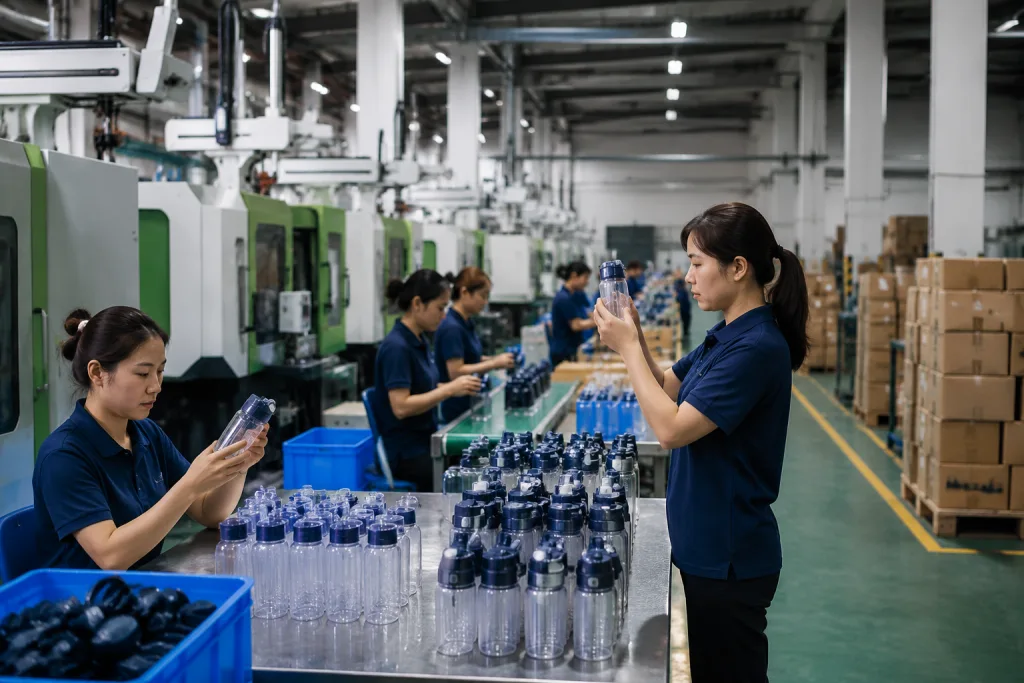
We run 16 injection-molding machines in-house at 280–650 tons clamp force, plus two blow-molding lines for the PETG and Tritan side. The PP line skips blow molding—everything is injection-molded body and cap. That means the critical path runs through resin drying, color dosing, molding, cap torque testing, silicone-seal insertion, and decoration. We keep all of that under one roof in Hangzhou. The one step we outsource is laser engraving on stainless lids. The partner is 4 km away, and we send a QC inspector to their floor on every batch. When a buyer asks "what do you outsource," they're really asking "who owns the defect when something goes wrong." Fewer hands mean a cleaner answer.
Monthly PP bottle capacity sits between 180,000 and 260,000 units across two dedicated assembly lines. That number shifts with cap complexity—a flip-straw sports lid with a silicone bite valve takes three extra assembly stations versus a simple screw cap. Decoration workload pulls it down too. A single-color silkscreen runs fast. Two print positions with three cap colors means more changeovers and a heavier sorting load at final QC. We built the lines for export rhythm, not domestic spot orders. A distributor reordering 40,000 units quarterly doesn't throw us into overtime—we've already blocked line time for it. The math that breaks is when a buyer wants 5,000 units with five SKU variants and expects 25-day lead time. That's not a capacity problem. That's a setup-cost problem.
Ask the factory these four things: mold ownership terms (you hold the mold or the factory does), machine tonnage on the specific press running your part, daily output per line with your decoration spec, and how many QC staff are on assembly at full speed. A 750 ml bottle with a straw lid leaks more often than a basic screw-cap bottle—we see a 1.2–1.8% leak rate at AQL 2.5 on straw-lid runs versus under 0.4% on simple caps. That difference shows up in inspection reports and in the rework bay. A factory that can't give you those numbers by SKU is guessing.
A sample proves one bottle can be made. Factory control proves 10,000 bottles come out the same. We've had buyers approve a perfect pre-production sample and then flag 8% of the shipment because the factory moved mold maintenance to a night-shift junior tech. That's the gap.
Safety Standards Buyers Should Specify
Food-contact compliance belongs in the PO, not a WeChat voice call. For the EU, most buyers we work with specify EU 10/2011, LFGB sensory, REACH SVHC screening, and specific migration testing for the exact food simulant and time/temperature conditions the bottle will see. For North America, FDA 21 CFR is the baseline, but if the cap has a spout or the bottle is marketed to kids under 12, CPSIA section 108 and ASTM F963 drop tests come into play. We've had a shipment held at Long Beach because the buyer only asked for "FDA" and the lab scope missed the silicone spout gasket.
PP resin itself is low-risk for food contact. The problems show up elsewhere. Color masterbatch with azo pigments, pad-printing ink not rated for indirect food contact, a silicone seal cured with a peroxide system that leaves residues, or a UV adhesive that never got migration-tested. We've seen a competing factory quote the PP body only and stay silent on the cap liner. That gets past a price-comparison spreadsheet. It doesn't get past a retail chain's compliance audit. If you're a brand owner shipping to Target or a distributor stocking Amazon FBA, that gap is yours to own.
For a custom run, ask for test reports issued within the last 12 months from SGS, Intertek, TÜV Rheinland, or Bureau Veritas. Then check the scope. A 2022 report on natural PP pellets tells you nothing about a 2026 bottle in opaque red with a two-color logo print. The report must name the finished article, the colorant, and all food-contact components—body, cap, gasket, valve if present. If you're importing into the EU, push for a Declaration of Compliance signed by the factory's technical director, not the sales rep. If the destination is Amazon, lock down FNSKU placement, polybag suffocation warning dimensions (we use 0.8 mm minimum thickness for the bag itself), and carton labeling before the first shot on the injection line.
One rule we enforce on every project: compliance documents get signed off at the pre-production meeting. Not at final payment. Once 5,000 bottles are shrink-wrapped on pallets, your leverage is gone and the factory knows it.
Logo And Customization Choices
Most PP bottle decoration problems come from choosing the wrong method for the surface. Silkscreen printing works for simple one- or two-color logos on a flat or slightly curved area. Heat transfer gives better color detail and is common for retail graphics. In-mold labeling looks clean and durable, but it requires tighter process control and usually a higher MOQ. Sticker labels are cheap, but they rarely hold up under wet handling over six months.
For canteen customizable programs, we separate decoration into three levels, not two. Level one is logo-only: stock mold, stock or standard Pantone color, one print position. Level two is canteen customized appearance: custom color body, custom cap color, logo, hang tag, and retail box. Level three is structural customization: new mold, new handle, custom straw design, special grip panel, or unique lid. Each level changes cost, sampling time, and risk. Skip the middle level and you will ask for a sampling extension.
A 5,000 pcs order with one-color silkscreen needs 7-10 days for sample approval and 25-35 days for mass production after deposit. A new mold for a custom canteen or customizable growler-style plastic bottle adds 20-30 days before production starts. PP can give a rugged large-capacity appearance, but it will not feel like powder-coated steel. One buyer called to complain that the bottle felt "too light," which is a material property, not a defect. If you need a customized growler look in PP, be honest about what PP can and cannot do. The math does not work if you want steel weight at plastic cost.
MOQ, Pricing, And Payment Reality
MOQ isn't a trick number. It ties directly to machine setup time, color-change material loss, printing plate costs, packaging MOQ from our suppliers, and QC labor. For a stock PP bottle with one-color logo, we can run 1,000 pcs, but the unit price stings. For stable FOB pricing, 3,000 pcs per design works better. For a Pantone-matched body color, 5,000 pcs per color gives cleaner economics — color masterbatch waste and machine cleaning get spread across more units.
Here's a realistic cost breakdown buyers see from us in Hangzhou. A basic 600-750 ml PP bottle lands around USD 0.65-1.10 FOB Ningbo or Shanghai in bulk pack. Simple one-color printing adds USD 0.05-0.18. Retail color box packaging runs USD 0.08-0.25. Add more for extra silicone parts, a straw brush, a custom hang tag, or individual polybags. Carton dimensions matter more than most buyers think. A bulky bottle can push freight cost up even when the piece price looks tight. We had a buyer once who saved USD 0.02 per piece on printing. They paid USD 0.15 extra per carton in freight because the box outer dimensions were off by 3 cm. QC flagged it on the loading pallet. Too late to fix.
New buyers get 30% deposit, 70% before shipment after third-party inspection. Repeat canteen distributors usually negotiate better terms after two or three clean orders, but first runs stay conservative. If a factory quotes 18-25% lower than the rest, ask what moved: resin grade, wall thickness, gasket material, AQL level, carton burst strength, or print adhesion. Cheap PP bottles get expensive fast when leakage claims hit your warehouse.
Inspection Checklist Before Shipment
A pre-shipment inspection catches what the factory floor tries to hide. We run AQL General Inspection Level II, critical defects at zero. Leakage, wrong material, sharp edges, unsafe contamination, or incorrect labeling? Reject. Full stop. Minor and major defect levels can flex based on your channel—but never these.
Your checklist should cover:
- Capacity check: verify usable volume against spec, e.g., 650 ml +/- 5%. QC once flagged a 650 ml bottle that held 590 ml—nobody caught it until the line ran 5,000 pieces.
- Leak test: invert filled bottles for 30+ minutes, including cap and straw models. A buyer shipped without this test once. Customer returns hit 12%.
- Drop test: carton drop from 76 cm for export cartons, adjusted by weight. 12 kg carton? Drop from 76 cm. 18 kg? Drop from 50 cm. The math works.
- Torque check: screw caps must close smoothly. No thread slipping. We see bad molds on this every quarter.
- Logo rub test: dry rub and wet rub, 20-50 cycles based on print type. Screen print on a textured surface? Push to 50 cycles.
- Color check: compare body, cap, and print against approved Pantone or signed sample. "Close enough" gets returned in Rotterdam.
- Packaging check: barcode, FNSKU, carton marks, inner quantity, gross weight. A typo on a carton mark cost one distributor $2,000 in fines.
Use the same checklist across all canteen suppliers. One list, one standard. It makes defect discussions factual—no opinions, just failed leak tests and wrong carton marks. For North American and European buyers, archive inspection photos with the PO, invoice, packing list, and lab reports. Paper saves your ass when the container lands.
How To Shortlist Suppliers
A good canteen supplier answers technical questions before pushing you to pay a sample fee. When you shortlist canteen manufacturers, ask for a quotation sheet that separates bottle cost, decoration cost, packaging cost, tooling cost, testing cost, and inland freight. If all costs are hidden inside one number, you cannot compare offers properly.
For a canteen distributor or brand owner, I rank supplier fit by five criteria: food-contact documentation, mold and production control, response accuracy, inspection discipline, and export packaging experience. Price sits behind those five every time. A supplier who understands FOB terms, HS codes, carton compression, pallet plans, and Amazon carton limits will save you time. A supplier who says "yes, can do" to everything will dump that work on your team later.
Ask whether the factory has BSCI, ISO 9001, or retailer audit experience if your channel requires it. Ask whether they have shipped to Germany, France, the UK, Canada, or the US in the past 12 months. China has many canteen vendors, and some are good at domestic wholesale but weak on export documentation. That is a different business.
For your first order, keep the specification controlled: one bottle size, one lid type, one or two colors, and one decoration method. After the first shipment passes inspection and sells through, expand into customizable drinkware, customized drinkware sets, or a distributor growler program. A stable supply chain is built by clean repeat orders, not by stuffing every idea into the first PO.
Send Your PP Bottle Spec For Factory Review
Share capacity, market, logo method, MOQ target, and packaging needs. We will return a practical FOB quote and production checklist.
Frequently asked questions
What MOQ should I expect from a pp drink bottle factory?
For a standard PP bottle with one logo, expect 3,000 pcs per design as a workable MOQ. Some factories accept 1,000 pcs, but the FOB unit price may rise by 15-35% because printing setup, carton purchase, and machine time are spread across fewer units. For Pantone matched body color, 5,000 pcs per color is more realistic. For new molds, many factories prefer 10,000 pcs or a tooling fee of roughly USD 1,200-4,500. Always confirm whether MOQ means per color, per logo, per bottle size, or total order quantity.
Is PP safe for drink bottles sold in Europe and North America?
Food-grade PP can be safe, but you need documentation for the actual product. For the EU, ask for EU 10/2011 migration testing, LFGB if required by your customer, and REACH screening where relevant. For the US, FDA food-contact suitability is commonly requested, and children’s items may trigger CPSIA or ASTM checks. Do not accept a generic resin certificate as complete proof. The cap, silicone seal, printing ink, straw, and color masterbatch should also be considered, especially for customized drinkware sold through retail or promotional channels.
How long does production take after sample approval?
For stock mold PP bottles with logo printing, mass production usually takes 25-35 days after deposit and approved sample. Add 5-10 days for sample development if the color, print, and packaging are straightforward. If you need a new mold, custom cap, or structural custom canteen design, allow 40-55 days or more before shipment. Lab testing can add 7-12 working days depending on the standard and lab queue. Peak season in China, especially before Chinese New Year, can stretch timelines by 10-20 days.
Which logo method works best on PP bottles?
For simple logos, silkscreen is usually the most economical and works well on smooth print areas. One-color printing may add about USD 0.05-0.12 per piece, depending on size and quantity. Heat transfer is better for multi-color artwork and retail graphics, often adding USD 0.12-0.30 per piece. In-mold labeling can look more integrated, but it needs higher MOQ and tighter process control. For promotional canteen orders, avoid oversized artwork on heavily curved areas unless the factory has tested that exact bottle shape.
Can one supplier handle canteens, growlers, and other drinkware?
Yes, but check whether they truly manufacture or only trade across categories. A pp drink bottle factory may be strong in plastic canteens but weaker in stainless steel custom growler production. If you need canteen customized orders plus a customized growler or travel tumbler line, ask for separate production specs, test reports, and factory photos for each category. At BottleForge Industrial in Zhejiang, we manage PP, stainless steel, and glass drinkware through category-specific lines because the tooling, testing, and defect risks are different.