Key Takeaways
- A practical PP bottle MOQ starts around 3,000-5,000 pcs per color for custom logo orders
- Ask for resin grade, cap material, wall thickness, and food-contact test scope before comparing FOB prices
- Pre-production samples usually need 7-12 days after artwork and color approval
- Your PO should list bottle body, lid, printing, packaging, inspection, testing, and spare parts as separate line items
Polypropylene bottles sound simple—until your RFQ comes back with five different prices, two cap materials, three printing options, and no clear statement on food-contact testing. That's the moment a buyer learns the hard way. We've seen a 100,000-piece order stall because the PP resin grade wasn't stated in writing; the line stopped while QC pulled a sample for FTIR testing. If you're buying for a retail brand, a promotion, a school program, or a distributor drinkware catalog, those small gaps become chargebacks, late launches, or bottles that smell wrong out of the carton.
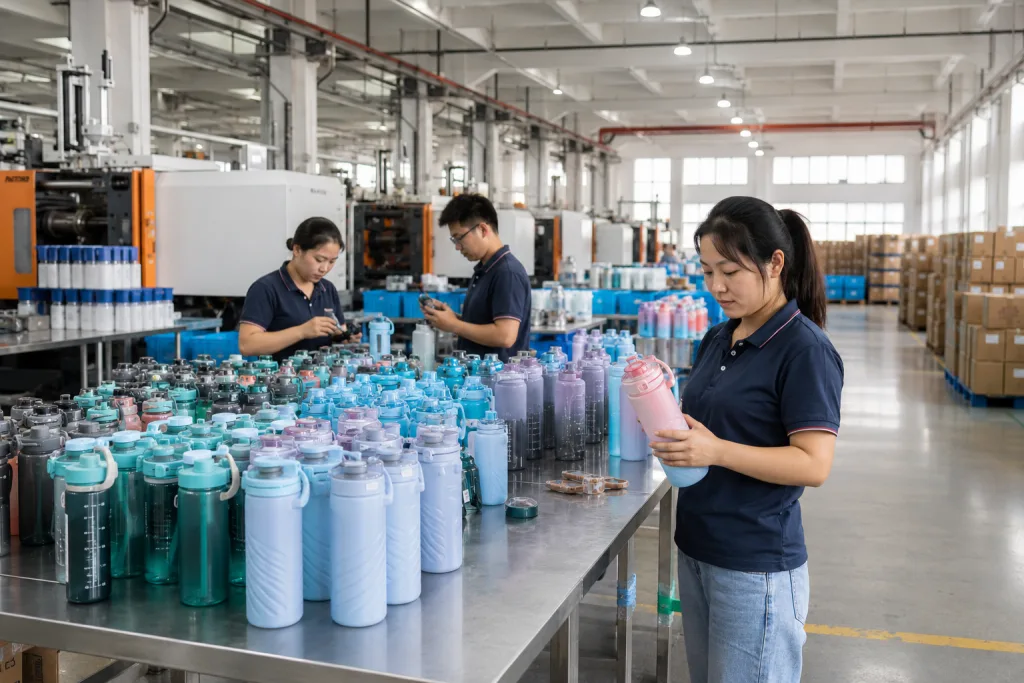
A good polypropylene water bottles manufacturer makes the process boring. Confirmed resin grade. Stable tooling. Clear artwork limits. Sample approval. AQL 2.5 inspection. Shipment paperwork that matches your PO—every line, every code. We run production at BottleForge Industrial in Hangzhou, Zhejiang. We quote PP projects the way export buyers actually purchase them: by SKU, color, logo process, carton plan, test requirement, and delivery window. No surprises. That's the baseline.
Start with the bottle job
Write the bottle's job description first. Not the price. Before you ping any PP water bottle manufacturer, get a one-page spec down—what this bottle actually has to survive. Polypropylene earns its place: light, takes a drop without cracking, dishwasher-safe if the wall thickness and gasket spec are right. We run it for sports teams, school programs, outdoor brands, and promotional campaigns. But PP is not vacuum insulation. It is not boiling water. If your brief says "custom growler" or "customized growler for beer," stop. PP warps at those temps. You need 304 stainless or glass.
Nail the use case. A 500 ml school canteen with student colorways ships differently than a 1,000 ml outdoor bottle headed to canteen distributors. Different testing thresholds, different packaging stack. EU and North American buyers flag four things on inspection: residual odor, lid leak at 90° tilt, drop survival from 1.2 m, and logo adhesion after 50 dishwasher cycles. Carton crush strength matters too—we've had a shipment arrive with 12% carton collapse because the buyer spec'd single-wall to save $0.18 a unit. Don't lead with capacity and target price. A low FOB hides thin walls, thread tolerance slop, and a cap gasket that quits at 300 open-close cycles. Returns eat the margin. We've done that math.
Our PP bottle runs at BottleForge in Hangzhou sit between 3,000 and 20,000 pcs per SKU. Monthly mixed capacity across plastic, stainless, and glass lines runs about 450,000 units. For a canteen promo order, 5,000 pcs MOQ is realistic. 500 pcs is not—injection mold setup alone burns half a shift, and then you've got color matching, pad-printing registration, and carton packing all chewing line time. QC pulled a sample last month where the thread pitch was off by 0.2 mm. Caught it before the mold ran a full cavity.
Write your buying target in one sentence before you hit send on the RFQ: “We need a 750 ml BPA-free polypropylene sports bottle for EU retail, two body colors, one-color logo, individual kraft box, REACH/LFGB documentation, FOB Ningbo, delivery by 20 May.” That sentence kills three email rounds. One sentence. Try it.
Build an RFQ suppliers can answer
A weak RFQ gets you a quote built on guesses. A tight one gets you a price you can actually compare across the three or four factories you're shortlisting. Use the same specification table for every supplier. Same column headers, same fields, same order. If you don't, you're not comparing costs — you're comparing who guessed differently.
Your RFQ needs bottle capacity, approximate dimensions, target weight, lid type, mouth diameter, carry handle design, body texture, logo method, packaging spec, testing requirements, and shipment term. For polypropylene bottles, the resin breakdown is where quotes drift apart. Spell out whether the body is food-grade PP, whether the lid is PP or PE, whether the gasket is silicone, and whether any Tritan, TPE, or metal parts show up anywhere in the assembly. Mixed materials shift both unit cost and compliance paperwork — a PE lid on a PP body looks trivial but changes the recycling classification and the per-kilo resin price by about 15%. We've had QC pull a sample and flag a PE lid on a PP-only spec sheet. The factory said "same function, cheaper." The buyer's compliance officer disagreed. The 3,000-piece shipment sat in Hamburg for 11 days while they sorted the paperwork.
- Body: PP, 600 ml, translucent blue, target weight 78–90 g, wall thickness target 1.2–1.6 mm.
- Lid: screw cap with flip spout, silicone gasket, leak test required.
- Decoration: one-color silkscreen logo, 55 × 35 mm print area, Pantone 286 C.
- Packaging: 1 pc/polybag or no polybag, 50 pcs/export carton, carton under 15 kg if possible.
- Compliance: FDA 21 CFR for US or EU 10/2011 plus LFGB if sold in Germany.
- Commercial: MOQ by color, FOB Ningbo or Shanghai, lead time after deposit.
For a distributor program running multiple customer logos across the same bottle body, ask for logo changeover charges in the RFQ itself. A factory might quote USD 0.78 per unit and then bury USD 55 per screen, USD 35 per pad print plate, and USD 45 per Pantone match in the fine print. These aren't junk fees — we pay for film output and screen coating, and a 6-color match on a curved PP surface takes a shift tech about two hours to dial in on our Sakurai press. But they need to be visible before your customer signs off on the resale quote. We've watched a deal collapse at the PO stage because the buyer's margin evaporated into six screens nobody budgeted for. Do the math: 5,000 units at USD 0.78 looked like USD 3,900. Actual landed cost was closer to USD 4,770 after changeovers and plate fees. That's the wrong time to find out.
If you're a distributor or a volume drinkware buyer, put forecast quantities in the RFQ. A factory prices 5,000 pieces one way and 5,000 pieces with a repeat plan of 30,000 over six months another way — tooling amortization, material pre-ordering, and line scheduling all shift. We run better when we know what's coming. You get a sharper number. Both sides win. Last quarter a buyer sent us a PO for 8,000 units with a note: "Assume 24,000 more by Q3." We shaved 9% off the unit price just by pre-booking the resin and locking two cavity sets on mold #427 for the full run.
Read the quote line by line
Read the quote line by line. Don't scan for the lowest FOB number and call it a day. A real quote from a polypropylene water bottles manufacturer spells out inclusions and exclusions. If the quote reads "PP bottle, logo, USD 1.05" and nothing else, you don't have enough to cut a PO. We've seen buyers sign off on exactly that, then get stung for USD 0.12 per piece on inner packaging they assumed was standard.
Start with MOQ. On a canteen project, MOQ might be stated per model, per color, or per logo—three different things. A supplier says 5,000 pcs total but requires 2,500 pcs per body color. You want five colors at 1,000 pcs each. That hits resin changeover, color cleaning, and scrap rate. The math doesn't work unless you sort it before promising assortments to your retail customer. One buyer we worked with ate USD 800 in color-cleaning charges because the quote said "5,000 pcs MOQ" and he read it as total.
Next, check tooling status. Existing molds are faster and cheaper. New molds run USD 1,500 to USD 8,000+ depending on cavity count, bottle structure, lid complexity, and whether you need exclusive mold rights. A proper quote for a custom canteen shape states mold ownership, maintenance responsibility, expected mold life (500,000–1,000,000 cycles for P20 steel), and sample schedule. A canteen supplier that dodges tooling details isn't helping you manage risk. QC pulled a sample from a new mold last quarter—0.5 mm parting line gap. Tooling details in the quote would have flagged that before we cut steel.
Then the decoration line. Silkscreen works for flat or slightly curved bottle areas. Pad printing handles caps and tight curves. Heat transfer gives more color but bumps setup cost and can fail under aggressive dishwasher use unless tested. Laser engraving on PP body decoration—we skip it. It doesn't hold. For customized drinkware, ask for a printed logo durability test: 3M tape test, alcohol rub test, and dishwasher cycles if the quote claims dishwasher-safe. A buyer flagged a logo after 12 dishwasher cycles—peeled clean off. The quote listed "dishwasher safe" with zero reference to a test standard.
Cheap PP bottles get expensive fast when the quotation leaves out testing, inner packaging, color matching, spare lids, and final inspection support.
On payment, most Zhejiang factories run 30% deposit, 70% before shipment for new buyers. LC can be discussed on larger orders, but for 5,000–10,000 pcs custom canteen orders, T/T is still the norm. We ship roughly 80% of our export orders under T/T. If a supplier pushes for 50% deposit on a 5,000-pc run, ask why. Not a red flag by itself, but it's the wrong number for that order size.
Put sample approvals in writing
Samples are not souvenirs. They are the physical contract between your PO and bulk production. For polypropylene bottles, you need two stages: a stock sample to check shape and handling, then a pre-production sample using your color, logo, and packaging. If new tooling is involved, add a T1 sample after mold trial.
A normal pre-production sample timeline is 7-12 days after artwork approval for existing molds. New mold T1 samples run 25-35 days, and another 5-10 if tooling adjustment is needed. If a canteen manufacturer promises new mold samples in a week, ask what they are skipping. We had a buyer who approved a T1 sample photo in 3 days and got a mold that cracked on cycle 50.
Approve samples against measurable points. Use Pantone or a physical color chip, not "light blue." For logo placement, specify tolerance like ±2 mm. For capacity, define brimful capacity and recommended fill line capacity. A "750 ml bottle" may mean 750 ml to the shoulder, to the fill line, or to the absolute top. That difference matters for labeling and customer complaints. QC once flagged a 5 mm logo shift we approved at sample stage—the buyer said "close enough" and the retail client rejected the full pallet.
Your sample approval file should include clear photos, signed sample comments, artwork version number, packaging dieline, and any defects you accept or reject. If you approve a sample with a visible gate mark, slight flow line, or seam line, do not later treat it as a bulk defect unless severity changes. Injection-molded PP has process marks; the question is whether they are controlled and commercially acceptable. We run a 3-piece gate mark on our standard canteen cap—visible, consistent, and it passes every buyer audit.
For canteen promotional orders, test real user behavior. Fill the bottle, shake it upside down for 30 seconds, drop it from 1 meter onto plywood (or concrete depending on your standard), open and close the lid 100 times, and leave water inside for 24 hours to check odor. These checks catch problems earlier than a beautiful photo ever will. One buyer skipped the 24-hour odor test and shipped 20,000 bottles that smelled like burnt PP. The math doesn't work on that kind of recall.
Write PO lines that prevent arguments
A one-line PO for custom drinkware is a dispute you've already agreed to lose. "5,000 pcs PP bottle with logo" — whose logo? What size? Which Pantone? When the only spec is a sentence, everything becomes subjective and the argument lands in your inbox after production is done. We learned this the hard way. A buyer once rejected an entire shipment because the logo felt "too small." No size was on the PO. QC pulled 200 samples, measured, and confirmed it matched our standard 45×25 mm default — but the buyer expected 55×35 mm. We ate the cost on 3,000 reprints at half margin. Now we refuse to run a line without broken-out PO items.
Split the order into separate lines: bottle body, lid assembly, logo method, retail packaging, export carton, testing, spare parts, freight term. If your Amazon fulfillment requires FNSKU labels, list them as a line. Bilingual warning stickers for EU? Line item. 1% spare lids? Write it in — even if free of charge. Factories make parts. They don't guess your downstream compliance system. One buyer's PO arrived with "Pantone 268 C" instead of "286 C." Nobody caught the typo until 2,000 bottles came off the line in navy instead of royal blue. A five-character mistake cost three weeks. The math doesn't work any other way.
Practical PO line items
- Item 1: 750 ml PP water bottle, existing mold BF-PP750, body color Pantone 286 C, 5,000 pcs.
- Item 2: Screw lid with flip spout, silicone gasket, matching blue, 100% leak test on assembly line.
- Item 3: One-color silkscreen logo, white ink, print area 55×35 mm, artwork file V3 dated.
- Item 4: Individual kraft box, 350 gsm, barcode sticker applied, 50 pcs per master carton.
- Item 5: EU food-contact test, REACH SVHC screening if required, report issued in buyer company name if agreed.
- Item 6: Final inspection to AQL 2.5 major / 4.0 minor before balance payment released.
FOB terms need a named port. FOB Ningbo is not FOB Shanghai. Trucking from our Zhejiang line to Ningbo port takes roughly 12 days door-to-vessel. Shanghai adds six more days and about 600 RMB in freight per container. Some North American buyers prefer Shanghai because they consolidate with other China suppliers. That's fine. But state it on the PO. If your forwarder books Shanghai and our quote assumed Ningbo, nobody absorbs that 600 RMB difference gracefully. I've seen a 40-foot container held at the CFS yard for three days over this exact mismatch.
For canteen distributors, specify carton markings by customer or SKU. Avoid mixed-carton instructions unless your warehouse truly requires them. Mixed SKUs slow our 4-person packing line by 30 seconds per master carton and push the mis-sort error rate close to 2%. On a 5,000-piece order, that's 100 bottles in the wrong box. Your distributor's receiving team will notice before you do.
Control bulk production before shipment
Bulk production control starts before the first carton gets sealed. For PP injection molding, we confirm the resin batch lot number, color masterbatch ratio, barrel and mold temps, injection pressure, and first-off samples against the signed golden sample. If you're ordering a canteen in a customized color, keep one approved color swatch at the factory and one in your office. Photos help, but lighting lies. We had a buyer reject 12,000 pcs because the factory QC photo showed a match and the buyer's office sample under D65 told a different story. Now we ship the signed sample back with the PO — non-negotiable.
During production, the risks that show up are color drift between cavities, black spots from barrel residue, short shots on thin-wall sections, flash on the rim or thread, cap fit inconsistency, missing gaskets, weak logo adhesion, and carton crush at the bottom layer of the pallet. A serious canteen factory runs inline checks: appearance every hour, weight per cavity every 2 hours, lid torque on 5 pcs per cavity, leak test on a hot-fill sample, print position against a jig. Ask what gets checked every hour and what gets checked per batch. "QC will check" is not a system. We pulled a batch last month where the 3rd cavity was running 0.8 g light — caught at the 2-hour weight check, not at final AQL.
For final inspection, AQL is the common language. Most B2B buyers run AQL 2.5 for major defects and 4.0 for minor, under ISO 2859-1 general inspection level II. Majors: leakage, cracked body, wrong logo, sharp flash near the mouth, missing gasket, wrong barcode, contamination. Minors: small print specks, slight color variation inside the approved range, light scuffs that don't affect saleability. One thing we flag for buyers: if your print has a registered trademark symbol, add it to the major defect list. A missing ® on 5,000 pcs going to a retail chain is a chargeback, not a minor.
If the bottles are for children, schools, or regulated retail channels, raise the bar. The math doesn't work to treat a kids' canteen like a generic giveaway bottle. Ask about ASTM F963 if the US market applies, choking hazard review for small detachable parts — silicone spouts, dust caps, lanyard clips — and stricter migration testing. A silicone gasket that passes LFGB for adults might still fail a kids' product if the surface-area-to-volume ratio pushes the result over the limit.
Don't wait until the container is booked to ask for test reports. Food-contact testing takes 5-10 working days depending on the lab and test scope. If your customer requires the report before shipment approval, build that time into the schedule. A normal existing-mold PP bottle order from approved sample to ready shipment runs 25-40 days, depending on quantity and decoration load. We've seen a 3-day lab delay push a shipment past a vessel cutoff and add 11 days to the delivery. That's a phone call nobody wants to make.
Plan cartons, labels, and logistics
Packaging burns more margin than any other cost line we track. Bottle comes off the line clean—QC pulls AQL 2.5, no findings—then the buyer's 3PL flags crushed cartons, label rejections, or pallets that won't slot into their racking. Product was perfect. Packaging undid the whole run.
We ship five-layer corrugated master cartons for anything above 8 kg gross. Keeping cartons under 15 kg avoids last-mile parcel surcharges and keeps the freight math straightforward. Some warehouse teams run 18 kg without blinking. Mention it upfront—that single number shifts carton count and shaves a few cents off unit landed cost. Otherwise we default to 15 kg and let the numbers settle the plan.
Retail packaging follows the channel, not a mood board. A polybag is cheapest, but two German buyers this year rejected it outright. Non-recyclable plastic packaging is now a contractual hard stop for them. A kraft tuck box reads cleaner on-shelf and gives you a flat surface for a barcode, though it adds $0.12–$0.18 per unit and eats cube space inside the master carton. A belly band drops material cost fast—tradeoff is the bottle body stays exposed, and scuffing shows up by the time it hits a returns desk. Sustainability claims warrant a hard look. PP is technically recyclable in plenty of municipal streams. "Technically" and "actually" are not the same thing. Check the destination city's collection rules before printing a chasing-arrows logo. We had a shipment held at customs over a recycling claim that wasn't valid in the buyer's province.
Label control trips marketplace and 3PL shipments more often than any factory defect. FNSKU placement, carton content labels, country of origin, suffocation warnings, inner barcode position—every one of these needs sign-off on a packaging proof. No verbal approvals. We picked up that lesson on a mixed-SKU Amazon shipment where the warehouse rejected 40 cartons because the carton label count didn't match the inner units. For distributors running mixed programs, SKU-level carton labels with scannable barcodes are non-negotiable. Handwritten marker on a carton buys you a put-away delay. Warehouses bill for that.
Incoterms should reflect what you actually control. FOB Ningbo is our standard—you nominate the forwarder, we load the container, risk transfers at the rail. Clean handoff. CIF works for first-time buyers without a freight relationship, but destination charges still land on your side, and those can surprise you if the forwarder's agent fees weren't quoted line by line. DDP sounds convenient on a 500-piece trial order, right up until the tax bill arrives and the seller's declared value doesn't reconcile with your resale math. For repeat B2B custom drinkware, FCA factory plus your own forwarder gives you the most cost transparency.
Palletization needs a decision before production starts, not after cartons are printed. Loose-loaded cartons max out a 40HQ container—more units per shipment, lower per-unit freight. Pallets cut handling damage at the warehouse but eat container space and add material cost. For North American DCs, confirm pallet dimensions and stacking strength early. We've watched a buyer spec 48×40 GMA pallets, then discover their racking only takes 42-inch. That rework cost sits in no one's budget.
Choose the right manufacturer fit
You want a polypropylene water bottles manufacturer that matches how you actually buy — not the cheapest price on Alibaba. A promotion agency running 10,000 pcs for a single event needs 10-day sampling, clean pad printing, and a firm ship date. A retail brand needs stable repeat colors across seasons, test documents that match the product, packaging that lands the same way every time, and a clear defect-handling process when QC pulls a bad batch. A canteen distributor needs flexible SKU management and reorder pricing that doesn't jump 15% between runs.
Ask direct questions. How many PP bottle injection lines are running this month? Is the practical MOQ per color 500 or 3,000 — and does that change if we pad the order with a different color? What food-contact standards have you tested recently — FDA, LFGB, or both — and can you show the lab report that matches that batch? Can you provide BSCI or ISO paperwork if the retailer's compliance team flags it? Who signs off artwork before the screens are cut? What happens when final inspection hits an AQL 2.5 failure — re-sort, re-run, or discount? You will learn more from these answers than from any glossy catalog.
Watch out for suppliers that say yes to every material and every deadline. Real factories know their limits. PP injection molding, stainless steel vacuum bottles, glass bottles, and large custom growlers do not all use the same tooling or process controls. We had a buyer insist on a 1.5 mm wall for a PP sports bottle — the line couldn't fill the cavity without sink marks. A good export team will tell you when a requested design needs a different material, a thicker wall, a softer gasket, or simply a longer lead time. The math doesn't work otherwise.
BottleForge Industrial works from Zhejiang, China with buyers who need custom drinkware built for resale, promotion, and distribution. We are practical about PP: it is excellent for light, affordable, durable bottles when the specification is controlled. Send a complete RFQ with target prices and MOQ, approve samples carefully, write the PO with real line items, and inspect before shipment. That is how you keep a simple water bottle from becoming a complicated import problem.
Send us your PP bottle RFQ for review
Share capacity, color, logo, packaging, test market, and target date. We will return a practical China factory quote with clear line items.
Frequently asked questions
What MOQ should I expect for custom polypropylene water bottles?
For an existing mold with one logo, expect a practical MOQ of 3,000-5,000 pcs per color from a China canteen supplier. Some factories may accept 1,000 pcs, but the unit price and setup charges usually rise because injection molding color changes, printing screens, and packing line setup are the same work for a smaller run. If you need five colors, confirm whether MOQ is per color or total order. For a new custom canteen mold, 10,000 pcs+ is more realistic because tooling, trials, and process tuning need volume to make commercial sense.
Is polypropylene safe for food-contact water bottles?
Food-grade PP is widely used for water bottles, lunch boxes, lids, and kitchen products. Safety depends on the resin, color masterbatch, additives, and any other parts such as silicone gaskets or TPE spouts. For the US, buyers often request FDA 21 CFR relevant compliance. For Europe, EU 10/2011 is common, and Germany may require LFGB testing. Ask the manufacturer which exact parts are covered by the report. A report only for natural PP resin is not the same as a test on the finished customized drinkware item with pigment and lid components.
How long does a custom PP bottle order take?
For an existing mold, allow 7-12 days for pre-production samples after artwork and color confirmation, then about 25-40 days for bulk production after sample approval and deposit. The range depends on quantity, logo process, packaging, and factory schedule. New mold projects usually add 25-35 days for first tooling samples, plus adjustment time if the thread, lid fit, or wall thickness needs correction. Food-contact testing may add 5-10 working days, so do not place it at the end of the schedule if your customer needs reports before shipment.
Which logo method is best for PP canteen promotional orders?
For most canteen promotional orders, one-color silkscreen printing is the most economical when the print area is reasonably flat and the quantity is 3,000 pcs or more. Pad printing is better for caps, small curves, and irregular surfaces. Heat transfer can handle multi-color artwork, but it costs more and should be tested for rub and dishwasher resistance. Ask for print size limits in millimeters, ink color by Pantone, setup charges, and logo durability checks such as tape test and alcohol rub. Do not approve production from a digital mockup only.
What should I inspect before paying the balance?
Use AQL inspection before balance payment or shipment release. Common settings are AQL 2.5 for major defects and 4.0 for minor defects under general inspection level II. Check leakage, cap fit, missing gaskets, sharp flash, cracks, black spots, odor, logo position, print adhesion, color consistency, barcode accuracy, carton strength, and packing count. For a 5,000 pcs order, inspection sampling may cover hundreds of units depending on the inspection table. If the order is for children or retail chains, add stricter checks for small parts, labeling, and food-contact documentation.