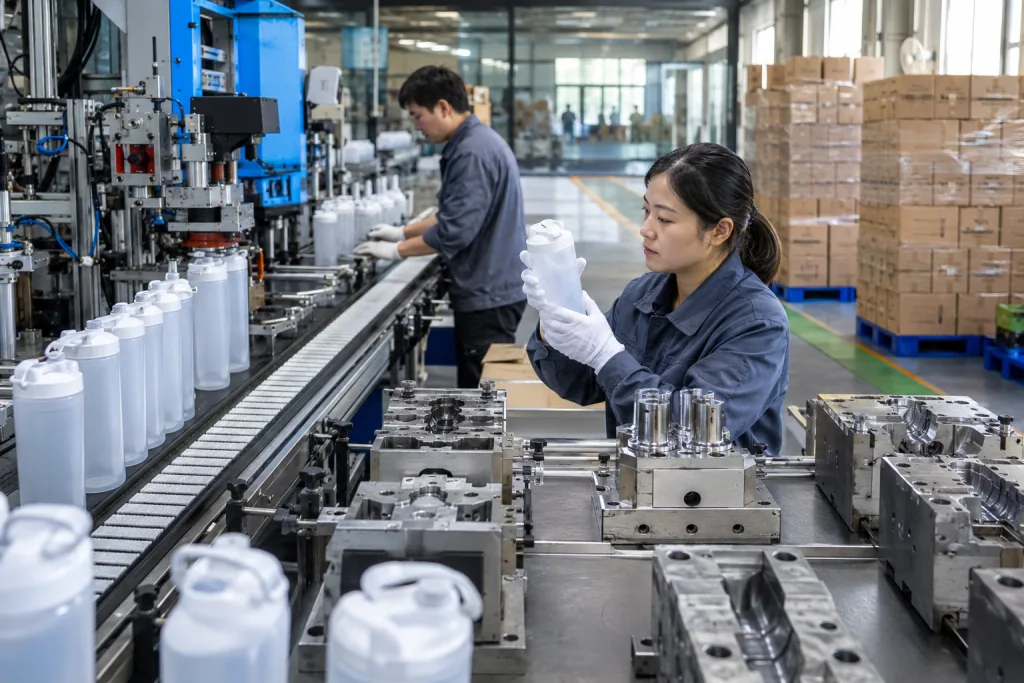
Key Takeaways
- A practical MOQ for custom PP bottles is usually 3,000-5,000 pcs per color, with 25-35 day production after sample approval
- Food-contact PP should be specified by grade, odor limit, and test standard, not only by material name
- Logo method depends on bottle shape: screen print suits flat panels, while in-mold label needs higher MOQ
- AQL inspection, drop testing, torque checks, and cap leak testing reduce avoidable distributor returns
Polypropylene water bottles look simple on a quotation sheet. They are not. Four choices usually decide landed cost, print pass rate, odor risk, and after-sale claims: resin spec, mold match, closure design, and packing method. We see this in about 6 PP bottle inquiries every month. If you are buying for a retail chain, school program, outdoor promo, or distributor drinkware line, “PP bottle, 750 ml, logo printed” leaves too much for the factory to guess. Last week QC pulled a 750 ml sample from the line; the cap gap measured 0.6 mm on a feeler gauge against our 0.3 mm max, and the buyer flagged leakage before we packed the first carton.
At our Zhejiang factory, we treat custom PP bottle projects like engineered packaging, not cheap giveaways. China can run low-price PP bottles fast, but chasing the lowest FOB is the wrong question to ask. The real check is whether your canteen supplier controls resin grade by batch, mold fit after 8 hours of running, cap sealing under drop test, color tolerance in the D65 light box, and export carton strength for 10,000 pieces. We have seen projects go sideways from one PO typo. “Matte black” became “milk black,” and the line printed 18 cartons before the operator caught it under the D65 light box.
Material line: PP is not one grade
A spec sheet that says “polypropylene” and stops there is not enough. For polypropylene water bottles custom runs, we ask for the exact PP grade, melt flow index, and supplier name before we open the mold schedule. Not just the polymer family. The material line should show food-contact certification, working temperature range, color masterbatch carrier resin, and any recycled content. On our line, QC checks the resin bag label against the PO before feeding the hopper; one buyer once wrote “PP random” on the PO, and purchasing had to stop the order for 2 days. For mouth-contact drinkware, most buyers choose virgin PP. Lower odor risk. Cleaner compliance file. More stable impact strength across 8-cavity and 16-cavity molds. If your brand story requires PCR content, flag it at RFQ stage because it changes the test plan, the color range, and sometimes the lead time by 12–18 days depending on PCR percentage and supplier batch availability.
A basic bottle body usually runs on a grade rated for roughly -10°C to 100°C. That does not make the bottle boil-safe. At the upper end, PP softens enough to distort thin-wall areas; QC pulled a 0.8 mm wall tumbler from our hot-fill test and the body ovalized at 92°C. Short answer: don't sell it as hot-fill. For sports bottles, school canteens, and promo giveaways, we position PP as lightweight cold-water drinkware, with wall thickness checked by ultrasonic gauge during first-article inspection. It is not an insulated bottle or a growler replacement. The math on heat loss and rigidity does not work, even when the buyer pushes for “same feel as stainless but cheaper.”
For Europe, request EU 10/2011 and LFGB-related food-contact documentation where applicable. For the US, FDA food-contact compliance is the baseline, though larger retailers often add REACH and CA Prop 65 to the spec package. Ask before the quote is final. If a canteen manufacturer cannot name the test package before pricing, including specific migration limits, organoleptic panel, and heavy metals, they are guessing. We have seen this go sideways: a factory quoted PP bottles at 30,000 pcs MOQ, then found out its resin supplier could not provide the FDA Drug Master File details when the buyer's compliance team asked in week 4.
Buyer impact: material choice drives odor profile, color-matching accuracy, compliance file size, and whether your product survives a summer warehouse in Texas or Spain without warping on the pallet.
Capacity, shape, and mold ownership
A 500 ml bottle isn't just a smaller 750. Wall thickness, rib placement, and label panel all shift. We ran 650 ml PP bottles where the sidewall sucked in slightly during cooling—QC flagged it at the first-article check. The mold needed an extra 0.3 mm at the waist. For distributor canteen orders, 600-750 ml covers the bulk of what buyers actually move: school lunch programs, gym retail, corporate events. 350-450 ml works for kids' sets and airline promos. At 1,000 ml, thin PP feels cheap. You need ribs or a 1.8 mm minimum wall, or the bottle flexes when squeezed. The math doesn't work otherwise.
Using an existing factory mold cuts lead time and tooling cost. In Zhejiang, our open-mold PP projects start around 3,000-5,000 pcs per color—actual minimum depends on whether you're doing a one-color pad print or a full-wrap heat transfer. A fully private mold runs USD 3,000-12,000. Flip cap? Add tooling. Carry handle? Add tooling. Locking straw lid? That's a separate mold insert. Tooling time is 20-35 days before T1 samples ship. We've seen buyers budget for tooling but forget the sample freight and revision loops. One buyer thought two rounds of sample tweaks was enough; we went five. Pad your timeline.
If you're building a retail canteen line, mold ownership belongs in the purchase agreement. Some vendors quote a "mold fee" but keep the tool under factory control. Fine for a one-off promo run. For a long-term program, it's a risk. I've seen a buyer lose access to their mold because the factory "reassigned" it during a slow season. Clarify three things in writing: exclusive, semi-exclusive by market, or open to other buyers. If you're paying full tooling, the mold is yours. Get the steel stamp number and a photo of the tool on the shelf. We do that as standard now.
- Open mold: MOQ as low as 3,000 pcs, 15-day lead, zero uniqueness.
- Modified mold: custom cap or grip panel; moderate cost, 25-30 days.
- Private mold: full brand control, highest upfront investment, 20-35 days tooling plus sample rounds.
Wall thickness and bottle strength
Wall thickness is where cheap PP bottles get exposed fast. That 0.8-1.0 mm average wall on a giveaway bottle flexes as soon as the buyer squeezes it. A retail or distributor bottle usually needs 1.1-1.5 mm, but the shape, rib depth, and handle root matter more than chasing thickness alone. Wrong question. We run a Mitutoyo thickness gauge around the shoulder, base, and handle root because bad mold flow can still leave thin corners, sink marks, and soft spots after the digital scale says the gram weight is fine. QC pulled one sample that met the target weight but showed 0.6 mm at the handle root. We stopped it before the line started.
Ask your canteen factory for target gram weight. For a 650 ml PP bottle body and cap, 70-95 g is normal for a lightweight promotional build, while 95-130 g gives a retail feel with less hand flex. Resin price moves week by week, so unit weight explains why one canteen supplier quotes USD 0.12 below another. The math works. On a 10,000 pcs PO, that gap is usually polypropylene cost, not some magic cycle setting on the injection machine.
Drop testing should match the sales channel. For promotional events, a 1.0 m drop onto plywood or concrete is usually enough. For retail, we run 1.2 m drops at different angles with the bottle filled to nominal capacity, then check the base, cap hinge, lanyard point, and thread area under a caliper and light box. We have seen a customizable canteen pass a standing drop but crack on shoulder impact. The buyer flagged it after 300 pcs in-store samples. Those returns eat margin fast.
Check compression during shipping. A 12 kg export carton stacked in a humid container from China to Europe, with 18 days at sea, will expose weak shoulders and oval caps. A buyer once flagged 4% oval caps from a single container; the issue traced back to a 0.3 mm wall variance at the shoulder, measured after QC cut three bottles from the same cavity. Carton strength and inner dividers are not decoration. We ship bottles, not round-looking problems for your warehouse team.
Cap, thread, and leak control
Cap failures drive more complaints than body leaks. The spec line must cover cap type, gasket material, thread turns, flip hinge design, and leak test method. A basic screw cap is cheaper and easier to clean. A flip cap with drinking spout sells better for sports and school use, but hinge fatigue shows up around the 8,000-cycle mark. A straw lid adds convenience and three more parts to inspect.
For a custom canteen program, we run leak tests with bottles filled, capped, inverted, shaken, then laid horizontally for a fixed period. Our standard: 30 minutes inverted at room temperature, plus random shake testing across 20 samples per lot. For higher-risk retail channels, add vacuum or pressure-assisted checks. The gasket is commonly silicone or TPE; it should be removable only if your cleaning instructions support that. One buyer flagged a TPE gasket that swelled after 100 dishwasher cycles—we swapped back to silicone.
Thread quality matters when you are sourcing from canteen manufacturers in high volume. If the cap requires more than 12 in-lbs of torque, children and older users complain. Below 8 in-lbs, the cap loosens in transit. During pre-shipment inspection, ask the QC team to record opening and closing torque on samples from multiple cartons, not only from the golden sample. We had a run where the golden sample read 10 in-lbs but production cartons averaged 14 in-lbs—the buyer rejected the lot.
If you sell through canteen distributors, replacement caps are worth discussing. A small spare-parts plan—0.5-1% extra caps packed separately—can save a distributor account after a promotion where caps are lost during kitting. 100 extra caps cost roughly $0.15 each versus losing a $5,000 repeat order.
Decoration line: logo is a process
Custom logo decoration on PP gives us less room for error than stainless steel. PP surface energy sits around 34 dynes/cm versus 38+ for steel, so ink adhesion can fail when the line skips surface prep. For polypropylene water bottles custom orders, ask whether the logo panel gets flame treatment, corona treatment, or another pre-treatment before printing. Ask early. Without that step, a clean sample can still scratch after 3 dishwasher cycles or a 2 kg warehouse rub test with kraft paper. We had a Melbourne buyer skip treatment to save USD 0.018 per piece, and QC pulled the sample on the third wash cycle.
Silkscreen printing is the workhorse for most canteen promotional orders. It behaves best on flat or gentle curve areas, usually with 1-3 spot colors and a screen mesh checked before the line starts. Heat transfer handles photo-style artwork, but adhesion must be tested; we run a 48-hour tape peel test after a hot-water soak before we ship. In-mold labeling looks retail-grade and holds up well, but MOQ moves higher because labels, mold setup, and scrap control need volume. The buyer flagged that cost once, and the math doesn't work below 5,000 units. Laser engraving is usually the wrong process for PP unless the resin has a special additive or surface layer designed for it.
For Pantone matching, expect tolerance. A custom canteen in PP will not match coated paper exactly because the base resin color, wall thickness, and surface texture change the visual result; a 1.2 mm wall and a 2.0 mm wall can read differently under the same D65 light box. We usually recommend approving a physical color chip or pre-production sample, not a PDF proof. For larger orders, write a Delta E target or approved range into the spec if your brand team is strict. One client tried PDF-only approval; the production run was 15% off from their expected hue, and we had to redo 2,100 units.
Logo size changes defect rates. A 35 mm one-color logo on a flat panel is stable. A 120 mm wrap print across a tapered bottle is a different job, and we have seen this go sideways when artwork crosses the mold parting line by 6 mm. Your canteen vendor should say when artwork is pushing the process too far. If they don't, that's the wrong question to ask—get a second opinion.
Compliance and inspection checkpoints
At the quote stage, compliance is the first file we open, not a box to tick after production. It decides the PP resin lot, the Pantone colorant we run on the injection line, the ink that can pass rub testing, and the carton label layout. Confirm the destination market before we touch a mold. Simple rule. A buyer once sent a PO with “EU food grade” on one line and “FDA only” in the artwork notes; the merchandiser caught it during our pre-production meeting, but it still cost us three days. Europe and North America need different paperwork. Last month, one retail chain sent a 12-page restricted substance list and asked us to sign it before they released the 30% deposit.
The document stack includes food-contact test reports for the PP body and cap, heavy metal tests on inks, a BPA-free declaration where the market calls for it, and REACH or LFGB support for EU programs. Children’s bottles add another layer: ASTM, CPSIA, or EN 71 depending on design, age grading, and shelf position. We sort this before tooling. The math doesn’t work if compliance starts after the steel is cut. A bright 350 ml bottle with a 14 mm detachable charm raises small-parts questions that a plain 750 ml sports bottle with a fixed flip cap does not. We’ve seen a buyer approve the cute accessory, then compliance flagged the small-parts risk after the mold was cut; the tool room had already opened the cavity insert on a CNC machine.
Inspection runs on AQL. Our standard setup: AQL 2.5 for major defects, 4.0 for minors, zero criticals accepted. Major defects include leakage at the cap thread, wrong logo, sharp flash within 5 mm of the drinking rim, cracked caps, and strong chemical odor. Minor defects cover small color specks, print misregistration within 1.5 mm, or surface marks outside the drinking zone. QC pulled a sample with a torque tester and a 0.2 mm feeler gauge. The inverted shake test at 40°C tells you everything. If the cap leaks, the unit price doesn’t matter. We have had buyers push back on rejecting “only 2 leaking pieces,” but for drinkware, leakage is not a cosmetic issue.
We run about 600,000 units a month across plastic and metal lines at our Hangzhou plant, but we don’t skip checkpoints for speed. Incoming PP gets checked by lot number against the supplier COA. First article sits locked on the QC table before mass printing starts, with the approved Pantone chip taped beside it. Mid-line QC grabs samples every two hours. Final AQL runs before export. China factories move fast. Good. But speed without a control plan is how orders go sideways when the line is already packing 18 cartons per hour.
Cost, MOQ, and lead time reality
PP bottles live in a cost-sensitive world, and buyers chase the lowest FOB price. That makes sense, but compare two quotations side by side — if MOQ, carton specs, testing scope, and decoration method aren't listed, you're comparing apples to truck tires. For an open-mold 650 ml PP customized drinkware bottle with one-color silkscreen logo, a realistic FOB China range is USD 0.65-1.35 per piece. The spread depends on weight, cap type, packing, and order quantity. Add a complex lid, two-color body, heat transfer label, or retail gift box and you climb fast.
MOQ for open colors is often lower if you accept standard factory colors. For exact Pantone body color, 3,000-5,000 pcs per color is a practical minimum. The math doesn't work below that — resin mixing, purge loss, and setup time must be absorbed. For in-mold labels or private mold projects, MOQ can move to 10,000 pcs or more. If a canteen manufacturer offers 500 pcs with exact custom color, ask whether they are painting, using available stock, or simply taking a loss on the first order. We've seen that go sideways when the second order quote jumps 40%.
Normal timing: 5-7 days for digital artwork and quote confirmation, 7-10 days for sampling on an existing mold, and 25-35 days for mass production after deposit and sample approval. Add 3-7 days for final inspection and export handling. Sea freight adds weeks depending on destination port and season. QC pulled a sample last month with a typo on the silk screen — that cost us 3 days. Small things kill timelines faster than big ones.
For canteen distributors and distributor growler buyers, landed cost matters more than FOB. A bulky lightweight bottle may have a low unit price but poor container efficiency. Always ask for carton size, gross weight, and units per 20GP or 40HQ before you promise margin to your sales team.
How to write the RFQ
A usable RFQ does two jobs: it gives you a clean price comparison, and it shows which suppliers are guessing. Don’t send a logo and ask for “best price.” We get that roughly 20 times a month. The price often breaks on revision 2, after the buyer adds a silicone gasket, a Pantone match, or Amazon packing. Send the full stack: bottle purpose with real use case, target market, annual volume forecast, first PO qty, capacity in ml, cap style, body color with Pantone if ready, decoration spec with print area dimensions, compliance docs required, packing method, inspection standard, and shipping term. If this is for Amazon, add barcode placement, FNSKU, suffocation warning wording, carton drop test spec, and master carton label format. One missing item is not a small gap. On our costing sheet, resin weight, print setup, carton CBM, and test cost sit in separate cells; leave one blank and the quote turns into a guess. The line needs facts.
Here’s what a quotable RFQ looks like: “750 ml virgin PP sports bottle, screw cap with silicone gasket, Pantone 286C body, one-color white silkscreen logo 45 × 30 mm, EU market, food-contact migration test required, AQL 2.5/4.0, individual polybag, 48 pcs per export carton, FOB Ningbo, first order 5,000 pcs.” That lands on our estimating desk and we can price it within 24 hours if the mold is standard. Clean and fast. A vague “custom bottle with logo” gets a placeholder number and a problem later. We’ve seen a PO go sideways over a cap thread pitch that nobody wrote down; QC pulled the sample, the cap leaked after 6 shakes, and the buyer flagged it three days before packing. By then the cartons were already printed.
When you compare vendors, ask each one to mark exceptions line by line. One factory might hit the color but quote 45 days when your launch needs 30. Another might meet the target price by cutting the wall thickness to 75 g, which changes the hand feel and the squeeze resistance. A third can include LFGB testing but will not go below 5,000 pcs MOQ because the print line needs that volume to cover setup. None of this kills the project. Hiding it does. We run a red-pen review on RFQs over 3,000 pcs, and the same issue comes up again and again: the buyer compares unit prices while the specs are not the same. That math does not work.
Be honest about the use case. A school fundraiser is not the same product as a marathon swag bag. A camping retailer SKU is not the same as a corporate wellness kit. Don’t push PP into the wrong job just because the unit price looks good; we’ve seen this go sideways when a buyer expected a gift-box feel from a lightweight sports bottle. If you need insulation, hot liquid use, or a premium retail hand feel, choose a double-wall stainless growler or thermos. PP works best for lightweight, colorful, dishwasher-safe drinkware at a low unit cost, backed by traceable food-contact documentation. That is its lane. We ship these in export cartons all week, often 48 pcs per carton with a 5-layer K=K box, and the projects that run smoothly start with one plain question: where will the bottle actually be used?
Send us your PP bottle spec sheet
We will review material, MOQ, logo method, testing, packing, and FOB cost before you commit to tooling or mass production.
Frequently asked questions
What MOQ should I expect for polypropylene water bottles custom?
For an existing mold with standard factory colors, some China suppliers can start around 1,000-2,000 pcs, but that usually limits decoration and color choice. For exact Pantone body color, 3,000-5,000 pcs per color is more realistic because the factory must mix resin, purge the injection machine, and control color consistency. If you need in-mold labeling, complex cap parts, or a private mold, MOQ often rises to 10,000 pcs or more. A canteen distributor should also consider carton quantity and freight efficiency, not only production MOQ.
Are PP bottles safe for hot water?
Food-contact PP can tolerate higher temperatures than many low-cost plastics, but that does not mean every PP bottle should be sold for boiling water. Many custom canteen designs are intended for cold or warm drinks only, often with recommended use below 80°C depending on wall thickness, cap design, and gasket material. If you want hot-water claims, specify the temperature, fill time, deformation limit, and test method before sampling. For true heat retention or premium hot beverage use, stainless vacuum drinkware is usually a better product choice.
Which logo method works best on PP water bottles?
For most canteen promotional programs, one-color or two-color silkscreen printing is the most cost-effective method, especially on a flat logo panel. PP needs surface treatment, such as flame or corona treatment, to improve ink adhesion. Heat transfer supports more colors but must be tested for scratch resistance and adhesion. In-mold labeling gives a more retail-grade look but usually needs higher MOQ and more setup time. Before mass production, approve a physical printed sample and run tape, rub, and wash tests instead of relying only on a digital proof.
What quality defects should I watch for before shipment?
The main defects are leakage, cap cracking, sharp flash around the mouth or thread, strong plastic odor, poor logo adhesion, color mismatch, and deformation after carton stacking. Use AQL inspection, commonly 2.5 for major defects and 4.0 for minor defects, with zero tolerance for critical food-contact or safety issues. Ask the inspector to fill bottles, invert them, check random cap torque, review carton labels, and compare production against the approved sample. For distributor drinkware orders, also confirm spare caps, barcode labels, and carton strength before final payment.
How long does a custom PP bottle order take from China?
For an open mold, allow 7-10 days for sampling after artwork and color details are confirmed, then 25-35 days for mass production after deposit and sample approval. Exact Pantone resin color, multi-color printing, custom packaging, or third-party testing can add 5-15 days. Private mold projects usually add 20-35 days for tooling before production sampling. Export from Zhejiang or nearby Ningbo/Shanghai ports is efficient, but ocean freight to Europe or North America still needs several weeks, especially during peak season.