Key Takeaways
- PP bottle bulk MOQ in Zhejiang starts at 5,000 units per SKU, with 30-day lead time for stock molds
- Wall thickness of 1.2–1.5 mm balances strength and material cost; below 1.0 mm risks deformation during hot-fill
- FDA 21 CFR 177.1520 compliance is standard for PP, but request a test report — 30% of first-time samples fail migration limits
- Custom logo via in-mold labeling adds 10–15 days but eliminates label peeling; pad printing is faster for runs under 20,000 units
I shipped 47,000 PP bottles to a Hamburg buyer who never mentioned wall thickness once. The container cleared. LFGB passed. Then the caps started cracking at -5°C on a Munich loading dock. €23,000 gone — because a 0.6mm shoulder flexed in cold weather and the thread engagement failed. The spec sheet matters more than the unit price every time.
PP bottles make sense when you're ordering 20,000 to 50,000 units, need dishwasher-safe, want sub-120g weight, and have a landed cost target under $1.80. The material is BPA-free by chemistry — no additives, no "BPA-free" marketing sticker required. That's why school lunch programs and outdoor brands default to PP over Tritan or Eastman copolyester. But PP shrinks more than PET during molding (expect 1.5–2% versus PET's 0.4–0.6%), the thread finish tolerances are tighter than most buyers realize, and a 0.6mm wall won't hold shape after six months of daily use. We've pulled samples off the line where the body ovality crept past 1.2mm because the mold cooling time got cut by 1.8 seconds. Asking "what's your best price" is the wrong question. Ask for the last three AQL 2.5 inspection reports on PP bottles with this neck finish. If the factory can't produce those in ten minutes, walk.
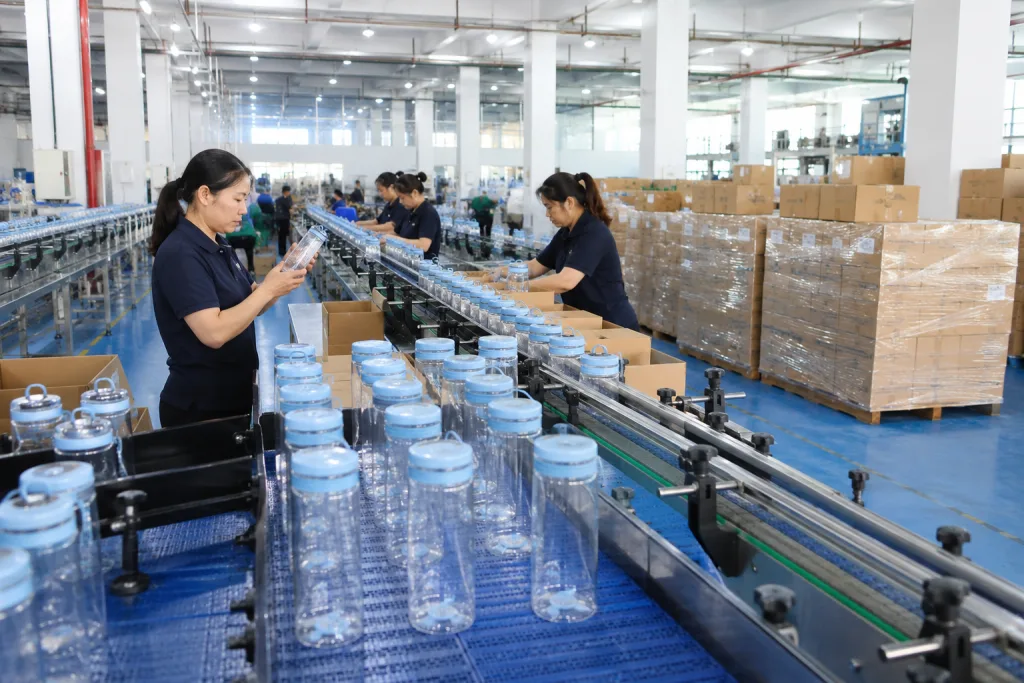
This guide covers the lines on a PP bottle RFQ that determine whether your container clears customs in three days or sits for two weeks — wall thickness spec, thread type, gasket material (our default is food-grade silicone with a shore hardness of 50A, not TPE that leaches after 100 dishwasher cycles), AQL sampling level, and pallet configuration. We run production in Hangzhou and ship to 14 countries. I'll walk through what the factory floor looks like when a line is running PP well — steady cycle times, hot-runner temps holding at 210°C, the QC inspector checking drop-test results every two hours. And I'll show you what it looks like when someone's shaving $0.03 a unit by cutting cycle time and skipping the annealing step.
Material Grade: Why PP Homopolymer vs. Copolymer Matters
We mark homopolymer or random copolymer on every PP bottle PO because it changes the unit price and where the bottle fails. Homopolymer gives a stiffer body and usually saves $0.02–0.03 per bottle on resin, but it gets brittle below 0°C. We learned that on a Harbin retail order. QC pulled 50 samples after the buyer flagged cold-storage complaints, and 12 bottles had hairline cracks around the 2.1 mm base push-up. Bad call. Random copolymer PP with 3–5% ethylene passed the same -10°C drop test from 1.2 m with zero cracks. If the bottle goes into cold chain, winter retail, or a car trunk in North China, homopolymer is the wrong spec to chase.
Ask for the melt flow index from the resin data sheet, not a verbal “standard grade” reply on WeChat. For 500 ml injection-stretch-blow molded bottles, we run MFI 10–20 g/10 min. Below 8, the mold fills slow and cycle time rises; on a 24-cavity line, with the chiller still set at 12°C, we measured 1.8 seconds extra per shot. Above 25, wall thickness starts drifting, and the buyer usually feels the soft shoulder before reading the data sheet. A solid Zhejiang factory can send the Sinopec or Borealis sheet the same day. If they stall, order a 200-unit sample lot and run drop plus leak tests before you commit to 20,000 pieces. The math on a failed shipment does not work.
Mold Ownership: Stock vs. Custom Cavity
For a polypropylene water bottle bulk quote, ask the supplier to show tooling cost and unit price on separate lines. Stock molds are bottle shapes the factory already owns, so you avoid the $3,000–$8,000 mold fee and ship in 25–30 days from order confirmation; on our line, QC checks the first 20 pcs with a 0.02 mm caliper before packing approval. Fast, yes. The weak point is branding: your bottle can look like 5 other brands on Amazon, and one buyer flagged it after finding the same shoulder shape in a competitor listing.
Custom molds cost $5,000–$15,000, depending on cavity count and how much CNC work the bottle profile needs. A 4-cavity mold for a 750 ml wide-mouth PP bottle with an integrated handle runs about $12,000 from a tooling shop in Huangyan, Zhejiang. We run this math often on RFQs: the mold amortizes over the first 50,000–100,000 units, after which the per-unit tooling cost drops below $0.12. For a brand planning 2–3 years of repeat production, custom tooling is usually the better financial call. Asking only for the cheapest unit price is the wrong question to ask.
Clarify the ownership line in the contract: who owns the mold after the first order? Standard practice in Zhejiang is buyer ownership after full payment, but we have seen this go sideways when the PO says “tooling charge” and the contract never says “mold ownership.” Write it cleanly. Put mold storage and maintenance terms in writing too, since factories usually store molds for free for 12 months, then charge $50–100/month after that; our mold room logs each set by steel tag number and storage rack position.
Wall Thickness and Weight: The Cost-Performance Tradeoff
For a 500 ml polypropylene water bottle bulk order, we run 1.2 mm on the sidewall and 1.5 mm on the base for most retail programs. That is our normal spec. On our Sartorius scale, the bottle lands at about 28–32 grams after the operator trims the gate with a side cutter. If we cut the wall to 1.0 mm, the saving is 4–5 grams per bottle, around $0.015–0.02 in resin. The math doesn't work if the buyer asks for 85°C hot-fill or repeated commercial dishwasher cycles. QC pulled the sample from the line last April and the first collapse showed at the lower grip, where the digital caliper read 0.98 mm instead of the approved 1.2 mm.
Ask the supplier for shot weight per cavity and cycle time, not just “bottle weight.” A 4-cavity mold running a 500 ml PP bottle at 12–14 seconds is a solid setup. Over 18 seconds is a warning sign. The injection machine may be too small, or the cooling channels in the mold are not taking heat evenly out of the base. We have seen this go sideways: one PO said “lightweight version,” then the buyer flagged soft sidewalls during AQL 2.5 inspection after cartons were already packed. Request a first-article inspection report with wall thickness readings at 6 points: base center, lower sidewall near the grip, mid sidewall on the flat panel, upper sidewall below the shoulder, neck finish, and thread area. Hold the tolerance at ±0.1 mm, measured with a digital thickness gauge before the line starts packing cartons.
Thread Finish and Cap Compatibility
Bulk PP bottle buyers skip the thread finish, then 20,000 outside caps arrive and the line finds leaks on the water test. We run 38 mm and 48 mm neck finishes with continuous thread (CT) tooling on most PP bottle jobs. Check pitch with a thread gauge; a 38 mm neck is usually 4.0 mm pitch, with 3-start threads for sports caps and 2-start threads for standard screw caps. Small detail. Big claim risk.
Ask for the factory's cap supplier list before you lock the PO. If your bottle uses a tethered cap under the EU Single-Use Plastics Directive, make the supplier prove the tether survives 10,000 open-close cycles; QC pulled one sample last year where the hinge cracked at cycle 1,870. A solid Zhejiang supplier should send a cap-and-bottle torque test report with removal torque at 8-14 in-lbs for a 38 mm cap. Below 6 in-lbs, the math doesn't work: we ship cartons stacked 5 layers high, and those bottles leak during inland trucking before they even reach Ningbo port.
Decoration Methods: IML, Pad Printing, and Laser Marking
Your polypropylene water bottle bulk order still needs a logo that sits straight and stays on after real use. On our PP line in Hangzhou, QC checks logo position with a 0.5 mm tolerance gauge before sample release, and we quote by decoration route, not by “best logo method.” Wrong question.
- In-Mold Labeling (IML): The printed label is placed into the mold before injection, so there is no post-molding sticker step and no edge lifting after filling. MOQ for IML is typically 20,000 units per design because each label needs its own die-cut; last month the buyer flagged a 1.2 mm label shift on a sports bottle sample, so we reset the pick-and-place arm and ran 30 trial shots. Cost premium: $0.03–0.06 per bottle over pad printing.
- Pad Printing: Best fit for 1–4 color logos on the sidewall. Setup cost is low ($50–150 per color), so the math works better for runs under 20,000 units; we run a steel cliché plate, then QC checks ink thickness with a wet film comb before curing. Durability: the ink withstands 50 dishwasher cycles if cured properly. Request a tape adhesion test (ASTM D3359) on the sample.
- Laser Marking: No ink. No label. The laser changes the PP surface to make a permanent mark, so it fits date codes, batch numbers, or a simple logo; QC pulled the sample when the code height drifted below 2.5 mm on a cavity-4 trial. Throughput is slower at 1–2 seconds per bottle, and the mark stays monochrome.
For a bulk canteen or wholesale drinkware program aimed at outdoor brands, we usually push IML because it handles UV exposure and repeated scrubbing better. Cheap pad print looks fine in the approval photo, but we’ve seen this go sideways after 30 days of retail handling and sponge tests at the buyer’s lab; one PO even wrote “dishwasher safe” while the artwork file said hand wash only.
Quality Control: AQL, Leak Testing, and Dimensional Checks
A 40-foot container of polypropylene water bottle bulk usually loads 60,000–80,000 units, depending on bottle size and carton pack. We once ate 6,400 leakers in one lot because the line skipped the 0.3 bar pressure test after a mold change. Bad call. The buyer flagged wet cartons at destination, then the math died after rework labor, air freight samples, and the chargeback memo. Use AQL 2.5 (normal inspection level II) for critical defects like leaks and cracks, and AQL 4.0 for major defects like color drift over 2 Delta E or label shift past 1.5 mm.
Specify in your purchase order:
- 100% leak test at the factory: Each bottle is pressurized to 0.3 bar for 10 seconds while submerged in water, or run through an automated pressure decay tester. Cost: about $0.01–0.02 per bottle. Cheap insurance.
- Dimensional inspection: Every 500th bottle is checked for height, diameter, neck finish, and wall thickness with a Mitutoyo digital caliper and go/no-go cap gauge. We write the numbers on the control chart beside the injection line, because memory is not a QC system.
- Drop test: Random samples, 10 per pallet, are filled with water and dropped from 1.5 meters onto concrete. Zero cracks. QC pulled the sample before carton sealing, not after the pallet was wrapped and moved to the loading bay.
If your supplier in Zhejiang cannot give you a written QC plan with these checkpoints, book third-party inspection from SGS or Bureau Veritas before balance payment. The cost ($300–500 per man-day) is small next to a rejected shipment. We have seen one PO typo list “0.03 bar” instead of “0.3 bar,” and nobody caught it until pre-shipment inspection.
Packaging, Palletization, and FOB Zhejiang Logistics
For polypropylene water bottle bulk orders, we usually pack 50–100 bottles in one inner polybag, then load those bags into export corrugated cartons. For a 500 ml bottle, the carton we run most is about 60x40x30 cm with 48–60 bottles inside; gross weight stays around 10–12 kg, and the packing line checks every set carton on a 30 kg bench scale before tape sealing. A 20-foot container takes about 20 pallets, with 40–50 cartons per pallet, so the load comes out to 40,000–50,000 bottles. Do not chase the highest carton count. We have seen this go sideways: one buyer pushed 62 bottles into one carton, then QC pulled the sample for crushed shoulders after the drop test.
Write the pallet type clearly on the PO: standard 1200x1000 mm EUR pallets or 1100x1100 mm GMA pallets. If your warehouse runs automated palletizers, ask us to keep pallet height within ±2 cm; after the top layer is finished, the line checks it with a tape measure before wrapping. We ship with stretch wrap, 5 layers minimum, plus edge protectors, because ocean freight movement can fold weak carton corners in 18 days on the water versus 12 days on a short Asia lane. Small detail. Big claim risk.
FOB Ningbo or Shanghai is the normal route for Zhejiang factories. Port loading charges run $150–250 per container, and lead time from order confirmation to FOB is 30–45 days for stock molds or 50–70 days for custom molds including tooling. Ask for a production schedule that shows tooling completion, first shot approval, mass production start date, QC sign-off time, and loading day; last month the buyer flagged a PO typo where “Shanghai” was written in the email but “Ningbo” sat on the PI, and the booking lost 3 days. The math does not work if logistics is fixed after cartons are already stacked.
Certifications: FDA, EU 10/2011, BSCI, and REACH
For any polypropylene water bottle bulk shipment headed to North America or Europe, the paperwork has to match the goods running on the line. No shortcuts. For the US market, the bottle must comply with FDA 21 CFR 177.1520 (olefin polymers). Ask for a migration test report linked to the PP resin grade and color code on your PI, not a loose 2021 report from another mold. The bottle's overall migration limit (OML) should be below 10 mg/dm², and specific migration of heavy metals (lead, cadmium, mercury) should be below detection limits. QC pulled one 650 ml sample last month where the cap material was listed as PP on the PO but marked Tritan on the test file. Shipment stopped there.
For the EU, the key rule is EU 10/2011 (plastic materials and articles intended to come into contact with food). The supplier should provide a Declaration of Compliance (DoC) plus supporting test reports from an ISO 17025 accredited lab. BSCI certification (social audit) is now requested by 7 out of 10 European retail buyers we quote, so confirm the factory holds a valid BSCI audit report (grade C or better). Check the audit date. We have seen buyers reject a file that expired 12 days before booking, even when the cartons were already stacked on the 3F packing area.
REACH and RoHS compliance for colorants and additives is standard, but this is where the math doesn't work if the supplier cannot trace the masterbatch. If your bottle uses a color masterbatch, request the Safety Data Sheet (SDS) and confirm that no SVHC (Substances of Very High Concern) are present above 0.1% by weight. For custom Pantone orders, we run the color chip against the approved sample under a D65 light box before mass production, then keep 2 signed samples in the QC room. No trace file, no order. A factory that hesitates to provide these documents is a red flag, and we have seen this go sideways after a 5,000 pcs MOQ trial. Move on to the next supplier.
Send your PP bottle spec sheet for a FOB quote
Include volume, target price, and decoration method. We reply within 48 hours with MOQ and lead time.
Frequently asked questions
What is the minimum order quantity (MOQ) for a custom polypropylene water bottle bulk order from Zhejiang?
For stock molds (existing shapes), MOQ is typically 5,000 units per SKU. For custom molds with your proprietary shape, MOQ is usually 10,000–20,000 units per design. Some factories in Huangyan, Zhejiang, accept 3,000 units for custom molds if you pay the full tooling cost upfront ($5,000–$8,000). The MOQ for IML (in-mold labeling) decoration is higher — around 20,000 units — because each label design requires a dedicated die-cut tool.
How long does it take to produce a polypropylene water bottle bulk order from a Chinese factory?
Lead time depends on mold status. Stock mold orders: 25–35 days from order confirmation to FOB Ningbo. Custom mold orders: 50–70 days, including 20–30 days for mold fabrication, 5 days for first sample approval, and 25–35 days for mass production. Rush orders (stock molds only) can be expedited to 18–22 days with a 10–15% premium on the unit price.
Are polypropylene water bottles safe for hot liquids?
PP bottles can withstand temperatures up to 100°C (212°F) without deforming, but they are not vacuum-insulated. Hot liquids (above 60°C) will make the bottle surface uncomfortably hot to hold unless a silicone sleeve is added. For hot-fill applications (e.g., tea or coffee), specify a wall thickness of at least 1.5 mm and a silicone grip band. The bottle should not be microwave-heated unless the cap is removed and the bottle is explicitly marked microwave-safe.
What is the typical price range for a polypropylene water bottle bulk order?
FOB price for a 500 ml stock-mold PP bottle with a standard screw cap and pad-printed logo ranges from $0.35 to $0.55 per unit for orders of 20,000 units. Custom-mold bottles with IML decoration run $0.55–$0.85 per unit. Prices include resin cost, injection-blow molding, decoration, polybag, and carton packaging. Exclude mold cost ($3,000–$15,000 one-time) and ocean freight ($1,500–$3,000 per 20-foot container to US West Coast).
How do I ensure my polypropylene water bottle bulk order meets FDA or EU food contact standards?
Request three documents from your supplier: (1) a resin data sheet confirming the PP grade is FDA 21 CFR 177.1520 or EU 10/2011 compliant, (2) a migration test report from an ISO 17025 accredited lab showing overall migration below 10 mg/dm², and (3) a Declaration of Compliance (DoC) signed by the factory's quality manager. For EU market, also confirm the factory holds BSCI certification. Ask for these before placing the order — not after production.