Key Takeaways
- For polypropylene vacuum flask bulk orders, define 304/316 stainless grade and PP lid resin before asking for FOB price
- A practical MOQ is 1,000 pieces per color for stock mold custom logo work
- Sample approval should cover leak test, 6-hour temperature test, logo adhesion, and carton drop test
- Bulk PO lines should specify AQL 2.5/4.0, Incoterm, barcode/FNSKU, spare parts, and approved golden sample
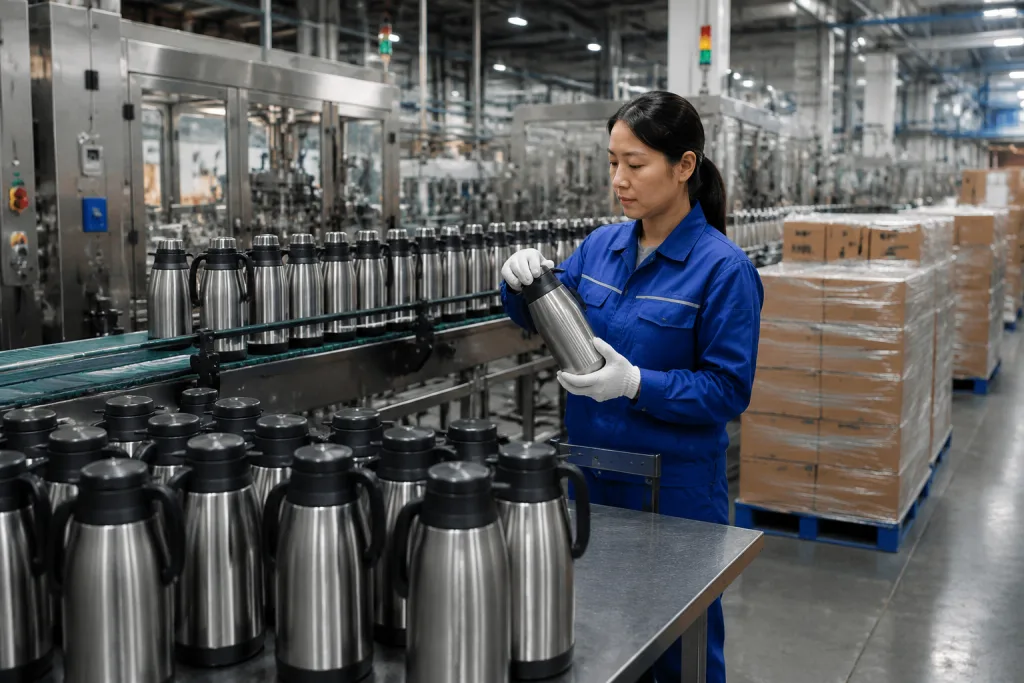
Buyers searching for polypropylene vacuum flask bulk are usually asking for a stainless vacuum bottle with PP parts: lid, handle, straw, bumper, cup, or inner stopper. The steel body does the insulation and takes the drop impact. The PP parts decide FDA or LFGB food-contact results, Pantone shift after injection molding, lid thread wear, and hand feel after 3,000 open-close cycles on our torque tester. Small part. Big risk.
For an outdoor retail program or a promotional thermos order, price is the wrong first question. We’ve seen this go sideways when the drawing only said “plastic lid” and QC pulled the bulk sample with the stopper lip 0.6 mm short. Then the math doesn’t work. A weak lid, late cartons, or a golden sample that production cannot repeat will burn more than USD 0.03 saved on resin. From our factory base in Zhejiang, China, we run custom thermos projects with a normal MOQ of 1,000 pieces per color and 25,000 to 40,000 units/month capacity, depending on the model mix on the line.
Start with the real product definition
The phrase polypropylene vacuum flask bulk creates problems because PP is not the vacuum body. The body should be 18/8 stainless steel, usually stamped SUS304, with a double-wall vacuum structure. PP grade 5 belongs in the lid, push button, inner stopper, straw connector, handle, or outer cup. Small part. Big confusion. Last month QC pulled a 750 ml sample from the line and the buyer had written “PP flask” on the PO, so the trading company quoted a plastic sports bottle, not a stainless thermos.
Lock the bill of materials before logo or price. For an outdoor retailer, we run 500 ml trail bottles and 750 ml daily-use flasks with SUS304 inner and outer wall, copper-coated vacuum layer, PP lid, silicone sealing ring, powder-coated finish, and leak-proof carry handle. For a promotional thermos, SUS304 inner with SUS201 outer can cut cost, but write it on the RFQ. Do not let a supplier thermos quotation hide material substitutions. We have seen this go sideways: the buyer approved a 0.38 mm body sample, then bulk goods arrived at 0.32 mm on the digital thickness gauge and failed the drop test.
A clean RFQ should include these baseline fields before our costing team opens the mold file or checks stock parts with the caliper:
- Capacity: 500 ml, 750 ml, 1,000 ml, or 1,200 ml, with tolerance of ±5% measured after filling to the neck line.
- Body: SUS304 inner, SUS304 or SUS201 outer, wall thickness around 0.35 mm to 0.50 mm depending on model and mold set.
- Plastic parts: food-grade PP, BPA-free, matched to Pantone or standard black/white after checking the lid under a D65 light box.
- Sealing: food-grade silicone ring, removable for cleaning, with no flash on the gasket edge after molding.
- Performance: hot water retention at 95°C start, 6 hours above 60°C for a normal 500 ml flask, tested with a probe thermometer.
- Packaging: white box, kraft box, retail color box, or mailer box, with carton drop-test requirement stated before artwork starts.
For your PO line draft at this stage, write: “Item: double-wall stainless vacuum flask with PP lid; capacity; stainless grade; PP food-contact lid; finish; packing; target FOB Ningbo/Shanghai; target order quantity.” Zhejiang is close to Ningbo and Shanghai ports, so FOB routing works for China export orders. “What is your best price?” is the wrong question to ask. Ask what material, wall thickness, MOQ, and packing the price is based on; our merchandiser has caught PO typos like “SUS304 outer” missing from one line, and that single omission changes the quote by about USD 0.18 to USD 0.35 per unit on common 500 ml stock molds.
Send an RFQ suppliers can price
A thermos factory quotes faster when the RFQ leaves no blanks. “Send price for thermos bulk” gets you a low first number, then the price changes after the drawing shows up. We see this 6 or 7 times a week. A workable RFQ reads like this: “750 ml stainless vacuum flask, SUS304 inner/outer, PP flip lid, silicone seal, powder coating, one-color logo, retail box, 3,000 pieces, FOB Ningbo, delivery before 15 September.” Then our costing sheet can price steel weight, PP lid injection, coating loss, logo printing, packing labor, inland trucking, and export documents line by line. No guessing. Last month QC pulled a 750 ml sample at 312 g body weight; the PO missed the material note, and that one blank changed the quote by USD 0.42 per piece.
For outdoor retail, state the actual use. Don’t write “outdoor bottle”; this is the wrong question to ask if the buyer needs shelf performance, not just a clean photo. Hiking and camping orders need a tougher lid, often with a thicker hinge pin and a tighter silicone seal. School use needs one-hand opening, plus a lid kids won’t cross-thread after lunch break. Car cup holder fit controls the lower body diameter, often 70 mm or less. Cold-weather use needs stronger heat retention, so a screw lid with PP cup is the safer choice. Straw lids sell well for cold drinks, but we run extra leak testing because the silicone straw port fails first. A wide-mouth flask cleans faster. Heat also drops faster after 8 or 10 openings. For promotional brands, tell the factory if the flask is for giveaway, e-commerce, event resale, or employee gift; each one changes carton strength and finish tolerance. The buyer flagged weak master cartons on a 2,000-piece promo order because the RFQ never mentioned Amazon-style drop handling.
Ask for layered pricing, not one flat number. A serious suppliers thermos reply should show price breaks such as 1,000, 3,000, 5,000, and 10,000 pieces, with packing and logo assumptions written beside each line. At Zhejiang factory level, a standard 500 ml stainless custom thermos with PP lid may sit around USD 3.20 to USD 5.80 FOB depending on steel grade, lid complexity, coating, and packaging. A 1,000 ml outdoor model can move to USD 5.50 to USD 9.50 FOB. Working ranges, not promises. The math doesn’t work if the buyer asks for 1,000 pieces, four colors, laser logo, color box, and the 10,000-piece price. On the line, changing from plain carton to retail box can push lead time from 12 days to 18 days when the box artwork has a barcode typo.
Your RFQ-stage PO line items should cover the model number or drawing reference; capacity in ml; material such as SUS304; lid type; logo method; body color; packing style; quantity; Incoterm; requested lead time; sample requirement; compliance request; payment terms. Add “quotation valid for 15 days” if steel prices are moving. We also like to see the logo file format, Pantone code, and carton mark wording before sample work starts. Small detail, big headache. One buyer wrote “black” on the PO, then attached a dark navy artwork file; QC caught it under the D65 light box before mass coating, but it still cost 2 sample days.
Check PP lid and stainless details
The lid is where 6 out of 10 bulk thermos claims start in our factory records. PP is tough, light, and accepted for food-contact use, but the mold must match the selling claim. Small part, big risk. A thin PP flip tab can crack in a winter outdoor program; QC pulled 32 cracked tabs after a -10°C drop test on the third tray. A push-button lid leaks when the spring sits 0.6 mm off-center or the silicone valve is pressed in by hand without a jig. A handle lid looks strong in photos, then fails because the hinge pin is only 1.5 mm instead of 2.0 mm. If you buy polypropylene vacuum flask bulk and approve only the stainless shell, this is the wrong question to ask. Approve the full drinking system.
Ask the thermos manufacturer for material declarations before the sample is signed. For Europe, you may need LFGB, EU food contact test, REACH-related declarations for coating and components, plus a BPA-free statement for plastic parts. For North America, FDA food-contact compliance is common, and 4 out of 5 promotional buyers we ship to ask for California Proposition 65 screening. If the flask is for children, ASTM or CPSIA checks can apply depending on age positioning and accessories. We had one PO where “adult sports bottle” became “kids school bottle” in the buyer’s Amazon copy; that wording change meant a different compliance check and 5 extra working days. Labels matter.
On the stainless side, check weight and wall thickness, not just capacity. Two factories can quote the same 750 ml capacity while one uses 0.35 mm body wall and another uses 0.45 mm. The heavier one costs USD 0.30 to USD 0.70 more in most runs, but it dents less and feels better on a retail shelf. We run a micrometer check on cut body samples, and a 0.08 mm gap from the quoted spec is enough for the buyer to flag it during pre-shipment inspection. Copper plating inside the vacuum layer can improve heat retention, but it adds cost. For a promotional thermos, a lighter body can make sense. For an outdoor retailer selling at a higher shelf price, the stronger body is the better buy.
At this step, your PO notes should list the PP lid grade and color, silicone ring hardness, stainless grade for inner and outer walls, body wall target, coating type, food-contact documents, and whether a removable spare seal is included. Put it in the PO, not only in WeChat. We’ve seen this go sideways when a buyer asked for black PP on the sample, then the PO said “dark grey” and the line packed 3,000 lids before anyone noticed. The math doesn’t work when rework takes 2 days and the vessel closing date is already fixed. If you want a thermos customizable platform across 6 SKUs, keep the lid system common so spare parts and testing stay manageable.
Choose decoration before sampling
Decoration is not a final touch. It changes the sample quote, line schedule, reject rate, and carton packing method. For an outdoor retail order, we usually engrave a logo under 50 mm wide on a matte powder body because the buyer wants a clean mark that will not rub off inside a backpack. Promo orders need a different call. We run silkscreen for a one-color campaign logo, and heat transfer when the artwork has full-color blocks or a gradient background. Pad printing still works on a small curved badge area, but the jig must lock the body without wobble. Curved stainless is where we have seen this go sideways; last month QC pulled a sample with the logo drifting 3 mm near the shoulder.
Laser engraving is durable and clean on powder-coated bodies. Safe choice. We run it often for 1,000 to 5,000 pieces when the buyer wants low setup risk and fewer approval loops. The limit is color: laser shows the base layer or stainless tone, not a Pantone ink. Silkscreen costs less for a simple one-color logo and works well on straight bottle walls, usually the 70 mm to 120 mm flat visual area. On tapered bodies, registration can drift after 300 pieces if the aluminum jig has play over 0.5 mm. Heat transfer and water transfer cover larger graphics, but QC needs to check edge lifting after tape test and rubbing marks after 20 dry wipes. For a customized thermos sold online, poor logo alignment gets noticed fast in reviews; the math does not work if a cheap print creates 2% returns.
Define logo size in millimeters, not by eye. Use wording like: "front logo 45 mm wide, centered 80 mm below shoulder," or "wrap print 210 mm x 90 mm, seam tolerance within 2 mm." Send vector artwork in AI with outlined fonts, plus a PDF for buyer approval. EPS is fine when your designer exports from older software. Confirm Pantone coated color if ink is used. We once received a PO with "Panton 186C" typed wrong, and the buyer flagged the red after the first drawdown on coated paper. If you are buying distributor thermos inventory for 12 small clients, use one neutral stock color and add laser engraving later. That keeps thermos bulk risk lower than ordering six powder colors at once, especially when MOQ is 1,000 pieces per color.
Decoration-stage PO line items should include: logo file name with version date; print position drawing with mm reference points; Pantone number and logo method; maximum acceptable position deviation; artwork approval photo requirement; whether mass production can start after digital mockup or only after physical pre-production sample. We prefer physical approval for first orders from China. This is the wrong place to save 3 days. One pre-production sample on the desk catches the crooked logo before the line packs 80 cartons.
Approve samples like a technician
A sample is not a souvenir. It is the control sheet for bulk production. For a new polypropylene vacuum flask bulk order, approve two rounds: a stock blank for thread fit, lid gap, PP smell, and 304 stainless body finish; then a decorated thermos sample for logo size, Pantone match, packing method, and grip feel against the hand. If the schedule is squeezed, we run one combined sample, but this is the wrong place to save 5 days. Last month QC pulled a 500 ml flask from the line with a 0.4 mm lid gap that looked clean in photos. We've seen this go sideways.
Normal sample cost for a stock stainless thermos runs USD 20 to USD 50 per piece plus courier. A logo sample can be USD 50 to USD 150, depending on screen setup, laser fixture, or heat-transfer film; a curved 500 ml body usually needs a separate jig, not a borrowed one from the 750 ml line. Lead time is 5 to 7 days for a stock sample and 7 to 12 days for a decorated sample after artwork approval. From Zhejiang, China, courier delivery to Europe or North America usually takes 4 to 7 working days, assuming no customs hold. DHL looks faster on paper, but we had one sample sit 3 extra days because the commercial invoice said “cup” while the PO said “vacuum flask.” Small typo. Big delay.
Test the sample in a simple, repeatable way. Fill it with 95°C water, close the lid, record room temperature, then check water temperature after 6 hours with a probe thermometer. Turn the flask upside down for 30 minutes on tissue paper for the leak check. Shake it ten times while closed. Open and close the lid 50 times. Rub the logo with a dry cloth, then a damp cloth. Check odor in the PP lid after washing with warm water. We also run a carton drop simulation when retail packaging carries the sale; the math does not work if a USD 0.18 color box fails after one 76 cm corner drop.
Your sample approval PO lines should state: “Golden sample approved on date; sample photos attached; any changes before bulk listed separately.” Do not write “same as sample” without exact photos and measurements attached. Be specific. We like to see mouth diameter, total height, logo position in mm, Pantone code, carton size, and gross weight written on the approval sheet; our QC table has a Mitutoyo caliper and a 30 kg scale ready for this. A good thermos supplier will accept these limits because they prevent later arguments. A weak thermos vendor may dodge written tolerances, and that is a warning sign before deposit payment.
Convert approval into bulk PO
After sample approval, the purchase order becomes the working contract. This is where 6 out of 10 buyers leave gaps. A line that says “5,000 pcs promotional thermos as quoted” will not hold up when the line is setting torque on the PP lid at 8-10 kgf.cm with a digital torque meter. Spell it out. Your PO should be boring and detailed, with no room for a merchandiser to guess. Production needs the BOM with the PP lid code and silicone ring size. QC needs defect limits. Finance needs the deposit split. Logistics needs carton size and gross weight before booking space. If a dispute happens, the PO beats a chat screenshot.
A practical bulk PO for a thermos factory should include the commercial line: quantity, unit price, trade term, currency, payment split, and whether bank charges are shared or buyer-side. Add the technical line: capacity, steel grade, lid material, silicone seal spec, coating finish, and the approved sample number written on the hang tag. Add the decoration line with logo method, logo size in mm, artwork file name, and approved color code. Packaging needs inner box material, carton pack, gross weight, carton mark, pallet request, and FNSKU rules if the goods go to Amazon. Inspection should state AQL level, inspection party, booking window, and who pays for re-inspection if the first check fails. Shipping needs port, forwarder contact, cut-off date, and delivery deadline. For example: “Item BF-750PP, 750 ml double-wall stainless vacuum flask, SUS304 inner/SUS304 outer, black PP screw lid, silicone seal, matte army green powder coating, laser logo 45 mm, individual kraft box, 24 pcs/export carton, 3,000 pcs, FOB Ningbo, unit price USD 6.20.” That is clear enough for the line and export docs. We have seen this go sideways when the buyer wrote “green as sample” but the approved Pantone sticker fell off the sample bag.
Add inspection terms before deposit. For general drinkware, AQL 2.5 for major defects and 4.0 for minor defects is common. Critical defects such as leaking, sharp edge, wrong material, unsafe odor, or broken lid function should be zero tolerance in the inspection checklist. QC pulled the sample once for a 0.6 mm burr on the mouth rim, and the buyer was right to reject it. No debate there. If you use third-party inspection, book it at least 5 to 7 days before planned ship date; SGS and Intertek inspectors still need the final packing list and carton marks before they come to the warehouse. For FNSKU labels on e-commerce cartons, state label size, placement side, barcode format, and whether we apply them on the packing line or your forwarder applies them after pickup.
Payment terms for first cooperation are often 30% deposit and 70% balance before shipment after inspection. For repeat buyers, terms can improve, but credit on a first order is the wrong question to ask; the math doesn't work when steel coils, kraft boxes, and PP lid parts are bought before the first carton leaves Hangzhou. We run standard manufacturer thermos orders at 30 to 45 days after deposit and final sample approval on existing models. Peak-season orders over 10,000 pcs or new molded PP lids can push this to 60 days, and a lid mold trial alone can take 12 days vs 18 days if the first T0 sample fails the leak test. The PO should name the approved sample as the production standard, down to the sample seal sticker and date, because one PO typo like “7500 ml” instead of “750 ml” can waste half a morning before the line even starts.
Control production before cartons close
Factory control is easiest before cartons close. Once 5,000 flasks are taped shut, one small correction means 2 extra workers opening boxes for 12 hours, then repacking with fresh carton labels. For a stainless and PP vacuum flask, we check incoming 304 stainless sheet thickness with a 0-25 mm micrometer, then we watch the weld seam, vacuum station, polishing dust, coating line, lid injection fit, logo position, leak test, and packing table. Final inspection alone is the wrong question to ask. We run station records before the packing crew starts closing cartons, because a 1 mm logo shift costs little at decoration and hurts after 86 master cartons are sealed.
Ask for production photos at three fixed points: raw material and components with batch labels, first finished pieces after decoration with a steel ruler beside the logo, and packed carton with shipping marks. For higher-value outdoor retail orders, request an inline inspection when 20% to 30% of goods are complete, usually around 1,000 to 1,500 pcs on a 5,000 pcs PO. QC pulled the sample last month and found the buyer's barcode file had one digit wrong, so we stopped before 86 cartons were printed. Good catch. That check catches coating color drift and PP lid fit trouble before the full batch is finished; it also stops barcode mistakes while the carton supplier can still change plates.
Functional testing needs vacuum performance sampling, lid torque or closure feel, leak test, coating adhesion, and carton weight check. We run hot-water retention on a sample group after 6 or 12 hours, with water filled to the same level and the cap tightened by hand, not with a wrench. Simple rule. For coating adhesion, cross-hatch tape testing shows weak surface prep when polishing dust stays on the body; our line uses 3M tape, and QC records the pulled grid before packing. For drop risk, one master carton can be dropped on corner, edge, and face from about 60 to 80 cm depending on carton weight and customer standard. Small dents travel fast. If you sell through outdoor distributor thermos channels, packaging damage is not a side issue; it becomes credit claims, and we have seen this go sideways over a 0.5 kg carton weight mismatch.
Your production-control PO addendum should state reporting dates, inspection standard, defect definitions, and rework responsibility. A reliable thermos manufacturer in China will not treat this as aggressive, because AQL 2.5, photo timing, and who pays rework are normal export discipline. At BottleForge Industrial in Hangzhou, Zhejiang, we prefer written checklists because they reduce emotional calls when the vessel date is 5 days away and the buyer flagged a label file at 9 p.m. One PO typo, like “matte black” written as “matt balck,” can waste 18 days vs 12 days if nobody locks the approved sample and checklist before coating starts.
Plan shipping and repeat orders
Shipping choice can move landed cost as much as the unit price. A 750 ml stainless bulk thermos fills cartons before it hits the weight limit. One export carton often holds 24 pieces and measures about 48 x 32 x 36 cm, depending on the inner box; on our line, QC checks the first sealed master carton with a 5 m tape measure after carton number 5. For 3,000 pieces, plan on 4 to 6 cubic meters, so sea freight wins on most orders. Air is for samples, event shortages, or 100 to 300 urgent pieces. The math doesn't work for a full promotional thermos program by air.
Use FOB if your forwarder already handles Ningbo pickups. Use CIF or DAP only after you check each destination charge: import duty rate, VAT/GST, customs broker fee, delivery appointment cost. For Europe and North America, 7 out of 10 buyers ask us for HS code guidance before cargo handover, then need the carton packing list, commercial invoice, and certificate documents checked against the PO; last month one buyer flagged a missing EORI number before the truck reached Ningbo warehouse. Small miss, big delay. If you sell through online channels, confirm FNSKU and suffocation warning first, then lock country-of-origin marking plus carton label placement before packing begins. The packing team will not guess where Amazon wants a 70 x 30 mm label.
For repeat orders, keep one technical file per SKU: approved sample photos with date stamps, drawing with mm tolerances, material declaration, logo file, Pantone color, box dieline, carton mark, inspection checklist, complaint record with photos. This is where 6 buyers out of 10 get lazy, and it costs them later. A thermos supplier becomes part of your supply chain when the file is tight, not when the quote looks cheap. For quarterly thermos promotional projects, standardize two body molds and rotate colors or logos; we run repeat BF-750PP orders faster when the lid torque is signed off, the spray color is fixed, and the carton mark matches the last shipment. You get sharper pricing. Normal reorders can move in 18 days instead of 25 days, with fewer mistakes than changing the lid, finish, and box every season.
A sensible reorder PO can be short only if the technical file is mature: “Repeat PO based on approved BF-750PP file version 2026-03, no material or packing change, 5,000 pcs, two colors, FOB Ningbo, ship before 30 June.” Good PO wording matters. We have seen this go sideways over one typo, like “matte black” in the email and “gloss black” on the PO, so QC pulled the sample before mass spraying and saved 5,000 pcs from rework. One word did it. That is how thermos custom buying becomes predictable instead of stressful.
Send your thermos RFQ before confirming the PO
Share capacity, lid type, logo file, quantity, and target market. We will reply with FOB pricing, MOQ, sample timing, and compliance options.
Frequently asked questions
Is a polypropylene vacuum flask actually made from PP?
Usually no. In B2B drinkware, a polypropylene vacuum flask normally means a stainless steel vacuum flask with PP plastic parts, most often the lid, cup, handle, straw connector, or stopper. The insulated body should be double-wall stainless steel, commonly SUS304 for the inner wall. PP is popular because it is food-contact suitable, lightweight, tough, and cost-effective. For bulk orders, specify both materials: for example, “SUS304 inner and outer body with food-grade PP screw lid and silicone seal.” If a supplier says the whole vacuum flask is polypropylene, ask for a section drawing and insulation test data because PP alone does not create the same vacuum insulation structure as stainless steel.
What MOQ should I expect for custom stainless thermos bulk?
For stock molds with standard colors, a realistic MOQ is usually 1,000 pieces per color for laser engraving or one-color printing. If you need a custom Pantone powder coating, many factories prefer 2,000 to 3,000 pieces per color because coating line setup and powder waste are real costs. For a new PP lid mold, MOQ can jump to 10,000 pieces or more, plus tooling cost from roughly USD 3,000 to USD 12,000 depending on complexity. At BottleForge Industrial in Zhejiang, China, we normally guide first-time buyers toward existing molds so they can test the market before paying for tooling.
How long does a customized thermos order take from sample to shipment?
A normal timeline is 5 to 7 days for a stock blank sample, 7 to 12 days for a logo sample, and 30 to 45 days for bulk production after deposit and final sample approval. Add 3 to 7 working days for courier sample delivery to Europe or North America. Sea freight then depends on destination, but many lanes take 25 to 45 days port to port. If your order needs custom PP tooling, add 25 to 40 days for mold development and testing before production. Peak season before back-to-school, Q4 gifting, and outdoor spring launches can add another 7 to 14 days.
Which logo method is best for outdoor retail versus promotional use?
For outdoor retail, laser engraving on powder coating is often the safest choice because it resists abrasion and looks clean. It is not ideal if you require a bright Pantone logo, but it is durable. For promotional thermos orders, one-color silkscreen is cost-effective and works well on simple logos, often adding only a small unit cost at 1,000+ pieces. Full-wrap heat transfer gives a stronger visual effect but needs stricter checking for seam alignment and edge adhesion. If the flask will be used hard in camping or hiking, avoid oversized prints in high-contact grip areas unless abrasion testing is passed.
What should be written on the PO to avoid bulk quality disputes?
Your PO should include more than quantity and price. Write the model number, capacity, stainless grade, PP lid type, silicone seal, finish, logo method, logo size, packing, carton quantity, Incoterm, unit price, lead time, payment terms, inspection standard, and approved sample reference. Use AQL 2.5 for major defects and 4.0 for minor defects unless your company has another standard. Critical defects such as leaking, sharp edges, wrong logo, unsafe odor, or broken lid function should be zero tolerance. Also state whether barcode labels, FNSKU labels, country-of-origin marking, and retail box artwork are factory responsibilities.