Key Takeaways
- For polypropylene vacuum bottle wholesale, define PP parts, stainless grade, capacity, and lid design before asking for price
- A realistic custom thermos MOQ is usually 1,000 units per color, with 35-45 days mass production after approval
- Use AQL inspection, vacuum retention tests, and REACH or LFGB checks for EU outdoor retail programs
- Your PO should list Incoterm, carton spec, barcode/FNSKU rules, logo process, spare parts, and defect allowance
Outdoor retailers and promo brands often write “polypropylene vacuum bottle” on an RFQ, but in about 8 out of 10 cases they mean a stainless vacuum thermos with PP contact parts: lid, stopper, handle, straw cap, inner plug, or sometimes the outer shell. That wording costs money. Last month, QC pulled a pre-production sample from the bench because the buyer’s PO said “PP bottle,” while the approved drawing showed 304 stainless inside with a PP flip lid. The inspector circled it in red pen on the sample tag. One loose line changed the quote, the test plan, and the carton mark. If the RFQ is unclear, a thermos supplier in China can quote 3 different constructions, and the lowest price is often the one that fails food-contact rules in your market.
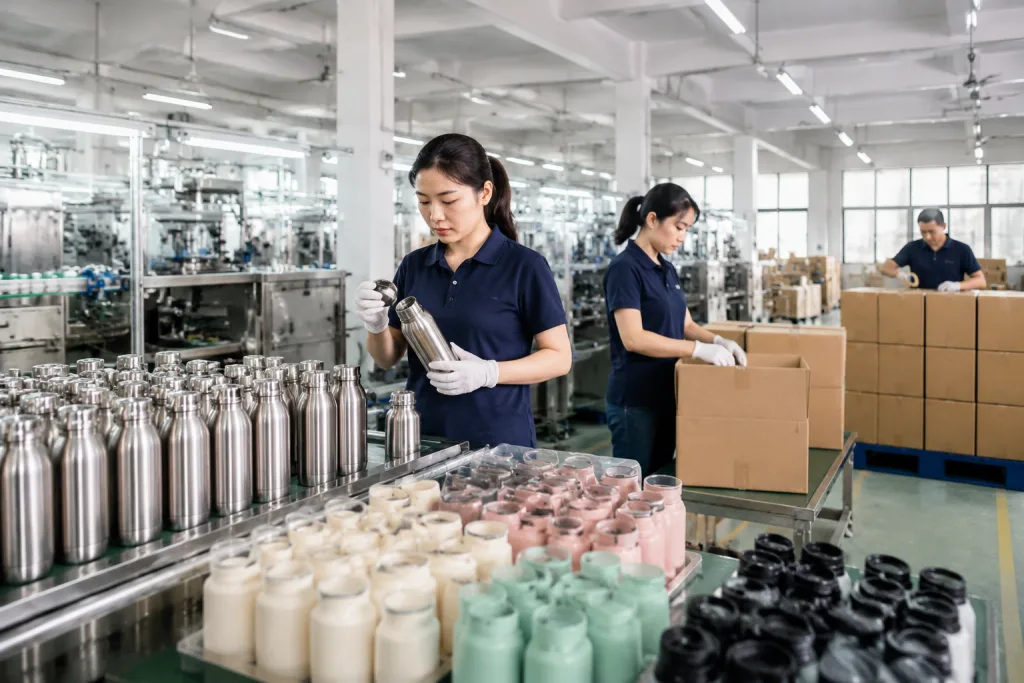
At BottleForge Industrial in Hangzhou, Zhejiang, we run polypropylene vacuum bottle wholesale projects as engineering and purchasing work, not a catalog click. You need the right material stack, an MOQ the line can hold, decoration that survives dishwasher rubbing and bag abrasion, and PO line items clear enough that nobody argues after the deposit lands. Our stainless thermos line runs about 450,000 units/month, with typical custom MOQ from 1,000 units per color. We measure body thickness with a digital caliper before mass production; 0.4 mm and 0.5 mm do not cost the same once you ship 20,000 pcs. Ask better questions. “What is your cheapest thermos?” is the wrong one. Ask whether the 0.4 mm body, PP grade, silicone seal, logo process, and export test requirement match the shelf price you promised your buyer.
Start With The Bottle Construction
The phrase polypropylene vacuum bottle wholesale creates bad quotes because it can describe 2 different bottles. One is a cheap PP outer shell with a small insulated insert inside. The other is the build we run on the line most weeks: double-wall stainless steel body, with PP used for the lid, stopper, push button, handle, straw, or drinking mouth. Pick the second structure when the retail shelf price is above promo-gift level and the bottle needs heat retention, cold retention, and dent resistance after warehouse handling. Photos are not enough. QC pulled one 500 ml sample after a 1.2 m drop test, and the PP shell showed stress whitening around the base within 3 minutes.
Your first RFQ should split every material. Do not write only “500 ml PP vacuum bottle.” Write this: 500 ml double-wall 304 stainless inner, 201 or 304 stainless outer, copper-coated vacuum layer optional, food-grade PP lid, silicone seal, powder-coated exterior, leakproof screw cap. That gives the thermos line a quote target and gives your compliance team a checklist they can mark off. We once received a PO with “PP bottle” in the item name and “304 thermos” in the packing mark; production stopped for 2 days while sales, engineering, and the carton printer fixed the mismatch on the box dieline.
For outdoor retailers, I suggest 304 stainless steel for the inner wall at 0.4 mm thickness and 201 stainless outer wall at 0.5 mm when the price target is tight. For premium trail or alpine gear, use 304 outer as well. PP parts should be food-contact grade, often PP5, with documents ready for FDA, LFGB, or EU 10/2011 migration testing based on your destination market. Ask for the material sheet early. Do not ask first, “Can we make it cheaper?” That is the wrong question if your buyer already flagged coating chips, lid odor, or weak heat retention on the last shipment; we have seen this go sideways after 3,000 pcs were packed and the buyer rejected the first carton inspection.
RFQ line items to include:
- Capacity: 350 ml, 500 ml, 750 ml, 1,000 ml, or your target volume tolerance, such as ±15 ml checked with a graduated cylinder
- Steel grade: 304 inner / 201 outer or 304 inner / 304 outer, with the grade confirmed before mass production by incoming material inspection using an XRF gun
- PP components: lid, stopper, handle, straw cap, mouth ring, or shell; tell us if the mold needs a logo insert and send the logo file before T1 sampling
- Performance target: 6 hours above 60°C or 12 hours cold retention, tested after the vacuum oven and final leak check
- Market: EU, UK, US, Canada, or mixed distributor thermos channels, because the test report and carton warning text change by region
Build A Useful RFQ Pack
A clean RFQ saves 5 to 10 emails and cuts the risk of surprise charges after sampling. A weak RFQ pulls in a cheap first price, then the add-ons show up: logo setup, thicker carton, color box insert, spare gasket. We see this every week. For a customized thermos program from a thermos manufacturer in China, send a one-page spec sheet, even when the model is still open. Price needs facts. Our sales desk checks the sheet against a 0.01 g scale, coating swatches, caliper readings on the PP lid, and the latest lid BOM before we release a quote.
For a promotional thermos order, give quantity, capacity, color count, logo size, packaging, delivery port, and deadline. For outdoor retail, add retail packaging dimensions, barcode placement, drop-test height, and expected spare lid ratio. Say the warehouse rules early. A distributor thermos program needs carton weight limits because European warehouse teams can reject cartons over 15 kg or 18 kg. We had this happen on a 2024 PO: the buyer flagged it after our outer carton hit 19.2 kg on the floor scale, and the math did not work once re-cartoning cost was added.
Use quantities that match your launch plan. A supplier thermos quote for 500 units will not show the real price at 5,000 units. At BottleForge in Zhejiang, our standard custom stainless thermos MOQ is 1,000 units per color, but we quote tiers at 1,000, 3,000, 5,000, and 10,000 units so your team can compare margin by channel. Typical FOB Ningbo or Shanghai prices for a 500 ml stainless vacuum bottle with PP lid run from USD 3.20 to USD 6.80, based on steel grade, coating, lid parts, and packaging. Here is where we push back: asking only for “best price” is the wrong question. QC pulled the sample last month because the PO said “matte black,” while the artwork file called for Pantone Black C gloss. Small typo. Big delay.
RFQ line items to include:
- Target order: 1,000 / 3,000 / 5,000 units, not just “best price”
- Incoterm: FOB Ningbo, FOB Shanghai, EXW Hangzhou, or DDP request with destination ZIP code and carton handover rule
- Decoration: laser engraving, silkscreen, heat transfer, UV print, or sleeve, with logo size in mm and artwork format
- Packaging: white box, kraft box, color box, gift tube, or retail hangtag, plus carton weight cap if your warehouse enforces one
- Compliance: REACH, LFGB, FDA, CPSIA if kids’ use is possible, with test report name matching the importer on record
Check Samples Before Chasing Price
About 7 out of 10 buyers ask for thermos bulk pricing before they touch a sample. Wrong first question. Price matters, but the sample shows whether the lid thread drags after 20 turns, whether the PP stopper smells after a 90°C rinse, whether the powder coat chips at the rolled rim, and whether the vacuum still holds after a hot-water check. We see it on the bench. On our line, QC uses a digital thermometer and a 0-150 mm caliper to check the mouth diameter within 0.3 mm. For a custom thermos project, we usually start with an existing mold sample in 3 to 7 days. A pre-production sample with your logo and color normally takes 7 to 14 days after artwork approval.
Ask for two sample types. First, get a blank engineering sample for size, hand feel, lid leak testing, and carton fit if you already have a retail box. Second, get a decorated sample for brand approval. Simple. If you skip the decorated sample, we have seen this go sideways: the buyer approved a mockup, then QC pulled the sample and found the 0.18 mm logo line was too thin for silkscreen on the curved body. Laser engraving can look weak on a light powder coat; white and pale gray are the two finishes buyers flag most often when we run the first logo piece.
Test samples like your customer will abuse them. Fill with boiling water and check the outer wall after 10 minutes with an infrared thermometer. Turn the bottle upside down for 30 minutes. Put it in a backpack with tissue paper wrapped around the lid, because one wet tissue tells the truth fast. For PP lids, open and close the cap 50 times and check hinge stress whitening under a desk lamp. If your product is for outdoor retailers, run a simple 1 m drop test onto plywood or a rubber mat. Stainless may dent, but the vacuum should not fail easily; the math does not work if 3% of a 5,000 pcs order comes back for insulation failure.
Sample PO line items:
- Model number and capacity confirmed by drawing or photo; we check it against the 2D drawing before the sample leaves Hangzhou
- Sample fee: usually USD 30-120 per style, refundable against bulk PO for some projects
- Logo file: AI, PDF, or EPS with Pantone color code; mark line width when the artwork has small text under 1.5 mm height
- Sample deadline: blank sample 3-7 days, logo sample 7-14 days
- Courier: DHL, FedEx, UPS, or buyer’s account; one PO typo in the account number can add 1 day at pickup
Do not approve a factory thermos sample only from photos. Photos hide lid wobble, coating texture, weight, smell, and thread quality; we ship the real sample because a 220 g lid feel cannot be judged on a screen.
Choose Decoration That Matches Use
A conference giveaway thermos and a trail thermos for outdoor retail should not carry the logo the same way. Same logo method is the wrong question to ask. Silkscreen is still the lowest-cost clean choice for a one-color mark; we run a 120T mesh screen when the artwork has no fine gradient and the logo stays under 55 mm wide. Laser engraving survives better on powder coating. QC pulled one sample last month because the buyer scratched the printed logo with a key ring on the packing table. Print failed fast. The engraved shade still depends on coating thickness and the 304 stainless underneath, so do not approve it from a flat computer mockup. Heat transfer or UV printing works for bigger graphics, but ask for abrasion checks if the bottle will hang from packs or bounce around in a truck bed.
For thermos custom branding, the safe artwork area is usually 30 mm to 70 mm wide on a 500 ml bottle, based on body curvature and the fixture clamp we use on the line. Full-wrap printing is possible. Registration causes the trouble. Expect ±1 mm to ±2 mm position tolerance for common logo processes, and write that on the PO instead of leaving it in email comments. We have seen a PO say “centered” while the approved drawing showed 42 mm from the bottom; the buyer flagged it after pre-shipment photos. If a brand manual needs a tight Pantone match, powder coating gets closer than standard spray painting, but powder coat still shifts between batches. Ask for a wet color chip or coated metal panel before mass production when color is critical; we have seen this go sideways over a 0.6 ΔE argument after cartons were sealed.
Customizable thermos lids add another decision. A PP lid can be molded in black or white from stock resin, while gray and custom Pantone-like colors need resin-chip matching. For a new PP injection color, MOQ may rise to 3,000 to 5,000 units because resin mixing and barrel cleaning do not make sense at small runs. Small runs hurt. On our 160-ton injection machine, a color change can eat half a shift before the first clean lid comes off the mold. If you are a thermos distributor testing a new market, use a standard black PP lid and spend the budget on a stronger coating or retail box; the math doesn't work when a 600-unit trial order pays for a full injection color change.
Decoration PO line items:
- Logo method and size in mm, with placement measured from the bottle bottom or from the centerline drawing
- Pantone code for body and lid, with print color listed on its own line if it differs from the coating
- Artwork approval file attached to PO; do not bury the final AI or PDF in a 14-email thread
- Allowed tolerance: logo position ±2 mm, with ΔE target written down if color control is required
- Abrasion test request: 3M tape test for adhesion, alcohol rub for ink resistance, or 50-cycle dry rub with the pass standard written before sampling
Price The Real Landed Program
Do not chase the lowest thermos quote. A USD 0.25 saving is gone fast when a 58 x 38 x 32 cm carton cubes out, the color box fails a 1.2 m drop test, or the line sticks FNSKU labels 3 mm off the Amazon template. We run the landed cost sheet before quoting: product cost, mold or setup charge, lab testing, packaging, Hangzhou-to-port trucking, ocean freight, duty, warehouse handling, defect reserve. Nine lines. Leave one out and the math doesn't work.
For polypropylene vacuum bottle wholesale orders, the lid often moves the price more than the stainless body. A screw PP lid with a silicone gasket is the low-risk choice; QC checks gasket compression with a 0.5 mm feeler gauge before leak testing. Add a push button or flip straw, and the line adds sliders, sealing checks, and hand assembly that can slow output from 1,200 pcs/day to about 850 pcs/day. A carry handle or locking ring needs its own fit check, so the cheap quote starts changing. If you need a new private mold, a stainless body mold can start around USD 1,500-3,500, while a custom PP lid tool may range from USD 3,000-8,000 depending on sliders and sealing design. For the first 3,000-5,000 pcs order, existing molds are usually smarter; we have seen this go sideways when the buyer pays tooling before the retail test is done.
Payment terms change the real price too. Standard China terms are 30% deposit and 70% balance before shipment after inspection, with QC pulling the sample against AQL 2.5 before we book the container. For established buyers, we can discuss balance against copy of bill of lading, but not on a first order. FOB Ningbo works well for Zhejiang factories because the truck run from Hangzhou is 2.5-3.5 hours, the docs team knows the port routine, and we can pick a 12-day sailing instead of the slow 18-day option when space is open. Simple choice.
Bulk PO line items:
- Unit price by Incoterm: FOB Ningbo for our usual port, FOB Shanghai if your forwarder requires it, CIF with named destination port, or DDP with duty and last-mile cost shown as separate lines
- Tooling charge and ownership terms if any custom PP or stainless mold is used, including cavity count, T1 sample lead time, and who keeps the mold plate after the order
- Payment terms: 30/70, LC at sight, or approved credit arrangement after 2 shipped orders and insurer check
- Carton size, gross weight, units per carton, and pallet request if needed; the buyer flagged this before when the PO said 24 pcs but the artwork file showed 20 pcs
- Spare parts: 1%-2% extra silicone seals or lids for distributor after-sales, packed in a marked inner bag so the warehouse does not mix them with saleable stock
Lock Compliance And Inspection
Compliance is where thermos vendor talks get sloppy. “Food grade” is not a test report, and one German buyer once stopped approval because our customer wrote that exact phrase on line 14 of the PO. For EU outdoor retail, ask for LFGB or EU 1935/2004 and EU 10/2011 migration reports for polypropylene, silicone, and every food-contact part touching the mouth or liquid; REACH should cover sprayed coating and powder coating codes where used. For the US, FDA food-contact expectations apply, and California programs need a Proposition 65 review before artwork approval. If the bottle is sold for children, add CPSIA and the relevant ASTM checks. Ask the right question. Do not ask “do you have certificates?” Ask whether the report matches the lid gasket, PP insert, coating code, and the current production batch number printed on the QC traveler beside the line.
Vacuum performance belongs in the quality plan, not in a sales promise. We run the basic check by filling with 95°C water, closing the lid, and taking a 6-hour reading at room temperature with a probe thermometer. Simple test. For a 500 ml stainless bottle, 8 out of 10 standard screw-lid models should stay above 60°C after 6 hours, but wide-mouth bodies and straw lids lose heat faster than narrow screw lids because the lid area is larger and the seal stack has more parts. Be honest with retail copy. “24 hours hot” sounds nice, but we have seen this go sideways when QC pulled the sample at 58°C, logged it on the inspection table, and the Amazon review team got involved.
Use AQL inspection before final payment. For a bulk thermos order, 9 out of 10 serious buyers we ship for use AQL 2.5 for major defects and 4.0 for minor defects, with critical defects set at 0. Critical defects include leakage, sharp edges, broken vacuum, contamination, wrong material, or unsafe lid failure. Major defects include obvious dents, wrong logo placement by 2 mm or more, coating peel after tape pull, and carton barcode errors; last month the buyer flagged a barcode digit mismatch before the container could close. Minor defects include small cosmetic marks within agreed limits, usually checked under a 40 cm viewing distance on the inspection table with a white LED lamp. The math does not work if you inspect only the top cartons.
QC PO line items:
- AQL level: general inspection level II, major 2.5, minor 4.0, critical 0, written the same way on the PO and the inspector booking form
- Leak test: 100% factory line check, then random third-party inspection with inverted bottles for 30 minutes
- Vacuum test: sample size, starting water temperature, 6-hour reading target, pass/fail rule, and the probe thermometer model recorded in the report
- Coating test: cross-hatch with 1 mm cutter spacing, tape pull with 3M tape, and rub test only when the buyer puts it in the spec
- Documents: test reports, BSCI or ISO 9001 certificate, inspection photos, packing list with carton count and gross weight
Plan Production And Shipment
After the pre-production sample is approved, the clock starts. In our Hangzhou, Zhejiang production flow, a standard customized thermos order takes 35 to 45 days after deposit and artwork approval. Add 7 to 10 days for a special powder color, a custom PP lid color matched by Pantone chip, or a retail box proof checked on a 300 dpi Epson plotter. The line needs color chips signed off under a D65 light box; last month one buyer flagged a 0.8 mm logo shift after we had already made the screen. Book 15 to 20 days earlier than your marketing calendar says during summer outdoor season or Q4 promo season. We've seen this go sideways.
A practical production schedule has five checkpoints: material purchase, stainless forming and welding, vacuum pumping, coating and decoration, then assembly and packing. Vacuum failure usually shows after pumping and heat testing, not at final packing, so ask your thermos factory where vacuum yield is checked. We run heat retention tests with a probe thermometer after vacuum pumping, and QC pulled the sample if the body temperature drifted outside the set range. A solid factory thermos line rejects failed vacuum bodies before decoration whenever the process allows it. Decorating bad bodies wastes money.
Shipping choice comes down to launch date and carton math. Sea freight is the normal choice for thermos bulk orders. A 500 ml stainless bottle in an individual box may pack 24 units per master carton, roughly 0.06 to 0.08 cbm per carton depending on packaging. Air freight works for samples or emergency replenishment; for a 3,000 pcs reorder, the math often fails once chargeable weight hits the quote sheet. If you sell through marketplaces, put FNSKU labeling, polybag warning text, carton labels, and pallet height limits in the PO instead of sending them after packing starts. We ship enough Amazon orders to say this plainly: a missing label template can delay loading by 1 full day.
Shipment PO line items:
- Final inspection date at least 3 days before vessel cutoff, with AQL 2.5 booked before packing tape is sealed
- Forwarder contact and booking responsibility, with cut-off time and SI deadline written in the same time zone
- Shipping marks and barcode labels, plus FNSKU placement and a carton label template with a 100 mm x 150 mm sample layout
- Palletization: pallet type, max height, corner protection, stretch wrap, and whether the warehouse accepts 1.6 m or 1.8 m stacks
- Document set: commercial invoice, packing list, bill of lading, certificate of origin if needed, with the PO number checked for typos before booking
Reorder Smarter After Launch
Treat the first order as the reorder map, not just container No. 1. Pull sell-through from Shopify, Amazon Vendor, or your distributor ERP by color and capacity, then check it against carton weight; our 500 ml PP-lid bottle runs 24 pcs per master carton at about 11.8 kg, and QC checks gross weight on a 30 kg floor scale before loading. Small detail. Outdoor retailers often take 750 ml and 1,000 ml bottles for camping sets, while promo buyers push 500 ml because unit cost and freight per piece stay under control. Do not ask only, “Which size sells best?” That is the wrong question. A thermos distributors program needs one compact gift size for MOQ-driven campaigns and one outdoor size that feels solid on shelf without looking like a cheap giveaway.
After 60 to 90 days of sales, review returns with photos, not stories. QC pulled the sample. Separate real factory defects from customer misuse, then count each issue by SKU and batch code printed on the bottom sticker. Leakage usually traces back to a missing 52 mm silicone ring, cross-threading after the customer forces the lid, or a lid thread with only 1.5 turns of bite when we would rather see closer to 2.2. Coating complaints come from weak abrasion resistance or customers putting powder-coated bottles in dishwashers; we run a simple 3M tape pull and a 500 g rub test before arguing about it. If the problem is instruction-related, add a care card with a dishwasher warning. If the problem is structural, change the lid or coating before the next PO; we have seen this go sideways when buyers reorder first and argue after shipment.
For repeat orders, negotiate from data. If your first 3,000-unit order had a defect rate below 0.8% and your reorder forecast is 10,000 units across two colors, a thermos manufacturer can book steel, PP lid parts, and powder coating time with less scrap. The line hates guesswork. You can ask for sharper pricing, reserved capacity, or free spare seals because the factory is not resetting silk-screen films, lid jigs, and carton marks from zero. Change every detail each time and you restart development. Expect sample time again, usually 12 days vs 18 days when a new lid mold insert is involved. The math does not work any other way.
Reorder PO line items:
- Reference the approved golden sample and previous PO number; one buyer once typed PO 2317 as 2137, and the carton mark nearly went to print wrong
- Confirm changes only: Pantone code with coated/uncoated callout, logo size in mm, lid version, packaging file name, carton count, barcode number, and the final dieline date
- Send defect feedback from the last shipment with close-up photos, counted quantities by SKU, and the AQL 2.5 inspection note if the inspector recorded it
- Forecast the next 3 months and 6 months by SKU, with launch dates for each channel and the first warehouse booking week
- Order spare parts and after-sales kits for thermos distributor service teams, including 52 mm silicone rings in 100 pc bags, PP lids packed by color, and retail-ready polybags with suffocation warning text
A stable supplier thermos relationship is not blind loyalty. It is fewer unknowns. When the factory knows your 1.2 m drop-test standard and you know the factory’s real daily output from the line sheet, polypropylene vacuum bottle wholesale becomes repeat work instead of a fresh gamble every season. We ship cleaner when the buyer gives clean data.
Send your thermos RFQ with real specs
Share capacity, quantity, market, logo files, and delivery deadline. We will return a practical FOB quote and sample plan.
Frequently asked questions
Is a polypropylene vacuum bottle the same as a stainless thermos?
Usually no. In wholesale sourcing, many buyers use “polypropylene vacuum bottle” to describe a stainless vacuum bottle with PP parts, such as the lid, stopper, handle, or straw cap. A true PP body bottle will not perform like a double-wall stainless thermos. For outdoor retail, specify 304 stainless inner wall, 201 or 304 outer wall, food-grade PP lid, and silicone gasket. If you need 6-hour hot retention above 60°C, stainless vacuum construction is the safer route. Put the material split in the RFQ so the thermos supplier does not quote a cheaper non-equivalent structure.
What MOQ should I expect for a custom thermos order?
For BottleForge in Zhejiang, the practical MOQ for a custom stainless thermos is usually 1,000 units per color using existing molds. If you need a custom PP lid color, full-wrap artwork, or private packaging, 3,000 units is more realistic. A new PP lid mold may require 5,000 units or more to make the economics reasonable. For promotional thermos orders with a standard black lid and one-color logo, we can often keep the first PO lean. Ask for price tiers at 1,000, 3,000, 5,000, and 10,000 units.
How long does sampling and bulk production take from China?
Blank stock samples normally take 3 to 7 days before courier pickup. A logo pre-production sample usually takes 7 to 14 days after artwork, Pantone color, and decoration method are confirmed. Bulk production from China is typically 35 to 45 days after deposit and sample approval for existing molds. Add 7 to 10 days for special powder coating, custom PP resin color, or new retail packaging. Sea freight to Europe or North America then adds roughly 25 to 45 days depending on port and season.
Which logo method is best for outdoor retail thermos bottles?
For outdoor use, laser engraving on powder coating is usually the most durable choice for a simple logo. It resists scratching better than many printed logos and looks clean on matte finishes. Silkscreen is cheaper and works well for one-color promotional thermos orders, but it needs tape and rub testing. Heat transfer or UV print is better for large graphics, yet abrasion risk is higher. For a 500 ml bottle, a 40 mm to 60 mm wide logo is usually safe. Always approve a physical decorated sample, not only a digital mockup.
What should be written on the bulk thermos purchase order?
Your PO should include model number, capacity, steel grade, PP lid specification, silicone gasket, color, logo method, logo size, packaging, carton quantity, barcode or FNSKU rules, Incoterm, price, payment terms, inspection standard, and shipment deadline. Add AQL terms, usually critical 0, major 2.5, minor 4.0 under general level II. For distributor thermos programs, include 1%-2% spare seals or lids for after-sales service. Attach approved artwork and sample photos to the PO. If a requirement is only in an email thread, it is easier to miss during production.