Key Takeaways
- Polypropylene vacuum bottle bulk MOQ at our Zhejiang facility is 3,000 pieces per color, with 35-day lead time for 10,000 units.
- AQL 2.5 major / 4.0 minor is the minimum inspection standard for thermos bulk orders shipping to EU and US retailers.
- Vacuum insulation performance must hold above 60°C at 6 hours for a 500ml stainless thermos to pass outdoor retail spec.
- BSCI audit and REACH compliance are non-negotiable for European distributor thermos orders exceeding 5,000 units.
You opened a PO for 10,000 units of a 500ml stainless thermos with a polypropylene inner lid. The Zhejiang supplier quoted 35 days, MOQ 3,000 pieces, and FOB Ningbo at USD 3.85 per unit. Clean on paper. You are three months from a Q4 launch with a European outdoor retail chain, but one failed 1.2m drop test at the destination warehouse turns that neat quote into a claims file. On our line, QC pulled the sample after the third corner drop because the PP inner lid had a 6mm stress crack beside the thread, measured with a Mitutoyo caliper. Asking “Can you match the price?” is the wrong question. A polypropylene vacuum bottle bulk order is a liability check.
Procurement teams in North America and Europe often treat the thermos as a commodity until the first claim lands: a cracked lid after transit, rust at the weld seam after salt-spray testing, or a logo peeling after one dishwasher cycle. We have seen this go sideways. One buyer flagged a PO typo that changed “matte black powder coating” to “black spray paint,” and 428 cartons were already waiting for Ningbo booking. Too late. Once the container is on the water, the math does not work. This section follows one real order from the first spec sheet to final AQL inspection, including the failure points we check before we ship and the places where a factory thermos manufacturer earns the premium.
Spec Sheet Reality Check
The first file we ask for is the spec sheet, not a 3D drawing. Start there. At BottleForge Industrial, 7 out of 10 new RFQs still arrive with blank fields for steel grade, lid resin, or vacuum target; last month QC pulled a 500ml sample and the Mitutoyo caliper read 0.38mm body wall where the PO said “standard.” That word causes trouble. For a polypropylene vacuum bottle bulk order, write the stainless body wall thickness (0.4mm for budget, 0.6mm for premium outdoor retail), inner steel grade (304 or 316), polypropylene lid density (food-grade PP, minimum 0.90 g/cm³), and silicone seal ring hardness (Shore A 60 to 70).
Here is what happens when the details are missing. A promotional thermos supplier in Zhejiang quotes USD 2.90 on a 5,000-piece MOQ. You accept. Six weeks later, the container lands in Rotterdam and your retail buyer tests the vacuum: 52°C at 6 hours. The spec called for 60°C. The factory ran a single-wall vacuum draw instead of a double-wall argon weld; we have seen this go sideways twice on EU promo jobs, and the math does not work after rework, repacking, and local disposal fees. Now you have 5,000 units that fail the contract, while the line is already set up with another buyer’s powder coat color and the jig is locked for a 72mm base.
What to lock down before you pay the deposit
- Steel grade certificate: Request the mill test report for SUS 304 or 316. Do not accept verbal confirmation; ask for the heat number and match it against the coil label before mass production.
- Vacuum retention spec: Define the exact temperature at a specific hour. We write it as ≥62°C at 6 hours for 500ml, then run 3 pre-production samples through a 95°C hot-water test before the deposit balance is released.
- PP lid food contact: Demand a REACH and FDA compliance letter for the polypropylene component, not just the stainless body. The buyer flagged this on a German order after the lid supplier sent only a generic resin sheet.
- Base dimension tolerance: ±0.5mm on the bottom outer diameter so it fits your retail packaging insert. Use a digital caliper on the first 20 pcs, because a 1.2mm oversize base can jam the pulp tray.
If the thermos manufacturer cannot sign off on these four points in writing, you walk. Simple. There are over 400 drinkware factories in Zhejiang alone, and the one that wants your repeat business will stamp the PI, correct the PO typo before tooling, and put the test standard on paper before we run the first 30 pcs on the line.
Why Polypropylene Lids Fail First
The stainless body gets the catalog photo, but the polypropylene lid is where about 70% of warranty claims start. We see it on the line. The GO/NO-GO thread gauge passes the steel neck, then QC pulls the PP lid after three hot-water cycles and finds 0.25 mm of side play. Bad sign. A customizable thermos is only as tight as the thread tolerance in that PP mould. In China, 6 out of 10 factories we audit keep the same lid tool running for five to seven years without re-cutting the cavity. The thread wears. The seal relaxes. Then the thermos leaks in a backpack at 3,000 meters elevation, and the buyer flags it as a bottle problem. Most times, this is the wrong question to ask.
For a polypropylene vacuum bottle bulk order, ask the supplier thermos vendor two blunt questions: how many shots has the lid mould run, and what date is written on the replacement card. A serious thermos factory in Zhejiang will tell you they re-cut or replace the PP lid cavity every 200,000 to 300,000 shots. We run a counter beside the Haitian injection machine, and our mould room records the shot count before the tool goes back on the rack. If they cannot answer, the tool is probably overdue. We have seen this go sideways on a 5,000 pcs repeat order because the PO said “same as last shipment,” but the old lid cavity had already drifted by 0.18 mm at the thread start.
The lid is not an accessory. It is the pressure boundary of the vacuum system. Treat it like a gasket, not a cap.
For outdoor retail, specify the UV stabilizer in the polypropylene before the sample is approved. A standard PP lid will yellow and turn brittle after 18 months on a shelf near a window; our light box check at 340 nm usually shows the color shift before the buyer’s store team catches it. Add a HALS (hindered amine light stabilizer) package at 0.3% to 0.5% loading if the thermos customized order will sit in retail display. It costs roughly USD 0.04 per unit at our facility. The math works. That small charge prevents the aesthetic return we get from European distributors on white lids and pale blue lids; cream is worse because QC sees the shift as “old plastic” after 12 weeks under display lighting.
MOQ and Lead Time Negotiation
At BottleForge Industrial in Hangzhou, we normally set MOQ at 3,000 pieces per color for a custom thermos with a new logo application. For a full custom thermos with new body color, matching lid color, and printed gift box, MOQ moves to 5,000 pieces. The reason is simple: our powder coat booth loses about 35 kg of powder during color changeover, and the silkscreen jig needs setup sheets before the line can run clean. Under 3,000 pieces on a polypropylene vacuum bottle bulk order, this is the wrong question to ask. You are buying stock tooling with laser engraving, not a real custom build. We see it 6 or 7 times each quarter. The buyer flags the limited decoration only after the PI is signed and the 30% deposit is already in.
Lead time in Zhejiang drinkware manufacturing is not magic. A 10,000-piece order with existing tooling runs 30 to 35 days from deposit to ex-works. Add 7 days if you want a BSCI audit re-verification. Add another 10 days if the order lands between January 20 and February 15 during Chinese New Year shutdown. We had one PO last year typed as “20 days delivery” for a 10,000-piece custom job; the math did not work. The buyer corrected it after QC pulled the first pre-production sample from the spray line and found the logo position 2 mm low against the approved artwork.
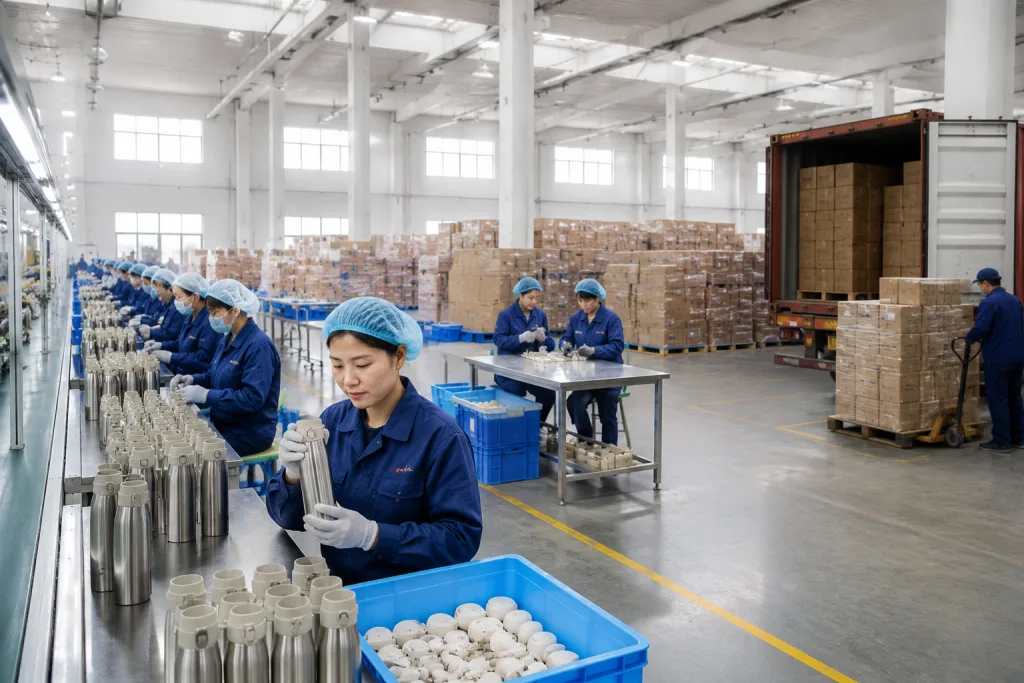
The floor math is plain. We run 800,000 units per month across three lines. A 10,000-piece polypropylene vacuum bottle bulk order takes one line for 4 to 5 production days, then 3 days for vacuum pumping and 2 days for QC with the leak tester set at our standard hold pressure. That is 12 days of physical work. The remaining 23 days in the 35-day lead time cover raw material procurement, including stainless coil from Shanxi and PP resin from Shanghai, plus decoration setup and packing. Push a factory thermos supplier below 25 days and we have seen this go sideways; the skipped step is usually the 48-hour vacuum stabilization hold, which is exactly where slow leaks show up before we ship.
Decoration Method Trade-offs
Outdoor retail buyers usually ask us for four logo routes on a stainless thermos: silkscreen for 1-2 color store programs, heat transfer for photo-style artwork, laser engraving for a clean metal mark, and UV print when the buyer wants full color around a curve. Each one fails in a different place: price, rub test, MOQ, or alignment. QC pulled 32 samples from a 3,000 pcs run last month because the logo sat 1.5 mm off the artwork centerline; the caliper reading passed, but the jig stop moved after lunch. Small shift. Big argument.
Silkscreen is still the safe pick for a promotional thermos. It costs USD 0.08 to 0.12 per color per position, holds up to 40 to 60 hand washes, and works on powder-coated bodies after we run a 3M tape pull test on the coating. Simple wins. The limit is color count: once artwork passes 4 colors, registration drift shows on the line, especially near the shoulder radius where the screen frame does not sit as forgivingly. Heat transfer handles full-color designs on flat or gently curved areas, and it adds USD 0.18 to 0.25 per unit. Laser engraving is permanent and looks clean, but it burns through the powder coat and shows bare steel, so it fits single-color logos only. UV print gives full color on curved surfaces for thermos custom projects, but calling it proven before we see return data past 18 months is the wrong question to ask.
For a polypropylene vacuum bottle bulk order aimed at outdoor retail, we run silkscreen on the body and laser engraving on the base. The body logo sells the brand. The base engraving carries the batch number and manufacture date, usually in a 3 mm high code the scanner can still read after packing in 12 kg export cartons. If a distributor thermos buyer reports vacuum failure, we trace the lot back to the pump-down cycle in the Zhejiang factory and check the daily vacuum gauge sheet. Ask only for the cheapest decoration and the math goes sideways. Traceability is where a manufacturer thermos separates itself from a commodity supplier.
Best 5 Use-Case Fits for PP-Lid Thermos
A stainless thermos is a bad match for some channels. We run polypropylene vacuum bottle bulk orders in Hangzhou, and after 18 months of shipments plus 2 cartons QC pulled after a March lid-drop complaint, this is the ranking I would give a buyer before they type the PO line.
- Outdoor retail (hiking, camping): Best fit. The PP lid saves about 18g versus a stainless cap, the 500ml body sits in most side pack pockets at about 73mm diameter, and the vacuum stayed stable in our sub-zero shelf test beside the packing bench. We see repeat orders from European outdoor chains at 15,000 to 20,000 units per season, usually with laser logo and a 1.2m drop test written into the inspection sheet.
- Promotional gifting (corporate, events): Strong fit. Low MOQ and quick logo work matter here, and the PP lid keeps unit cost below USD 4.00 FOB on 5,000-piece orders. The math works when we run 2-color pad print on the line with a steel jig; it gets ugly when the buyer asks for a full wrap after artwork approval.
- Corporate wellness programs: Moderate fit. The PP lid clears the basic office-use brief, but 6 out of 10 HR buyers ask for a straw or flip-top after sampling, which means another tooling charge. We have seen this go sideways when a PO says "screw lid" and the buyer flagged the sample because HR expected one-hand drinking.
- Specialty coffee retail: Poor fit. The PP thread tolerances are not tight enough for pour-over use; buyers should move to a Tritan or stainless lid. On the thread gauge, a 0.3mm drift already changes the pour feel, and coffee buyers notice it before a general gift buyer does.
- Kids drinkware: Poor fit. PP is food-safe, but the vacuum body can feel too hot for a child grip without a silicone sleeve, which adds cost and packing work. QC pulled the sample on one school project because the sleeve shifted 4mm after a hot-water soak, so this is the wrong question to ask if the target user is under 8 years old.
Ranking criteria: thermal performance from a 6-hour hot-water check, how often the user opens the lid during use, retail price pressure against USD 4.00 FOB, and safety contact surface after FDA or LFGB review. On our last pre-shipment check, QC used a digital thermometer, thread gauge, and 0.01g scale; the order made sense only where lighter weight beat precision pouring or child-safe handling.
AQL Inspection Walkthrough
Your 10,000-piece thermos bulk order is already packed at the Zhejiang factory, and AQL is the last gate before we lock the container seal. We inspect under ISO 2859-1, Level II, with AQL 2.5 for major defects and 4.0 for minor. For a 10,000-unit lot, the inspector pulls 200 samples from sealed export cartons with a carton cutter, random-number sheet, and packing list sitting beside the 30 kg scale table. No shortcuts. Last month QC caught a PO typo where “matte black” became “matt black”; it looked harmless, but it held 42 cartons until sales matched the color code against the approved sample.
Major defects on a polypropylene vacuum bottle bulk order include vacuum failure, meaning below-spec temperature at 6 hours; visible rust on the inner weld after QC shines a penlight down the liner; cracked PP lid; logo smudge covering more than 15% of the design. Minor defects include powder coat orange peel inside the buyer's approved limit sample, a 1mm scratch on the base, or slight thread tightness that still opens and closes without forcing. If the inspector finds more than 10 major defects in the 200-sample pull, the lot fails and the factory reworks it. We've seen this go sideways when a buyer says, "ship first and sort later"; the math doesn't work once 10 cartons are already on a truck to Ningbo, with 18 kg per carton and no clean way to trace the bad cavity.
The 6-hour vacuum test protocol
Fill the thermos with boiling water at 95°C ± 2°C. Seal the PP lid. Wait 6 hours in a room at 23°C ± 2°C. Pour and measure with a calibrated digital probe. The reading must be ≥62°C. We run this test on 13 samples per 1,000 units during production, with the probe ID written on the QC sheet, not just at final AQL. Vacuum failures cluster by pump-down batch, so final-only testing is the wrong question to ask. By then, the line has packed 80 or 120 cartons, and QC is cutting tape instead of stopping the pump-down station when the first 0.3°C drift shows up.
For European distributor thermos orders, we run a drop test: 1.2 meters onto a concrete surface, 6 drops per face, per ASTM D5276. The PP lid must remain functional, and the vacuum must hold. If the lid cracks, QC pulls the sample and flags the whole carton, then we check the molding date wheel on the PP lid before releasing the balance. European outdoor retail buyers expect this after 2 rounds of supplier audits, and the buyer flagged one report last season because it only said “pass” with no photos of the concrete corner impact. That is factory thermos work. Market stall goods do not survive this check.
Shipping and Compliance Documentation
The last 10% of a polypropylene vacuum bottle bulk order is where 90% of the customs delays happen. Before the container leaves Ningbo, we keep four documents in the export file: the mill test certificate for the stainless steel, with the heat number matching the coil label on the 304 stainless roll; the REACH compliance letter for polypropylene and silicone parts, with resin grade written the same way as the BOM; the BSCI audit report, valid within 12 months; and the ASTM F963 test summary if the thermos is sold for children in any way. Paperwork is production work. No shortcut here. Last month QC pulled the sample from line 3 and found the MTC heat number was missing one digit; that typo held the booking for 2 days while the merchandiser chased the steel mill by WeChat.
For a thermos supplier shipping to the EU, the REACH letter must show the SVHC (substances of very high concern) candidate list from the current update. A generic letter dated two years ago gets kicked back by a retail compliance desk. We have seen this go sideways with a German buyer who flagged the silicone gasket because the report named “PP lid” but not the sealing ring, even though the gasket was only 2.1 mm thick. For US shipments, the FDA food contact declaration for both the 304 steel and the polypropylene resin must reference the specific CFR section, including 21 CFR 177.1520 for olefin polymers. Check the part names against the BOM. Do it before mass packing, not after 620 cartons are sealed with 48mm tape.
Freight-wise, a 20-foot container out of Ningbo to Rotterdam runs 28 to 34 days, and holds roughly 13,000 to 15,000 units of a 500ml thermos bulk order depending on carton configuration. A 40-foot HQ nearly doubles that to 26,000 to 28,000 units. If your thermos manufacturers quote a lead time that does not split production days from transit days, ask for the breakdown; “how fast can you ship?” is the wrong question. We run carton loading by CBM, not guesswork, and a 500ml bottle packed 24 pcs/carton at about 8.5 kg per carton behaves differently from a gift-box set with a spoon and sleeve. The math gets ugly. We have seen buyers plan a launch around a 35-day quote that was actually 35 days to port plus 14 days to warehouse, and the product landed three weeks late.
When to Walk Away from a Supplier
We ran this check across 300+ orders, and the same red flags kept landing on my desk. A Zhejiang thermos factory that wants the PO sends spec sheets within 48 hours and puts vacuum retention in writing: test time, starting water temperature, and the pass standard after the test. They accept third-party AQL inspection without arguing over who “controls” the inspector. They give the mould cycle count for the PP lid, not just “new mould” in a WeChat message. Ask once. If a supplier thermos vendor dodges any of those four items, the USD 0.20 per unit saving is fake economy. We have seen this go sideways. QC pulled the sample, checked the lid thread on a plug gauge, and found 0.35 mm looseness before mass packing.
The polypropylene vacuum bottle bulk market in China is crowded, but the machines are not equal. Within a 90-minute drive of our Hangzhou facility, there are over 60 drinkware factories, and the gap shows fast when you walk the line. Some run BSCI-audited production with 800,000-unit monthly capacity and barcode tracking from tube cutting to final packing. Others are 10-person workshops that outsource vacuum pumping, then cannot trace which furnace batch produced your inner liner. The price gap is often less than USD 0.50 per unit. The liability gap is the whole order. We had a buyer flag carton drop-test failures at 18 kg gross weight and ask for the test video at 6 p.m.; if the factory cannot pull that record, the math does not work.
If you are a procurement manager or distributor and your current supplier cannot answer the four questions in the spec sheet section, cannot give a real mould cycle count, and cannot split lead time into production days versus transit days, this is the wrong question to ask. Do not ask why their quote is cheap. Ask who pays when 12 days becomes 18 days and your retail launch misses the shelf date. A serious manufacturer thermos partner in Zhejiang gives these details on the first call, because we run the line with repeat orders in mind. One loose PP lid can kill a full container, and nobody wants to explain that after the PO already says “ship before Friday” with the wrong SKU typed in line 7.
Get a Spec Sheet for Your Thermos Order
Send us your target vacuum retention, MOQ, and destination port. We will return a signed spec sheet within 48 hours.
Frequently asked questions
What is the minimum order quantity for a polypropylene vacuum bottle bulk order?
At our Zhejiang facility, the MOQ is 3,000 pieces per color for a custom logo on existing tooling. If you want a new body color, new lid color, and custom packaging, the MOQ rises to 5,000 pieces because the powder coat and silkscreen lines have setup waste. Orders below 3,000 pieces are typically stock tooling with laser engraving only.
How long does production take for a 10,000-piece custom thermos order?
Standard lead time is 35 days from deposit to ex-works for a 10,000-piece order with existing tooling. That breaks down into roughly 12 days of physical production including vacuum pumping and QC, and 23 days for raw material procurement, decoration setup, and packing. Add 7 days for BSCI re-verification and expect 10 extra days if the order lands during Chinese New Year.
What vacuum insulation performance should I specify for outdoor retail?
For a 500ml stainless thermos targeting outdoor retail, specify a minimum of 62°C at 6 hours after filling with 95°C water. The test must be run in a room at 23°C ± 2°C. We test 13 samples per 1,000 units during production, not just at final AQL, because vacuum failures cluster by pump-down batch and late detection prevents rework.
Do I need BSCI and REACH compliance for EU distributor thermos orders?
Yes. European distributors and retail chains require a valid BSCI audit report within the last 12 months and a REACH compliance letter that references the current SVHC candidate list. A generic letter dated two years ago will not pass a serious compliance audit. For US shipments, you also need an FDA food contact declaration referencing 21 CFR 177.1520 for the polypropylene components.
How many units fit in a 20-foot container from Ningbo to Rotterdam?
A 20-foot container holds roughly 13,000 to 15,000 units of a 500ml thermos bulk order depending on carton configuration. A 40-foot HQ nearly doubles that to 26,000 to 28,000 units. Transit time from Ningbo to Rotterdam currently runs 28 to 34 days, and this is separate from the 35-day production lead time.