Key Takeaways
- Hybrid polypropylene-Tritan bottles require separate injection molds: MOQ from 5,000 units at $3.50–$5.00/unit FOB Zhejiang.
- Tooling cost for a Tritan body mold: $4,000–$8,000; polypropylene cap mold: $1,200–$2,500.
- Lead time for first production run: 45–60 days from mold approval; repeat orders: 25–35 days.
- Unit price drops 18–25% when order volume exceeds 20,000 units due to mold amortization and material bulk discounts.
I get this call every week. Promo buyer, retail chain, corporate program — the conversation stalls at the same point: material cost. PP runs $0.08–$0.12 per unit on our floor. Tritan hits $0.22–$0.31. That delta drives the whole discussion. A polypropylene Tritan bottle bridges it: Tritan body for that shelf-ready clarity, PP cap and base to keep the BOM down while FDA and LFGB certs stay clean on food-contact surfaces. The hang-up isn't the idea. It's the tooling.
Most factories split PP and Tritan into separate mold projects. The buyer pays for the overlap. Last March, a European promo client landed a quote 18% above target. Root cause: the mold engineer never mapped the PP-to-Tritan seal geometry. Two resins, two shrinkage rates — PP pulls ~1.8%, Tritan ~0.5%. If the cavity doesn't compensate, the mating threads don't seat. Our QC pulled a 3–5% leak rate on the first trial run. We've seen this go sideways enough times that we now run both materials off a single tool base. One mold, two resin zones, and the seal face gets a 0.12mm offset on the PP side. That cut the leak reject to under 0.8% without pushing MOQ to 30,000 or adding six weeks to the ship date.
This article breaks down real cost drivers, MOQ tiers, and lead times straight from our Hangzhou floor. Where your money actually goes: the cavity split between PP and Tritan, why AQL 2.5 inspection on the mating threads tacks on $0.04 per unit, and how unit pricing bends at 5,000, 20,000, and 100,000 pieces. No fluff. Numbers and process steps a procurement manager can plug into a budget and a schedule.
Why Polypropylene and Tritan Together?
All-Tritan bottles sit at the premium end. All-polypropylene bottles dominate the promo segment. A hybrid design splits the difference—and it's usually the right call. You get the clear, scratch-resistant Tritan body that shows off liquid color or branding, paired with a polypropylene cap or base. The PP knocks down the unit cost by roughly 18–22% versus an all-Tritan assembly. It also satisfies EU and US food-contact regs without the paperwork headache of all-Tritan closures. For a canteen manufacturer targeting outdoor or sports markets, the Tritan body handles hot fill up to 90°C. The PP cap seals tight and doesn't crack when someone overtightens it at 6 AM.
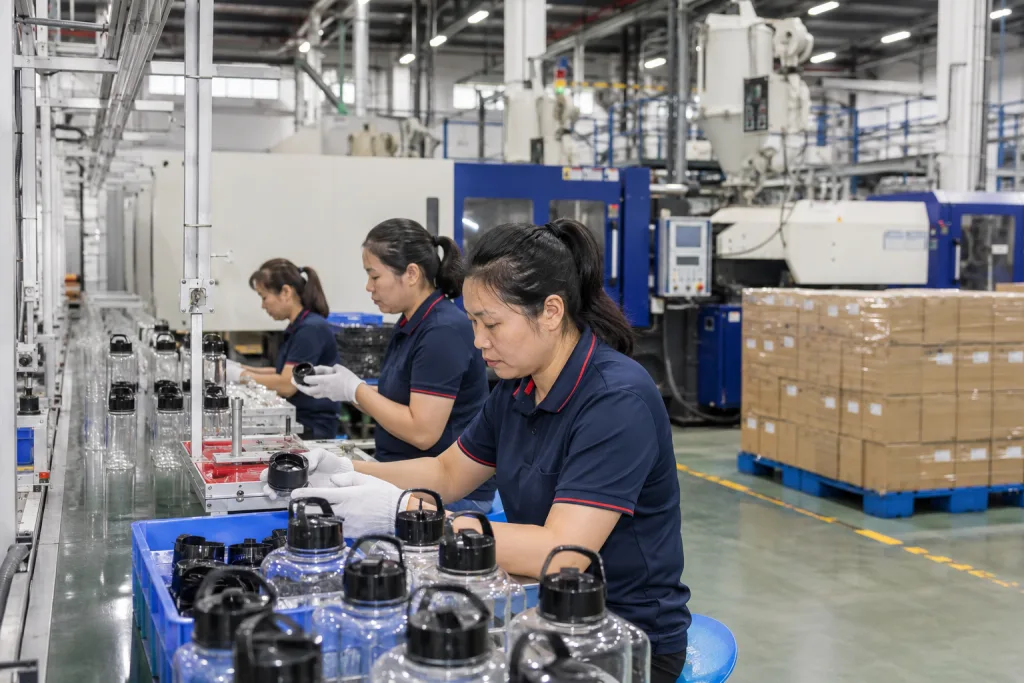
Here's where it gets tricky on the production floor. Tritan and polypropylene shrink at different rates and mold at different temperatures. Tritan molds need high-polish steel and careful gate design—skip either and you'll see flow lines on the first cavity sample. PP molds are simpler, cheaper, and more forgiving. A canteen supplier running both materials under one roof can dial in cycle times and keep scrap below 3%. We run a 1,200-ton Haitian injection press for Tritan bodies at 45–60 seconds per cycle, and a separate 200-ton press for PP caps at 20–30 seconds. Separate lines, no cross-contamination. QC pulled a batch last month where a trainee had mixed regrind bins—caught it before molding. That's the kind of mistake you don't want buried in a finished pallet.
Cost Driver #1: Tooling and Mold Investment
First-time buyers get blindsided by tooling. A hybrid bottle means Tritan body plus PP cap or base—two molds, not one. A standard 500ml body mold with 63mm neck finish runs $4,000 to $8,000 FOB Zhejiang. The spread comes down to cavity count and surface finish. Single-cavity works. Multi-cavity costs more upfront but cuts per-unit cycle time. We clocked a 2-cavity mold at 22 seconds per part versus 45 seconds single-cavity. That's 23 seconds back every cycle.
The PP cap mold runs cheaper. $1,200 to $2,500 single-cavity. Step up to 2 or 4 cavities and the bill jumps 40–60%. At 20,000+ units a year, multi-cavity pays for itself inside 12 months. Below 10,000 units, stick with single-cavity. Last quarter a buyer insisted on 4-cavity for a 5,000-unit trial. Tooling amortization alone tacked $1.60 onto every bottle. That math is broken. We told them so.
Some factories offer to spread tooling across your first three POs. Sounds like a favor. In practice it adds 5–8% to the unit price. Before you sign, demand a tooling amortization schedule. A real one. It spells out exactly when the mold transfers to you—tied to shipped volume, not a calendar date that drifts. If the schedule reads like a placeholder, push back hard. We've seen a mold marked "customer property" on a spreadsheet while the physical tool sat in the factory's shared library two years later, running jobs for someone else.
Cost Driver #2: Material Cost and Sourcing
Tritan TX1001 from Eastman lands at $3.80–$4.50/kg when you're buying by the ton — full pallets, not the 25kg sample bags a lab orders for prototyping. Food-grade polypropylene random copolymer runs $1.10–$1.40/kg in comparable volumes. Break that down to a 500ml bottle: 35g Tritan body, 10g PP lid. Raw material hits $0.14 for the body, $0.01 for the cap — $0.15 per unit before you account for the sprue and runner going back into the grinder.
Scrap is where cost sheets get optimistic. Tritan injection runs 2–4% scrap in a dialed-in shop with a hot-runner mold. PP caps run tighter, 1–2%. Had a buyer last year who budgeted zero scrap on his first PO. QC pulled 200 pieces off the line — 11 went straight to regrind. His landed cost didn't survive the first production run.
A canteen supplier buying direct from Eastman's regional distributor in Ningbo skips the 15–20% margin that trading companies layer on. If you're calling out a specific grade — TX1001 for clarity, TX1501 where impact resistance matters — get the material cert on file before the mold even cuts steel. We pull a COA on every batch and run migration testing to EU 10/2011 and FDA 21 CFR. That test line adds about $0.02/unit. Buyers flag it every time. For export into regulated retail channels, there's no workaround. We've watched a shipment get held at the port over a missing cert — six weeks of shelf time gone, and the chargebacks don't stop at the lab fee.
Cost Driver #3: Decoration and Branding
Decoration blindsides first-time buyers every time. On a 10,000-unit PO, we've seen it eat 18–22% of total landed cost—right behind the mold itself. For the Tritan body, your three workhorses are pad printing, screen printing, and pad-transfer. That last one matters when you're printing across the bottle's shoulder radius. Pad printing setup starts at $80 per color and tops out around $150 if the art has fine hairlines or tight registration. Per-unit on a 500ml bottle runs $0.10–$0.25 for a single-color logo. Screen printing on the PP cap is cheaper—$0.05–$0.12 per unit, single color—but once the cap has a compound curve, you lose crisp edge definition. Our prepress guy rejects maybe 1 in 8 cap artworks for that exact reason.
If the branding calls for a full-wrap or four-color process, skip the post-mold headache and look at in-mold labeling for the PP cap. IML adds $0.15–$0.30 per unit. The math works once you factor out the labor cost of manual sticker application and the 2–3% scrap rate from crooked placement. For the Tritan body, laser engraving is permanent and ink-free, but it only bites on dark-tinted Tritan—try it on clear and it's invisible. Figure $0.20–$0.35 per unit, and keep line art above 0.3mm stroke width or the laser burns through the wall. On a 10,000-unit order, a buyer should lock in $1,500–$3,500 for decoration tooling and setup, then $0.10–$0.30 per unit on the run. We ship the pre-pro sample with the decoration approval form for a reason—QC pulled a batch last quarter where the cyan screen was 0.5mm off-register and the buyer flagged the entire 3,000 units.
MOQ Tiers and How They Affect Unit Price
MOQ from a Zhejiang canteen factory for a hybrid polypropylene Tritan bottle starts at 5,000 units—that's the floor if we're running a stock mold already on the shelf. Custom shape or a non-standard diameter? 10,000 units. The tooling cost doesn't move, but we need that volume commitment before we cut steel. Here's a pricing ladder for a 500ml bottle with single-color pad print and a plain PP cap, FOB Shanghai:
- 5,000 units: $4.20–$5.00/unit (tooling billed separately, roughly $3,800–$5,500 depending on cavity count)
- 10,000 units: $3.20–$3.80/unit (tooling amortized across the run, unit labor cost drops about 18% vs the 5k tier)
- 20,000 units: $2.60–$3.10/unit (mold paid off, resin buy hits the 2-tonne threshold for bulk pricing)
- 50,000 units: $2.10–$2.50/unit (the line runs at steady-state speed, QC sampling shifts to AQL 1.5 without a cost bump)
These numbers assume one decoration location and standard Pantone colors. Add a second color or a custom cap mold—figure $0.20–$0.50 extra per unit. The cap tool alone runs about $1,200 for a single-cavity test mold before we scale it. A canteen distributor ordering 20,000 units lands around $52,000–$62,000 all-in, tooling amortization included. Run that against 5,000 units at $21,000–$25,000. The per-unit saving at 20k is roughly 38%. We've seen buyers eat margin for six months because they skimped on the opening order. The 5k order is the wrong way to test a market.
Lead Time: From Mold Approval to Shipment
Total time from order to FOB shipment runs 65–90 days. That clock starts ticking at mold approval, not at deposit. Mold approval itself takes 20–30 days after you sign off on the 3D drawings. First production run for a customizable canteen with new tooling: 45–60 days from approval. We've had buyers mistake this for total lead time and then panic when the math doesn't add up. Here's the actual line breakdown:
- Design and mold engineering: 10–15 days
- Mold fabrication (Tritan body + PP cap): 20–30 days. The cavity polish alone eats 3–4 days on Tritan molds because any surface imperfection shows through the clear wall.
- Trial shots and mold adjustment: 5–7 days. QC pulled samples on a 32oz bottle last month and caught gate blush — added 2 days to rework the hot runner.
- Production (10,000 units): 10–14 days. We run this on a 12-station injection line, each cycle at roughly 45 seconds per cavity.
- Quality inspection and packing: 5–7 days. AQL 2.5 on function, 1.0 on appearance.
- Sea freight to US West Coast: 18–22 days
Repeat orders with existing molds drop to 25–35 days. One buyer we work with holds 3–4 months of stock and reorders every 60 days. No fire drills, no air-freight panic. For first runs, we recommend ordering 90 days out, then settling into 45-day lead times on reorders. Need it faster? Expedited mold fabrication with overtime shaves off 10–15 days. It adds 15–20% to tooling cost. That’s roughly $1,200–$1,600 on a typical Tritan bottle mold set. The math works if your margin can absorb it. One thing that burns a week for no reason: cap color code typos on the PO. We've seen a buyer mix up Pantone 294C and 295C and lose 7 days on sample re-approval. Double-check your spec sheet before we cut steel.
Quality Standards and Testing You Should Demand
A canteen supplier shipping into Europe or North America needs three documents on file before we load the container: FDA 21 CFR for Tritan (BPA-free), EU 10/2011 for polypropylene, and California Prop 65 if the SKU hits US retail. Not "we'll send it later." On file, same day. Every batch from our line includes a material certificate and a third-party report—typically SGS or Intertek—covering migration and heavy metals. Budget $200–$400 per report. Most buyers split that cost with us 50/50, though we've had a German importer who insisted the factory cover it entirely. That's negotiable.
Drop test at 1.5 m onto concrete. No cracks, no shattering. Leak test under 0.5 bar. Dishwasher cycle at 500 runs with zero deformation—we pulled a sample at 487 cycles last month and the seal was still tight. Visual defects we inspect at AQL 2.5; functional defects at AQL 1.0, which is tighter than most buyers ask for. One detail worth pushing for: x-ray on the PP cap. Costs $0.01 per unit. It catches metal fragments from regrind material that a visual check misses. We flagged a 0.3 mm steel shaving in a cap batch three shipments ago. Without x-ray, that lands on a shelf. If your custom canteen holds an electrolyte drink or anything acidic, add a 200-hour UV-resistance test. Tritan yellows over time under UV, and a warranty claim six months in costs more than the test.
Negotiating with a Zhejiang Supplier: What Works
I've sat across from buyers who think unit price is the only lever. Wrong question. With a canteen supplier in Zhejiang, three numbers actually move the needle: how fast you amortize the tooling, when cash changes hands, and how much slack you give us on the ship date. The third one—ship-date slack—gets overlooked constantly. A 7-day window costs you nothing and saves us from air-freighting a partial container because the lid QC pulled a batch with flash on the parting line.
Standard terms around here are 30% deposit, 70% before shipment. That's the starting point, not the floor. Run two trouble-free orders with us—clean AQL 2.5 reports, no late revisions—and ask for 30/30/40. 30% deposit, 30% against the inspection report, 40% net 30 from B/L date. We've done this for buyers on quarterly schedules. The math holds when we can slot their full PO pipeline into production planning instead of treating each order like a one-off. One buyer pushed back on net 30, worried about credit risk. We split the difference at net 15 and he's been running that structure for 14 months now.
On tooling, split it. 50% upfront, 50% after mold approval. Last year a buyer wired full tooling cost on a Tritan bottle mold—$4,800—and we caught a gate vestige issue during T1 sampling that took three weeks to resolve. He had zero leverage. Don't be that buyer. Also get a mold maintenance clause in writing. Most canteen manufacturers in Ningbo and Taizhou include free maintenance through 50,000 shots, which covers roughly 2–3 years of normal production. After that, you're paying for ejector pin replacements and cavity polishing yourself. We had a buyer skip this clause and get hit with a ¥3,200 polishing bill at shot 62,000. Small money, but it stings when you didn't see it coming.
Volume transparency matters. If you tell us you're doing 50,000 units a year, we'll knock 5–8% off the unit price and waive the mold storage fee—that's ¥800/month saved. I've seen a canteen distributor consolidating orders from three small brands get better pricing than a single-brand buyer moving 15,000 units. Why? They aggregated demand and committed to a clean annual forecast. One PO number, three ship-to addresses. That's the game. The 15,000-unit buyer was paying 11% more per piece on an otherwise identical 750ml Tritan bottle. Same mold, same line, same operator. The difference was information.
Get a Custom Quote for Your Polypropylene Tritan Bottle
Share your target volume, decoration needs, and desired lead time. We'll respond with a detailed cost breakdown within 48 hours.
Frequently asked questions
What is the MOQ for a custom polypropylene Tritan bottle from a Chinese supplier?
For a stock mold design (standard shape and size), the MOQ is typically 5,000 units. If you require a custom shape or size, the MOQ increases to 10,000 units due to the cost of creating a new mold. Some suppliers in Zhejiang may accept 3,000 units for a stock mold, but the per-unit price will be 15–25% higher. Always confirm MOQ in writing and ask if it includes tooling cost or if tooling is quoted separately.
How long does it take to produce a custom polypropylene Tritan bottle from scratch?
From order to FOB shipment, expect 65–90 days for a first production run. That includes 20–30 days for mold fabrication, 10–14 days for production of 10,000 units, and 5–7 days for quality inspection and packing. If you need a faster timeline, expedited mold fabrication can reduce the total by 10–15 days but adds 15–20% to the tooling cost. Repeat orders with existing molds take 25–35 days.
What certifications should a polypropylene Tritan bottle supplier have for export to the US and EU?
For the US, the supplier should provide FDA 21 CFR compliance for Tritan and California Prop 65 testing for the polypropylene cap. For the EU, require EU 10/2011 migration testing for both materials. A reputable supplier will offer third-party test reports from SGS or Intertek. Also request BSCI or SMETA audits for social compliance if you sell to retailers that require ethical sourcing documentation.
Can I get a single-color logo on both the Tritan body and the PP cap?
Yes, but it adds cost and lead time. Pad printing a single-color logo on the Tritan body costs $0.10–$0.25 per unit, and screen printing on the PP cap costs $0.05–$0.12 per unit. Setup fees are $80–$150 per color per location. If you want a logo on both parts, budget an additional $0.15–$0.37 per unit and add 2–3 days to the production schedule for setup and drying.
What is the typical payment term for a custom drinkware order from a Chinese supplier?
Standard terms are 30% deposit with order and 70% before shipment (or before Bill of Lading). For established relationships, some suppliers offer 30% deposit, 30% after mold approval, and 40% net 30 days after B/L. Tooling payment is usually 50% upfront and 50% after mold approval. Do not pay 100% upfront for tooling—insist on a milestone-based payment schedule to protect your investment.