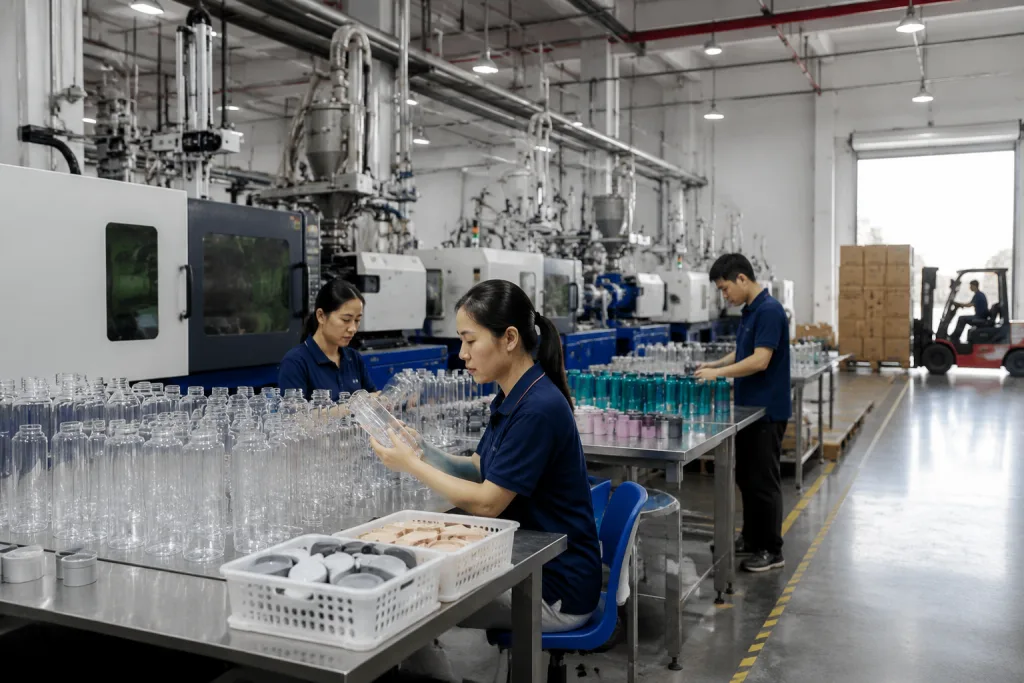
Key Takeaways
- Typical MOQ is 3,000 pieces per color for stock molds and 8,000-10,000 pieces for private mold programs
- Tritan usually costs 25-45% more than PP but gives better clarity, stiffness, and premium shelf appeal
- A serious canteen manufacturer should quote AQL inspection, leak testing, carton drop testing, and food-contact reports
- Normal production lead time is 25-40 days after sample approval, with tooling adding 20-35 days
If you are searching for a polypropylene tritan bottle manufacturer, don’t start with the glossy catalog. That is the wrong question to ask. Start with PP vs Tritan for your market, then check the logo method, mold change cost, and cap tolerance. Small gaps matter. On the line, a 0.3 mm cap fit can decide whether the bottle passes the upside-down leak test or gets packed into a rework carton.
At BottleForge Industrial in Hangzhou, Zhejiang, we speak with about 18 buyers a week comparing PP, Tritan, stainless, and glass across China. Finding a canteen factory is easy. Finding one that gives straight answers on MOQ, tooling, 12 days vs 18 days lead time, compliance documents, and failure risk before the deposit is paid is harder. Last month, QC pulled a sample with a torque gauge and side-lay test because the straw lid passed upright testing but leaked after 30 minutes on its side; the buyer flagged it before we released the export cartons.
Start With Material, Not Shape
Buyers often send a retail shelf photo first and ask us to copy the shape. Wrong starting point. A polypropylene tritan bottle manufacturer should lock PP or Tritan before anyone draws the body, because the resin changes FOB price, clarity, 1.2 m drop-test behavior, printing choice, and FDA or LFGB paperwork. Last month on our line, QC pulled a 650 ml sample after 1.2 m drops on the concrete pad; the body shape passed, but the lid hinge cracked because the buyer chose the wrong resin for a school channel.
Polypropylene, usually called PP, fits a value custom canteen, school bottle, gym giveaway, or canteen promotional program where price matters more than glass-like clarity. It feels lighter in hand and has a slightly waxy touch. On the same 650 ml size, PP normally saves about USD 0.30-0.60 per piece against Tritan. It is not crystal clear. If your brand team wants a glass-look shelf photo, PP will look basic, and the buyer will flag it as soon as the first photo sample hits WhatsApp. We run PP bodies with color masterbatch checked on a simple 2 mm color plaque before mass production; for 3,000-10,000 pc budget orders, that small check stops shade drift across cartons.
Tritan is a copolyester for buyers who want a clearer, harder bottle without moving to glass. Shelf appeal sells it. It fits customized drinkware, sports bottles, and retail canteen customized programs where the bottle sits in a blister card or color box and the customer sees the body before touching it. Tritan also holds odor better than 6 cheaper plastic grades we reject for export orders, so the bottle feels safer and cleaner at retail. We still check wall thickness with a digital caliper, usually around 1.6-2.2 mm on the main body. Thin Tritan can look clear in photos, then sound cheap when tapped on the inspection table.
A practical price gap: if a 650 ml PP bottle is quoted around USD 1.10-1.45 FOB China in a simple stock mold, a comparable Tritan bottle may sit around USD 1.55-2.20 depending on cap design, wall thickness, and packaging. The math does not work when a canteen vendor says Tritan and PP cost the same. Ask for the resin grade and confirm it on the material declaration. We have seen this go sideways when a PO had “Tritian” typed by mistake and the supplier shipped a lower-cost body nobody approved.
Questions To Ask Before Quotation
A clean RFQ can be short, but it has to lock the build. Send 3 canteen manufacturers “500 ml bottle with logo” and you will get 3 prices that do not belong on the same spreadsheet. One supplier quotes a retail color box with E-flute insert. Another quotes bulk polybag, 100 pcs per master carton. A third quietly changes the cap gasket. QC pulled a sample last month where the silicone gasket measured 1.6 mm on the Mitutoyo caliper, not the 2.0 mm shown on the drawing. Cheap? Wrong question. The lowest quote is often the quote carrying the most hidden assumptions.
Send these details before asking for price. We run the cost sheet from these lines, not from a photo dropped into a WeChat chat. If one line is missing, the merchandiser will fill the gap with an assumption, and that is where the buyer flagged it on 2 recent POs.
- Capacity: State 500 ml, 650 ml, 750 ml, 1 L, or give the exact brim capacity and usable fill capacity if your market label needs both.
- Material: Confirm PP, Tritan, or a mixed build such as Tritan body with PP lid. If the lid uses a silicone seal, call out food-grade silicone.
- Cap type: Name the cap style, such as screw cap or flip straw. For push button, carry loop, chug lid, or infuser insert, attach a reference photo. If there is a straw, give the straw length in mm.
- Decoration: For silkscreen, tell us 1 spot color or 2 spot colors. For heat transfer, give artwork size in mm. UV print, in-mold color, laser on metal badge, and paper insert each need separate pricing because the line changes tools and fixtures. A 35 mm logo and a full-wrap print price differently.
- Packaging: Confirm bulk pack or single box first. Then state white box, kraft box, retail color box, FNSKU label, and master carton marks if needed. We still see POs where “color box” is typed in the email but “bulk pack” sits in the attachment.
- Compliance market: Name the selling market: EU, UK, USA, Canada, or promotional-only domestic market. Testing cost changes when LFGB or FDA paperwork is required.
- Incoterm: Use FOB Ningbo, FOB Shanghai, EXW Zhejiang, or DDP if you need landed pricing. DDP also needs delivery postcode and carton estimate.
For BottleForge’s Zhejiang production network, a normal stock mold MOQ is 3,000 pieces per color. Private color matching below 3,000 pieces is possible, but the math does not work well. The injection line still needs resin drying, Pantone checking under the D65 light box, and a purge run before stable color comes out. That is real machine time, usually 25 to 40 kg of resin before the operator signs off. If you need one canteen with separate lid color options, separate body color options, and a logo print, split the MOQ by component on the RFQ. We have seen this go sideways when the final purchase order asks for 3 lid colors and each color triggers its own setup quantity.
Checklist For Factory Capability
Do not approve a canteen factory from showroom samples only. That is the wrong question to ask. A sample can be hand-picked, touched up with polishing paste, or assembled by the line leader instead of the normal operators. Ask how the factory holds control when 30,000 units move through injection molding, bottle blowing, lid assembly, decoration, and packing in the same week. On our floor, QC pulled a lid sample last month because the silicone gasket sat 0.8 mm proud after assembly.
Use this checklist when qualifying a polypropylene tritan bottle manufacturer:
- Monthly output: ask for actual units/month by product family, not one big mixed number from a sales deck. Our coordinated capacity for plastic bottles is about 450,000 units/month, depending on cap complexity and decoration load; a flip-top lid with 5 parts runs slower than a plain screw cap, and the line knows it by the second shift.
- Injection machines: confirm tonnage range and whether the factory molds caps, handles, buttons, and inserts in-house. We run cap tools on smaller tonnage machines and heavier handle molds on larger presses; a mismatched machine leaves flash on button edges that buyers flag fast.
- Bottle forming: confirm if Tritan bodies are injection stretch blow molded or injection molded, depending on design. Wall thickness matters. A 0.3 mm thin spot near the shoulder can fail a drop test even when the sample looks clean on the light table.
- Assembly control: ask how gaskets, straws, spring buttons, and locks are checked before packing. A spring button should click the same after 50 open-close cycles, not just once at the packing table, and QC should have a simple cycle jig for that check.
- Color control: request Pantone matching procedure and signed pre-production color swatches. Do not accept “close enough” on PP colors; we have seen a buyer reject 12 cartons because the cap was one shade warmer than the approved swatch.
- Audit status: BSCI, Sedex, ISO 9001, or customer audit history matters for distributor drinkware programs. Retail buyers ask for these documents before they talk price, and one typo on the factory name in an audit file can slow approval by 7 days.
- Inspection method: AQL 2.5 major / 4.0 minor is common, but leakage may require 100% functional check. For sports caps, we ship only after the line does an upside-down leak check, because the math does not work if 1 leaking bottle reaches a retail shelf.
If you are a canteen distributor serving retail chains, ask whether the factory keeps retained samples from each batch for at least 12 months. Boring shelf space. Still necessary. Retained samples matter when a complaint lands 6 months later and you need to compare production lots, gasket hardness, color, logo position, and date code. Serious canteen suppliers in China keep them because it protects both sides; we label ours by PO number, carton mark, and production date before they leave the QC room.
Customization That Actually Works
“Canteen customizable” is too loose for a PO. On our Hangzhou line, it can mean a 35 mm one-color logo on a stock PP bottle, or a new Tritan body mold with separate lid tooling. Split the job first: surface decoration or geometry change. Simple test. Ask what changes the bottle shape, seal compression, drop test result, or carton loading. “Can you customize it?” is the wrong question. Cosmetic work moves faster and carries less risk. Structural changes need engineering drawings, tooling, trial shots, and leak testing; QC pulled a 0.6 mm gasket mismatch last month that looked fine on the drawing but leaked after 12 hours upside down.
For a standard custom canteen, we run silkscreen printing for simple one-color logos and UV printing for small gradient artwork. We also handle heat transfer for wraparound promo graphics, Pantone chip color matching, lid color swaps, hangtag design, retail box artwork, and barcode labels. Silkscreen works well for simple logos, often one to three colors; our print master checks the first 20 pcs with 3M tape before the batch moves. UV print handles gradients and small artwork, but it costs more and needs adhesion checks on curved surfaces, especially around a 70 mm bottle diameter. Heat transfer can look sharp on promo bottles. Test abrasion anyway. We have seen this go sideways when the buyer approved artwork on flat film and skipped the bottle scratch test.
For a canteen customized beyond surface branding, expect tooling discussions. A new cap may cost USD 3,000-8,000 in mold fees. A new body mold can run USD 6,000-18,000 depending on cavity count and part size. A flip-lid with button, spring, gasket, and lock needs more validation than a simple screw lid because leakage often starts at the spring seat or gasket groove. Small parts matter. Private tooling lead time is often 20-35 days, plus 7-10 days for T1 sample review and revisions; on a 2-cavity mold, one 0.2 mm steel change can add 3 days before we ship revised samples.
If you also buy a custom growler or customizable growler line, do not assume the same decoration method fits plastic. Stainless and glass behave differently from PP and Tritan under printing heat or scratch testing; our UV oven setting for Tritan is not the setting we use on stainless powder coating. The buyer flagged this once after a PO typo said “PP” while the artwork file named “Tritan clear,” and the math does not work if production starts before material is confirmed. A capable canteen manufacturer will warn you before production, not after the artwork fails tape testing.
Compliance Is Not Optional Paperwork
Food-contact compliance is where 6 out of 10 cheap quotes start to crack. PP and Tritan bottles touch drinking water, lemon tea at pH 3.5, and caps that kids drop on classroom floors. If you sell into Europe or North America, the file has to match the exact resin grade, the color masterbatch code on the batch sticker, the lid material, the gasket hardness, and the straw we run on the line. QC checks incoming material with a handheld scanner and a 0.01 g scale before the bags move to injection. No shortcuts here.
For the EU, buyers usually ask for LFGB or EU food-contact migration testing, plus REACH screening for restricted substances. For the United States, FDA food-contact material declarations are standard, and children’s products need CPSIA attention if the bottle is sold for kids. ASTM testing can apply to children’s drinkware with small parts or mechanical safety risks. QC pulled one straw-cap sample last March because the 6 mm silicone plug came out by hand; the buyer flagged it before shipment, and he was right to push back.
Ask whether reports already exist, cover this product, or require new testing. Existing resin reports help. They do not close the file. A blue Tritan body, black PP lid, silicone gasket, printed logo, and straw create 5 contact or near-contact points, so one generic resin report does not cover the full bottle. If your order is for a kids bottle or school canteen campaign, a generic “BPA free” statement is the wrong proof to accept. The math doesn't work. We have seen this go sideways when a lab asked for the ink MSDS and the supplier only had a WeChat screenshot.
Plan the testing budget early. A basic food-contact test set may cost a few hundred dollars; broader retail compliance can run above USD 1,000 depending on market and lab scope. Lead time is usually 7-12 working days after samples arrive at the lab, but missed sample labels can turn that into 16 working days; one PO typo on “Tritan TX1001” held a lab booking for 2 days. In Zhejiang and broader China manufacturing, reliable exporters put testing into the project calendar before mold trial, usually around T1 sample review with the caliper still sitting on the QC table, not after the buyer asks for shipment photos.
Pricing, MOQ, And Lead Time
MOQ is not a penalty. It is the break-even point for resin purchase, mold setup, color purge, decoration jig setup, AQL inspection, and carton packing labor at the end of the line. For polypropylene and Tritan bottle programs using existing molds, BottleForge usually starts at 3,000 pieces per color. For private designs with a new cap or a body shape that needs slower cooling, a realistic MOQ is 8,000-10,000 pieces because the injection line needs enough shots to stabilize molding pressure and lid torque. The math doesn't work below that. Last month QC pulled 32 warped PP bodies from the first 500 shots before the barrel temperature settled at the injection machine.
FOB pricing is not just about capacity. A 750 ml Tritan bottle with a plain screw lid can price below a 600 ml bottle with a flip straw and locking button, because every cap part adds tooling wear, silicone fitting work, and assembly checks. Caps eat time. They also create leak risk. Wall thickness matters too: a thin 1.2 mm PP wall cuts resin cost but feels cheap and deforms in squeeze tests, while 1.5-2.2 mm gives better hand feel on most plastic bottles. We check that with a Mitutoyo caliper at the shoulder and lower body. Cheap is the wrong question to ask if the buyer will reject 2% leaking lids at final inspection.
For planning, use these working timelines: 3-5 days for an initial quote if artwork and specs are clear, 7-12 days for decorated samples, 25-40 days for mass production after approval and deposit, and 7-12 working days for standard lab testing. Sea freight from Ningbo or Shanghai to Europe or North America varies by sailing, but 28-45 days port-to-port is a fair planning range. We ship faster when the PO matches the approved sample. One buyer typed PMS 186C on the PO after approving PMS 185C, and that small typo cost 4 days while the spray line waited.
If you are a distributor canteen buyer with seasonal promotions, reserve capacity early. China factories get tight before major retail shipping windows, especially when 12 injection machines are already booked for back-to-school bottles and the MOQ queue is full. March approvals move cleaner. A buyer who signs artwork in March usually gets better delivery control than a buyer who waits until late May and still expects a June vessel. We have seen this go sideways, especially when QC pulled the sample and found the logo 2 mm off-center after the print jig was already set.
Inspection And Defect Control
Plastic drinkware defects are simple to call out: lid leaks, ink rub-off after a 3M tape test, body scratches over 10 mm, color drift, warped caps, loose straws, crushed cartons, and odor after the bottle stays closed for 24 hours. No mystery there. On our Hangzhou line, QC pulls these at the torque tester, inside the D65 light box, and during a 20-piece water-fill check; we have seen this go sideways when the PO only says “good quality” and gives no reject limit.
Your purchase order should name the inspection standard. AQL 2.5 for major defects and 4.0 for minor defects is common for customized drinkware, but leakage needs tighter control. For push-button lids or straw bottles, we recommend 100% water leak testing at assembly or a fixed pressure/vacuum test based on the lid structure; we run 300 ml to 800 ml samples upside down for 30 minutes before packing approval. For retail packaging, include carton drop testing and barcode scanning before shipment. One buyer flagged 47 unreadable UPC labels after the cartons were sealed, and re-labeling took 2 workers almost half a day.
Define defects before mass production. This is the wrong question to ask after packing starts. A 1 mm black dot on the bottle body can pass on a giveaway PP bottle, but the math does not work for a premium retail Tritan item at USD 6.99 shelf price. Logo misalignment tolerance should be written as plus or minus 1.5 mm, measured with a digital caliper from the mold parting line or center rib. Color difference should be checked against an approved Pantone chip or signed master sample under a D65 light box. Put numbers on it early. They stop emotional arguments later.
For canteen vendors supplying 6 to 20 SKUs, lot traceability matters. Each carton should show item number, color, quantity, production date or batch code, gross weight, net weight, and carton size; our packing table scale prints weights to 0.1 kg, so warehouse claims are easier to check. If you ship to Amazon or a 3PL, add FNSKU, suffocation warning on polybags where required, and carton labels in the format your warehouse accepts. A small PO typo can block a shipment: we once had “blue lid” written instead of “black lid,” and final inspection held 120 cartons until the buyer confirmed the correction.
How To Choose Your Supplier
China has 300+ canteen vendors and bottle factories, but only 40 or 50 can run a basic giveaway order without daily chasing. Risk decides the supplier. A one-time event gift at 3,000 pcs MOQ does not need the same control as a retailer’s 12-month replenishment program, where color repeats get checked against a Pantone book inside a D65 light box. For a distributor growler or distributor drinkware catalog, repeatability beats the cheapest first quote. We have seen the line lose half a day because a cap insert drawing missed 0.2 mm on the sealing lip.
Choose a canteen supplier that answers technical questions in plain production terms. They should explain resin choice with grade numbers, mold ownership with cavity count, cap gasket material with Shore hardness, decoration limits by print area, AQL plan, lab testing, packaging drop test, and the exact step after a failed first sample. Ask for details. If they cannot explain PP vs Tritan by heat resistance and dishwasher risk under actual test conditions, the math does not work for a serious program. QC pulled the sample last month on a 0.35 mm gasket mismatch, and that small part failed the leak test.
Check communication speed too. During development, a 24-hour reply is normal. During production, we ship updates at clear checkpoints: material purchase, pre-production sample, start of molding, decoration, inline inspection, final inspection, and booking. Silence for three weeks is not a production strategy. We run the line with molding cycle records and inline photos from the injection machine screen, and buyers usually flag missing updates before they flag price.
At BottleForge Industrial in Hangzhou, Zhejiang, we prefer to challenge unclear specs before quoting too fast. “What is your best price?” is the wrong question to ask. We once caught a PO typo listing Tritan body with PP temperature claim, and fixing that before tooling saved 12 days vs 18 days of sample rework. If you want a stable custom drinkware program, ask harder questions early and make the factory put the answers in writing.
Send Your Bottle Spec Before You Lock Pricing
Share capacity, material, logo, packaging, and target market. We will check feasibility, MOQ, lead time, and FOB China cost.
Frequently asked questions
Is Tritan always better than polypropylene for custom drinkware?
No. Tritan is clearer, stiffer, and more premium-looking, so it works well for retail bottles and higher-value customized drinkware. PP is usually better for budget canteen promotional programs, school bottles, and high-volume giveaways where price and light weight matter more than glass-like clarity. In FOB China pricing, Tritan can be 25-45% more expensive than PP for a similar 600-750 ml bottle. PP also handles some matte textures well. The right material depends on target price, shelf positioning, durability expectation, and compliance market.
What MOQ should I expect from a polypropylene tritan bottle manufacturer?
For existing stock molds, expect about 3,000 pieces per color for PP or Tritan bottles. If you need a private Pantone body, special lid color, and custom packaging, each component may have its own practical MOQ. For private mold projects, 8,000-10,000 pieces is a more realistic starting point because tooling, setup, and process stabilization cost more. A canteen factory may accept 1,000 pieces for a sample order, but the unit price will be higher and color choices may be limited to available resin.
Can I use the same logo process on PP, Tritan, stainless, and glass?
Not safely. PP, Tritan, stainless steel, and glass have different surface energy, heat tolerance, and adhesion behavior. Silkscreen printing is common on PP and Tritan, but ink selection and curing must match the plastic. UV printing can show fine detail, but it needs adhesion testing on curved surfaces. Laser engraving works well on stainless but not as a standard method for plastic bottle bodies. If your line includes a custom growler, plastic canteen, and glass bottle, test each material separately before approving mass production.
What compliance documents should canteen distributors request?
For Europe, ask for EU food-contact migration or LFGB reports, plus REACH information where applicable. For the United States, request FDA food-contact material declarations and review CPSIA if the bottle targets children. The report should match the actual body resin, lid material, silicone gasket, straw, colorant, and printed surface where relevant. A generic BPA-free statement is not enough for serious retail. Testing normally takes 7-12 working days after samples reach the lab, so include it in your timeline before booking shipment.
How long does a customized canteen order take from sample to shipment?
For an existing mold, plan 7-12 days for decorated samples after artwork confirmation, then 25-40 days for mass production after sample approval and deposit. Add 7-12 working days if new lab testing is needed. If you require private tooling, add 20-35 days for mold making and first trial samples. Ocean freight from Ningbo or Shanghai to Europe or North America often needs 28-45 days port-to-port, excluding customs and inland trucking. Seasonal capacity can add delays if you approve late.