Key Takeaways
- PP bottles usually start around USD 0.65-1.20 FOB at 3,000 pcs, while Tritan often runs USD 1.35-2.80 FOB at similar volume
- Tritan wins on glass-like clarity and retail shelf appeal; PP wins on soft-touch utility and lower promotional cost
- For custom molds, expect 25-35 days for tooling and 20-30 days for first mass production after sample approval
- Use AQL 2.5/4.0 inspection, food-contact testing, and cap leak testing before shipping distributor canteen orders
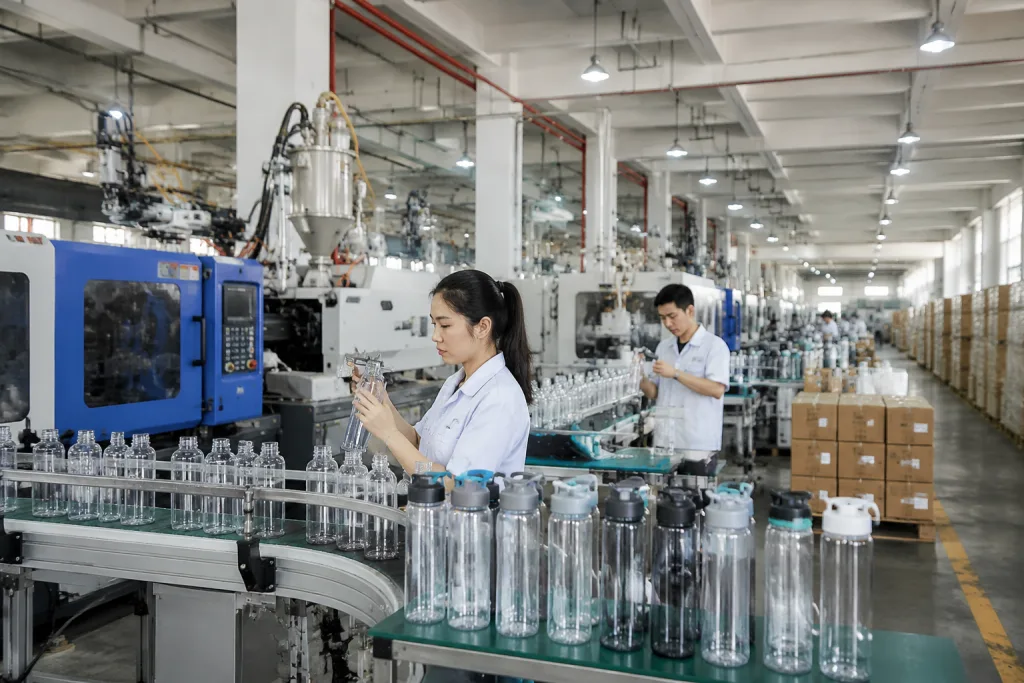
If you are sourcing from a polypropylene tritan bottle factory, do not treat PP and Tritan as one plastic. They can look close in a catalog photo. On the line, the difference shows fast. PP usually gives a lower unit cost and softer color tone; Tritan gives clearer walls, a better shelf feel, and different heat limits. Last month, QC pulled 30 samples and used a digital caliper for a 0.5 mm wall check after a buyer asked for “glass-like” clarity on a PP quote. Wrong target. That material choice can move your margin by 8–15%, change complaint risk, and decide how many 12 kg cartons sit in your warehouse after the first shipment.
From our Hangzhou, Zhejiang factory team, “which plastic is better?” is the wrong question to ask. Ask which plastic fits your sales channel. A school canteen customized bottle needs drop resistance and simple carton marks; a gym retail shaker needs lid torque checked at 8–10 kgf·cm and clean logo printing; a North America distributor program needs tighter packing, barcode control, and fewer surprises at AQL inspection. We run all three in China, but the PO cannot treat them as one item. We have seen this go sideways: “Tritan” was typed as “PP” on one line of a 5,000 pcs order, and the buyer flagged it only after the pre-production sample was already on the table.
PP vs Tritan at a glance
A polypropylene tritan bottle factory discussion should start with a blunt comparison, not a catalog pitch. PP is semi-opaque and light, with a little flex in the hand; we run it for school canteens, sports programs with squeeze caps, and promo bottles where the buyer is fighting for a USD 0.10 saving. Tritan is a copolyester. It gives clear, glass-like walls, better shelf value, and easier retail approval when the buyer wants the bottle to look closer to drinkware than packaging. Both are BPA-free when the resin and color masterbatch are written correctly on the BOM. They sell differently. Last month QC pulled one PP sample at 0.78 mm wall thickness after a buyer asked why the bottle looked “milky” beside a Tritan counter sample.
Here is the working spec table we use when a canteen distributor asks us to quote both materials on the same shape. It happens about 6 times a quarter. The usual trigger is a PO saying “clear PP,” one small typo that burns half a day on the line and sends the mold master back to the caliper before anyone talks price:
| Spec | PP bottle | Tritan bottle |
|---|---|---|
| Typical FOB range | USD 0.65-1.20 | USD 1.35-2.80 |
| MOQ per color | 3,000 pcs | 2,000-3,000 pcs |
| Visual feel | Matte or milky | Clear, glass-like |
| Heat tolerance | Often around 100°C, depends on grade | Usually 90-100°C, grade dependent |
| Impact resistance | Good flexibility | Good rigidity and toughness |
| Best channels | School, canteen promotional, mass giveaway | Retail, corporate gift, fitness, outdoor |
Our Zhejiang plant can run around 450,000 plastic drinkware units per month across PP, Tritan, AS, and PETG projects. Capacity matters. Material choice matters more. The wrong question is “which plastic is better?” Ask where it will sell and what abuse it must survive. A cheap Tritan quote with 0.9 mm walls and loose caps is not a premium product; we’ve seen this go sideways after the buyer flagged stress marks around the shoulder during carton drop testing from 1.2 m. A well-designed PP bottle with a tight lid, clean parting line, and stable 3,000 pcs color lot can beat it in school and outdoor programs.
Where PP makes better sense
PP is the better pick when the buyer is squeezing landed cost, asking for 6 or 8 body colors, and not asking for crystal-clear walls. For school canteens, summer camps, staff onboarding kits, charity events, or promo runs above 5,000 pcs, PP leaves budget for a proper lid instead of a thin cap that leaks after two weeks. We run these on multi-cavity injection molds; QC checks first shots with a 0.02 mm caliper before logo printing starts. Ask the right question. “Which plastic looks nicer?” is the wrong one. “Will the buyer reject the carton price?” decides the order.
For a 600 ml PP canteen with a one-color silk screen logo, a realistic China FOB price at 5,000 pcs often lands at USD 0.78-0.95, depending on cap structure, strap, packaging, and wall thickness. Basic squeeze-style or utility bottles usually sit around 1.0-1.3 mm wall thickness. If you want a heavier canteen customizable body, we move closer to 1.5 mm, but the mold cycle can stretch from 18 seconds to around 24 seconds, and freight weight climbs by 12-18 g per bottle. Small change. Real cost. Last month the buyer flagged it after seeing the carton gross weight jump on the PI; our packing table had already updated the CTN GW to 14.6 kg, but the buyer’s PO still showed 13.8 kg.
PP also takes solid color matching cleanly. If your brand has a strict Pantone target, PP can be compounded for red, navy, green, or school colors with less drama than clear Tritan, especially when the masterbatch supplier sends a 2 kg trial batch before mass production. The trade-off is plain: PP does not look like premium retail drinkware. It looks practical. For 20,000 pcs going into a school supply bundle, that is the point. We have seen this go sideways when a buyer asked for a luxury look at a giveaway budget. The math does not work.
- Choose PP for giveaways and school supply bundles where the target is 5,000-50,000 pcs, with bulk cartons, simple polybags, and no costly insert tray.
- Avoid PP if the buyer expects glass-like clarity or upscale retail packaging with a shelf price above USD 9.99.
- Watch the cap because most leak complaints come from lid design and gasket fit, not the PP body; QC pulled the sample twice when thread tolerance drifted by 0.15 mm.
For canteen vendors serving municipal tenders or education channels, PP usually wins because the buyer compares landed cost first and appearance second. We ship these orders in simple 5-ply export cartons, and the PO often has one messy line that matters more than the logo artwork: carton quantity. Get that wrong and loading gets ugly. We once had a 5,000 pcs order where the PO said 100 pcs per carton, while the approved packing was 80 pcs; that changed the carton count from 50 to 63 and killed the pallet plan.
Where Tritan earns its premium
Tritan earns its price when the bottle has to look clean on a retail shelf and sharp in the hero photo. PP has a softer, milky cast. Tritan shows lemon slices with clean edges and blue electrolyte powder without the “why is it cloudy?” complaint we hear from retail buyers. We run clarity checks under a 6500K light box; one hazy cavity in a 4-cavity mold can make a full carton look cheap. For customizable drinkware sold through gyms with logo walls, or on marketplaces where one image does the selling, the clear body often pays back the extra unit cost.
A 700 ml Tritan sports bottle with flip lid, silicone gasket, carry loop, and one-color logo usually lands around USD 1.65-2.20 FOB China at 3,000 pcs. Add time-marker print on both sides, a 350 g gift box, metallic lid trim, or a rubberized grip and the quote can move above USD 2.50. Buyers ask why Tritan is not only 10% above PP. Wrong question. The gap comes from resin cost, tighter injection settings, gate-area scrap, and the cap finish buyers expect on a premium bottle. Last month QC pulled 47 pcs from a 3,000 pcs run for black dots near the shoulder; those rejects are still sitting in the blue scrap cart beside machine No. 6.
Tritan also fits when you want a custom growler look without stainless steel or glass. For a lightweight customized growler concept in 1 L or 1.5 L, it gives clear visibility and a firmer hand feel than PP. Do not sell it as unbreakable. The math does not work after replacements. We have seen this go sideways on rigid-base designs: one buyer flagged corner cracks after a -5°C drop test from 1.2 m onto concrete, and the first email came with 9 close-up photos from their warehouse floor.
For a canteen manufacturer serving retail programs, Tritan is easier to sell with lifestyle photography and better margins. For a canteen promotional campaign handed out free at a marathon, PP usually wins on cost. Simple split. If the buyer keeps the bottle, Tritan makes sense; if the bottle is a low-cost giveaway, PP is safer. On POs, we still see “tritan/PP same mold” typed into the material line, and our merchandiser has to stop the order before tooling because shrinkage and wall thickness are not the same. We run separate mold-flow notes for this reason.
Use-case fit by buyer type
Match the bottle to the sales channel before you pick the shape. Shape comes second. Last year, 17 new buyers chose a bottle profile first, then learned the canteen distributor had a EUR 1.60 resale ceiling; the Tritan version was dead before sampling. Start with the channel, target retail price, and the number of complaints the buyer will tolerate per 1,000 pcs. Then work backward from cost. On the line, QC pulled a 600 ml PP sample with 0.35 mm parting-line flash near the grip; it looked fine in WhatsApp photos, but a school buyer would flag it during first-carton inspection.
| Buyer type | Better fit | Reason |
|---|---|---|
| School or camp canteen supplier | PP | Lower unit cost and better Pantone matching for house colors; we run 3 color chips before bulk because students do not pay extra for a crystal-clear wall |
| Gym retail brand | Tritan | Clear body gives a cleaner shelf look, and the printed logo stays visible through the wall after shrink packing |
| Corporate promotional agency | PP or Tritan | Gift budget decides it: USD 1 landed vs USD 3 landed, so the quote should split carton CBM from logo cost instead of hiding both in one line |
| Outdoor distributor growler program | Tritan or stainless | Higher perceived value, with 1 L and above capacity options that look stronger on a retail rack |
| Mass event canteen promotional order | PP | Price and color matching beat clarity here; the buyer normally pushes hardest on MOQ, delivery date, and whether the logo sits straight on the front face |
If you buy drinkware for distribution, ask for two quotes: one value PP version and one retail Tritan version. Keep the lid, capacity, carton packing, and logo method close enough for a fair check. Last month, one PO said “same lid,” but the PDF drawing showed a basic screw cap on one item and a leakproof flip lid with a silicone gasket on the other. Bad comparison. QC marked the lid difference in red on the sample sheet. At that point, you are not comparing materials. You are comparing two different bottles, and the math doesn't work.
For canteen distributors in Europe, check REACH and food-contact documents before artwork starts. For North America, ask about FDA food-contact compliance, California Proposition 65 where relevant, and ASTM-related physical tests if the bottle is for children. We check this against the BOM and resin grade sheet before opening the mold file. This is not paperwork for later. A solid canteen factory in China should say which tests apply before you pay for packaging artwork; we have seen 8,000 color boxes reprinted because one compliance line was missing beside the recycling mark.
Customization choices that change cost
Custom drinkware pricing jumps the moment you leave a stock bottle with a one-color logo. We quote PP and Tritan bottles by resin grade, mold cavity count, cycle time, decoration method, pack-out, and inspection level, but material is only one line on the cost sheet. Last month QC pulled a 650ml Tritan sample from a 4-cavity mold; the body weight was 118g, the caliper showed a 1.2mm wall at the shoulder, and the buyer still asked why custom color cost more than clear. Wrong question. The gap comes from scrap rate, purge loss, and machine hours on the line.
For logos, silk screen is still the safe workhorse. Low cost. Clean result. It fits simple artwork, mainly 1-2 colors under 80mm wide. On PP, silk screen holds well after flame treatment; the line checks surface tension with a dyne pen before printing, and we reject anything under 38 dynes. On Tritan, it works too, but large artwork on a curved clear body needs a tighter fixture, or the logo creeps 1.5mm around the shoulder. UV printing gives sharper detail and more colors, but setup takes longer and reject trays fill faster. Laser engraving is a poor fit for most PP or Tritan bodies. We run it more on stainless clips and metal lids.
Color is where buyers underquote themselves. A stock transparent Tritan body with a custom lid color can usually meet MOQ at 2,000-3,000 pcs. A full custom Pantone Tritan body often needs 5,000 pcs because color drift and resin purge loss are less forgiving; we have dumped 22kg of off-shade Tritan before the masterbatch settled. PP color matching is easier at 3,000 pcs per color, so it works for canteen customizable school sets where buyers need class-group colors, such as red lids for Grade 1 and blue lids for Grade 2. One PO came in with “Panton 2925C.” Small typo, real delay.
Packaging can quietly eat your margin. Bulk pack may run 50-100 pcs per master carton depending on bottle capacity and lid shape. Individual white boxes add roughly USD 0.08-0.18 per unit. Printed retail boxes often add USD 0.15-0.35 per unit plus plate or proofing fees. For ecommerce canteen vendors, we usually add barcode labels and FNSKU labels, then run drop-test cartons and keep carton weight below courier limits; 15kg is a common target. We have seen this go sideways when a buyer approved a nice box but forgot the 76cm drop test. QC pulled the carton after the third corner drop because the flip lid cracked against the inner wall.
Spend money on the lid before you spend money on a fancy box. A beautiful package will not save a bottle that leaks in a backpack.
Testing and compliance checkpoints
Plastic drinkware looks simple on the line. It still touches food, so we clear the file before shipment, not after a retailer compliance desk blocks the PO. For Europe, buyers usually ask for EU food-contact compliance, LFGB for Germany, and REACH/SVHC screening. For the United States, FDA food-contact requirements are standard; California Proposition 65 depends on the sales state and the retail channel. Last month, QC pulled the resin COA for a PP lid because the buyer flagged one missing batch number on the packing list. The typo was “B23017” instead of “B23071,” and it held the carton labels for 6 hours.
Physical testing counts as much as the documents. We run leak tests on assembled bottles, lid torque checks with a digital torque meter, 1.0 m drop tests for sports and school designs, dishwasher simulation when that claim is printed on the color box, plus odor checks after 80°C hot-water filling. For children’s bottles, ASTM or CPSIA-related checks depend on age grading and small components. Ask this before tooling. We have seen projects lose 12 days because a silicone straw tip was treated as a child-accessible part only after the mold was finished; by then the 2D drawing had already been signed and the insert steel was cut.
Inspection should follow an agreed AQL standard. A practical setup is AQL 2.5 for major defects and 4.0 for minor defects, with critical defects not accepted. Major defects include leakage, wrong material, sharp edges, poor cap fit, missing logo, or severe color mismatch. Minor defects include small print specks, light flow marks, or packaging scuffs inside the approved limit sample. On one 30,000 pcs order, the inspector found 7 bottles with cap-thread flashing over 0.3 mm. The line stopped carton sealing, trimmed the threads with a deburring knife, and rechecked the packed goods before release.
If your canteen suppliers dodge testing questions, treat it as a warning sign. A responsible canteen manufacturer should confirm resin grade, share prior test reports when available, and state whether new testing is included or billed separately. In Zhejiang and broader China manufacturing, serious factories are used to third-party inspections from SGS, Intertek, TUV, or Bureau Veritas. The math does not work if you save USD 180 on testing and then face a rejected container. We ship containers every month; one failed retail audit costs more than the lab invoice, and we have seen this go sideways over a single Tritan material declaration missing from the file.
MOQ, tooling, and production timing
MOQ is where a custom drinkware project either clears costing or dies in the spreadsheet. For stock PP bottles with a custom logo, 3,000 pcs per color is our normal floor; below that, pad-print setup, color change, carton labels, and machine cleaning eat the margin. For stock Tritan bottles, 2,000-3,000 pcs works if the body color stays standard and the change is only logo or lid color. For a new private mold, we usually start at 10,000 pcs because tooling trials, resin drying, and line tuning need enough volume to settle. The math doesn't work at 800 pcs. Last month QC pulled a 650 ml Tritan sample because the lid color was 1.8 mm off the approved color chip at the hinge area. Small detail. Big argument.
Tooling time for a new plastic bottle body is commonly 25-35 days after 3D drawing approval. First samples need another 5-7 days for review and adjustment. After the golden sample is signed, mass production normally runs 20-30 days for 3,000-20,000 pcs, based on decoration method and packaging. Peak season before summer adds 7-14 days, so a June sports bottle order placed in late May is the wrong plan. We run the first injection trial with a Mitutoyo caliper, torque tester, and leak test tank beside the machine; if the thread shrinks by 0.3 mm, the line stops for adjustment.
Tool cost changes with bottle size and cavity count. A simple lid insert may be a few hundred dollars. A new bottle body mold can range from USD 3,000 to over USD 12,000, based on capacity, shape, thread structure, and number of cavities. If a canteen factory quotes a low tool charge, ask who owns the mold, whether it is 1-cavity or 2-cavity, and whether maintenance is included after 50,000 shots. We’ve seen this go sideways: the buyer paid for “private tooling” and later found the same 750 ml body in another importer’s catalog.
For FOB Ningbo or Shanghai, Zhejiang factories have a practical freight advantage because inland trucking is short and predictable. From our side of Hangzhou, a full container to Ningbo port is usually a same-day truck, not a two-day cross-province handoff. That matters when your distributor growler or customized canteen shipment has a fixed retail launch date. The production calendar starts only after deposit, artwork approval, packaging file approval, and confirmed test requirements; one buyer once sent a PO with “Trian” instead of “Tritan,” and we held the job until the material line was corrected.
How to brief the factory
A clear RFQ saves 2–3 email rounds. A loose one gives you three prices based on three lids, two carton sizes, and different resin grades, so the comparison is useless. Send the basics to the polypropylene tritan bottle factory: capacity, PP or Tritan target, FOB price target, order quantity, body color count, logo method, packaging, destination market, and compliance standard. Be specific. On our costing sheet, lid tooling, carton CBM, logo setup, and resin grade sit in separate cells; if one is blank, sales has to guess, and that guess gets challenged later. We see it on the line: the quote says PP, the sample room reads Tritan, and the buyer’s PO has no material line at all. If the material is not fixed, ask us to quote one PP version and one Tritan version with the same capacity and lid style.
For example, a useful brief says: “700 ml bottle, leakproof flip lid, one-color logo, 5,000 pcs, two body colors, individual white box, EU market, REACH and EU food-contact required, FOB Ningbo, target ship date September 10.” Good brief. That gives the canteen supplier enough detail to quote cleanly and check whether the line can handle the color change without losing half a shift on barrel cleaning. We run a purge on the injection machine, and dark blue to clear is not a 10-minute changeover. A weak brief says: “Send best price for custom canteen.” That usually gets you a low anchor price that moves later, often after the buyer flags the missing Pantone code or we find the logo is 48 mm wide, not 30 mm, on the artwork file.
Ask for production photos, BSCI or ISO 9001 status if your customer requires it, prior test reports for similar materials, and a pre-production sample. For distributor canteen programs, get carton dimensions and gross weight before artwork approval. We have seen a 1 L bottle carton move from 0.062 CBM to 0.081 CBM after adding a retail box, and the freight erased the PP price advantage. The math doesn't work if you compare only unit price. QC pulled the sample, the bottle passed leak testing, then the carton failed a drop check because the insert was 1.5 mm too thin. Freight can change the winner between PP and Tritan, especially for bulky 1 L bottles or a customizable growler with a retail box.
The best factory relationship is direct and specific. You do not need every resin code, but you should control the commercial calls: material, cap quality, compliance level, packaging, and inspection method. Asking “what is your lowest price?” first is the wrong question to ask. Ask which resin we run, what torque test we use on the cap, and whether final inspection follows AQL 2.5 or your own checklist. We use a torque meter on threaded caps, not a thumb-feel check from the packing table. We ship better reorders when those points are locked before the PO, not after someone notices a typo in “FOB Ningbo” or a missing spare gasket line. Once those points are fixed, a capable China factory can make the product repeatable instead of cheap for one shipment and painful on the reorder.
Send your PP or Tritan bottle brief today
Share capacity, quantity, logo, packaging, and destination market. We will quote practical PP and Tritan options with MOQ and lead time.
Frequently asked questions
Is PP or Tritan better for a custom canteen order?
PP is usually better for a custom canteen when your budget is tight, the order is promotional, or the customer wants strong solid colors. At 5,000 pcs, PP may quote around USD 0.78-0.95 FOB for a simple 600 ml bottle. Tritan is better when the bottle must look premium, clear, and retail-ready. A 700 ml Tritan bottle often runs USD 1.65-2.20 FOB with a decent flip lid. If your canteen customized project is for schools or events, PP is often enough. If it is for gyms, ecommerce, or corporate gifting, Tritan usually earns the higher price.
What MOQ should I expect from a polypropylene tritan bottle factory?
For stock designs, expect 3,000 pcs per color for PP and about 2,000-3,000 pcs for Tritan if the body color is standard. Custom Pantone body colors often push MOQ to 5,000 pcs. New private molds normally need 10,000 pcs or more to make sense, although tooling can start with sample development before the full order. For a canteen promotional order with one logo and two colors, 6,000 pcs total is a practical starting point. Very small orders are possible only when you accept stock colors, simple packaging, and higher unit prices.
Can Tritan bottles pass European and North American food-contact tests?
Yes, if the correct resin and colorants are used and the factory manages material traceability. For Europe, you may need EU food-contact testing, LFGB for Germany, and REACH/SVHC screening. For North America, FDA food-contact compliance is common, with California Proposition 65 depending on your sales channel. Do not rely only on an old test report unless the material, color, and supplier are the same. For customized drinkware, new testing is often worth the cost, especially for large retail or distributor drinkware programs above 10,000 pcs.
How long does a customized canteen project take?
For a stock bottle with logo printing, plan 20-30 days for mass production after artwork and sample approval. Add about 5-7 days for sample making and courier time. For a new mold, tooling usually takes 25-35 days after drawing approval, plus time for adjustment. A realistic custom canteen timeline is 35-45 days for stock shape and 60-75 days for new private mold, excluding sea freight. If packaging, testing, or FNSKU labeling is required, confirm those details before deposit because they can add several days.
What defects should I inspect before shipment?
Check leakage, cap fit, gasket placement, odor, sharp edges, logo position, color match, scratches, flow marks, carton labeling, and barcode accuracy. Use AQL 2.5 for major defects and 4.0 for minor defects unless your retailer requires stricter levels. For canteen distributors, leakage is the most expensive defect because it leads directly to returns. Test filled bottles upside down and on their side for at least 30 minutes. For Tritan, also inspect clarity and black specks. For PP, inspect color consistency and deformation after warm water filling if heat resistance is claimed.