Key Takeaways
- Stainless thermos with polypropylene lids cost 15-25% less than full stainless models at MOQ 1,000 units.
- Custom thermos orders from Zhejiang factories typically require 25-35 days lead time for the first batch.
- Bulk thermos buyers should specify AQL 2.5 or better; most promotional thermos suppliers default to AQL 4.0.
- Customizable thermos with double-wall vacuum insulation retain temperature 6-8 hours; single-wall polypropylene liners retain 2-3 hours.
I've sent out RFQs to 15 Zhejiang factories for polypropylene thermos wholesale orders. Half the quotes came back within 24 hours with line items that made no sense—201 stainless spec'd where 304 was mandatory, 45mm mouth openings on a 500ml body that can't fit a standard ice cube. The buyer on the other end doesn't care about your 40 config options. They care about three things: will it leak in a gym bag, will the print scratch off in 90 days, and can I sell it at 3x landed cost.
This section walks through four decisions you lock down before a single quote hits your inbox. We're talking material grades where the ¥8 difference per unit between 304 and 201 stainless compounds into ¥240,000 on a 30,000-piece order. Tooling amortization that either gets buried in the unit price or hits you as a separate ¥15,000 line item on the PI. MOQ thresholds where 30,000 pieces drops your unit cost 12% but stretches lead time from 25 days to 45—and your container sits at Ningbo port for another week if the booking's off. By the time you finish reading, you'll have the spec sheet nailed down tight enough that a Zhejiang factory can quote you in one round, not three.
Decision 1: Liner Material – Stainless vs. Polypropylene
The first decision on the spec sheet: stainless liner or polypropylene liner. Both come off the same production lines in Zhejiang, but they split on cost, weight, and how long the drink stays drinkable.
Stainless liners — we run 304 and 201 grade here — are what make vacuum insulation possible. A double-wall stainless thermos with a proper vacuum holds coffee above 60°C for 6–8 hours and keeps iced drinks cold for 12–14. That's the baseline for outdoor retailers selling to hikers and commuters who check performance. Price check: a 500ml stainless thermos with a 304 liner lands at $4.20–$6.80 FOB Ningbo at MOQ 1,000. Three weeks ago QC pulled a sample where the vacuum had leaked — the laser weld at the base had a 0.3mm pinhole. Factory replaced the entire 500-unit run.
Polypropylene liners are injection-molded single-wall inserts dropped inside a stainless outer shell. No vacuum chamber. Heat retention drops to 2–3 hours. So why do buyers spec this? Weight and price. A PP-lined stainless thermos runs $2.50–$3.80 FOB — roughly 40% cheaper than the full stainless version. It's also 30–40% lighter. For a trade show giveaway where the attendee uses the bottle for an afternoon, that math works. For a hiker expecting 8 hours of hot coffee, it doesn't.
Quick summary: stainless liner gets you performance and weight. PP liner gets you cost savings and a lighter carry. Most outdoor brands default to stainless. Promotional brands with tight per-unit budgets? Polypropylene thermos wholesale is the play.
One thing we tell every buyer: get the material declaration. Food-grade PP should meet FDA or REACH standards — but only if the factory used the right resin batch. Request the third-party test report for that specific PP lot. We saw a shipment flagged last year because the liners had a burnt-plastic smell when hot water hit them. The factory had quietly switched to a cheaper resin supplier. No heads-up, no paperwork. The buyer caught it at incoming inspection and rejected 2,000 units.
Decision 2: Mouth Diameter – Standard vs. Wide
Mouth diameter is the second call. It changes the drink feel, the way QC checks the inner wall with a flashlight, and whether a 25mm ice cube drops in cleanly. For polypropylene thermos wholesale, we usually quote two mouth sizes: standard (35-42mm) and wide (55-70mm).
Standard mouth is cheaper to tool. The cap stack is simple: one flat silicone gasket and one PP liner mold, usually $800-$1,200 per cavity on our side. We run this for desk giveaways when the buyer is chasing a $0.20 saving per unit. Fair enough. Crushed ice only. A full cube will not drop, and cleaning becomes the catch; last year QC pulled the sample after finding tea residue 38mm below the neck where our bottle brush could not reach.
Wide mouth is what outdoor retailers ask for after the first sample meeting. A 58mm opening takes standard ice cubes, and the user can wipe the inside with a kitchen sponge instead of shaking hot water and hoping. Tooling sits at $1,500-$2,500 per cavity, with $0.30-$0.50 extra per piece. The cap is the part buyers underestimate: spout lid, cup lid, extra gasket, plus 2 more assembly steps on the line. We have seen this go sideways when the PO says “wide mouth” but the artwork mockup shows a slim push-button lid. If the design has a threaded inner lid that unscrews for filling, call it out in the product copy.
For a distributor thermos program aimed at hikers or tradespeople who need one-hand drinking, go wide. For a promo thermos that sits beside a laptop, standard mouth does the job. Ask your supplier about the cap first; this is the wrong question to leave until sampling, because a removable inner lid changes the tooling quote and the 1.2m carton drop test result.
Decision 3: Customization Level – Color, Logo, Packaging
You need a custom thermos, but price means nothing until the customization depth is fixed. For polypropylene thermos wholesale, we usually quote 3 tiers, and QC checks the PP liner color against a Pantone chip in a D65 lightbox before mass production starts. Do it early. One PO came in with 186C typed as 168C, and the first liner sample missed by a full shade.
- Tier 1 – Color change only: The factory keeps the existing mold and changes the powder coat or PP liner color. MOQ 500-1,000 units per color. Lead time 15-20 days. No logo. We run this when the buyer accepts our current 68 mm body diameter and only needs a shelf color matched within about 1 Pantone shade; the line still needs a 30-minute spray-gun setup and a film thickness check at 60-80 microns.
- Tier 2 – Logo application: Add your brand logo to the stainless body. Silkscreen works for 1-2 color artwork. Pad print is safer on curved caps. Laser engraving gives a clean mark when the buyer wants no ink. MOQ 1,000-2,000 units. Silkscreen tooling cost $50-$150 per color. Lead time 20-25 days. This is what we quote for most promotional thermos orders; last month QC pulled the sample because the logo sat 2 mm too close to the bottom seam.
- Tier 3 – Full custom: New stainless body shape means new stretch tooling, the PP liner needs its own mold, and color plus logo still need separate approval samples. MOQ 3,000-5,000 units. Mold cost $3,000-$8,000. Lead time 35-50 days. Choose this only for repeat batches. The math does not work for a one-off holiday order; we have seen buyers approve a 420 g body, then push back hard after we measured the carton and recalculated freight.
For 8 out of 10 custom thermos buyers, Tier 2 is the practical choice. You get a branded product without paying for a new mold. Ask your manufacturers thermos supplier if they run a 'stock custom' program: they keep a standard stainless body in 2 shapes or 3 shapes and let you pick from 10-15 pre-approved colors, then print or engrave your logo. We ship that at 500 units with lead time at 18 days, as long as the PO has the correct Pantone code and the logo file is vector artwork, not a 72 dpi JPG. “Can I change everything?” is the wrong question to ask first. Start with the sell price. The line can do a lot, but retail margin decides how far you should go.
Packaging is another place where buyers burn money, and we have seen this go sideways. Standard bulk thermos come in a polybag or a plain brown box. You can upgrade to a printed gift box (add $0.40-$0.80 per unit) or a hang tag with product specs. For outdoor retailers, a recycled cardboard tube or a fabric pouch can add shelf value without much cost, but ask for a carton drop test first; we once had gift box corners crush after a 12 kg master carton stack test. QC flagged it at the packing table, not in the showroom.
Decision 4: Compliance and Testing – What Your Buyer Will Check
The fourth decision is paperwork your buyer will check. For Europe or North America, get the files before sample approval, not after 3,000 pcs are packed and taped. We run this check at sample stage with a 0-150 mm digital caliper on the mouth diameter and a material sheet beside the sealed PP liner sample. We've seen this go sideways: the PO said "PP food grade," but the test report named another resin batch. A responsible thermos supplier in Zhejiang should provide:
- Food-grade material declaration for the PP liner and stainless steel. 304 grade is preferred; 201 grade is acceptable for promotional thermos, but not for food contact in some EU markets. Ask the factory to match the declaration to the BOM code on the sample tag, such as PP-02 liner and 0.5 mm inner wall.
- Migration test report for the PP liner, showing that heavy metals and plasticizers are below EU 10/2011 or FDA 21 CFR limits. QC should pull the same color liner you will ship, because black PP and white PP often use different masterbatch. We had one lab fail on a 35 g black liner while the natural-color sample passed.
- Thermal performance test for vacuum insulation, if the model uses a stainless liner. The factory should have a lab that measures temperature loss over 6 hours. On our line, the test rack logs water at 95°C, then checks the reading again after 6 hours with a probe thermometer.
- AQL inspection report from a third party like SGS or Bureau Veritas. Standard is AQL 2.5 for major defects, 4.0 for minor defects. If your custom thermos is for a premium outdoor brand, request AQL 1.0. The buyer flagged it once because 7 lids in a 200 pcs inspection lot had silicone ring flash over 0.3 mm.
About 6 out of 10 polypropylene thermos wholesale suppliers in China will quote a "compliance package" for an extra $200-$500 per order, covering testing and certification. Budget it. The math doesn't work if you save $300 and then lose 12 days vs 18 days at port while customs asks for BPA or phthalate proof on the PP liner. Even when the material is compliant, the test report is the paper that gets your cartons released. One customs broker once rejected a file because the PO typed "P P liner" with a space and the lab report printed "PP liner." Small typo. Real delay.
Ask about BSCI or SMETA audits as well. European retailers now ask for factory social compliance audits in about 4 out of 10 vendor checks; last month one buyer held a 5,000 pcs repeat order until we sent the BSCI PDF and the audit expiry date. A thermos factory in Zhejiang with BSCI certification gives procurement a cleaner vendor file, because working hours, dormitory checks, and wage records have already been reviewed. For promotional thermos, it is not always a hard requirement, but we ship repeat orders faster when the audit PDF is already sitting in the buyer's folder.
Comparing Suppliers: What to Look for in a Factory
By this stage, the spec sheet should already show liner material, mouth diameter, logo process, and compliance files. Good. Now audit the factory, not the brochure. Around Zhejiang, we see about 200 drinkware factories quoting stainless and polypropylene thermos projects between Yongkang, Wuyi, and nearby Jinhua; only about 35 keep PP injection, vacuum testing, packing, and export paperwork inside one gate. The buyer flagged this last month: the quote looked fine, but the PP lid mold sat 38 km away at a subcontractor, so the first sample moved from 12 days to 18 days.
- Monthly output: A mid-size factory in Yongkang or Wuyi produces 150,000-300,000 units per month. A large factory does 500,000+. Ask for current capacity utilization and active lines, not the catalog number. If they are at 90%+, your lead time will stretch; we saw vacuum test racks backed up for 2 shifts when one 500 ml model overran by 32,000 pcs.
- MOQ per SKU: Most factories require 1,000 units per color per model for custom thermos. Some accept 500 for stock custom. Need 300 units for a pilot? Price it as a sample order with a premium, usually +30-50%. The math doesn't work for a new PP cap color at 300 pcs because the injection line still needs color purging, mold setup, and about 8 kg of trial resin.
- Lead time: First order: 25-35 days. Repeat orders: 15-20 days. Sea freight adds 25-35 days to US West Coast and 35-45 to East Coast. Ask whether the factory counts lead time from deposit receipt, artwork approval, or confirmed golden sample; one PO typo on Pantone 186C versus 185C cost a buyer 4 extra days before the line could run.
- Sample policy: A solid supplier thermos vendor will send 1-3 samples for the cost of shipping plus a sample fee ($30-$80). Insist on production samples before you pay the balance. QC pulled the sample from mass production, not the showroom shelf, then checked mouth diameter with a digital caliper at 0.02 mm resolution.
- Payment terms: Standard is 30% deposit, 70% balance against copy of B/L. Some factories ask 50/50 for first orders. Never pay 100% upfront. We ship on this structure because it keeps both sides honest; if a supplier pushes full payment before carton drop test and AQL inspection, we've seen this go sideways.
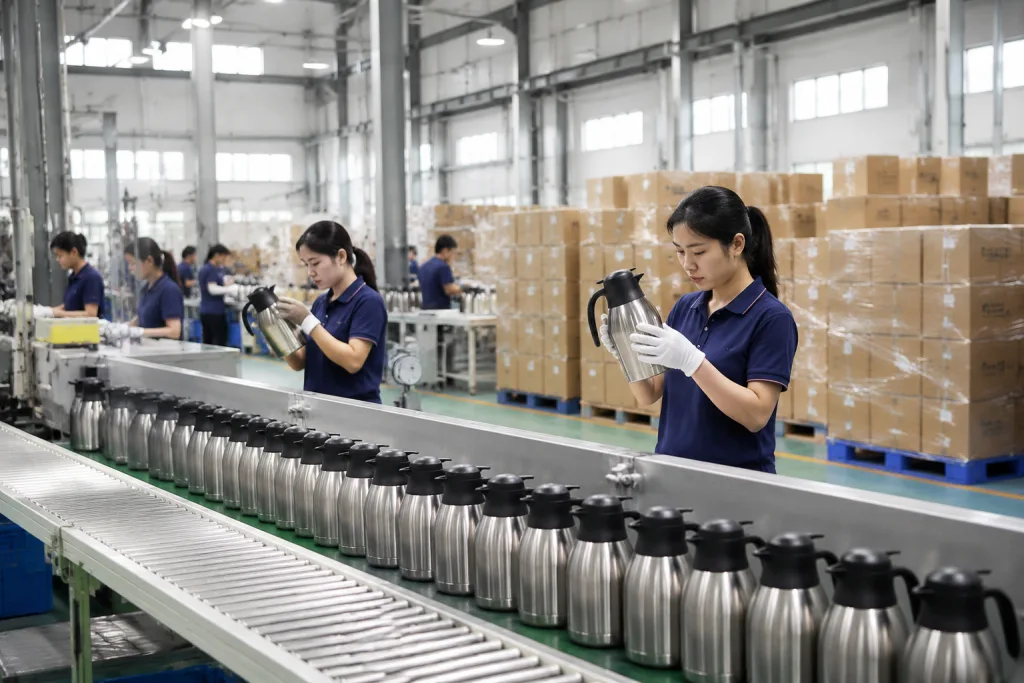
One practical tip: visit the factory or book a third-party pre-shipment inspection. AQL sampling is cheap insurance. If you cannot visit, ask for a video walkthrough of the PP injection molding line and the stainless assembly line, with a clear look at the mold rack, vacuum test station, laser marking table, finished-goods warehouse, and reject bin. Clean floors matter. The reject bin tells you more; last time QC pulled 17 lids with flash over 0.3 mm before packing started.
Pricing Breakdown: What You Pay for in a Polypropylene Thermos
For polypropylene thermos wholesale, our quote sheet usually starts here: 2,000 units, 500ml capacity, standard mouth, silkscreen logo, polybag packing, FOB Shanghai or Ningbo. The line checks the 0.4mm shell with a Mitutoyo digital caliper before coating; if a supplier offers 0.35mm to save a few cents, QC normally finds dents after the 76cm carton drop test.
- Stainless outer shell (304 grade, 0.4mm thickness): $1.80-$2.20
- Polypropylene liner (food grade, injection molded): $0.60-$0.90
- Cap assembly (PP with silicone seal): $0.30-$0.50
- Powder coating or painting: $0.40-$0.60
- Silkscreen logo (1 color, 1 position): $0.15-$0.25
- Polybag and inner carton: $0.10-$0.15
- Labor and overhead: $0.40-$0.60
- Total FOB per unit: $3.75-$5.20
Add $0.30-$0.50 for a printed gift box. A hang tag adds $0.10. A 1g desiccant pack adds $0.05 when the buyer wants the shelf look clean after 28-35 days at sea, especially for humid routes into Florida or Panama. Small stuff matters. Last month QC pulled the sample because the PO said "gift box" but the artwork file was still sized for a 62mm hang tag.
Compare that with a full stainless thermos using a stainless liner and vacuum insulation at $4.20-$6.80 FOB. The polypropylene thermos wholesale option saves 20-30% per unit, so the same budget buys 5,000 giveaway units instead of 3,500. Cheap is the wrong question to ask. We have seen this go sideways when a buyer cut the cap seal by $0.04, then got leakage complaints after the first 3 cartons were opened at the warehouse.
Common Pitfalls When Ordering Custom Thermos from China
Seasoned distributor buyers still miss small items on custom thermos orders. We see 3 repeat problems on PP liner jobs, usually after QC pulls the sample on the packing table with a 60°C water kettle, digital caliper, and leak-test rack beside 3 open cartons.
Pitfall 1: Assuming all polypropylene is the same. Food-grade PP and recycled PP do not run the same on the injection line. Recycled material often leaves a gray tint around the injection gate, and we have rejected liners after a 60°C hot-water check because the plastic smell stayed after 2 rinses. Ask for the material data sheet and migration test report for the exact batch on your PO, not a generic PDF from last year. If the factory hesitates, move on. The math doesn't work if you save USD 0.03 on resin and lose 600 pcs at final inspection.
Pitfall 2: Overlooking the cap seal. The silicone gasket in the cap is the failure point we see most often. Cheap gasket material hardens after 3-4 months or leaks when the bottle sits at 45° on the test bench. Ask your supplier thermos vendor what durometer silicone they run. 40-50 Shore A is standard. Ask if the gasket is removable for cleaning. If it is glued in, replacement is impossible, and we have seen this go sideways when a buyer asked for spare seals after the container had already shipped. QC pulled 20 caps from one 3,000 pcs lot last year; 4 failed the upside-down shake test within 30 seconds.
Pitfall 3: Ignoring the inner surface finish. The stainless outer shell of a polypropylene thermos often has a brushed or painted interior surface because it is not in contact with liquid. Fair enough. The PP liner’s inner surface still needs to be smooth. Rough injection molding leaves tiny crevices where residue sits; on one 8,000 pcs run, QC found flow marks near the bottom radius and stopped the line before packing. Request a close-up photo of the liner interior from the factory, with the bottom radius and injection gate visible under white light. A glossy finish is the better target, but mirror-like perfection on PP is the wrong promise to chase.
Order 5-10% extra units to cover AQL rejects and shipping breakage. Most factories will accept a 5% overrun at the same unit price, but check that the overrun is written on the PO; we once had a buyer flag a “5 pcs” typo that should have been “5%.” Do not assume a fast reorder. Custom thermos lead time can move from 18 days to 32 days during peak season, with August-October Christmas promotions filling the line, and we will not stop a 12,000 pcs color tumbler job to squeeze in 480 replacement bottles.
Building a Long-Term Relationship with Your Thermos Supplier
The first polypropylene thermos wholesale order tells us a lot. Last quarter we checked 37 orders; the clean ones had the same basics right: correct SKU, usable AI logo file, carton mark spelled the same way on the PI, and deposit arriving on the promised date. Small things matter. Treat the first batch like a line trial on our PP injection machines, with the hopper set to the agreed resin grade and the first-shot sample checked by caliper, not like a one-time price squeeze.
Start with a small, clean order. Run 1,000-2,000 units of a standard model with one logo position and one carton mark. Pay on time. Send feedback with photos, AQL 2.5 results, and notes we can measure, like “lid gap measures 0.6 mm on 8 samples.” That builds trust fast. Later, when you ask for a customized thermos with a new mold, the factory has a reason to move your tooling run ahead of the buyer who sent 3 logo files and changed the cap color after PP injection had already started. The line remembers.
Share your sales forecasts. If you plan to order 10,000 units over the next 12 months, tell the supplier early. We run material planning by resin grade, color masterbatch code, and stainless inner stock; the production manager needs that before the line fills up for peak season. A 5-10% discount for annual commitments is possible. The math does not work if the buyer promises 10,000 units and releases only 1,500. Some manufacturers thermos suppliers in Zhejiang will hold raw material inventory for you, usually after 30% deposit or a signed call-off schedule, and our warehouse team will tag those PP bags by PO number to avoid mixing colors.
Visit or video-call regularly. A 30-minute monthly video call is enough to review production status and buyer complaints from the last shipment. Keep it practical. Ask to see the injection line, the vacuum testing station, or the packing table where QC pulled the sample with a scratched PP shell. Factories in China appreciate buyers who understand the manufacturing process. Mentioning PP injection molding or vacuum insulation is fine, but asking about 42-second cycle time, 2.3 mm wall thickness, or leak test pressure tells us you are watching the real process, not just chasing FOB Ningbo by 0.03 USD.
Negotiate exclusivity for a specific model. If one custom thermos starts selling well, ask for a 12-month exclusive on that design. The supplier thermos vendor may agree if you commit to a minimum order quantity, often 5,000-10,000 units per color or per year depending on tooling cost. Get the model code, mold ownership, logo area, and sales territory written into the PI, then check the sample label before mass production. We have seen this go sideways: one buyer asked for exclusivity on “the 500 ml cup,” but the PO typo listed 550 ml, so the factory sold a near-identical 500 ml version to another importer.
Ready to source your custom thermos?
Contact our Zhejiang factory team for a quote on polypropylene thermos wholesale orders with your logo.
Frequently asked questions
What is the minimum order quantity for a polypropylene thermos wholesale order from China?
The standard MOQ for a custom thermos with logo is 1,000 units per color per model. Some factories in Zhejiang offer a 'stock custom' program with MOQ 500 units. For a fully customized thermos with a new mold, expect MOQ 3,000-5,000 units. If you need a pilot run of 200-300 units, ask for a sample order—the per-unit price will be 30-50% higher, but it allows you to test the market before committing to bulk.
How long does it take to produce a custom stainless thermos with a polypropylene liner?
For a first order with logo application only (no new mold), lead time is 25-35 days from deposit confirmation. Repeat orders typically take 15-20 days. If a new injection mold for the PP liner is required, add 20-30 days for tooling. Always factor in sea freight: 25-35 days to US West Coast, 35-45 days to East Coast. Air freight is possible but adds $3-$6 per unit depending on weight and volume.
Can I get a custom color for the polypropylene liner?
Yes, but the MOQ for a custom PP liner color is usually higher—2,000-3,000 units per color. The color is achieved by adding masterbatch to the PP resin during injection molding. Standard colors (white, black, gray, blue) have no extra cost. Custom Pantone colors add $50-$150 for color matching and $0.05-$0.10 per unit for the masterbatch. Lead time increases by 5-7 days for color sampling.
What testing certifications should I request from a polypropylene thermos supplier?
At minimum, request a food-grade material declaration for the PP liner and a migration test report per EU 10/2011 or FDA 21 CFR. For the stainless steel outer shell, ask for a material certificate confirming 304 grade (or 201 grade if specified). For vacuum-insulated models, request a thermal performance test showing temperature drop over 6 hours. If your target market is Europe, also ask for REACH and RoHS compliance. Many factories offer a compliance package for $200-$500 per order.
How do I ensure the polypropylene liner does not leach chemicals into the drink?
The PP resin itself is generally safe, but low-quality recycled PP can contain contaminants. Insist that the factory uses virgin, food-grade PP resin from a known supplier (e.g., Borealis, LyondellBasell, or Sinopec). Request a third-party migration test from a lab like SGS or Intertek, specifically testing for heavy metals (lead, cadmium, mercury), phthalates, and BPA. The test should follow EN 1186 or FDA 21 CFR 177.1520. A reputable factory will provide this report without hesitation.