Key Takeaways
- Specify PP lid grade (food-grade, BPA-free, heat resistant to 120°C) and require a material certificate on every custom thermos order.
- Demand vacuum insulation test reports showing 8+ hour heat retention (≥65°C after 6 hours) for any bulk thermos shipment.
- Use AQL 2.5 for visual defects and AQL 1.0 for functional defects on your QC checklist; reject any batch that fails.
- Plan for 30–45 days lead time from PO to FOB Shanghai for a custom stainless thermos with PP components, including 10–15 days for sampling.
You are building an outdoor retail line: a custom stainless thermos that can take trail knocks, keep coffee hot for eight hours, and still show a clean logo after 30 minutes in our carton rub tester. You picked a polypropylene thermos supplier in Zhejiang because the PP lid and stopper have to pass food-contact checks, stay BPA-free, and survive daily twisting at the thread. Fair choice. The first PO is where buyers get stuck. A 0.3 mm lid mismatch, a missing Pantone C suffix, or a gasket hardness left blank at 50 Shore A can stop the line for 6 days. We have seen this go sideways. Lock the drawing, sample sign-off, AQL 2.5 inspection points, and shipment date before you send the PO.
This article follows one real buying case: an outdoor retailer ordering 5,000 pieces of a 500 ml stainless steel vacuum thermos with a PP drinking lid and a silicone gasket. We run through the questions our sales desk asks, the numbers our engineer checks with a Mitutoyo digital caliper, and the pushback buyers usually send after QC pulled the sample from the line. Ask for “good quality” and the math doesn't work. Ask for 304 stainless wall thickness, eight-hour heat retention data, AQL level, carton drop test results, and lead time by process, and a polypropylene thermos supplier in China can give you answers we can build against.
Defining Your Custom Stainless Thermos Specs
Start the first call with the polypropylene thermos supplier from a locked spec sheet, not a mood board. We run it line by line: 500 ml double-wall vacuum-insulated stainless steel bottle; 304 stainless inner liner; 201 stainless outer shell; PP drinking lid; silicone sealing ring. The lid needs a threaded screw-on structure with one-hand push-button opening. Include the PP base cup. Small parts bite. QC pulled a sample last month where the base cup sat 0.8 mm proud, and the buyer flagged the wobble on the carton table before we even reached the drop test.
Put the target size in writing: bottle height 270 mm, diameter 75 mm, weight 320 g. Wall thickness should read outer wall 0.35 mm and inner wall 0.30 mm. Those are normal numbers for factory thermos production in Zhejiang, so the supplier should check them with a digital caliper before anyone starts talking about tooling. Short answer: no new mold. If they quote 12 days for sampling with the existing tube size and 18 days after a mold change, the math doesn't work for a standard 500 ml body.
For the PP lid, call out food-grade polypropylene, BPA-free status, and heat resistance to 120°C. Ask for a material data sheet (MDS) from the resin maker, plus a certificate of compliance (COC). We usually ask the lid line to mark the resin lot on the internal sample tag, because one PO typo once changed PP to PC and delayed approval by 4 days. A serious manufacturer thermos supplier sends both documents without making the buyer chase twice.
Insulation performance needs a vacuum test report showing the bottle keeps at least 65°C after 6 hours with an initial fill of 95°C water. That is the benchmark for any thermos bulk order aimed at outdoor use. The test is basic: hot water, probe thermometer, timer, and one sealed sample from the same welding batch. If the supplier cannot produce a third-party lab report, walk away; we've seen this go sideways when vacuum failure shows up at AQL instead of pre-production.
Define the custom logo placement early: laser engraving on the outer body, 20 mm x 60 mm, single color. Ask what vector file they need, usually AI or EPS. Your supplier should confirm that laser engraving adds 3-5 days to the lead time and costs approximately USD 0.15 per piece for setup. We ship cleaner samples when artwork is checked at 1:1 scale first, because a 1 mm offset near the bottle curve looks cheap fast.
Sampling: The First Physical Check
Once the spec sheet is signed, we run the first sample on the line. For a customized thermos order, our sample lead time is 10–15 days; “can you ship it next week?” came from 3 buyers last month, and the answer was still no. Sample cost is usually USD 30–50 including DHL shipping, and you receive one pre-production sample with your logo engraved. QC pulled the cup after laser marking and checked the body diameter with a 0–150 mm digital caliper.
Test the sample on your own desk before you approve mass production. Do not skip it. We have seen one PO say “black lid” while the artwork file showed Pantone 7546C, and that small mismatch stopped the line for half a day.
- Vacuum test: Fill with boiling water, cap it, and check the temperature after 6 hours with a probe thermometer. It should read ≥65°C. Touch the outer wall near the weld line; if that area feels warm, the vacuum has leaked.
- Lid seal test: Fill the bottle, close the lid, then invert it over a paper towel for 10 minutes. No drops. We have seen this go sideways when the PP gasket was 0.3 mm too thin.
- PP lid integrity: Check for flash and sink marks under a desk lamp, then look at the thin sections around the thread. The lid should screw on smoothly without cross-threading; if it bites after half a turn, the thread tooling needs work.
- Logo alignment: Measure engraving depth, with 0.1–0.2 mm as typical, and check the logo position from the bottom edge. Use a caliper. A 2 mm logo drift looks small beside the laser machine but looks cheap on a retail shelf.
If the sample passes, approve mass production in writing and reference the sample photo number on the PO. If it fails, ask for a revised sample with the defect circled in photos. “Please improve quality” is the wrong instruction. The math does not work. Most distributor thermos suppliers will do one revision at no extra cost; a second revision can add a small fee, especially when the line has to adjust mold temperature or laser power from 18W to 22W.
One outdoor retailer rejected the first sample because the PP lid had a 0.5 mm flash line that could trap dirt. The supplier revised the mold, QC checked the next lid with a feeler gauge, and the second sample passed. That 20-minute check saved the retailer from a 5,000-piece recall.
Mass Production QC: What You Must Inspect
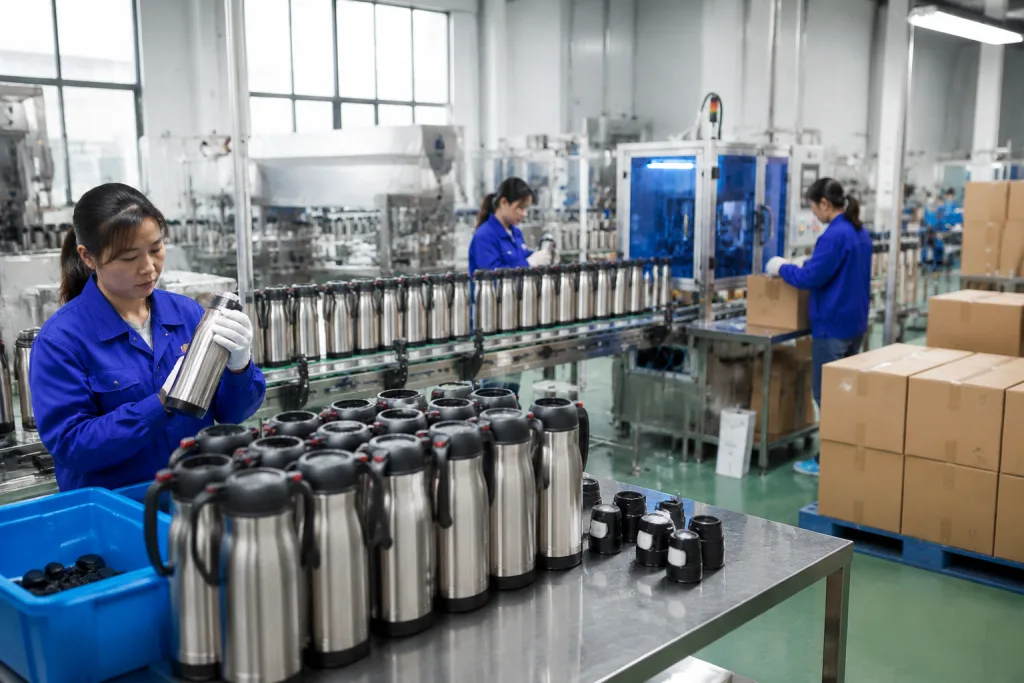
After the signed sample is locked, bulk starts. For a 5,000-piece bulk thermos order, production takes 20–25 days. We run MPI when about 30% of shells are assembled, then FRI after packing but before the container leaves Ningbo or Shanghai. Do not skip it. We have seen this go sideways: one buyer found 0.8 mm logo drift only after the cartons reached Hamburg, and the fixture mark was still sitting on the laser jig when QC checked the next batch.
Hire a third-party QC firm, such as Bureau Veritas or SGS; if the budget is tight, use a local inspector in Zhejiang who can reach Hangzhou, Yongkang, or Jinhua within 4 hours. The inspector should follow AQL (Acceptable Quality Limit) standards: AQL 2.5 for visual defects like scratches and dents, and AQL 1.0 for functional defects like leaks, vacuum failure, or lid malfunction. Ask for caliper photos. A pass stamp is not enough. Cheap inspection reports waste money here; if the report has no 0.01 mm caliper reading or water-test photo, the buyer has no proof when the factory pushes back.
Your QC checklist should include:
- Vacuum insulation: Test 10 random pieces from the batch. All must meet the 6-hour 65°C threshold, and QC should record starting water temperature with a probe thermometer, usually a Testo or similar digital probe we run on the line.
- PP lid fit: Check that lids screw on and off without wrist-breaking force. Measure thread engagement with a marked sample lid: minimum 3 full turns, with no cross-threading after 5 open-close cycles.
- Gasket seal: Silicone gasket must sit flat with no rolled edge or 1 mm gap. Run a water leak test on 20 pieces, then invert each bottle for 30 minutes on a dry kraft sheet so any drip shows fast.
- Logo durability: Rub the engraved area with a cloth soaked in isopropyl alcohol 10 times. The logo must not fade or smudge; the buyer flagged this once when a laser setting was changed from 18W to 12W mid-shift.
- Drop test: Drop the filled bottle from 1.2 m onto concrete. No dents that affect insulation, no lid cracks, and no loose rattle inside the double wall after impact; QC should shake the sample beside the line, not just look at it.
If the batch fails AQL, reject it and demand rework or a commercial discount before balance payment. A reliable thermos manufacturer in China will have a 2–3% defect rate at most; anything above 5% is a red flag. The math doesn't work if you accept 7% defects on a 5,000-piece order and then pay local labor to sort 350 bad units in your warehouse. We have had buyers argue for shipment first and sorting later, but once 62 cartons are in their DC, the repair cost is no longer factory-floor cost.
Check the packaging before FRI closes: each thermos in an individual polybag, with a PP lid cap and a care card, packed 12 per master carton. Carton dimensions should match your logistics provider's pallet plan. We ship 12-pack cartons at around 14–16 kg gross weight, and QC pulled the sample more than once because the PO said "white box" while the packing line used color box artwork. Small typo, big mess.
Certifications and Compliance Documents
Before the container leaves the factory, your polypropylene thermos supplier should send the compliance pack for customs clearance and retailer onboarding. We check it against the PI and carton mark file before loading; one PO typo, “PP lid” written as “PC lid,” once froze a buyer’s document review for 4 days.
For the US market, you need FDA compliance for the PP lid and silicone gasket. Ask for a material declaration showing FDA-grade PP for the lid and FDA-grade silicone for the gasket. For the EU market, request REACH and LFGB compliance. In our files, 8 out of 10 Chinese factory thermos suppliers keep these reports ready; if one is missing or expired, a Shanghai or Guangzhou lab usually needs 2–3 weeks after QC pulled the sample and sealed it with the lab submission label.
For the stainless steel body, request a material test report (MTR) confirming 304 grade for the inner liner and 201 grade for the outer body. The MTR must show chromium content (18% for 304, 16% for 201) and nickel content (8% for 304, 3.5% for 201). Check the heat number against the coil tag on the workshop floor. If the report says 304 but the line is running mixed scrap, the math doesn't work.
Ask for a BSCI social compliance audit report if you sell to European retailers. About 6 Zhejiang distributor thermos suppliers out of 10 have BSCI certification on file; if not, you can request a factory audit at your cost (approximately USD 500). We’ve seen this go sideways when the buyer flagged a report with a different factory address than the one printed on the carton label.
Get a fumigation certificate for the wooden pallets used in the container. No certificate, no smooth release. Our warehouse stamps the pallet batch before loading, and a missing IPPC mark on one 1.1 m pallet is enough for customs to ask questions.
Logistics and Lead Time Planning
Build the order calendar from the factory side: 10–15 days for sampling, 20–25 days for mass production, 3–5 days for final inspection and loading. Total: 33–45 days from PO to FOB Shanghai. For a 5,000-piece bulk thermos order, FOB should land around USD 4.50–6.00 per piece, depending on logo process and packaging. We run laser marking faster than full-color heat transfer: 2 sample cups can be checked the same afternoon, while heat transfer usually needs a baking test on the line. Last month QC pulled a sample because the logo was 1.5 mm off-center on the cup body. Small miss. Big argument.
Shipping math starts with carton data, not a guess from the sales sheet. A 20-foot container holds about 8,000–10,000 pieces of 500 ml thermos when we pack 24 pcs per master carton and keep carton weight under 15 kg. For 5,000 pieces, we ship LCL (less than container load) or consolidate with 2 other orders if the vessel cutoff lines up. LCL shipping to Los Angeles costs about USD 1,500–2,500, with transit time 25–30 days. To Rotterdam, expect USD 2,000–3,000 and 30–35 days. The buyer flagged this before: the product price looked fine, but the LCL charge killed the margin. The math doesn’t work if freight is checked after the PO.
Your supplier should provide a packing list and commercial invoice with HS code 961700 (vacuum flasks and other vacuum vessels). The invoice value must match your declared value for customs. We check the PO against the invoice line by line on a printed A4 set before booking, because one typo, like “5000 sets” instead of “5000 pcs,” can hold documents at the forwarder’s desk for 1–2 days. It happens.
A common mistake is leaving out the 7–10 day delay at the destination port for customs clearance. Plan your retail launch date with at least 2 weeks of buffer after the estimated arrival. This is the wrong place to squeeze time; we’ve seen this go sideways when a buyer booked ads before the container cleared, then the line sat because FDA paperwork was requested during inspection. We ship the goods, but customs still checks the file.
Building a Long-Term Relationship with Your Supplier
After the first order ships clean, the supplier test is not over. Repeat business is where the real test starts. Asking only “Can they quote cheaper?” is the wrong question to ask. Ask which order volume, payment timing, and locked spec let the line run with fewer stops; on our Hangzhou floor, QC pulled 3 samples from the 95°C sealing test before we released the last balance invoice.
- Increase order volume: Moving from 5,000 to 10,000 pieces per SKU can reduce unit cost by 10–15%. We quote tiered pricing at 5K, 10K, and 20K because carton packing gets cleaner, PP injection setup waste drops after the first 80 shots, and 304 stainless body welding runs smoother when the line stays on one SKU for 2 full shifts.
- Standardize your spec: Use the same PP lid design across multiple bottle sizes, such as 350 ml, 500 ml, and 750 ml, only when the thread diameter and silicone gasket groove match the same mm drawing. Check the drawing first. One shared lid tool can avoid a new mold charge, and last month it cut approval from 18 days to 11 days after the buyer accepted the same 63 mm thread.
- Pay on time: A 30% deposit with 70% balance against the bill of lading is standard. Pay the deposit within 3 days of the invoice. We have seen this go sideways when a PO typo changed “matte black” to “mate black” and the deposit sat for 9 days while purchasing checked it; by then, our PP resin booking had moved to another 12,000-piece job.
- Visit the factory: If the schedule allows it, fly to Zhejiang for a factory visit. Walk the assembly line and check the vacuum testing station yourself. Buyers ask sharper questions after they see 18 cartons opened under AQL 2.5, with 0.02 mm calipers on the lid thread and QC lab records on the desk, instead of just reading a PDF report.
One promotional thermos brand we ship for started with a 3,000-piece order and now places 50,000-piece orders twice a year. Their per-unit cost dropped from USD 5.80 to USD 4.20, and their lead time moved from 45 days to 30 days because we reserved production slots and pre-ordered 1.8 tons of PP resin before their artwork file arrived. The math worked.
Request a custom stainless thermos quote today
Send your spec sheet and logo file. We will reply within 24 hours with a FOB Shanghai price and a sample lead time.
Frequently asked questions
What is the minimum order quantity (MOQ) for a custom stainless thermos from a polypropylene thermos supplier?
Most polypropylene thermos suppliers in Zhejiang set an MOQ of 1,000 pieces per SKU for a standard 500 ml thermos with a PP lid. For custom logo engraving and custom packaging, the MOQ is typically 3,000 pieces. If you need a lower MOQ, expect a 20–30% price premium per unit. We offer 1,000-piece MOQ for first-time buyers with a USD 500 tooling fee.
How do I verify that the PP lid is truly food-grade and BPA-free?
Request a material data sheet (MDS) from the supplier that lists the resin grade and manufacturer. Then ask for a third-party test report from an ISO 17025 accredited lab (e.g., SGS or Intertek) showing BPA content below 0.1 ppm and migration limits per EU 10/2011 or FDA 21 CFR 177.1520. A reputable supplier will provide these documents within 5 business days.
What is the typical lead time for a customized thermos order from China?
From PO to FOB Shanghai, expect 30–45 days for a custom stainless thermos with a PP lid. This includes 10–15 days for sample production and approval, 20–25 days for mass production, and 3–5 days for final inspection and container loading. Express shipping (DHL/FedEx) for samples takes 3–5 days.
Can I get a custom color for the PP lid on my thermos?
Yes, most polypropylene thermos suppliers can match Pantone colors for the PP lid. The standard color options are black, white, and gray. Custom colors require a mold change or insert, which adds a one-time tooling fee of USD 200–500 per color and extends the lead time by 5–7 days. The MOQ for custom color lids is typically 3,000 pieces.
What payment terms do Chinese thermos manufacturers accept?
Standard terms are 30% deposit via T/T (telegraphic transfer) with the balance of 70% paid against a copy of the bill of lading. Some suppliers accept L/C (letter of credit) for orders above USD 20,000. PayPal and credit cards are not common for B2B orders. We require 30% deposit and 70% before shipment for first-time buyers.