Key Takeaways
- Virgin PP liner at 0.8mm minimum wall thickness prevents stress cracking under 5,000+ hot-fill cycles
- MOQ 500 units for a polypropylene thermos private label with single-color silkscreen; 1,000 for full-wrap
- FOB Hangzhou pricing starts at $2.85 for a 500ml custom thermos with PP liner and 304 stainless outer
- BSCI-audited factory with inline AQL 2.5 inspection catches thread misalignment before it reaches your warehouse
Search "custom thermos" and you get 400 listings that look copied from the same Alibaba folder. The PP liner is where orders start to drift. For outdoor retail or a promo run, a polypropylene thermos private label still has to pass a 1.2 m drop test, hold lid torque after hot filling, and keep coffee from carrying that resin smell on day three. Supplier hunting is the easy part. The real check is whether the factory can confirm PP liner grade, 0.6 mm outer wall thickness, lid torque, and print adhesion in one email, with the caliper reading and torque-meter value attached, instead of the sales desk guessing from an old PI.
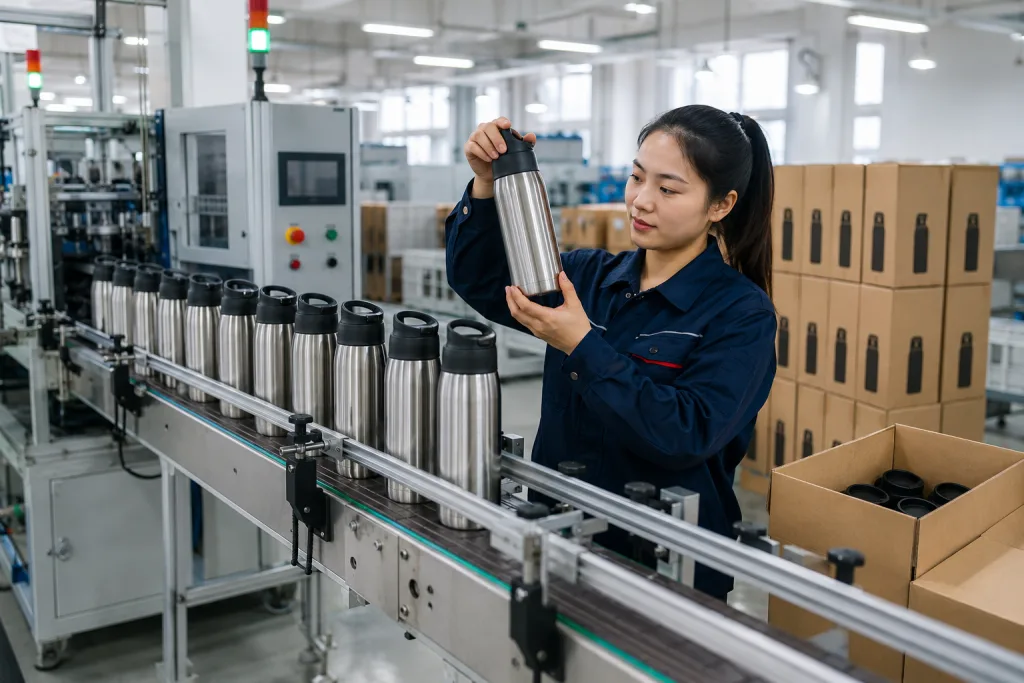
We ship 180,000 stainless and PP-lined units a month from our Zhejiang plant, and QC has pulled enough failed samples with a digital torque meter and 3M tape test to know where orders go sideways. Last April, a distributor asked why a cheaper 0.45 mm body saved 3 cents; the math doesn't work when AQL 2.5 inspection catches dented shoulders and the buyer flags the carton photos before balance payment. Bad savings. Here is the line-by-line breakdown of what a polypropylene thermos private label should show on paper, plus what each number means before we run the line.
Liner Material: Virgin PP vs. Recycled vs. Tritan
Your polypropylene thermos private label is won or lost at the liner. In Zhejiang, we usually quote 3 liner choices: virgin PP, recycled PP, or Tritan. Same mold, different trouble. On our 180T injection machine, the setting that gives a clean virgin PP liner can leave recycled PP with short shots around the 0.6mm thread root, and QC will see it before the buyer does.
Virgin polypropylene (PP) is the safe workhorse. At 0.8mm minimum wall thickness, it handles 95°C coffee poured into a bottle that sat at -5°C in a truck overnight. We run ASTM D256 impact tests on every incoming PP batch, and QC checks the first 20 liners with a digital caliper before mass production starts. Virgin PP also passes EU 10/2011 migration limits without the acetaldehyde smell we sometimes catch from recycled resin. Simple choice. If your buyer expects the bottle to survive concrete drops on a jobsite, specify virgin PP and put the 0.8mm wall callout on the PO.
Recycled PP cuts material cost by roughly 18%, but the melt-flow index shifts lot to lot. That shift shows up fast: the thread gauge feels loose on one lid and tight on the next, then the buyer flags leakage after 300 units in field use. We stock rPP for buyers who request it, but we write the minimum 1.2mm wall thickness into the PI because thinner rPP is where we have seen this go sideways. QC pulled one rPP sample last season with a 0.74mm weak spot near the shoulder, and the math does not work if 2% of cartons come back for leaking lids.
Tritan is the higher-cost option, not a magic upgrade. It is BPA-free copolyester with glass-like clarity, but it adds $0.90 to $1.40 to the unit cost versus PP. For a promotional thermos campaign ordering 5,000 units, the math does not always work. Tritan makes sense for a customizable thermos targeting high-end outdoor retail when the shelf display needs a clear liner and the MOQ is already above 3,000 pcs. For most purchase orders we ship, virgin PP at 0.8mm is the cleaner spec to put on the PO; last month one buyer typed “Tritain” on the PO, and we held the sample until they confirmed the resin code.
Outer Body: 304 vs. 201 Stainless and Wall Gauge
The outer body on a polypropylene thermos private label is not decoration. It is the part that takes the hit when a 750ml bottle drops off a truck tailgate or gets crushed in a mixed carton under 14kg of other stock. QC pulled one sample last month with a 6mm dent on the shoulder; the liner passed leak test at 0.3MPa, but the body looked cheap. Alloy decides whether that dent stays cosmetic or turns into a return.
304 stainless (18/8) is the spec we run for any bulk thermos going to North America or the EU. 0.5mm wall thickness is the floor we recommend. At 0.4mm, you save $0.15 per unit, but the bottle oil-cans under thumb pressure, and the buyer flagged that feel in under 10 seconds at our sample table. Bad trade. 304 handles chloride from road salt and dishwasher detergent better, so if your distributor sells into the Midwest or Scandinavia, this is the wrong place to chase pennies.
201 stainless has higher manganese and lower nickel. It is $0.30 cheaper per body, but we have seen tea-staining show up within six months in humid markets like Manila and Ho Chi Minh City. We produce 201 bodies for price-sensitive orders, but we cap the spec at 0.6mm wall to offset weaker corrosion resistance, and the line checks wall gauge with a Mitutoyo digital micrometer every 2 hours. A custom thermos with a 201 body and a virgin PP liner is the entry-level private label spec. It works. Do not call it premium.
Vacuum insulation between the stainless outer and PP liner is the third variable. A 2.5mm vacuum gap with copper-coated inner wall gets you 8-hour heat retention above 60°C; without copper coating, lab testing on our 500ml sample drops that by roughly 90 minutes. The math is simple. For outdoor retail, specify the copper, because we have seen this go sideways when a buyer saves $0.18 and then asks why the flask misses the shelf claim after QC pulled the sample from a 24-piece pilot carton.
Decoration: Silkscreen, Laser, and PP Adhesion Reality
Printing on a stainless body is routine line work. Printing on the PP liner shoulder or lid is where a polypropylene thermos private label can bite. PP surface energy sits around 29 dynes/cm, and our Sherman dyne test pen shows ink beading if the lid comes from molding, sits 6 hours, and goes straight under the screen frame without fresh treatment.
Silkscreen on the stainless body is still the volume choice. Single-color logo, MOQ 500 units, $0.18 per impression at our Hangzhou facility. We flash-cure at 160°C for 90 seconds, then QC pulls 8 samples for tape test and rub test before the line keeps running. Simple test. Done right, the print survives 200 dishwasher cycles. Full-wrap silkscreen adds $0.55 and moves MOQ to 1,000. For a promotional thermos run of 2,500 units for a beer brand, full-wrap is usually the right call; the shelf impact covers the slower setup on the curved jig, even when the operator needs 18 minutes instead of 12 to dial in the first print.
Laser engraving is a different animal. No ink. No cure time. The ytterbium fiber laser cuts about 0.03mm into the stainless, so the mark will not peel in transit or after washing. It is $0.40 per mark, MOQ 300. The catch is simple: it only works on the stainless body. You cannot laser-engrave a PP liner or lid without melting the surface into a gummy mess; we have seen this go sideways when a buyer sent one logo spec for both parts and the PO typo said "laser on lid." We run 30W fiber lasers and can hold 0.1mm registration tolerance, tight enough for QR codes that scan when QC checks them with a phone at 15cm.
PP lid and shoulder printing needs corona or plasma treatment right before ink application. We run in-line corona at a 38 dynes/cm target and check it with dyne pens every 2 hours, because one weak station can ruin a whole lid batch. Without treatment, the print delaminates within weeks. If your customized thermos includes a PP infuser basket with a logo, confirm your supplier has in-line treatment on the line, not a side table with a hand torch. I would push back here: a pre-shipment photo proves almost nothing. We checked 14 supplier samples where the logo looked clean on day one, then failed tape pull after 72 hours.
Lid Engineering: Thread Pitch, Seals, and Failure Points
The lid is the warranty item. If a polypropylene thermos private label leaks at the cap, the buyer sends claims, not a repeat PO. We’ve seen this go sideways: 3 cartons passed carton-drop, then QC pulled the sample from the 55°C water bath and found coffee marks under the lid skirt with a white wipe cloth.
Thread pitch. We run a 3-start thread on PP lids, 4mm pitch. It opens in 1.5 turns instead of 3. Small detail. It matters when the user has one hand on the thermos and the other on a leash, glove, or toolbox handle. Coarser threads strip less because each turn gives more contact face on the cap and neck. On the line, we check it with a digital torque meter: screw the lid on and off 500 times, then see whether closing torque drops by more than 30%. If it does, the thread is too light.
Silicone seal ring. Specify food-grade silicone, 60 Shore A durometer, 2.5mm cross-section. The groove needs a dovetail profile, or the ring can roll out during tightening; the buyer flagged this once after 2,000pcs because the seal sat proud by 0.3mm. We mold seals in-house to control flash. A 0.1mm molding flash on the seal face will weep coffee at 80°C. Inline leak testing at 0.05 MPa for 10 seconds catches it before packing, and QC marks failed caps with a red paint pen so they don’t drift back to the packing table.
Flip-top vs. screw-top. Flip-top lids add $0.40 to $0.70 and bring in a living hinge, usually the first fatigue point. For a distributor thermos sold into the trades, a simple screw-top with a tether is more reliable; the math doesn't work if 6% of lids come back from a jobsite promo. For a gym promotion, buyers expect the flip-top. We mold the hinge from PP with 20% glass fiber and check it on a cycle jig to push flexural fatigue life past 20,000 cycles.
Quality Control: AQL, Lab Testing, and What to Inspect
A polypropylene thermos private label order leaves Zhejiang in a 40HQ container, usually 58,000 to 62,000 pcs depending on carton size. The risk sits in the 6 to 8 hours between final assembly, carton sealing, and FOB release. Short window. Last month QC pulled one sample with a 0.7 mm lid gap after the carton had already been strapped with two PP bands. That is where margin gets protected or burned, and we have seen one loose lid turn into 23 cartons opened again on the line.
AQL sampling. We run AQL 2.5 Level II for visual inspection and AQL 1.0 for functional tests. For a 5,000-unit order, that means 200 samples for visual checks and 125 for functional checks. Visual inspection covers scratch depth over 0.3 mm, print shift over 1 mm, and color delta against the approved Pantone chip under a D65 light box. Functional inspection covers vacuum integrity, lid torque at 18 to 22 kgf.cm, leak testing after inversion, and capacity verification on a digital scale. If three functional failures show up, the lot is held for 100% re-inspection. Put it in the PI. We have seen this go sideways when the PO only says “standard QC” and the buyer flags leaking lids after arrival.
Third-party lab testing. REACH, FDA 21 CFR, and California Prop 65 are table stakes. For a manufacturer thermos going into EU retail, request EN 12546-1 migration testing on the PP liner itself, not only the outer cup. The lab will run 3% acetic acid at 70°C for 2 hours and measure total migration. The pass limit is 10 mg/dm². A virgin PP liner from our plant usually tests below 3 mg/dm² when the injection line runs at 210°C with dried resin at the hopper. Recycled PP can hit 8-9 mg/dm² and still pass, but the buffer is thin. The math does not work if retail asks for annual retesting and the MOQ is only 1,000 pcs; we had one buyer push back on a USD 480 lab fee for that exact reason.
Inline checks. The best QC happens before the box is taped. We station inspectors at body welding and lid assembly, with one QC table beside each line and a reject tray marked by defect code. A laser micrometer checks wall thickness on 1 in 50 bodies. A thermal camera scans vacuum panels for hot spots that point to a lost vacuum. Fast catch, cheap fix. These checks catch problems while the operator can still adjust the welding jig or replace a 52 mm silicone ring, instead of arguing after the container is already sitting at Ningbo port.
Pricing and MOQ Structure for Private Label Orders
Pricing first. For a polypropylene thermos private label job we run in Zhejiang, unit cost comes from order volume, print setup, and box spec. This is the wrong question to ask if a buyer puts a 3,000-unit stock-color order beside a 500-unit Pantone job and expects the same line cost. Our costing sheet starts with body capacity in ml, carton CBM, and fixture count on the silkscreen table; then the technician checks the 12-cavity jig and confirms whether the cup sits flat within 0.3mm before we quote.
Base unit pricing, FOB Hangzhou:
- 500ml, 304 body, virgin PP liner, no decoration: $2.45 at 3,000 units
- 750ml, same spec: $2.80 at 3,000 units
- 1,000ml, same spec: $3.20 at 3,000 units
Add single-color silkscreen: +$0.18. Full-wrap print: +$0.55. Laser engraving: +$0.40. Gift box: +$0.60 to $1.20, based on 350gsm versus 450gsm paper; the 8mm EVA insert costs more than folded paperboard because it needs die-cutting and hand placement. Real quote example: a thermos bulk order of 5,000 units with full-wrap print and a two-piece gift box lands around $4.15 FOB per unit for the 750ml size, assuming QC does not pull the sample for print offset over 1.5mm on the caliper check.
MOQ reality. 500 units is the floor for a single-color logo on a stock body color. Go lower and the line loses time. If you need a custom Pantone powder coat on the stainless, MOQ jumps to 1,000 because the coating line needs enough pieces to cover booth cleaning, powder recovery, and the 30kg minimum powder order. For a supplier thermos with custom mold components, such as a unique lid shape or an overmolded grip, tooling amortization adds $800 to $2,500 and the MOQ starts at 3,000 units to keep that cost below $0.30 per unit. We've seen this go sideways when the PO says PMS 186C but the artwork file says PMS 185C, and nobody catches it until the pre-production sample is already on the light box.
Lead time. We quote 25 days from artwork approval to FOB for a standard private label order, counted after the signed dieline and 30% deposit hit our system. Add 10 days if custom mold components are involved, since CNC trial parts and first-shot lid fitting usually burn 3 to 4 days before mass production starts. Sea freight to Long Beach is another 14-18 days. Plan 45 days door-to-door for a West Coast delivery, 55 for East Coast, and add 2 days if the buyer flags carton marks after we print the master carton on the 5-layer K=K board.
Send us your spec sheet for a polypropylene thermos private label quote
Get FOB pricing, MOQ, and a 25-day lead time within 24 hours.
Frequently asked questions
What is the minimum order quantity for a polypropylene thermos private label?
MOQ starts at 500 units for a single-color silkscreen logo on a stock body color. If you need a custom Pantone powder coat or full-wrap decoration, MOQ rises to 1,000 units. Orders involving custom mold components—like a unique lid shape—typically require 3,000 units to amortize tooling costs below $0.30 per unit. FOB Hangzhou pricing at 500 units runs approximately $3.10 for a 500ml bottle with virgin PP liner and 304 stainless outer.
How do I ensure the polypropylene liner won't crack or leach chemicals?
Specify virgin polypropylene with a minimum 0.8mm wall thickness. Request ASTM D256 impact test data and EU 10/2011 migration test reports for the specific liner batch. Virgin PP from a BSCI-audited Zhejiang factory typically tests below 3 mg/dm² total migration, well under the 10 mg/dm² limit. Avoid recycled PP for hot-fill applications unless you increase wall thickness to 1.2mm and accept higher migration values around 8-9 mg/dm².
Can you print a logo on the polypropylene lid or shoulder?
Yes, but it requires in-line corona or plasma treatment immediately before ink application to raise the PP surface energy from 29 dynes/cm to at least 38 dynes/cm. Without treatment, the print will delaminate within weeks. Confirm your supplier has in-line treatment capability. Silkscreen on the stainless body does not require this step and is more durable for high-wear areas.
What's the lead time from artwork approval to delivery?
Standard polypropylene thermos private label orders ship 25 days after artwork approval, FOB Hangzhou. Custom mold components add 10 days. Sea freight to Los Angeles takes 14-18 days, plus customs clearance. Plan on 45 days door-to-door for West Coast deliveries and 55 days for East Coast. Air freight cuts transit to 5-7 days but adds roughly $1.80 per unit for a 500ml bottle.
What quality inspections do you perform before shipping?
We default to AQL 2.5 Level II for visual inspection and AQL 1.0 for functional tests. Functional checks include vacuum integrity, lid torque, leak testing at 0.05 MPa, and capacity verification. Inline inspections occur at body welding, liner insertion, and lid assembly stations. A laser micrometer checks wall thickness on 1 in 50 bodies, and a thermal camera scans for vacuum loss. Third-party lab testing for REACH, FDA, and Prop 65 compliance is available on request.