Key Takeaways
- A practical custom thermos RFQ should specify steel grade, PP grade, lid test method, coating, AQL, carton drop test, and packing layout.
- For mixed stainless and polypropylene thermos orders, lid leakage usually creates more claims than vacuum insulation failure.
- Typical MOQ is 1,000-3,000 units per color for factory thermos production, with 30-45 days lead time after artwork approval.
- Outdoor and promotional buyers should treat smell, color drift, FNSKU placement, and carton strength as QC items, not afterthoughts.
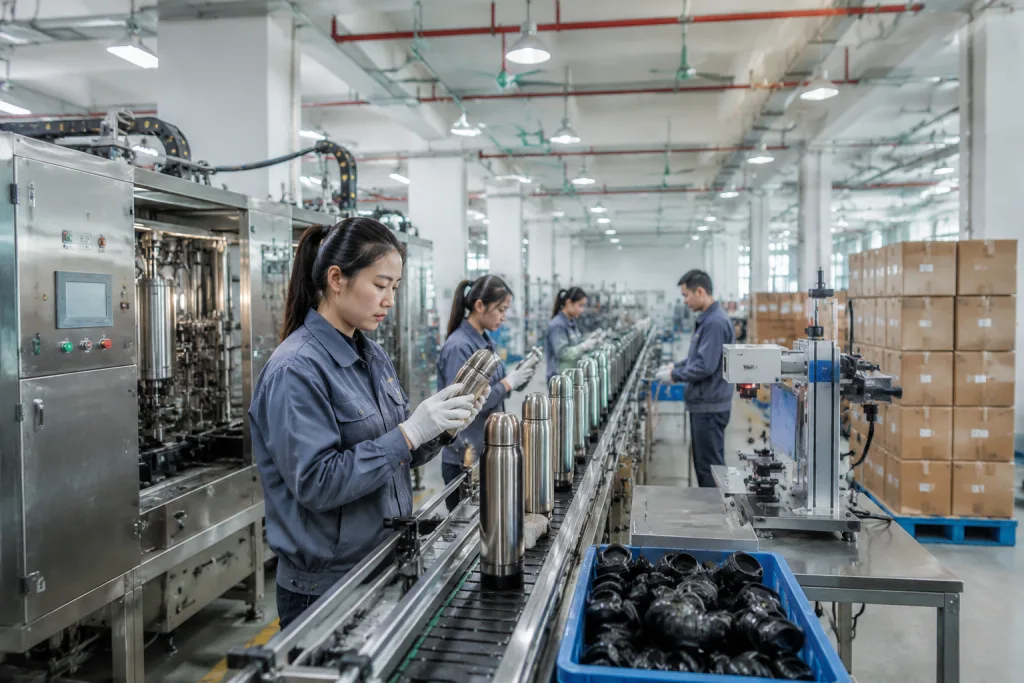
If you search for a polypropylene thermos manufacturer, you are likely sourcing a mixed-material thermos, not a plain plastic bottle. The body is 304 or 316 stainless steel, the lid shell and drinking spout are PP, the sealing ring is silicone, and the order still has to pass coating, carton drop checks, and sometimes a retail sleeve with an EAN-13 barcode sticker. One 0.3 mm lid tolerance can kill the shipment. We run the cap on a torque gauge at the line because the buyer will not accept a clean-looking cup if the lid slips or leaks.
For outdoor retailers and promotional brands, the costly failures usually start at the joint between parts. We have seen 3% leaking lids on the line, powder coating scratched after one trade show, lids with a recycled-plastic smell, and 5-layer cartons crushed after ocean freight from Ningbo. QC pulled the sample last month on a 1,000 pcs promo order because the inner plug sat 0.6 mm high. Small gap. Big problem. Asking only “PP or stainless” is the wrong question; the real risk sits where the materials meet, and we have seen this go sideways when the lid tooling is treated as an afterthought.
The search term is misleading
A buyer typing polypropylene thermos manufacturer is usually not asking for a full PP bottle. They are asking about the lid, food-contact safety, and leak risk. For the insulated thermos we ship, 304 stainless steel normally makes the inner liner and outer shell; PP sits in the lid, handle, button, straw cap, or inner stopper. Different parts, different headaches. On the line, a 0.3 mm stainless wall goes through thickness gauges and weld checks, while a PP lid from a 200-ton injection press gets checked with calipers, plug gauges, and a silicone gasket fit test.
Stainless steel trouble usually starts at laser welding, vacuum loss, polishing drag marks, wall thickness drift, passivation gaps, or coating adhesion after the cross-hatch tape test. PP trouble looks different: odor after unpacking, warping after a 95°C hot-water test, Pantone mismatch under a D65 light box, loose closure fit, mold flashing over 0.2 mm, or missing food-contact paperwork. Both sides matter. We have seen this go sideways: the bottle passed the 24-hour vacuum test, then QC pulled the sample and found the push-button lid leaking at the silicone gasket.
In Zhejiang, China, 40-plus drinkware factories coordinate stainless shell forming with injection molding partners in Yongkang, Ningbo, and Taizhou. BottleForge Industrial works from Hangzhou with a monthly stainless drinkware capacity of about 450,000 units, depending on SKU complexity and finish. For a custom thermos project, that capacity number is the wrong question to ask. Ask whether the factory controls the 2D drawing, PP resin grade, sealing structure, and final inverted water test under one QC plan, because a 1 mm lid tolerance can ruin a full container order.
If you are buying bulk thermos stock for retail programs or outdoor promotions, do not stop at the catalog price. Ask for the assembly drawing, material declaration, lid exploded view, and the test method used before packing. Those four files tell you more about supplier thermos capability than a polished product photo. Last month a buyer flagged a PO typo that changed “PP lid” to “PC lid”; we stopped the order before tooling, because the math does not work after 3,000 pieces are already molded.
Failure one: leaking lids
Leaks trigger complaints fast because buyers test this the first day they open the carton. Vacuum loss can hide for 3 weeks. A lid leak ruins a backpack in 10 minutes. On a customizable thermos with a PP lid, we check five bench points: silicone gasket height with a 0.02 mm feeler gauge, thread bite on the go/no-go ring, push-button return, straw vent seating, plus PP shrinkage after molding. QC pulled 32 samples from one 3,000 pc pilot run last month. Five failed after inversion because the gasket sat 0.4 mm low in the groove.
PP shrinks after injection molding, usually around 1.0% to 2.5% depending on resin grade, mold temperature, and wall thickness. If the lid comes from a loose prototype and then goes straight into thermos bulk production without go/no-go gauge checks, the cap can feel smooth on the line but leak when the bottle is upside down. A 0.2 mm seal gap is enough. The math doesn't work if the buyer approves a hand-polished sample and expects every mass lid to match it; we saw cavity 6 fail at 30 minutes while cavities 1 to 5 passed.
For outdoor retailers, write the test method instead of only saying “leakproof.” We run 90% fill with room-temperature water, normal closing torque, 30 minutes inverted, then 20 hand shakes at the packing table. Simple test. For sports caps or flip lids, add side pressure in a packed carton position, because the push button can open against a divider board under 12 kg stacking weight. A promotional thermos used on a desk does not need the same abuse level as a hiking bottle, but it still needs a clear pass/fail line the inspector can mark on the report.
On the PO, write the lid material as food-contact PP, not just “plastic.” Ask whether the gasket is LFGB-grade silicone if selling into Europe, and request FDA food-contact documentation for North America. For customized thermos orders, freeze the lid color standard with Pantone or a physical master sample. Changing PP colorant can affect shrinkage and fit on tight thread designs. We've seen this go sideways: the buyer flagged one order after “black lid” was typed as “black lead” on the PO, and the color master never reached our injection team.
Practical spec: 100% leak test on assembled units, plus AQL 1.0 for critical lid defects during final inspection.
Failure two: weak insulation claims
Insulation claims are cheap to print and painful to defend. We still see quotes saying “keeps hot 12 hours” or “cold 24 hours” with no starting temperature, room temperature, fill volume, or cup condition. The math gets messy fast. Last winter, one EU distributor asked for lab data after QC pulled the sample at 48°C after 6 hours in a 16°C room, using a Fluke infrared thermometer on the open mouth.
For stainless vacuum thermos production, the weak point is often vacuum pumping, laser welding, pinhole leakage around the bottom seal, or rough handling before powder coating. On the line, we run vacuum testing before decoration, then check again after assembly with a water bath tester and infrared thermometer. Three samples from a 5,000 pcs order is not a test plan. It is gambling on the shipment.
Wall thickness matters too. Common stainless thermos bodies use inner wall thickness around 0.4 mm and outer wall around 0.5 mm, but the right number changes by shape and capacity. Too thin, dents show up. Too heavy, the freight math starts to hurt. For a 500 ml outdoor custom thermos, 260 g vs 330 g changes both hand feel and carton load; we have seen buyers flag 14 kg master cartons as too heavy for retail handling.
Ask your thermos factory to test with a written method. A simple benchmark is 95°C water, 20°C ambient temperature, full capacity filled to the shoulder, lid closed within 60 seconds, temperature checked at 6 hours and 12 hours. For cold testing, use 4°C water or an ice-water protocol, then keep the same setup for every supplier. Do not compare supplier A’s 24-hour claim with supplier B’s 12-hour claim unless the method is identical; this is the wrong question to ask if nobody writes the test sheet.
For promotional brands, be careful with exaggerated insulation copy. A claim printed on 20,000 sleeves becomes a compliance and returns problem if the product cannot perform. We have seen this go sideways over one PO typo, where “12h hot” became “24h hot” on the artwork file. Use a conservative, tested statement. A bigger number from an optimistic thermos vendor will not help when the buyer’s lab opens the carton and runs its own 6-hour check.
Failure three: coating that looks cheap
Finish sells first. The buyer judges the bottle before opening the lid, so I would spec powder coating and spray paint by channel, not by catalog photo. On our line, QC usually catches 7 finish failures: scratches on the shoulder, orange peel texture on the body, Pantone drift between batches, weak logo contrast, dust spots under clear coat, base chips after packing, and oil marks near the neck seam. A customized thermos for an outdoor retailer cannot use the same finish spec as a 1-day conference giveaway. We had one buyer reject 600 pcs because the matte black looked gray under a 6500K light box.
For powder coating, ask for coating thickness. A normal range is 60-90 microns. Too thin, and you see bare metal on rolled edges after the tumbler hits the conveyor rail. Too heavy, and 0.3 mm laser strokes start to blur; on some lids, the cap also feels tight after assembly. Adhesion should be checked with a cross-cut tape test, commonly aligned with ISO 2409. For abrasion, ask the factory to run 50 passes with a 500 g weighted cloth, or use an alcohol wipe test if the logo is pad printed or silkscreened. QC pulled the sample first for a reason.
Logo method matters. Laser engraving lasts on stainless and powder-coated surfaces, but it shows the base material color, not Pantone ink. Silkscreen gives closer color control, yet it fails on curved bodies or textured coating when pretreatment is weak; we have seen 2 mm edge lift after 24 hours. Heat transfer can look clean on promotional thermos orders, but test it around seam areas and tapered bodies before you approve 3,000 pcs. The math doesn't work if the logo only looks good on the flat side.
The better question is simple: what will the bottle look like after 30 days in a gym bag? For an outdoor retail thermos custom program, request three pre-production samples and abuse them before bulk approval. Put one in a freezer at -18°C for 12 hours, one in a cup holder for 7 days, and one in a backpack with keys and a 1 kg power bank. Not a lab test. It still catches finish choices that are too delicate for the sales channel, and we've seen this go sideways.
For bulk thermos orders from China, lock the finish sample before mass production. Photo approval is weak. Light angle, texture, and gloss level are hard to judge on screen, especially for dark green, sand beige, matte black, and metallic colors. Use a signed golden sample with a Pantone code and a gloss reading from a 60° gloss meter. One PO typo, “mat black” instead of “matte black,” once cost 12 days vs 18 days on rework and re-approval.
Failure four: unsafe or smelly plastic
Polypropylene works well for thermos lids because it is light, stable in the injection mold, and cheaper than a Tritan or stainless cap assembly. PP is not the problem. Resin control is. Damp pellets in the hopper dryer, unapproved recycled resin, too much color masterbatch, or the wrong slip additive can leave a sour smell the buyer notices before checking the logo print. We run most PP lid jobs at 210-230°C, with the hopper dryer around 80°C for 2-3 hours when the material needs drying, and one bad resin lot can turn an approved sample into 20,000 smelly lids. A thermos manufacturer shipping to Europe or North America should treat lid material as a compliance item, not a cheap accessory. The math doesn't work if purchasing chases a 0.03 USD saving and creates a claim on the full shipment.
If your product is sold in the EU, ask for LFGB or EU food-contact declarations, plus REACH-related information where it applies. For the US, request FDA food-contact compliance for the plastic and silicone parts. If children may use the product, discuss CPSIA and applicable ASTM requirements before tooling starts; we have seen buyers flag this after the first 300 pcs pilot run, when the straw mold was already cut. Too late. A kids-style stainless thermos with a PP lid, 5.5 mm silicone straw, and flip button carries a different compliance risk from an adult desk bottle, especially when the buyer asks for soft-touch coating near the drinking area.
Odor testing is basic. Do it anyway. Open the lid after 24 hours in a sealed polybag, then smell the PP parts and silicone ring before anyone washes the sample. Fill the bottle with 60°C water for 2 hours, close it, and smell again. QC pulled the sample on one order after the silicone gasket smelled like solvent at the second check, even though the PP lid looked fine under the caliper and the fit gap stayed within 0.3 mm. If there is chemical odor in the sample stage, it rarely improves during thermos bulk production. It gets worse when 12,000 pieces sit sealed in export cartons for 28 days during ocean freight.
For a distributor thermos program, request a bill of materials that separates inner stainless, outer stainless, lid PP, gasket silicone, straw material if any, coating, and ink. Make the factory write the PP grade on the BOM, not just “food grade plastic”; we once saw a PO typo list “PP+ABS” after the approved sample used PP only. Small typo, big headache. A proper BOM gives your compliance team something real to file and blocks quiet substitutions during the line changeover, when the injection team is trying to finish 8 cavities before the packing shift starts. If the factory says “same as sample,” still put the material grade and compliance documents in the purchase file.
At BottleForge in Zhejiang, we recommend virgin PP for food-contact lid structures unless the buyer has a documented recycled-content program with separate testing. We can run recycled-content trials, but MOQ, odor testing, and deformation checks need to be agreed before the first T1 sample. For a 10,000 pcs promotion order, we would rather test 12 lids after hot-water aging than argue after packing. Sustainable positioning sells. Bad smell kills repeat orders. We've seen this go sideways when a buyer wanted eco claims on a 10,000 pcs promotion order but did not budget for separate LFGB testing on the lid and gasket.
Failure five: retail packing breaks
A thermos factory can pass the hard checks and still lose the buyer money at packing. We see it on the line. The bottle clears AQL 2.5, the logo edge stays within 0.2 mm on the digital caliper, then the master carton reaches the retailer with a crushed corner and a shelf box nobody wants to display. For outdoor retailers and promo brands, packing is part of the product spec. Treating the carton as “free” is the wrong question to ask.
Start with the shipping route. A palletized domestic truck move is simple compared with LCL ocean freight or courier drops to 400 event locations. If you sell through marketplace fulfillment, FNSKU placement and polybag suffocation warnings must match the routing guide; we had one buyer flag a 3 mm barcode quiet-zone issue after 15,000 cartons were printed. Painful call. If you ship to retail DCs, confirm carton marks and inner pack quantity before mass production, then ask whether their warehouse requires a 76 cm drop test.
For a 500 ml to 750 ml stainless factory thermos, common master cartons use 5-ply corrugated board, often around 12-15 kg gross weight depending on pack count. Do not let a supplier thermos team quote the lowest FOB price by thinning the carton from K=K to B=C board without writing it clearly on the PI. The math does not work. Saving USD 0.08 per unit on packaging can cost USD 1,200 in chargebacks on one 15,000 pcs order, and we have seen this go sideways after QC found soft corners during carton compression checks.
Ask for an ISTA-style drop test, or at least a factory drop test from 76 cm on corners and long edges for export cartons. QC pulled the sample. One 12 kg carton landed on the long edge, and the gift box corner split by 18 mm. For gift boxes, specify 350 gsm or 400 gsm paper and the insert material, then check whether the bottle rubs against the lid or handle. Matte coated bottles show shiny rub marks after 20 shake-test cycles when the insert is loose.
Lead time should include packaging approval. A normal custom thermos schedule is 7-10 days for sampling after artwork, 30-45 days for mass production after deposit and sample approval, and another 3-7 days for final inspection and booking. Box changes after the line starts are not small changes. A clean reprint usually takes 12 days, while 18 days happens when the PO has a typo in the Pantone code and the printer has already made plates.
Failure six: the RFQ hides risk
The weakest RFQs are short: “Quote 10,000 pcs stainless thermos, logo one color, best price.” Wrong question. It forces each thermos supplier to guess the spec, and each guess moves the price. One factory quotes 201 stainless outside; another quotes 304 stainless. One includes a 350 gsm retail box with E-flute insert; another packs in a plain white box. On the line, 0.4 mm outer wall and 0.35 mm outer wall look close until the caliper comes out. Last month, QC pulled the sample and the caliper showed the “same” body was 0.6 mm smaller at the shoulder. Cheap FOB often means the quote got thinner before the bottle did.
A serious RFQ for manufacturers thermos sourcing should state capacity in ml, body diameter in mm, lid type with PP grade, steel grade, silicone hardness, finish, logo method, packing, compliance market, inspection level, Incoterms, and delivery date. Be blunt. If the thermos promotional order must reach a trade show on June 18, put that date in line one of the RFQ, not in email three. We’ve seen this go sideways when a buyer approved artwork 9 days late, then asked us to ship 10,000 pcs stainless bottles by air. The math doesn’t work. A 500 ml bottle with color box eats carton volume fast; our freight forwarder will bill by chargeable weight, not by the buyer’s hope.
For inspection, use AQL language. Common final inspection levels are General Inspection Level II with AQL 0 for critical defects, 2.5 for major defects, and 4.0 for minor defects. Tighten it for retail launches or relax it for simple giveaways, but define it before mass production starts. Critical defects include leakage from the lid seal, sharp edges at the rim, contamination inside the cup, and wrong material or unsafe packaging. Major defects include logo drift over 1.5 mm, visible dents under a 600 lux lamp, coating chips at the bottom edge, and wrong carton marks. QC pulled the sample on one order because the PO said “mat black” instead of “matte black”; small typo, big argument.
Price needs context. For 500 ml stainless thermos custom projects, FOB China pricing often sits roughly between USD 3.20 and USD 7.50 per unit depending on lid complexity, steel grade, coating, logo, and packing. A USD 2.85 quote is not magic. It usually cuts something: 24-hour coating curing time, 5-layer export carton strength, salt spray testing, or material traceability. On our line, a powder-coated body needs rack space after spraying, and rushing that step shows up as chips around the bottom ring after the 3M tape pull test.
If you need a long-term thermos distributor line, ask the factory what can stay consistent for 12 months: mold number, lid design, Pantone color, spare gasket stock, carton size, and reorder MOQ. We run some colors every 30 days, but custom PP lids may need a 3,000 pcs MOQ if the injection machine is changing resin. A good thermos vendor will tell you where tolerances are tight, such as ±0.2 mm on lid thread fit or small shade drift between powder batches. A risky one just says yes to every request.
Send your thermos spec before you quote
We will review materials, lid risks, MOQ, packing, and FOB options before you commit to a custom stainless thermos order.
Frequently asked questions
Is a polypropylene thermos manufacturer the right supplier for stainless thermos bottles?
Only if the supplier controls both stainless bottle production and PP lid quality. Most insulated thermos products are not made fully from polypropylene; they use stainless steel bodies with PP lids, handles, buttons, or stoppers. Ask whether the factory performs vacuum testing, lid leakage testing, and PP material inspection under one QC plan. For a 1,000-3,000 unit custom thermos order, you should receive material declarations for stainless steel, PP, and silicone before mass production. If the supplier only offers plastic injection service and outsources the stainless bottle without clear QC responsibility, use caution.
What MOQ should we expect for a customized thermos order?
For most stainless customized thermos projects from China, the practical MOQ is 1,000-3,000 units per color. Simple laser engraving on an existing model may be possible at 500 units, but custom powder coating, Pantone lids, molded PP parts, or retail packaging usually push MOQ higher. New lid tooling is a separate decision and can require USD 2,000-8,000 depending on complexity. If you need thermos bulk pricing for retail distribution, quote 3,000, 5,000, and 10,000 units so the factory can show where coating, packing, and labor efficiencies actually improve.
How do we prevent lid leaks in bulk thermos production?
Specify the test method in the PO. A useful standard is 90% water fill, lid closed to normal hand torque, inverted for 30 minutes, then shaken 20 times. Require 100% leak testing during assembly and use AQL 1.0 or tighter for final inspection of critical leak defects. Also freeze the PP resin, silicone gasket hardness, and lid color after sample approval. Colorant changes and resin substitutions can affect shrinkage by small amounts, sometimes only 0.2-0.3 mm, but that is enough to weaken gasket compression on a threaded thermos lid.
Which compliance documents should outdoor retailers request?
For Europe, request food-contact declarations for stainless steel, PP, silicone, and coatings, plus LFGB or EU 1935/2004 support where applicable. REACH information may be needed for coatings, inks, and certain accessories. For North America, ask for FDA food-contact statements for plastic and silicone parts. If the product may be used by children, discuss CPSIA and relevant ASTM testing before confirming artwork. A thermos supplier should also provide a bill of materials listing 304 or 316 stainless, PP lid grade, silicone gasket, coating type, and ink system.
What lead time is realistic for promotional thermos orders?
For an existing stainless thermos model with logo customization, plan 7-10 days for samples and 30-45 days for mass production after deposit and sample approval. Add 3-7 days for final inspection, booking, and export documents. Custom PP lid color, new packaging, or special coating can add 7-15 days. If the event date is fixed, do not build the schedule around the fastest verbal promise. Confirm artwork approval date, carton artwork deadline, inspection date, and FOB China handover date in writing.