Key Takeaways
- Spec 304 or 316 stainless steel, PP grade, lid gasket material, and vacuum test standard before sampling
- For most custom thermos orders, practical MOQ starts around 1,000-3,000 units per color
- AQL inspection should separate critical leakage defects from cosmetic defects at different limits
- Normal OEM lead time from approved sample to shipment is 30-45 days in Zhejiang, China
If you search for a polypropylene thermos flask manufacturer, you are probably buying a bottle for retail, promo, or a private-label line, not asking for a resin lesson. On our line, the real structure is often 304 stainless inside and outside, while PP is used for the lid, handle, base, push button, or outer shell. Normal build. The trouble starts at the seal: a gasket groove cut 0.2 mm shallow from a 0.3 mm spec will leak, no matter how clean the sample photo looks.
Outdoor retailers and promo brands usually feel the pain after approval: lids leaking at 45 degrees, coating lifting in a cross-cut tape test, insulation missing the 12-hour claim, export cartons crushed after 18 days at sea, or logo color drifting 1 Pantone shade between lots. We run custom thermos programs in Zhejiang, China, and we’ve seen this go sideways when a buyer approves the nice desk sample but skips the failure list. QC pulled one sample with a caliper and a tilt-test jig; the buyer flagged it, and then the PO typo on lid color turned into a shipment argument after inspection. Wrong time.
The material mix fails first
The phrase polypropylene thermos flask manufacturer creates messy RFQs. One buyer is asking for a plastic-body insulated flask. Another buyer means a stainless vacuum thermos with PP only on the lid, drinking cup, handle, stopper, or bottom bumper. Price comes after the structure is clear. We had one German PO where the item name said “PP thermos,” but the 2D drawing showed a 304 stainless inner tank; QC pulled the sample from the rack, checked it with a magnet and caliper, and the quote moved from plastic molding cost to vacuum flask costing.
For a stable bulk thermos program, we run 304 stainless steel for the inner liner and outer shell, 0.4-0.5 mm wall thickness for common 500-750 ml sizes, with food-contact PP on the lid set. That covers most coffee and tea orders. If the bottle will hold salty drinks, sit in coastal retail, or carry acidic beverages for 12-24 hours, 316 stainless for the inner liner is the safer call. It adds roughly USD 0.25-0.60 per unit, depending on size and market metal price. The math does not work for every promo order. On the line, our digital thickness gauge checks the shell before vacuum welding; 0.35 mm looks fine in photos but dents too fast in a 1.2 m carton drop test.
The common failure is not PP itself. It is the wrong PP. Low-grade polypropylene can smell after 95°C hot-water filling, warp near the thread under dishwasher-style heat, or turn brittle after 6-8 freeze-thaw cycles. We have seen this go sideways when a buyer approved a good-looking lid but skipped the resin confirmation; during inspection, the stopper gave off a light plastic odor after the hot water soak. QC wrote it down. For Europe and North America, ask for food-contact paperwork: LFGB or EU 10/2011 where applicable, FDA food-contact declaration for the US, plus REACH/SVHC screening for parts the user can touch.
Your RFQ should state the stainless grade, PP resin grade, silicone gasket grade, target liquid temperature, dishwasher claim if any, and the intended drink: coffee, tea, soup, carbonated drinks, or cold water only. Be blunt here. A manufacturer thermos quote without these details is a placeholder price, and the buyer usually flags the gap after the sample invoice, not before. We also need the lid drawing tolerance in mm; a 0.2 mm mismatch at the PP thread can cause leakage even when the stainless body passes vacuum testing. One buyer once sent us a PO with “silicon ring” typed instead of “silicone ring,” and purchasing almost sourced the wrong gasket material.
Vacuum loss hides behind nice samples
A custom thermos can look perfect on your desk and still fail in a customer’s car cup holder. Vacuum insulation starts at the inner-tank weld: oil left on the seam after drawing, a copper electrode that has already run 8,000-10,000 hits, or a 0.2 mm gap near the base can kill the bottle before the logo printer touches it. Then the vacuum station needs the right evacuation time, not just a green “pass” on the PLC screen. The bad part is simple. You can’t see it. On one 500 ml OEM run, QC pulled 32 bottles from the line after the helium leak detector showed weak vacuum, while the logo print and powder coating both looked clean. No buyer pays for a sharp logo if the coffee turns lukewarm after three hours.
Ask your thermos factory for its insulation test method, not a catalog line. We run the basic factory test for stainless vacuum flasks: fill with water at 95°C, close the lid, keep the samples in a 20-25°C room, then measure after 6, 12, and 24 hours with a calibrated probe thermometer. Use a real probe. Hands lie. For 500 ml models, a fair claim is around 65°C after 6 hours and 40°C after 12 hours, depending on mouth diameter and lid structure. A 55 mm wide-mouth food jar will not behave like a slim drink flask with a 38 mm mouth; we had one buyer push back hard after comparing two samples side by side on the same meeting table. The math doesn’t work if a supplier sells the food jar using the slim-flask result.
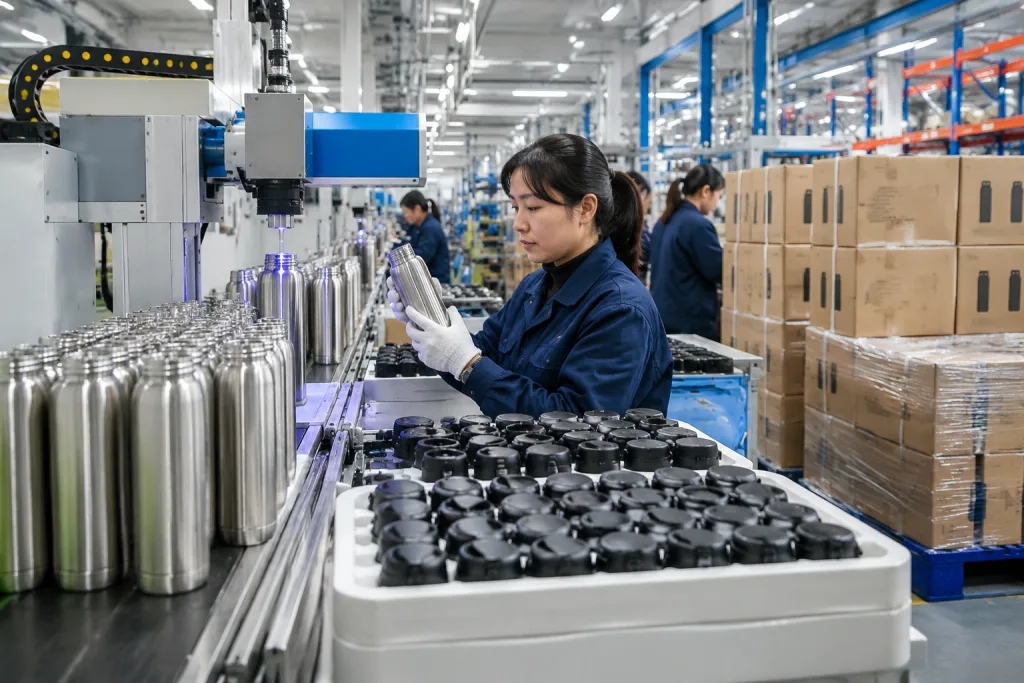
At BottleForge Industrial in Hangzhou, Zhejiang, our stainless thermos capacity is about 420,000 units per month across standard and OEM lines, but vacuum retention is still controlled by production batch, night or day shift, and the exact model tooling. Big output does not replace testing. We ship bulk thermos orders only after 100% vacuum detection during production, then random finished-goods temperature testing before packing. For a recent 10,000 pcs order, the line logged vacuum results by carton range, and the packing team held 80 pcs aside for 24-hour checks before sealing the master cartons. One PO even had the color code typed as “BK” instead of “BLK”; QC caught it during the carton-range check, not in the office.
If you are comparing thermos suppliers, ask what reject rate they see after vacuum detection, whether test records show production date plus machine number, and where vacuum failure sits under AQL. I’d ask for one photo of the vacuum tester screen plus the batch sheet. Simple request. We classify leakage and vacuum loss as critical or major defects, not minor cosmetic defects, because they kill the product function. We have seen this go sideways when a buyer flagged “warm bottle” complaints two weeks after delivery, and the supplier only had a showroom sample test sheet with no batch record.
Lids leak from small design compromises
Distributor thermos complaints usually start at the lid. The stainless body passes salt spray and drop checks, then one shallow thread or one soft gasket turns the order into a backpack leak claim. We see it on the line: QC pulled the sample, filled 450 ml warm water, inverted it for 30 minutes, and the seam showed a wet ring on the tissue paper. Not good. Outdoor retailers need tighter lid checks than office promo buyers because the bottle gets shaken in a side pocket, dropped on concrete, frozen overnight, then clipped to a bag with a carabiner. Different use case. Different risk.
For a customized thermos lid, put four measured points on the drawing. Thread height and overlap need enough bite to stop cross-threading; for one 500 ml model we run, a 0.3 mm change in thread depth was the difference between smooth closing and 17 buyer complaints in the first shipment. The gasket should come out for cleaning, but it must not fall into the sink when the user rinses the cap under a tap. Any drinking spout should pass repeated open-close cycling; 3,000 cycles is a fair benchmark for promotional thermos programs, while premium outdoor lines often write 5,000 cycles into the test sheet. The air vent must control pressure spit-back with hot liquid inside, or the buyer will flag it during first-use testing.
Leak testing cannot be symbolic. We run an inverted static test for 30 minutes, then a rolling test on the bench after filling with warm water; for sports lids, we add 20 hand-shake cycles because that is where weak silicone shows up. Cold water sitting still is the wrong test. If a thermos manufacturer only tests with cold water and no movement, the math does not work. On one PP lid trial, the cap passed 20 cold-water checks, then failed after 8 warm shake cycles because the silicone gasket relaxed and shifted 1.2 mm from the groove. For carbonated drinks, most vacuum thermos designs should be labeled “not for carbonated beverages” unless the lid has a real pressure-release structure.
Put the lid requirements into the purchase specification. Do not rely on a sample photo. A thermos vendor can change gasket hardness or switch the PP lid supplier between sample approval and mass production unless you lock the BOM; we have seen this go sideways when a PO said “same as sample” but never listed the gasket Shore A. The buyer flagged it only after pre-shipment inspection, when QC cut open 6 caps and found two gasket batches mixed in one carton. Both sides should sign the sample and keep it as the golden sample.
Decoration fails when artwork meets steel
Promotional thermos orders usually break at decoration, not at the vacuum body. Steel gives you less room than PP. Powder-coated stainless and tapered bodies expose loose artwork fast. We once ran a 62 mm logo that looked fine on the PDF, then stretched 3 mm on a tapered 500 ml body and crossed the weld seam by 1.5 mm. QC pulled the sample. The buyer flagged it.
For thermos custom branding, choose the process by wear requirement and target cost, not by the prettiest mockup. Laser engraving stays clean on stainless or powder-coated surfaces and survives daily handling, but it will not print a full-color mascot with gradient shading. Silk screen works for one or two solid colors on simple logos; setup is usually USD 35-80 per color, and our line checks position with a 0.5 mm film ruler before mass printing. Heat transfer fits retail-style graphics with fades, but edge lifting shows up after packing if the coating was not wiped with alcohol and cured at 160°C for the full cycle. UV printing gives a wider color range. We still run abrasion testing before we ship.
The real failure is a mismatch between the brand standard and the decoration method. Pantone on stainless or matte coating is not Pantone on paper. Email approval is the wrong question to ask here. Ask for a physical pre-production sample and check it under daylight and office LED light; last month one gray logo passed indoors and looked green outside at 2 pm, right beside the loading bay door. For a custom thermos used as a corporate gift, a Delta E color difference of under 2 may matter. For low-cost promotional thermos orders, we see buyers accept wider tolerance, but write that tolerance on the PO before production. Arguing after 48 cartons are packed does not work.
For thermos promotional projects, specify logo size in millimeters, placement distance from bottom and seam, coating color with Pantone code, artwork file format, and abrasion requirement in cycles. A simple 3M tape test after printing and a 50-cycle rub test catch problems before cartons leave China. We also mark the seam position on the sample with masking tape, because “centered logo” means nothing if sales, design, and the printing operator each picture a different center line on a 500 ml body. We have seen this go sideways over a 6 mm placement gap.
Coating and dents punish weak specs
Outdoor bottles get punished. We see them dropped on gravel, forced into 72 mm bike cages, and packed loose beside spare lids in mixed cartons for distributor thermos warehouses. Four failures come back on our QC table: powder coat chips at the shoulder, paint scratches from carton staples, base dents, and wobble when the bottom is out by 1.5 mm on the flatness gauge.
For a factory thermos order, put the surface spec in writing: coating type, target thickness, adhesion result, pencil hardness, and color tolerance against the approved Pantone chip. Be specific. Powder coating is the better call for outdoor retail because the grip feels firmer and the finish takes rack rub from metal display hooks better than basic spray paint. We normally run 60-90 microns, checked with a coating thickness meter after curing. Too thin, it scratches on the carton staple. Too thick, and the cup fit or lid thread starts to bind. This is the wrong place to save RMB 0.18 per bottle.
Drop testing is where about 6 out of 10 clean-looking samples lose credibility. For a 500-750 ml stainless thermos, we often test from 1.0 meter onto plywood or concrete-style test surfaces, then check leakage, lid failure, and base-ring dents with a 0.02 mm feeler gauge on the bench. QC pulled the sample last month after the stopper cracked on the third corner drop. Retail buyers sometimes ask for ISTA-style carton drop tests on e-commerce orders. The math doesn't work if one cracked lid in every hundred units creates more return cost than the cheaper lid saved.
Packaging belongs in the product spec. A single white box with thin dividers can pass for a local event giveaway, but we have seen this go sideways at a North American outdoor retailer's distribution center when the buyer flagged crushed corners at AQL 2.5 inspection. Export cartons should stay under 15 kg gross where possible, with edge-crush strength set for pallet stacking. We ship retail boxes or bulk pack from the same line, so choose based on the shipping route, MOQ, and how many warehouse touches hit the carton before the bottle reaches the shelf.
Inspection plans must rank the risk
AQL only works when defect classes are set correctly. We still see buyers drop 20 checks into one flat sheet: scratch, leak, wrong barcode, dirty box, loose lid, all marked the same. Bad call. On the line, QC checks lid gaps with a 0.5 mm feeler gauge; a leaking lid should not sit in the same bucket as a pinhead speck on the export carton.
For stainless and PP thermos bulk shipments, we run three defect classes. Critical defects cover leakage, sharp edges, unsafe material contamination, broken locking mechanisms, and the wrong food-contact component, such as PP where the approved BOM says 304 stainless. Major defects cover poor insulation after the hot-water test, wrong logo position by more than 1 mm, coating peeling, dented body, unstable base, incorrect capacity, and barcode/FNSKU errors that stop warehouse receiving. Minor defects are small cosmetic marks inside the agreed viewing distance, light carton scuffs, or color drift inside the approved tolerance chip; last month QC pulled the sample under a D65 light box because the buyer flagged a 1 mm logo shift.
A common inspection plan is ANSI/ASQ Z1.4 general inspection level II, with AQL 0 for critical, 2.5 for major, and 4.0 for minor. For higher-value retail orders, tighten major defects to 1.5 if the unit price can carry the extra sorting cost; below USD 4.20 FOB, the math often does not work after repacking labor. For Amazon or marketplace shipments, check carton labels and FNSKU first, then confirm suffocation warnings for polybags and master carton dimensions, because one 58 cm carton keyed as 85 cm on the PO can slow inbound receiving by 7 days.
Ask when inspection happens. Final random inspection catches visible problems, but it comes late. For new customizable thermos projects, add inline inspection during assembly and pre-shipment inspection after at least 80% of goods are packed; we usually have QC pull 32 units from sealed cartons before the tape gun leaves the packing table. Our typical OEM lead time in Zhejiang is 30-45 days after deposit and approved sample, so book inspection around production week 3 or 4. Waiting for the final day is the wrong question to ask, because rework on 3,000 packed units makes the math fall apart.
Commercial shortcuts create late surprises
The lowest thermos quote usually has a missing line item: carton spec with 7 mm 5-layer board, FDA or LFGB material papers, spare silicone gaskets, retail barcode label, logo setup, inner box artwork, or reject allowance after AQL 2.5 inspection. Cheap is not the issue. “Who is cheapest?” is the wrong question to ask. We put the same 0.48 mm body wall, same 304 stainless inner, same PP lid, and same 12 kg drop-carton requirement on the quote sheet; then the price starts to mean something. QC pulled the sample last week and found the bottom carton corner split open after the third drop on the drop tester.
For a standard 500 ml stainless custom thermos with PP lid, realistic FOB China pricing often sits around USD 3.20-6.80, depending on steel grade, coating thickness, lid structure, logo process, packaging spec, and order quantity. Small parts add up fast. A simple laser logo on our rotary marking jig costs less than a molded custom lid with Pantone coating and a retail gift box using 350 gsm art paper. Tooling for a new PP lid or handle can range from USD 1,500 to over USD 8,000 based on cavity count and undercut structure. If a supplier thermos quote skips tooling but promises a unique shape, ask for the mold drawing, cavity count, and who owns the steel. We have seen this go sideways.
MOQ also matters. For standard models with logo decoration, 1,000 units per SKU is often workable, and the line can run it without changing spray fixtures twice in one shift. For custom coating colors, 2,000-3,000 units per color is more realistic because powder loss and color change cleaning take 45-60 minutes per changeover, even with the spray booth already warmed up. For fully customized thermos molds, the commercial MOQ may be 5,000-10,000 units because tooling, testing, and line setup need to be spread across enough units. The math does not work at 800 pieces, no matter how clean the CAD looks.
Use FOB Ningbo or FOB Shanghai terms if you want a clean comparison from Zhejiang, China factories. Confirm payment terms, sample timing, mass production lead time, inspection rights, and replacement policy before deposit; last month a buyer flagged a PO typo that said “matte black lid” while the approved sample had a black body and grey PP lid. Good thermos suppliers talk about failure risk early, including PP shrinkage at 0.6-1.2%, lid thread fit checked with a go/no-go gauge, and whether the silicone ring passes the 100°C hot-water test. If every answer is “no problem,” that is usually the first problem.
Send your thermos spec before you request price
Share capacity, lid style, logo method, MOQ, market, and test requirements. We will flag the weak points before sampling starts.
Frequently asked questions
Is a polypropylene thermos flask the same as a stainless vacuum thermos?
Not always. Many buyers use the phrase polypropylene thermos flask manufacturer when they mean a stainless vacuum flask with PP components such as the lid, cup, handle, stopper, or base ring. A true plastic-bodied thermos has different insulation performance and heat-resistance limits. For outdoor retail and higher-value promotional programs, we usually recommend 304 stainless steel inner and outer walls with food-contact PP lid parts and silicone gaskets. Ask the factory to identify every material in the BOM, including stainless grade, PP type, gasket material, coating, and any adhesives. Without that, you cannot properly check FDA, LFGB, EU 10/2011, REACH, or customer-specific restricted substance requirements.
What MOQ should we expect for a custom thermos order?
For standard stainless thermos models with your logo, MOQ is usually 1,000 units per SKU. If you need a custom powder coating color, plan for 2,000-3,000 units per color because coating line setup and color matching create extra waste. For a new molded PP lid, handle, cup, or body shape, commercial MOQ often moves to 5,000-10,000 units, plus tooling cost. Promotional thermos buyers sometimes ask for 500 units, and it may be possible on stocked colors, but the unit price and setup cost per piece will be higher. The best RFQ states quantity by color, logo process, packaging, and target delivery date.
How do we prevent stainless thermos flasks from leaking?
Leak prevention starts with lid engineering, not final inspection. Specify thread engagement, gasket material, gasket hardness if available, push-button cycle life, and whether the product is for hot drinks only or also cold and iced drinks. During QC, use more than one test: inverted static test, horizontal storage test, and shake test with warm water. We treat leakage as a critical or major defect under AQL, depending on the buyer’s classification, because it makes the product unusable. For outdoor retailers, we recommend testing samples after 3,000-5,000 open-close cycles and after a 1.0 meter drop test, because lids often fail after impact rather than during a gentle table test.
What lead time is realistic for distributor thermos programs?
For a standard thermos customized with logo and existing color, sample approval usually takes 5-10 days and mass production takes about 30-45 days after deposit and approved sample. Custom color matching can add 7-14 days because you need a coated sample, not just a Pantone number. New PP tooling may add 25-45 days before production, depending on mold complexity and revisions. Add ocean freight time separately: roughly 25-40 days to many European ports and 18-35 days to North America depending on route and season. If your event date is fixed, build in at least 10 days for inspection, rework, and export paperwork.
What should be on our inspection checklist for thermos bulk shipments?
A useful checklist separates function, safety, appearance, and logistics. Function checks should include leakage, insulation retention, lid operation, capacity, base stability, and cup fit if applicable. Safety checks should cover sharp edges, material declarations, odor, gasket condition, and food-contact surfaces. Appearance checks include dents, scratches, coating adhesion, logo placement, Pantone tolerance, and carton cleanliness. Logistics checks include inner box, master carton strength, barcode, FNSKU if needed, quantity per carton, gross weight, and shipping marks. For most thermos bulk orders, use ANSI/ASQ Z1.4 general level II with AQL 0 critical, 2.5 major, and 4.0 minor, tightened if your retail customer requires it.