Key Takeaways
- Define PP parts clearly: lid, handle, cup, sleeve, or outer shell before pricing
- Normal MOQ is 1,000 pcs per color for custom thermos orders from Zhejiang, China
- Use 2 sample rounds: blank functional sample in 7 days and logo sample in 10-12 days
- Set AQL 2.5 for major defects and require 95°C hot water retention testing
Buyers searching for polypropylene thermos flask bulk are usually asking for two things: a PP outer part that survives retail rack handling, and stainless vacuum performance that does not bring complaints 30 days after delivery. The trouble starts with the wording. “PP thermos” can mean a PP cup, PP handle, PP lid, PP sleeve, or a full plastic outer shell over a 304 stainless liner. Last month our tooling room checked a lid fit with a feeler gauge and found a 0.6 mm gap, because the RFQ never said which part had to be plastic.
From Hangzhou, Zhejiang, we see this on 6 to 8 RFQs a week. Specs matter. A winter campaign gift flask is not the same build as a distributor SKU for outdoor shops, and quoting both from one blurry photo is the wrong question to ask. Define the structure, sample approval rule, PO line item wording, and AQL 2.5 inspection standard before we run the sample. QC pulled one pre-shipment sample in March where the PO said “PP body” but the approved sample had only a PP handle. Small words cost time. Clear specs keep the line moving, stop mold-change arguments, and cut rework before bulk packing.
Start with the real bottle structure
Your RFQ should not start with “send price for polypropylene thermos flask bulk.” Good search phrase. Weak buying brief. A thermos factory prices the bottle by structure first: 304 stainless steel inner liner, 201 or 304 stainless outer wall, vacuum gap, PP lid or stopper, then the add-ons such as a fold handle with 3.5 mm pin, a drinking cup, or a 28 g bottom bumper. Last month one buyer sent us a PO with “PP thermos” in the item line and “304 body” in the spec sheet. QC pulled the pre-production sample on the vacuum test rack because the lid drawing called out PP-05 while the body BOM said brushed 304 stainless.
If you want a full PP outer shell, say it in the first email. Say it clearly. It changes mold cost, impact testing, logo printing, and how we pack the bottle in the inner box. PP is lighter and cuts dent complaints, but it does not wear like powder-coated stainless steel. Keys in a backpack leave white stress marks instead of small paint chips. For retail shelves, a stainless exterior with a PP handle usually sells better at sight. For school, hiking, or employee gift programs, a PP cup with a push-button stopper is the safer build because the cup takes abuse and the stopper is easier for gloves. We have seen this go sideways when the buyer asks for “cheap PP look” after the stainless tooling sample is approved. The math doesn’t work.
Useful RFQ lines look like this: capacity 500 ml, 750 ml, or 1,000 ml with target bottle height; inner steel grade SUS304; outer wall SUS201 or SUS304 with wall thickness, for example 0.40 mm; PP lid in food-contact grade; silicone gasket with LFGB or FDA compliant material and shore hardness if you have it; copper plating required or not; powder coating thickness 60-80 microns; carton drop test 76 cm. Put the numbers in writing. If these fields stay blank, 6 thermos suppliers can quote 6 different bottles, and the lowest price might only mean a 0.38 mm outer wall, a weak stopper spring, or a gasket that curled after our 95°C hot-water test. We check that with a torque gauge, not by eye.
At BottleForge Industrial in Zhejiang, China, our stainless thermos capacity is about 420,000 units per month across standard models, with a usual MOQ of 1,000 pcs per color for a customizable thermos and 3,000-5,000 pcs when new PP mold parts are required. We run calipers on the mouth diameter, check vacuum hold on the test rack, and flag logo artwork before mass production if the print area is 2 mm too close to the handle seam. Small detail. Big delay. One PO last quarter had the Pantone code typed as 186C in the email and 168C in the attachment; the buyer flagged it late, so we froze the line for 4 hours before pad printing.
Write the RFQ like a PO preview
A good RFQ should read like the PO you expect to place. It cuts out quotation games and lets the thermos manufacturer check the steel grade, PP lid tooling, packing cost, and test requirements in one pass. We run costing from a spec sheet, not from “standard quality.” Outdoor retailers should spell out the retail carton: 350 gsm or 400 gsm board, window or closed box, barcode position at the bottom right or side panel, and carton drop requirement. Promotional brands should give the event delivery date, logo size, and shipping term, whether FOB Ningbo, FOB Shanghai, or DDP to a warehouse. Last month a buyer wrote “black box” on the RFQ, then the PO said “matte black gift box”; QC pulled the sample under the D65 light box, and the paper finish mismatch cost 6 days.
For a polypropylene thermos flask bulk project, ask the thermos manufacturer to quote two constructions: one economy build and one retail-grade build. Example: 750 ml stainless vacuum flask with PP cup lid, 304 inner and 201 outer wall, versus 750 ml with 304 inner and 304 outer, 0.22 mm powder coating, and an upgraded stopper with a tighter silicone ring. The gap often lands at USD 0.45-0.90 per unit, but returns hurt more than saving a few cents. “What is your cheapest 750 ml?” is the wrong question. Ask what fails first after 3 carton drops and 12 hours in a 95°C hot-water test. We have seen powder coat chip around the shoulder radius at 0.18 mm coating thickness when the buyer pushed for the low-cost finish.
Put the quote table into PO-style line items before you issue a PO. Simple works. Our merchandiser can hand this to the line, and the costing clerk can check MOQ, logo setup, carton CBM, and inspection cost without guessing from a WhatsApp thread.
- Line 1: 750 ml bulk thermos, SUS304 inner, PP cup lid, matte black powder coat, 2,000 pcs.
- Line 2: One-color silkscreen logo, 60 x 35 mm, one position, PMS matched.
- Line 3: Retail color box, E-flute, barcode printed, 2,000 pcs.
- Line 4: Master carton, 24 pcs/ctn, export grade, shipping marks.
- Line 5: Pre-shipment inspection to AQL 2.5 major, 4.0 minor.
This format makes supplier comparison cleaner when you speak with 3 or 4 thermos suppliers. You will spot who left out logo setup, inner carton, drop test, or compliance paperwork. The line knows. If the RFQ says only “packing included,” one factory may quote a white box and another may quote a 350 gsm printed retail box with E-flute mailer protection. The math does not work when those quotes sit side by side. We once caught a PO typo where “24 pcs/ctn” became “12 pcs/ctn”; the CBM doubled on the booking sheet, and the buyer flagged it before we shipped.
Price samples before chasing cents
Samples are not decoration. They stop bad parts before we pack 24 pcs per carton and lose them inside a 40HQ. For a customized thermos, we run two sample stages: first a blank functional sample, then a logo and packing sample. Skipping the blank sample to save 5 working days is false economy when PP parts are involved. We have seen this go sideways: a PP cup lid looked fine in photos, then cross-threaded after 20 open-close cycles on the line.
The blank sample should confirm hand feel, lid threading, stopper opening force, cup fit, silicone gasket seal, weight, and heat retention with the same test notes used for bulk QC. Use a digital scale, vernier caliper, and a hand torque check; QC pulled one 750 ml sample last month because the gasket sat 0.8 mm proud and leaked when inverted. Small gap. Big problem. A normal 750 ml stainless vacuum bottle with PP cup lid should hold water above about 60°C after 12 hours when filled with 95°C water at room temperature around 20°C. Performance changes with body diameter, copper plating, cap structure, and fill volume, so put the test method into your approval notes before the line starts.
Sample costs are usually simple. Existing mold blank samples may cost USD 30-80 per style including local handling, and we can usually finish them in 5-7 working days in Zhejiang. Logo samples commonly need 10-12 working days after artwork approval because the pad-print jig or laser position sheet has to match the real bottle curve. If your thermos custom project requires a new PP handle, new cap, or special molded color insert, tooling can run from USD 800 to USD 3,500 depending on part size and mold complexity. The math does not work if a buyer argues over USD 50 in samples while the first order MOQ is 1,000 pcs and the cap tool still needs T1 fitting on the injection line.
Your sample PO should be clear:
- Sample PO Line 1: 2 pcs blank 750 ml stainless and PP thermos, matte black.
- Sample PO Line 2: 2 pcs logo sample, laser engraving or silkscreen as artwork BF-750-V2.
- Sample PO Line 3: 1 set color box and insert card for packing approval.
- Sample PO Line 4: Sample freight by courier, charged at actual cost.
Do not approve by photos only if the cap mechanism is new. Wrong question. Ask your supplier thermos contact to send a 30-second leak test video with the bottle inverted after 10 shakes, then still ship physical samples. The buyer flagged this once after a PO typo changed "silkscreen black" to "silkscreen blank"; a real sample on the desk caught it before mass production.
Lock artwork, color, and compliance
After sample sign-off, delays usually come from artwork revisions and missing compliance papers. A promotional thermos looks simple on a buyer’s desk. On the line, a logo on a curved powder-coated body has limits once we set the rotary screen jig and clamp the bottle in the V-block fixture. Silkscreen is fine for one or two colors inside a flatter print window, such as 55 x 28 mm. Laser engraving looks clean and lasts, but it cuts down to the stainless substrate, so it will not match PMS colors. Heat transfer can carry detailed graphics; we still run 3M tape pull and an 80°C hot-water soak for 30 minutes before we trust it on powder coating. We have seen this go sideways when a buyer approved a PDF mockup, then flagged a 1.5 mm logo lean during pre-shipment inspection.
For a thermos promotional order, send the vector logo, Pantone code, print size in millimeters, position from bottom or seam, and acceptable tolerance. Be specific. A normal placement tolerance is ±2 mm for standard cylindrical bottles; asking for ±0.5 mm on a 70 mm diameter bottle is the wrong question to ask unless you pay for a dedicated fixture. If the logo must line up with a handle, tell the factory thermos team before mass production because we need a handle-position jig and an extra first-piece check every 500 pcs. QC pulled the first 12 bottles last week just to check seam-to-logo distance with a digital caliper. Small detail. Big delay.
Compliance depends on the selling market. For Europe, ask for LFGB or EU food-contact support covering the PP lid, the silicone gasket, and each stainless contact surface, plus REACH for coatings if your retailer requires it. For the United States, FDA food-contact material declarations apply, and ASTM-related packaging or children’s product rules matter when the item is sold for kids. For larger distributors thermos programs, end customers often ask for BSCI. QC pulled the sample carton last month because the PO said “PP lid” while the test report listed “AS lid.” That typo cost 4 days and held 3 pallets in the packing area.
At this stage your PO should add control lines, not just product quantity. We prefer these written before deposit, because changing them after the powder coating line starts means 12 days vs 18 days on a normal 3,000 pcs run. The math does not work when the buyer wants 6 carton-mark changes after we ship the printed master carton to the line.
- PO Line 6: Artwork approval sheet signed with logo size 55 x 28 mm, print position marked from bottle bottom in mm.
- PO Line 7: PP lid and silicone gasket food-contact declaration supplied before deposit, with material names matching the BOM.
- PO Line 8: Powder coating color matched to Pantone 426C, tolerance approved by physical chip under D65 light box.
- PO Line 9: Retail barcode, SKU label, or FNSKU if shipping to an e-commerce warehouse, checked against the carton mark before mass packing.
This is where a good thermos vendor earns its margin. The bottle is not hard. The work is keeping the logo file, gasket material, carton label, and test report matched while the line is still moving, with the packing table checking 20 cartons per hour against the signed PO.
Confirm bulk production control points
After the deposit lands, production should not disappear into a black box. A thermos manufacturers team should send a schedule with named gates: steel coil purchase with a grade-label photo; tube forming with the line number; seam welding with the operator shift; vacuum pumping with the test rack record; polishing before coating; powder coating with the Pantone or RAL color code; logo printing with the artwork version; final assembly; carton packing with the shipping mark checked against the PO. “In production” means nothing. For standard models, mass production normally takes 25-35 days after deposit and final artwork approval. New PP tooling or custom cap development can push the timeline to 45-60 days; we run T1 cap samples on the injection machine before the main line starts, and one buyer flagged a PO typo that said “mat black” instead of “matte black.” Small typo, big headache.
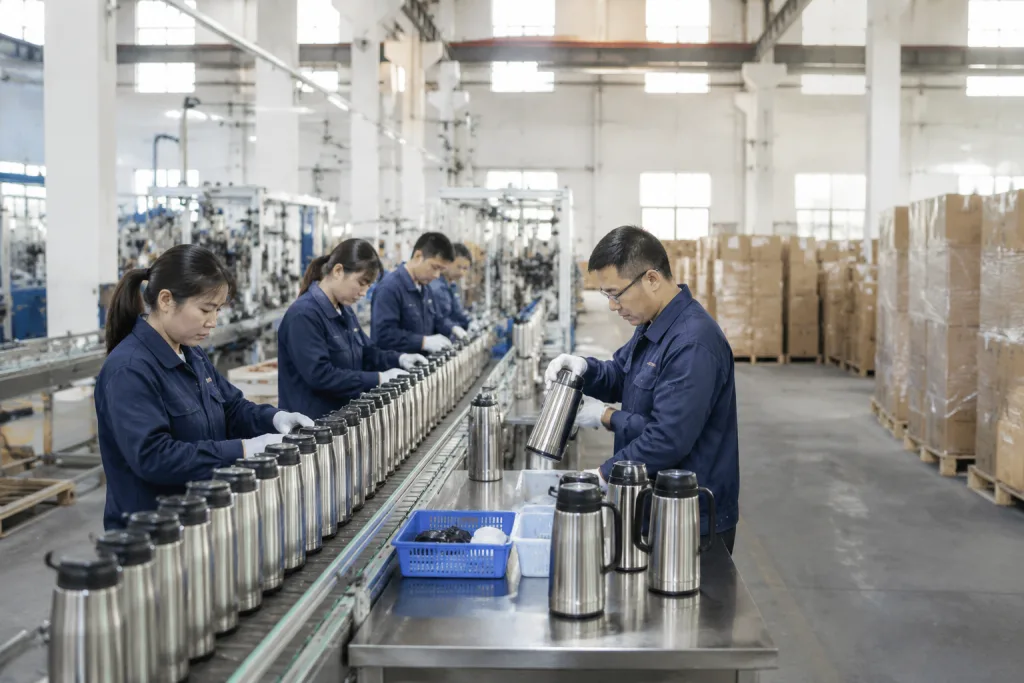
For stainless vacuum construction, cosmetic checks are only half the job. Wall thickness matters. Common stainless outer wall thickness ranges from 0.4 mm to 0.5 mm; dropping to 0.35 mm saves a few cents, but the math doesn't work if retail returns start showing dents after carton drop tests. Vacuum failure needs screening with the temperature hold test, and QC pulled the sample after 6 hours when one batch lost 11°C more than the approved sample. Coating adhesion should be checked by cross-cut test where applicable. Lids must pass leak testing, usually inverted or shaken after filling. For PP parts, we inspect injection gate marks and warping against the drawing, then check thread fit on the actual stainless body with a go/no-go feel from the line, not a loose cap from the sample room.
A good production PO for thermos bulk should include inspection authority. If the buyer or third-party inspector finds major defects above AQL 2.5, shipment waits until sorting or rework is completed. Define critical defects as leakage, vacuum failure, sharp edges, wrong material, missing logo, unsafe odor, or incorrect barcode. Minor scuffs may fall under AQL 4.0, but retail buyers should set cosmetic zones in writing: front logo area measured within 30 mm around the print; side shelf-facing area checked under normal light; bottom rim where small handling marks usually pass. We've seen this go sideways when the inspector rejected tiny base scratches after 128 cartons were sealed.
Ask for 3 factory updates: material arrival photos, first mass-production unit photos, and packed carton photos. No daily drama. You need proof at the right gates: 304 stainless sheet label before cutting, first unit with logo under a 6500K light box, and master carton marks before tape sealing. In China, a clear gate approval process saves more time than 18 emails after goods are already packed, especially when the MOQ is 3,000 pcs and the line has moved to the next color.
Inspect cartons before paying balance
Pre-shipment inspection protects the PO. It is not the time to redesign the bottle. For a distributor thermos shipment, we inspect after at least 80% of goods are packed and 100% are produced. The inspector should pull cartons under ANSI/ASQ Z1.4, check quantity against the packing list, inspect workmanship under a 600 lux light, run basic function checks, scan barcodes, verify carton marks, and do the drop test if the checklist calls for it. QC pulled 13 cartons last month and found 2 color boxes with crushed corners before the balance invoice went out.
For polypropylene thermos flask bulk orders, inspection should cover hot water retention on selected units, leak testing with the bottle inverted for 30 minutes, cap open-close cycles, PP and silicone odor, coating rub, and logo adhesion with 3M tape. Run the basics. If the flask includes a PP cup lid, confirm the cup seats tightly and does not rattle inside the carton; we usually allow 1-2 mm movement, not a loose cup banging around for 30 days at sea. Retail customers catch this even when the vacuum test passes at 6 hours.
Your final PO and inspection checklist should match line by line. If your PO says 24 pcs per master carton, do not accept 20 pcs because the factory ran short of carton size. The math does not work. It changes freight cost and pallet count, then the warehouse receiving team has to explain why the 40HQ arrived with 18 extra pallets. The buyer flagged this exact issue after their WMS showed the wrong carton quantity. If the PO says FNSKU sticker on each color box, scan 20 boxes during inspection with a handheld scanner. For Amazon-style or e-commerce shipments, one barcode mistake can cost more than the inspection fee.
Balance payment is usually made after passed inspection and before shipment under standard export terms. About 8 out of 10 thermos factories we deal with work on 30% deposit and 70% balance before loading. For established buyers with repeat volume, we can discuss other terms, but first orders should stay simple: approved sample, signed PO, deposit, production, inspection, balance, booking, shipment. We have seen this go sideways when a first PO had a color ratio typo, 500 black written as 50 black, and nobody caught it until the line had packed the first 22 cartons.
Plan freight and reorder data
The sourcing job is not finished when the container leaves Ningbo or Shanghai. For the first shipment, keep a SKU sheet that shows weekly color sell-through, complaint rate per 1,000 pcs, lid replacement requests by model, carton damage photos from receiving, and landed cost after duty. Thirty days is the minimum. We usually ask buyers to track 30 days of store or Amazon returns, because QC pulled the sample once for a 0.4 mm lid gasket gap that only showed up after 95°C hot-water testing on the bench. That data tells you whether to repeat the same manufacturer thermos design or adjust capacity, color, or packing before the next PO.
Freight planning starts before the line finishes packing. A 750 ml customized thermos with color box may pack around 12-24 pcs per carton, based on body shape and gift box thickness. Carton size bites. We have seen a 48 x 36 x 32 cm carton quote look fine, then the final gift box pushed it to 52 x 39 x 35 cm and the buyer flagged the CBM jump after booking. Ask for estimated carton size and gross weight at quotation stage, then confirm actual figures after packing with a 150 kg carton scale and tape measure. For European and North American buyers, FOB terms are clean if you already have a forwarder. If not, ask your thermos supplier for EXW and FOB pricing so you can see the local charge difference line by line.
For reorders, keep the approved sample code, production batch number, coating color code, logo artwork version, and PP material specification in one technical file. “Same as last time” is the wrong question to ask after six months. Resin batches move. Powder coating suppliers switch. Carton vendors change paper grade; we once saw a PO typo turn PP lid spec “PP-05” into “PP-50,” and the line stopped for 2 days while sales checked it with the buyer. A serious thermos distributors program should maintain one technical file for each SKU, with the signed sample photo and 304 stainless body spec attached.
Our practical advice is simple: buy the first bulk thermos order with enough control to learn, not with 8 custom variables that make every delay expensive. Standard body. Proven PP lid. Use one logo method and one tested carton with a 76 cm drop-test record; we run this because pairing new lids with untested packing in the same PO is where we’ve seen this go sideways. The math doesn't work when every small change needs a new sample round. After the market proves demand, move to a more customizable thermos with private mold parts or seasonal colors.
Send your thermos RFQ for a practical quote
Share capacity, PP parts, logo method, quantity, and target market. We will return factory pricing, sample timing, and packing options.
Frequently asked questions
What does polypropylene thermos flask bulk usually mean in factory terms?
In factory terms, it rarely means the whole flask is polypropylene. Most bulk thermos products use a stainless steel vacuum liner, usually SUS304 for the inner wall, with PP used for the lid, drinking cup, handle, stopper, or protective base. If you want a full PP outer shell around a stainless liner, state that clearly because it may require separate tooling. For existing models, MOQ is often 1,000 pcs per color. For new PP molded parts, MOQ can rise to 3,000-5,000 pcs because injection setup and color matching take more material and machine time.
How much should a custom thermos cost in bulk?
For a standard 500-750 ml stainless vacuum flask with PP lid, many factory thermos quotes from China fall roughly between USD 3.20 and USD 6.80 FOB, depending on steel grade, wall thickness, coating, cap design, and packaging. A 304 inner with 201 outer is cheaper than full 304 construction. One-color logo printing may add USD 0.08-0.25 per unit, while gift box packing can add USD 0.25-0.70. Treat very low prices carefully: they may exclude retail packaging, use thin 0.35 mm outer steel, or skip proper vacuum testing.
Which logo method is best for a promotional thermos?
For most promotional thermos orders, silkscreen is the best low-cost choice for one or two solid colors, especially on powder-coated bottles. Laser engraving is more durable and looks clean, but it does not reproduce Pantone colors because it exposes the metal layer. Heat transfer is better for multi-color graphics, but adhesion must be tested on the exact coating. For a 2,000 pcs thermos promotional order, approve a physical logo sample before production. Set logo size, position, and tolerance in millimeters; ±2 mm placement tolerance is normal on cylindrical drinkware.
How long does a thermos bulk order take from RFQ to shipment?
For an existing stainless and PP model, a realistic timeline is 2-3 days for quotation, 5-7 working days for blank sample, 10-12 working days for logo sample, and 25-35 days for mass production after deposit and artwork approval. Add 3-5 days for inspection, balance payment, and vessel booking. If you need new PP mold parts, add 20-30 days for tooling and trial injection. Many delays come from late artwork, unclear carton requirements, or changing Pantone colors after sample approval.
What inspection standard should I use for thermos customized orders?
Use ANSI/ASQ Z1.4 sampling with AQL 2.5 for major defects and AQL 4.0 for minor defects as a common starting point. Critical defects should be zero tolerance: leakage, vacuum failure, unsafe odor, sharp metal edges, wrong logo, wrong barcode, or wrong material. Test selected units with 95°C hot water, then check temperature retention after a defined time such as 6 or 12 hours. Also inspect PP lid fit, silicone gasket seating, coating scratches, carton drop resistance, and barcode scanning. Put the same standard in the PO before production starts.