Key Takeaways
- For a 5,000-piece bulk thermos order, confirm 304 stainless body and food-grade PP lid before sampling
- A practical MOQ is 1,000-3,000 pcs per color for stocked molds, higher for new PP tooling
- Use AQL 2.5/4.0 with leak, vacuum, coating adhesion, and carton drop checks
- Normal lead time is 35-50 days after sample approval and deposit for custom logo orders
You might be searching for a polypropylene thermos factory because the cap set is PP: lid, handle, straw, or inner plug. Fair enough. For outdoor retail and promo orders, this is the wrong question to ask. Most heat-retention complaints and dent claims start with the stainless vacuum body, not the PP part. QC pulled one sample last month with a 0.35 mm wall difference after the 1.2 m drop test; the lid passed the 30-minute leak test.
The buyer path is familiar on the line: 5,000 pieces of a custom thermos, retail-ready, with a logo, powder coating, and a lid that will not leak in a backpack. We run these orders from Zhejiang, China, and the job wins or fails before mass production starts. Put the material callouts on the PO. Set the tooling tolerance in mm. Write the AQL limits beside the packaging spec, because we have seen one typo, “304 inner / 201 outer,” turn a 12-day sample approval into 18 days.
Start with the actual use case
Say you are buying for an outdoor retail chain and need a 750 ml bottle for hiking and campsite coffee. Your search term says polypropylene thermos factory, but the PO is not only PP. It includes stainless vacuum insulation, PP lid parts, food-contact compliance, logo work, export cartons, and shipping documents. Pricing only the plastic lid is the wrong question. We have seen this go sideways. QC pulled the sample after a 1.2 m drop test, and the carton corner crushed at 9.6 kg stacking pressure before the bottle failed.
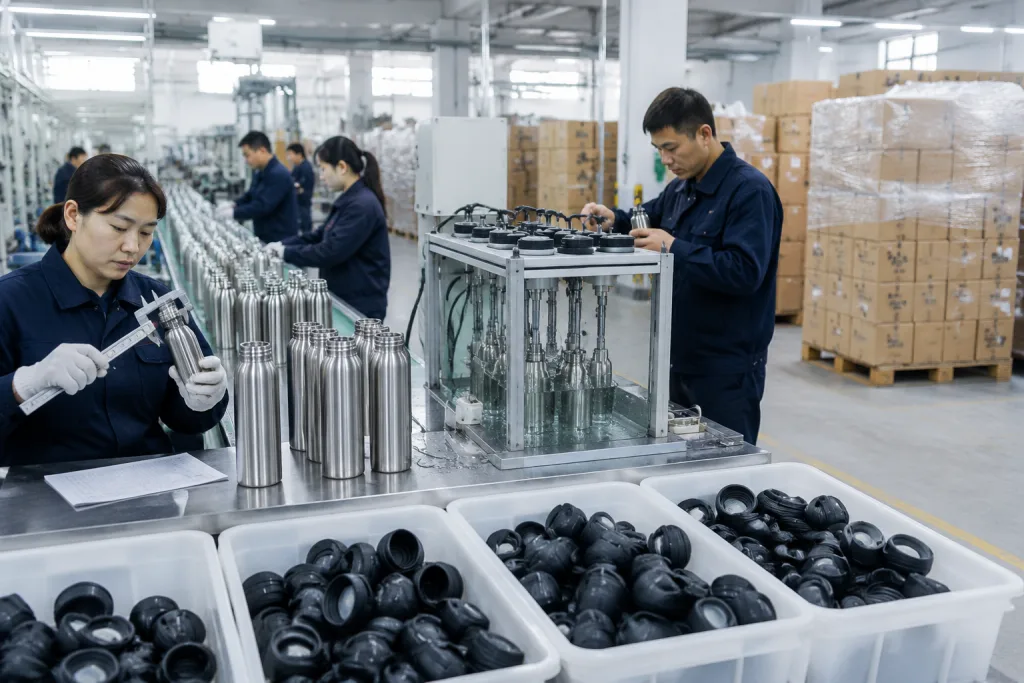
The first document we ask for is not artwork. It is the product requirement sheet. Capacity: 750 ml nominal. Outer body: 304 stainless steel, 0.50 mm wall before forming. Inner liner: 304 stainless steel, 0.40 mm wall. Lid: food-grade PP with silicone sealing ring. Finish: powder coating, matte black and forest green. Logo: one-color silkscreen, 45 x 28 mm. Packaging: individual kraft box, 24 pcs per export carton. On the line, we run a Mitutoyo digital caliper check before polishing; a 0.03 mm body-wall drift is easier to catch there than after the surface looks clean.
For a thermos bulk order, write down the use environment. Will the bottle sit in a car at 45°C for 6 hours? Will customers carry carbonated drinks? Will the cap clip to a bag with 3 kg of pull on the loop? Those answers change pressure testing and thread design, and they decide whether we quote a screw lid or a cup lid with a separate sealing ring. A conference giveaway can ship with lighter packaging. An outdoor retail distributor needs stronger cartons and barcode control; the buyer flagged this once after 18 cartons arrived with mixed EAN stickers.
At BottleForge Industrial in Hangzhou, Zhejiang, our stocked stainless thermos lines start at 1,000 pcs per color and 3,000 pcs for a fully customized thermos color with stable coating yield. New PP lid tooling is a separate cost: tooling can add USD 1,200-4,500 and 20-30 days. The math does not work for 300 pcs unless the buyer accepts a stock lid and we run only logo plus carton marks. We ship that kind of order often, but the PO must say stock lid clearly; one typo between “black lid” and “black body” can hold the line for 2 days.
Specify PP parts without guessing
Polypropylene works well for a thermos lid when the resin grade is picked for hot-drink contact. It is light, molds cleanly, and holds size after cooling if the shrinkage is set right. But “PP lid” is the wrong spec to put on a PO. On our injection line, the traveler needs the resin grade, color masterbatch code, shrinkage allowance in mm, sealing design, and a clear “no recycled PP” note for food-contact parts. We once had a buyer flag a PO because the lid material line only said “plastic.” QC pulled 12 random lids from the 800-ton injection press output, and packing stopped for half a shift.
For Europe, ask for food-contact documents aligned with EU 10/2011 and LFGB sensory expectations where relevant. For North America, request FDA food-contact material declarations, then match the silicone seal document against the lid BOM line by line. Do not assume it is covered. If your brand needs REACH or Prop 65 screening, tell the supplier before the thermos quotation is locked; the math doesn't work after mass production, because a USD 0.08 material choice can turn into a 5,000-piece dispute when QC pulled the sample and the lab report does not match the file. We have seen this go sideways over one missing gasket code.
In our buyer scenario, the main cap is PP, the sealing or grip ring is TPE or silicone, and any requested decorative top plate is 304 stainless. The thread should engage smoothly for at least 1.5 turns, with no flash on the drinking edge. We check it with a thread gauge and a fingertip pass because 0.2 mm flash is enough to get rejected. Simple check. We run a leak test at inverted position for 30 minutes and a shake test for 20 cycles after filling with water at room temperature. For hot fill, check lid deformation after 95°C water exposure for 10 minutes, then measure the cap OD with a digital caliper before the line releases bulk packing.
If you need a thermos customizable with different caps for outdoor, office, and promotional channels, keep the stainless body common and change the PP lid assembly by channel. Carry handle for outdoor. Flip sip for office. Flat logo top for promo. Same body, fewer headaches. This protects MOQ and cuts inventory pressure when we ship 3,000-piece runs and the buyer wants 2 lid colors split by carton mark; it also lets thermos distributors carry one body shape with several lid options instead of managing separate SKUs. The buyer flagged this once after a carton mark typo mixed “BK lid” and “BLK lid,” so we now lock the lid code before printing master cartons.
Build the costed sample brief
A clean sample brief saves 14 days. For a custom thermos, we quote faster when the RFQ starts with the FOB port, such as Ningbo or Shanghai. Then give the annual forecast by release, for example 3,000 pcs in March and 2,000 pcs in June, instead of one loose yearly number. Attach editable AI or PDF artwork with logo size, name the packaging type with box material, and state the inspection level, such as AQL 2.5. “Send best price for 750 ml” is the wrong question to ask. Our manufacturer thermos team then has to guess 0.4 mm or 0.5 mm outer steel, powder coating grade, PP lid structure, kraft box thickness, and compliance test scope. Last month our Mitutoyo caliper check showed one buyer expected 0.5 mm outer steel, while the RFQ never said it. Cheap quotes hide assumptions.
A realistic FOB Ningbo or Shanghai target for a 750 ml stainless vacuum bottle with PP screw lid, powder coating, one-color logo, and kraft box is around USD 4.20-6.20 at 5,000 pcs. Bottle shape changes the stretch loss. Coating yield after the spray line matters too, especially when the carton spec moves from standard export carton to 5-layer K=K. Costs move fast. A cup-lid design with 3 silicone parts, a carry handle rated at 8 kg, or copper plating inside the vacuum wall will push the unit cost higher because QC has more points to pull during leak testing and assembly. Do not compare quotes unless the material and inspection assumptions match. The math does not work.
Sample timing is normally 7-10 days for existing mold with standard coating and logo, or 15-20 days if a special Pantone coating is needed and the powder supplier has to match a wet sample under D65 light. We run it like this. Pre-production sample approval should record weight on a 0.1 g scale, real capacity to the fill line, logo placement in mm from the bottom, lid torque feel after 20 open-close cycles, coating color under D65 light, and packaging barcode scan. If you sell through marketplaces, add FNSKU or SKU label placement to the brief; we once had QC pull the sample because the PO typed “FNSKU on carton” instead of “on gift box.” If you sell through outdoor retail, add inner carton labels and case pack dimensions because warehouse teams will flag a 2 mm label mismatch faster than buyers expect.
A dependable thermos vendor will push back on details likely to fail. For example, a 90 mm silkscreen logo over a curved powder-coated body can show edge distortion after the line runs 300 pcs, and we have seen this go sideways when the buyer approved only a flat artwork proof. Laser engraving lasts better, but it exposes stainless steel and changes the visual effect. Pick based on retail price and brand style, not on what is easiest for the factory thermos line.
Lock branding before mass production
Branding mistakes hurt because the bottle can pass the leak test and still become dead stock. Approve one golden sample before the line starts, then lock the front-view photo, logo width and height in mm, Pantone number, and signed comments on the sample tag. No guessing. On promotional thermos jobs, 7 out of 10 buyers argue about the logo before they argue about the cup; we had one PO where “matte black” was typed as “mate black,” and QC pulled the sample before 5,000 bodies went into the spray booth. Good catch. For outdoor retail, the mark has to survive hand rubbing, dishwasher habits, and 6 weeks on a shelf display under shop lights, so we check it under the D65 light box before release.
Common branding options are silkscreen for 1-2 colors on straight body areas, heat transfer for wrap-style artwork, laser engraving for stainless bodies, pad printing on PP lids, and raised or recessed details from new tooling. We run silkscreen with a positioning jig when the printable window is over 45 mm high; below that, the operator fights the curve all shift and the reject bin fills fast. Laser engraving holds up on stainless bodies and gives a cleaner retail look. Heat transfer handles bigger artwork, but adhesion needs a batch check with a blade edge and tape pull. Pad printing on PP lids is where we have seen this go sideways: textured PP can reject ink unless corona treatment and the ink hardener ratio are right, and one buyer flagged ghosting after only 200 trial lids.
For this 5,000-piece order, we would set logo tolerance at ±1.5 mm for position and require a 3M tape adhesion test after curing. Powder coating thickness may be around 60-90 microns depending on finish, and our QC gauge checks it before packing, not after the cartons are sealed. Too thin, scratch resistance drops. Too thick, threads, base fit, or color consistency can drift; we once saw a 0.4 mm thread tightness issue after a heavy texture coat. The wrong question is “can you do this finish?” A thermos manufacturer in China should explain the trade-off instead of answering every finish with “no problem,” because the math does not work when 38 cartons are already labeled and the cap torque feels wrong.
If you are buying as a thermos distributor or for distributors thermos programs across several clients, create a neutral base model and control logo versions by purchase order. We ship repeat programs this way because one 304 stainless body spec can carry 8 client logos without changing the mold or carton insert. The line stays cleaner. That keeps MOQ pressure lower and cuts approval time from 18 days to about 12 days on repeat artwork, since the caliper readings, carton insert fit, and leak test record are already approved. It is less glamorous than inventing a new shape, but the math works better, especially when the buyer flags a 2 mm logo move after the first client reorder and the PO still shows last season’s SKU code.
Set QC checkpoints that matter
QC on a stainless thermos cannot be a quick look at the packing table. We run checks from incoming stainless coil and PP resin through forming, welding, vacuum pumping, then packed-carton inspection. In Zhejiang, China, our stainless drinkware capacity is about 450,000 units per month across thermos, tumbler, and sports bottle lines, but the math does not work if the checkpoint sheet only says “OK” and “NG.” Too loose. On our line, QC uses a 0.01 mm digital caliper, checks the first 12 pieces from the press, and signs the first-article board before mass production starts.
For the stainless body, check material certificates for 304 stainless steel and confirm wall thickness with a micrometer; do not trust only the supplier stamp. The weld bead and vacuum seal need real inspection because heat retention drops fast when the vacuum layer leaks at the seam. Last April, QC pulled 8 samples with weak vacuum after the helium leak tester showed unstable readings. Short test. No guessing. For a 750 ml bottle, we usually fill with 95°C water, close the lid, and measure after 6 hours at 20°C ambient. Bottle shape and cap structure change the result, so put the agreed number into the QC plan; we have seen this go sideways when the PO says “keep warm” but the QC file has no temperature number.
For PP parts, inspect color against the approved chip under a D65 light box, then check flash at the parting line and sink marks near thick ribs. Thread fit needs a go/no-go gauge, not a thumb feel from the assembly worker. Close the cap for 24 hours and check odor. A cap can pass visual inspection and still cross-thread after 20 open-close cycles, which is how returns start. Leak testing should cover upright and inverted positions, then a side-position check with the bottle laid flat for 30 minutes on kraft paper. For coating, we run cross-hatch adhesion testing with 3M tape and rub testing on the logo area, then check for dust points, orange peel, exposed steel, and color deviation; one buyer rejected 3 cartons because the matte black looked 1 shade warm under store lighting. Carton drop testing should match the sales channel. For e-commerce, we often strengthen the inner box and run drop checks from 76 cm on corners, edges, and faces; the buyer flagged this after one Amazon shipment arrived with 11 crushed gift boxes.
Final inspection can use ANSI/ASQ Z1.4 with AQL 2.5 for major defects and 4.0 for minor defects. Critical defects such as leakage, unsafe burrs, wrong material, or wrong logo should be zero tolerance. QC pulled the sample before sealing the export cartons, and that timing matters; after the cartons are strapped with 12 mm PP banding, rework is slow and nobody likes that bill. Good thermos suppliers accept this discussion before deposit, not after goods are packed and the forwarder is already asking for the VGM.
Plan cartons, shipping, and reorder control
This last stage is where 7 out of 10 first-time buyers lose margin. Strong bottle, weak carton. A 750 ml stainless manufacturer thermos packed in a soft K=K carton can still land as a claim, and we have seen this go sideways. For this size, we run 24 pcs per master carton in most jobs, with carton size around 52 x 36 x 48 cm after the retail box and bottle diameter are fixed. Gross weight is usually 12-15 kg on the floor scale. QC pulled the packed sample, checked the corner seam with a steel ruler, then ran edge crush on the carton compression tester before we confirmed the booking sheet. Confirm the actual data after the pre-production sample because freight is charged by volume or weight, whichever is higher.
For FOB China shipments, lock Ningbo or Shanghai port, export carton marks, pallet rules, and document timing before the carton artwork goes to print. Small details bite. If your warehouse uses EAN, UPC, FNSKU, or retailer routing labels, send the files before packaging production; last month the buyer flagged one FNSKU with a missing digit after 3,000 color boxes were printed. Nobody enjoyed that call. For Amazon-style fulfillment, carton weight limits and scannable labels are fixed requirements. For outdoor distributors, mixed SKU carton labels often matter more than glossy retail packaging because their DC staff scan the 70 x 40 mm label, not the gift box.
Reorder control matters just as much. Keep a signed spec sheet with steel grade shown as 304 stainless or the agreed grade, body weight range in grams, coating code from the spray line, PP resin requirement from the material card, silicone hardness from the durometer check, logo file version, carton construction, and AQL standard. Without that file, your second order becomes a negotiation from memory. The line needs numbers. With it, a thermos customized program can run for years with small changes instead of constant firefighting. We ship repeat orders faster when the body weight tolerance, such as +/-8 g, is already locked.
If you are comparing thermos manufacturers or thermos suppliers in China, ask one practical question: “Show me the control plan for my exact order.” A real supplier thermos team can answer with checkpoints, sample timing, and defect definitions tied to your PO. They should show where the pre-production sample is signed, where the leak test sits on the line, and what defect counts fail under AQL 2.5. We use a 100°C hot-water leak test before packing on this type of bottle, and QC writes the failed-cap count on the inspection sheet. A trading-only answer usually stays at “best quality, best price.” That is the wrong answer to accept for a bulk thermos program carrying your brand name.
Send your thermos spec before you request price
Share capacity, lid type, logo, packaging, MOQ, and target market. We will return a practical FOB quote and QC plan.
Frequently asked questions
Is a polypropylene thermos factory the same as a stainless thermos factory?
Not usually. A polypropylene thermos factory may specialize in injection-molded lids, cups, or plastic insulated bottles, while a stainless thermos factory handles forming, welding, vacuum insulation, coating, and assembly. Many commercial bottles use both: a 304 stainless vacuum body with a PP lid and silicone seal. For a custom thermos order, you need both capabilities controlled under one quality plan. If the stainless body and PP lid come from separate suppliers, confirm who owns fit, leak testing, and food-contact documentation. For 3,000-10,000 pcs, it is safer to buy from one accountable thermos manufacturer that manages the PP parts and final QC.
What MOQ should I expect for a customized thermos order?
For stocked stainless body molds, a practical MOQ is usually 1,000 pcs per color for simple logo work and 3,000 pcs per color for custom powder coating. If you need a new PP lid, handle, or proprietary cap shape, MOQ can rise to 5,000-10,000 pcs because injection tooling and color setup must be justified. New PP tooling often costs USD 1,200-4,500, depending on cavity count and complexity. For promotional thermos orders with tight budgets, start with an existing factory thermos body and customize logo, color, and packaging first.
How long does production take for thermos bulk orders from China?
For an existing model with custom logo and standard packaging, sample preparation usually takes 7-10 days, and mass production takes 35-50 days after sample approval and deposit. Special Pantone coating, new PP parts, retail packaging, or third-party lab testing can add 10-30 days. Ocean freight to Europe or North America may add another 25-45 days depending on port and season. If you need goods for a fixed outdoor retail launch, work backward from the shelf date and allow at least 15 days for inspection, booking, and customs paperwork.
Which tests should I require before accepting a bulk thermos shipment?
At minimum, require leak testing, vacuum heat retention testing, coating adhesion testing, visual inspection, logo placement checks, and carton drop testing. For AQL, many buyers use ANSI/ASQ Z1.4 with AQL 2.5 for major defects and 4.0 for minor defects, with zero tolerance for leakage, unsafe burrs, wrong logo, or wrong material. For PP lids, check odor, deformation after hot water exposure, thread engagement, and silicone seal fit. If selling in Europe, add relevant food-contact and REACH documentation. If selling in North America, request FDA food-contact declarations and any retailer-specific tests.
Can one thermos supplier support retail and promotional channels together?
Yes, but the specification should separate the shared product from channel-specific packaging. Use one stainless body, one PP lid platform, and one approved coating system, then vary logo, retail box, barcode, and carton labels by order. A distributor thermos program may need neutral cartons and multiple logo versions, while a promotional thermos project may need fast logo approval and lower-cost packaging. The supplier should maintain a version-controlled spec sheet so the thermos custom program does not drift between reorders. This is especially important once annual volume exceeds 20,000-50,000 pcs.