Key Takeaways
- A realistic polypropylene thermos custom MOQ starts at 3,000-5,000 pcs per color for factory production
- 304 stainless inner liner with PP outer parts is the safer structure for food contact and insulation
- Normal lead time is 35-45 days after deposit and artwork approval from Zhejiang, China
- Use AQL 2.5/4.0 inspection plus 100% leak testing for promotional thermos orders
You have a promotion brief from an outdoor chain: rugged bottle, cold mornings, printed retail sleeve, 5,000 pieces, and no surprise failures after delivery. The search term says polypropylene thermos custom, but 7 out of 10 buyers move away from a full-PP build after the first quotation. Last month the buyer flagged a 0.35 mm sleeve color shift on the Pantone drawdown, then asked about 304 stainless liner grade, cap leakage after 30 minutes upside down, logo rub resistance after 50 passes, and whether our Hangzhou line could pass a real AQL inspection.
This is where 6 out of 10 projects start to slip. A PP outer shell can hold the shelf price, but the inside still needs food-grade stainless steel and stable vacuum performance. We run it as a custom thermos order with plastic component control: QC pulled the sample, checked cap torque with a digital torque meter, measured mouth diameter at 54.2 mm with calipers, and logged vacuum loss after heat retention testing. Cheap plastic bottle job? Wrong question. The math does not work if the liner, cap seal, and sleeve printing are treated like low-risk promo parts.
Start with the buyer brief
Start with a real buyer brief. One buyer asked us to quote a 500 ml polypropylene thermos custom order for an outdoor retailer, plus a corporate gift channel. Target order: 5,000 units, two body colors, one printed logo, individual color box packing, FOB Ningbo. On our quote sheet, that puts two Pantone chips on the desk, a 38 mm logo file open in AI, and one buyer question: can the same carton pass retail shelf display and gift packing checks? Fair question.
The first call is the structure. A pure polypropylene hot water flask is the wrong question if the buyer expects thermos performance. For outdoor retail or promotional orders, we run a double-wall stainless steel vacuum liner, then use food-grade PP for the lid, handle, bumper, or outer decorative shell. Heat retention stays stable, and the visible parts match color cleaner. QC pulled one PP-only sample last year: it dropped from 95°C to 58°C in 6 hours. The buyer flagged it before we reached logo printing.
For this case, the working specification would be: 304 stainless steel inner wall, 201 or 304 stainless outer vacuum wall depending on price point, PP lid and handle, silicone sealing ring, 500 ml capacity, 0.4-0.5 mm stainless sheet thickness before forming, and powder-coated or PP-colored outer finish. If the brief says dishwasher safe, stop and check the whole construction. Printed logos and PP parts do not all survive high heat cycles. We have seen this go sideways when a PO says “dishwasher safe” in one line and the approved sample uses a pad-printed logo cured at 160°C.
As a thermos supplier in Zhejiang, China, we ask for the retail channel, selling price target, artwork size, country of sale, and testing requirement before quoting. Without those details, a cheap thermos vendor can quote in 20 minutes, but the math may fail after sampling. Compliance is a common miss: the buyer wants EU retail, but the brief only says “food safe” with no LFGB line, no test lab name, and no AQL 2.5 inspection plan. That delay is not small. It can turn a 12-day sample schedule into 18 days.
Build the specification before pricing
A custom thermos price is not one number. It is a cost sheet: 304 stainless thickness, PP lid structure, mold status, logo process, color box paper weight, and AQL 2.5 inspection hours. For the buyer case above, a workable FOB Ningbo range is USD 3.20-4.80 per piece at 5,000 pcs, based on 0.4 mm or 0.5 mm 304 stainless, hinge pin material, 300 gsm versus 350 gsm color box paper, and silk screen versus laser logo. We run this quote almost every week. Ask 5 thermos suppliers for “500 ml PP thermos with logo” and you may get USD 2.10 to USD 6.00. Wrong question. The line cannot price cleanly until it has wall thickness, PP grade, artwork size in mm, and whether packing is white box, color box, or mailer box.
Write the specification as a purchasing document, not a sales sentence. The factory thermos team should confirm capacity tolerance in ml, inner and outer wall material, cap PP grade, gasket hardness, coating, decoration area in mm, packaging, carton quantity, and drop test requirement. For outdoor retail, we normally suggest a stronger lid hinge and a silicone gasket around 50-60 Shore A; QC pulled one sample last season where the hinge pin walked out after 3 drops from 1.2 m onto the test room concrete floor. Small part, big claim risk. For distributor thermos orders shipping to 6 or 8 customers, keep the body shape neutral and put the branding into logo customization, because a new lid mold can eat the margin before the first carton leaves Ningbo.
- Capacity: 500 ml nominal, with actual fill volume checked on the sample by measuring cup before approval.
- Insulation: target 6 hours hot retention above 55°C from 95°C starting water, with the test record tied to the approved lid design.
- Food contact: 304 stainless inner liner, PP parts declared food-grade, silicone gasket LFGB or FDA grade.
- Compliance: REACH, LFGB, FDA, or California Prop 65 screening depending on market.
- Packing: one unit per color box, 24 pcs per export carton, carton under 15 kg if possible.
A customizable thermos is easier to control when you lock the base product first. Change one item per round: color, logo size, sleeve, or lid. Not all four. We have seen a simple thermos bulk program slip from 12 days to 18 days because the buyer changed Pantone color after the pre-production sample and then flagged a 2 mm logo shift on the PO artwork. We checked it with a digital caliper; the artwork file had the same 2 mm offset, but the print film was already made. The math doesn't work when one artwork revision costs half a production day.
Confirm samples without being polite
Sample approval is where you get strict. Not rude. Specific. For a polypropylene thermos custom order, we ask for 2 sign-offs when the schedule allows: first a pre-production sample in stock PP colors, then a final PP sample with the real logo, carton mark, insert card, and approved color chip. Normal sample lead time is 7-10 days for a stock mold with custom logo, or 12-18 days when we need new PP color matching. On our Hangzhou line, the color technician checks the PP granules against the chip in a D65 light box before we run the sample mold, and QC writes the color batch number on the sample tag with a black marker. No guessing.
Do not approve from photos. Get physical units and test them like a customer who paid full price. Fill with hot water, invert for 30 minutes, shake the bottle hard, open and close the lid 50 times, smell the PP parts, rub the logo with a wet cloth, then push the unit into a backpack pocket. QC pulled one sample last year where the gasket dropped after 17 lid cycles; the buyer first said “looks fine,” then flagged leakage after bulk packing. We’ve seen this go sideways. If the lid squeaks, the gasket falls out, or the logo scratches during your desk test, bulk thermos production will not fix it.
Color causes arguments. Pantone matching on PP and powder coating is not the same as printing on paper, and this is the wrong question to ask if the buyer expects paper-card accuracy from molded plastic. A Delta E tolerance under 1.5 costs more and is not always realistic for molded PP parts. For promotional brands, Delta E 2.0-3.0 works in most cases if you approve a physical chip checked beside the bottle body, lid, and silicone ring under D65 light. For retail packaging, send dielines early and check barcode size, recycling marks, importer address, warning statements, and FNSKU labels if the stock will later enter marketplace fulfillment. We have seen a PO typo on the importer ZIP code delay carton printing by 2 days; the plate maker had already output the carton film.
Sample approval should say: “approved for structure, leakage, logo size, packaging layout, and color within agreed tolerance.” It should not say: “looks good.”
Plan production like a factory
Once the signed sample is on our QC table, ask the thermos manufacturer for a dated production schedule, not “we will arrange soon.” At BottleForge Industrial in Hangzhou, Zhejiang, we run a normal stainless thermos line at about 300,000 units per month across mixed bottle and tumbler orders, but your slot still depends on 304 stainless coil booking, spray booth hours, and lid assembly capacity. For the 5,000 pc buyer scenario, a safe lead time is 35-45 days after deposit, final artwork, and carton mark approval. Four words matter here. Carton mark first. No approved carton mark, no line release. Our packing team will not print master cartons from a WhatsApp screenshot; they need the final PDF with barcode size, shipping mark, and gross weight confirmed.
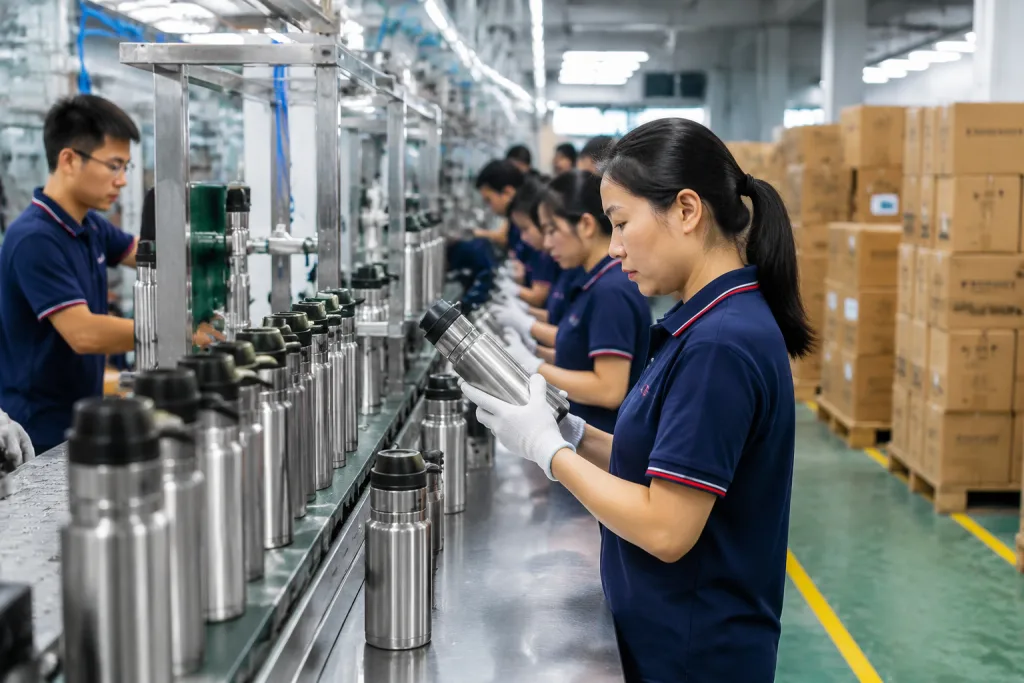
The order flow is usually stainless sheet cutting, tube forming, welding, vacuum brazing, polishing, coating or shell assembly, PP injection or lid assembly, logo decoration, leak testing, packing, and final inspection. QC pulled one sample last month because the PP sleeve sat 0.6 mm proud at the bottom ring; the fixture gauge caught it before packing, and the line stopped for adjustment. If the design uses a PP outer shell, check whether the color part comes from existing tooling. New injection mold work can add 20-35 days and several thousand USD, so most distributor thermos programs stay inside existing mold families. That is the right call most of the time. A new PP shell sounds simple on a video call, but the mold trial, shrinkage check, and color matching under the D65 light box can eat two weeks fast.
Payment terms for a first order from China are commonly 30% deposit and 70% before shipment after inspection. For repeat distributor thermos accounts with stable volume, terms can be discussed, but do not build your launch schedule around credit approval. We have seen this go sideways when a buyer's PO said FOB Shanghai, while their forwarder booked Ningbo; two port names on one file cost 3 days before anyone touched the cartons. The buyer flagged the delay after the booking cut-off, which was too late. FOB Ningbo or FOB Shanghai are common from Zhejiang factories. EXW quotes look cheaper, but the math doesn't work once local trucking, customs handling, and port charges move back to your side. We had one 12-pallet order sit because the PO also misspelled the consignee name by one letter.
If you are buying thermos bulk for a fixed campaign date, add a buffer and put it on the calendar. Production may take 40 days, sea freight to Europe may take 30-40 days port to port, and inland delivery can add another week. That is 77-87 days before you have stock at the distributor warehouse, assuming the vessel rolls on time and the cartons pass final AQL check. We ship samples by air. Air freight works for 2-6 cartons of samples, not for 5,000 stainless vacuum units unless the promotion margin can absorb the freight bill. This is the wrong place to save 5 days; missed retail windows cost more than a clean production buffer.
QC checks that catch real failures
QC for a customized thermos cannot stop at a shelf photo. Claims come later. The costly failures are leaking lids, weak vacuum, weld rust, coating peel, plastic odor, shifted logos, and cartons crushed hard enough for Amazon or a distributor to debit the invoice. We run AQL 2.5 for major defects and AQL 4.0 for minor defects, with critical defects set at zero acceptance. For a 5,000 pc order, that usually gives a Level II sample size of 200 units under ANSI/ASQ Z1.4, unless your own standard is tighter. Check the PO line by line. Last month a buyer flagged “matte balck” on the artwork file during pre-production review; that one typo nearly became 5,000 wrong color labels on the packing bench.
Some checks belong on the line, not just in the final sampling room. Leakage is one. Every unit should pass an air pressure test or water inversion check before packing; our common setup is a pressure jig, silicone sealing head, and a 30-second hold. Vacuum performance needs another method. Full 6-hour hot water retention on every bottle would choke the line, so we run thermal response checks on the conveyor and retention sampling from finished goods. Fair trade. For retail outdoor products, we also run carton drop tests from 76 cm on one corner, three edges, and six faces, mainly when the order will pass through courier networks. We have seen this go sideways: a 12 kg master carton looked clean at visual inspection, then split at the taped bottom after the second edge drop.
Logo QC depends on the process. Silk screen printing works for one or two colors on a smooth area, but it needs adhesion testing, not a quick look under office lights. Laser engraving lasts on stainless surfaces; for most PP shells, “can you laser it?” is the wrong question. Ask whether the resin and color masterbatch are made for marking. Heat transfer can look clean on curved bodies, then fail after rubbing around the thumb grip. A practical tape test uses 3M 600 or similar tape, pulled at 180 degrees after firm pressure. QC pulled the sample with a 10x loupe and found broken edges on 3 of 32 printed logos in one PP lid batch. Small defect. Big complaint risk.
Ask for inspection photos, defect classification, carton weights, barcode scans, and a short video of leak testing. Ask before shipment. A serious thermos manufacturers team in China will not be offended by that request. We ship this way every week. The math does not work if you discover a leaking lid after 200 cartons have already left Ningbo port and the buyer is holding the balance payment.
Choose customization that survives distribution
Outdoor retailers and promo buyers often ask one bottle to cover 6 or 8 campaigns in a season. A thermos customizable platform fits that job. We run one approved body, then change the outer PP color, logo position, sleeve material, or gift box artwork by order. The mold stays put. Sampling risk drops. Reorders are cleaner for thermos distributors because QC checks each batch against the same golden sample on the light table, with a 0.2 mm logo-position tolerance and a caliper check before packing.
For this buyer scenario, opening a complex new lid is the wrong question to ask unless the retailer has signed a 12-month program with firm release quantities. Lid tooling costs real money, takes 18-25 days before first shots, and one small seal groove error can fail the leak test at the pressure jig. We have seen this go sideways. A new PP color plus a clean one-color logo is usually enough for a promotional thermos. If the product needs a better shelf feel, spend on coating texture or a stronger retail box with 350 gsm board, not a novelty cap the buyer may reject after one 1.2 m drop test.
Decoration cost guidance is simple. One-color silk screen may add USD 0.06-0.15 per unit depending on print area. Laser engraving on stainless can add USD 0.12-0.30. Full wrap heat transfer can add USD 0.35-0.80 and carries more reject risk on tapered bodies; QC pulled 27 pcs from one 500 pc trial because the seam line drifted near the lower curve. Custom color boxes often need 1,000-3,000 pcs MOQ, but a manufacturer thermos factory may require 5,000 pcs so the line can run assembly and packing without stop-start changeovers.
If you are a thermos distributor serving several end clients, ask the supplier thermos team to keep neutral stock of undecorated semi-finished bodies only after the first order proves demand. Holding finished goods with one logo is risky. Holding approved components is smarter, but the math does not work without forecast discipline and a written agreement on storage time, aging checks, and who pays when 2,000 pcs of a slow-moving PP color sit in the rack for 90 days. We ship enough mixed-logo orders to know where this breaks: the buyer flagged one PO typo on Pantone 186 C vs 185 C after cartons were already printed.
Ship the order with fewer surprises
Before shipment, the paperwork has to match the goods on the pallet. The commercial invoice should say stainless steel vacuum flask or stainless steel thermos with PP components, not “plastic bottle.” We saw this go sideways when a PO typo said “PP bottle” and Ningbo customs asked for a revised invoice at 4:30 p.m.; the truck was already waiting at Bay 6. HS codes change by destination and by how the broker reads the product, so confirm with your importer of record before we print the carton marks. For Europe and North America, put food contact declarations and test reports in one folder, then add the packing list, carton marks, and factory audit files with the 5-digit job card number in every file name. Our export clerk checks those names against the job card before booking the vessel.
For Amazon-style or marketplace routing, send FNSKU labels and carton labels before final packing starts. Add suffocation warnings for polybags if used, plus master carton dimensions in mm. Labels first. Do not send label files after the cartons are sealed. Relabeling 5,000 units in Zhejiang is possible, but the math does not work: 2 workers with barcode scanners and 40 mm clear tape usually need 12 days vs 2 days when the line applies labels during packing. The extra handling also leaves rub marks on PP lids, and the buyer flagged this on a black-lid order last quarter.
A realistic loading plan matters too. A 500 ml stainless and PP customized thermos packed in color box may run around 0.018-0.025 cbm per carton of 24 pcs, depending on box design and insert thickness. That means 5,000 pcs can fit LCL or a partial container, but carton strength matters because LCL cargo gets touched at least 4 more times before delivery. QC pulled one sample carton last month with a crushed 18 mm corner after a drop test. Use 5-ply export cartons for heavier thermos bulk shipments, with edge crush strength suitable for stacking, and ask for the actual carton size in mm before the forwarder quotes. Guessing from last year’s box is a bad habit.
Your final approval should cover the passed inspection report, passed lab testing if required, and correct shipping documents. This is the wrong question to ask at the end: “Can we fix it after arrival?” If one item is missing, hold the balance payment until the issue is fixed. A good thermos supplier would rather solve it before vessel booking than argue after the goods arrive in your warehouse. We run the pre-shipment file against the AQL report, lab report date, and packing list carton count before we release the SO; last week QC caught a 10-carton count mismatch before the forwarder sent the SI.
Send your thermos brief for factory review
Share capacity, logo, quantity, market, and target price. We will reply with a practical MOQ, material plan, and FOB China estimate.
Frequently asked questions
Can a polypropylene thermos custom product still have stainless insulation?
Yes. The common structure is a stainless steel vacuum liner with PP used for the lid, handle, bumper, or outer decorative shell. For food contact, we usually specify 304 stainless steel inside, food-grade PP, and silicone gaskets. This gives better heat retention than a simple plastic flask while still allowing bright molded colors for promotional thermos programs. For a 500 ml model, you can target around 6 hours of useful hot retention, but the exact result depends on body diameter, cap design, and vacuum quality. Ask your thermos manufacturer for a test method, starting water temperature, ambient temperature, and measured result, not just a marketing claim.
What MOQ should I expect for custom thermos production?
For a stock mold with custom logo, many thermos suppliers in China can discuss 1,000-2,000 pcs, but the practical MOQ for stable pricing is 3,000-5,000 pcs per color. If you need custom PP color matching, custom color box, or special lid parts, 5,000 pcs is a more realistic starting point. New injection molds can push the project higher because tooling cost and setup time must be justified. For distributor thermos orders, we often recommend using one body color and changing the logo for different clients, rather than splitting 5,000 pcs into five small color batches.
Which logo method is best for a customized thermos?
It depends on the surface. On stainless steel, laser engraving is durable and clean, usually adding about USD 0.12-0.30 per unit. On powder coating or PP shells, silk screen printing is common for one or two colors and may add USD 0.06-0.15 per unit. Heat transfer works for larger graphics but costs more and needs stronger QC because wrinkles and adhesion defects can appear on curved bodies. For outdoor retail, I would choose durability over a complicated graphic. Always approve a physical logo sample and run tape, rub, and water exposure checks before mass production.
How long does a 5,000 piece thermos bulk order take?
For an existing mold, normal production lead time is about 35-45 days after deposit, artwork approval, and packaging approval. Add 7-10 days for logo samples, or 12-18 days if you need PP color matching. Sea freight from China to Europe or North America can add roughly 25-45 days depending on port, season, and routing. If the order is linked to an event date, build a buffer of at least 2 weeks. Rushing stainless vacuum production is risky because welding, vacuum testing, coating curing, and packing all need controlled time.
What inspections should I require before paying the balance?
Use AQL inspection, typically AQL 2.5 for major defects and AQL 4.0 for minor defects, with zero tolerance for critical issues like contamination, serious leakage, or unsafe sharp edges. For a 5,000 pc order, a standard Level II inspection often checks 200 sampled units. Require 100% factory leak testing, sampled heat retention testing, logo adhesion checks, carton drop testing, barcode scans, and carton weight verification. The inspection report should include photos of defects, packing, labels, and measurements. Pay the 70% balance only after the report, lab documents if required, and shipping paperwork are consistent.